
Kirjailija
St Augustine
Kirjat ja teokset yhdessä paikassa: 91 kirjaa, julkaisuja vuosilta 1991–2025, suosituimpiin kuuluu The Confessions of St. Augustine. Vertaile teosten hintoja ja tarkista saatavuus suomalaisista kirjakaupoista.
Nimi esiintyy myös muodoissa: St. Augustine
91 kirjaa
Kirjojen julkaisuvuodet: 1991–2025.
The Ultimate Early Church Collection: The Imitation of Christ, On the Incarnation, Augustine's Confessions, and Others.
Thomas À Kempis; St Athanasius; St Augustine
Grapevine India Publishers Pvt Ltd
2024
sidottu
Discover the Wisdom of the Early Church Fathers The Ultimate Early Church Collection brings together timeless writings from some of Christianity's most influential voices. This carefully curated anthology offers profound insights into faith, theology, devotion, and the life of the early Church. Included in this Collection: The Imitation of Christ Augustine's Confessions Statement of Faith Life of Antony Apology On the Flesh of Christ Prescription Against Heretics Epistle to the Ephesians Epistle to the Romans Epistle to the Smyrnaeans The First Apology The Second Apology Dialogue with Trypho On the Hexameron On the Holy Spirit Fragments from the Lost Writings of Irenaeus Letter to the Corinthians Epistles of Cyprian of Carthage Select Orations Against Jovinianus On Marriage and Family Life Exposition of the Faith The Principles Epistle to the Philippians The Martyrdom of Polycarp Why Read the Early Church Fathers? Foundations of Christian Theology: These writings form the cornerstone of early Christian doctrine and practice. Timeless Spiritual Guidance: Discover insights into faith, devotion, and living a Christ-centered life. Understanding the Church's Heritage: Explore the history and theology that shaped the early Church. Inspirational Lives of Faith: Read about the martyrs, apologists, and theologians whose lives exemplified unwavering commitment to Christ. Key Themes: Faith and Devotion Theology and Doctrine Christian Unity Martyrdom and Witness Spiritual Discipline Whether you are a student of theology, a believer seeking deeper understanding, or simply curious about the roots of Christianity, The Ultimate Early Church Collection is an essential addition to your library. Delve into the rich heritage of the early Church and be inspired by its enduring wisdom.
The Confessions of St. Augustine of Hippo is counted among the greatest Christian classics ever written. Combining poignant autobiography and profound theological reflection, the work stands as an enduring testimony to God's grace and provident care, summoning readers throughout the centuries to join the strains of the confession of praise that Augustine here directs to his creator and saviour. This new edition of the Confessions, here presented for the first time in a single-volume, Latin-English facing format, is the inaugural volume of a planned fifty-volume bilingual edition of the Complete Works of St. Augustine.
More than an autobiography, The Confessions of St. Augustine is one of the most influential religious books in the Christian tradition. A great work of Western literature, it recalls crucial events and episodes in the author's life, in particular, life with his devoutly Christian mother and his origins in rural Algeria in the mid-fourth century A. D.; the rise to a lavish life at the imperial court in Milan; his struggle with sexual desires; eventual renunciation of secular ambitions and marriage; and recovery of his Catholic faith. This intensely personal narrative -- among the first in which self-analysis was used to describe spiritual and emotional experiences -- provides a detailed, classic recounting of one man's internal struggles and religious conversion. The book will be useful to anyone interested in the impact made by one of the foremost leaders in the development of Christian thought. In his Confessions, Saint Augustine reflects upon his life in the light of scripture and the presence of God. He begins with his infancy, pondering the many sins of his life before his conversion, and he confesses not only his sins but even more the greatness of God. This work presents a wonderful contrast between the Holy God who created all things and whom heaven and earth cannot contain, and a commonly sinful man who has joyfully received God's loving salvation and mercy. Many scholars consider Saint Augustine to be among the greatest and most influential fathers of the early church. And as you read his Confessions, you will find the confident humility that is common among those whom Jesus calls "great in the kingdom of heaven." Augustine writes as a common man, and so his words span time and tradition. May his Confessions guide you to the One whom he confesses.
More than an autobiography, The Confessions of St. Augustine is one of the most influential religious books in the Christian tradition. A great work of Western literature, it recalls crucial events and episodes in the author's life, in particular, life with his devoutly Christian mother and his origins in rural Algeria in the mid-fourth century A. D. A remarkably honest and revealing spiritual autobiography, the Confessions also address fundamental issues of Christian doctrine, and many of the prayers and meditations it includes are still an integral part of the practice of Christianity today.
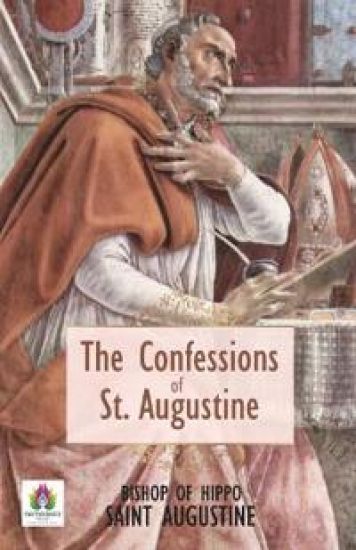
Confessions is an autobiographical work by Saint Augustine of Hippo, consisting of 13 books written in Latin between AD 397 and 400. The work outlines Saint Augustine's sinful youth and his conversion to Christianity. In the work, Augustine writes about how he regrets having led a sinful and immoral life. He discusses his regrets for following the Manichaean religion and believing in astrology. He writes about his friend Nebridius's role in helping to persuade him that astrology was not only incorrect but evil, and Saint Ambrose's role in his conversion to Christianity.
The Essential Letters volume in the series of Augustine's complete works features a rich selection from the Bishop of Hippo's extensive surviving correspondence. Following a rich introductory chapter by Augustine scholar Przemyslaw Nehring, the letters are then arranged in categories that focus on Augustine in his different roles, for example, as philosopher, theologian, exegete, and monastic founder. These writings display Augustine's wide-ranging concerns with a similarly wide range of correspondents and often provide a glimpse of his character that cannot be obtained in his other writings, not even in The Confessions.
Few ancient Christian authors attempted anything like a complete commentary on the Gospel of John, among them Origen, John Chrysostom and Augustine. Of these, Augustine's must count as the greatest. Unlike Origen's, it has come down to us in its entirety, and of the others that remain it is certainly the most theologically profound. John's gospel allows Augustine to range broadly over themes that were his life's work -the Trinity, the person of Christ, the nature of the Church and its sacraments, the fulfillment of the divine plan. The 124 homilies that constitute Augustine's commentary, however, are masterpieces not only of theological profundity but also of pastoral engagement. In the question-and-answer style that he frequently employs, for example, one can sense Augustine's real awareness of his congregation's struggles with the gospel text. And the congregation's response to Augustine, which he frequently alludes to, is an indication of the success of his dialogical preaching style. The Johannine literature drew out the best in Augustine. The Homilies on the Gospel of John are the indispensable complement to The Homilies on The First Epistle of John, published in this series, and they should be a part of any serious theological library.
De doctrina Christiana (English: On Christian Doctrine or On Christian Teaching) is a theological text written by Saint Augustine of Hippo. It consists of four books that describe how to interpret and teach the Scriptures. The first three of these books were published in 397 and the fourth added in 426. By writing this text, Saint Augustine set three tasks for Christian teachers and preachers: to discover the truth in the contents of the Scriptures, to teach the truth from the Scriptures, and to defend scriptural truth when it was attacked. One of Saint Augustine's most important contributions to Christian Theology, "On Christian Doctrine" is essential reading for any serious believer interested in learning more about faith in God. The four books of St. Augustin On Christian Doctrine (De Doctrina Christiana, iv libri) are a compend of exegetical theology to guide the reader in the understanding and interpretation of the Sacred Scriptures, according to the analogy of faith. The first three books were written ad 397 the fourth was added 426. It is the first and best patristic work on biblical Hermeneutics, and continued for a thousand years, together with the Prefaces of Jerome, to be the chief exegetical guide. Although it is superseded as a scientific work by modern Hermeneutics and Critical Introductions to the Old and New Testaments, it is not surpassed for originality, depth and spiritual insight.
De doctrina Christiana (English: On Christian Doctrine or On Christian Teaching) is a theological text written by Saint Augustine of Hippo. It consists of four books that describe how to interpret and teach the Scriptures. The first three of these books were published in 397 and the fourth added in 426. By writing this text, Saint Augustine set three tasks for Christian teachers and preachers: to discover the truth in the contents of the Scriptures, to teach the truth from the Scriptures, and to defend scriptural truth when it was attacked. One of Saint Augustine's most important contributions to Christian Theology, "On Christian Doctrine" is essential reading for any serious believer interested in learning more about faith in God. The four books of St. Augustin On Christian Doctrine (De Doctrina Christiana, iv libri) are a compend of exegetical theology to guide the reader in the understanding and interpretation of the Sacred Scriptures, according to the analogy of faith. The first three books were written ad 397 the fourth was added 426. It is the first and best patristic work on biblical Hermeneutics, and continued for a thousand years, together with the Prefaces of Jerome, to be the chief exegetical guide. Although it is superseded as a scientific work by modern Hermeneutics and Critical Introductions to the Old and New Testaments, it is not surpassed for originality, depth and spiritual insight.
A Treatise Concerning the Correction of the Donatists
St Augustine
Lighthouse Publishing
2018
pokkari
A Letter of Augustin to Boniface, who, as we learn from Epistle 220, was Tribune, and afterwards Count in Africa. In it Augustin shows that the heresy of the Donatists has nothing in common with that of Arius; and points out the moderation with which it was possible to recall the heretics to the communion of the Church through awe of the imperial laws. He adds remarks concerning the savage conduct of the Donatists and Circumcelliones, concluding with a discussion of the unpardonable nature of the sin against the Holy Ghost
If anyone will piously and soberly consider the sermon which our Lord Jesus Christ spoke on the mount, as we read it in the Gospel according to Matthew, I think that he will find in it, so far as regards the highest morals, a perfect standard of the Christian life: and this we do not rashly venture to promise but gather it from the very words of the Lord Himself.
Wherein the truth of predestination and grace is defended against the semi-Pelagians, --those people to wit, who by no means withdraw altogether from the Pelagian heresy, in that they contend that the beginning of salvation and of faith is of ourselves; so that in virtue, as it were, of this precedent merit, the other good gifts of God are attained. Augustin shows that not only the increase, but the very beginning also of faith is in God's gift. On this matter he does not disavow that he once thought differently, and that in some small works, written before his episcopate, he was in error, as in that exposition, which they object to him, of propositions from the epistle to the Romans. But he points out that he was subsequently convinced chiefly by this testimony, "but what hast thou that thou hast not received?" which he proves is to be taken as a testimony concerning faith itself also. He says that faith is to be counted among other works, which the apostle denies anticipating God's grace when He says, "not of works." He declares that the hardness of the heart is taken away by grace, and that all come to Christ who are taught to come by the Father; but that those whom He teaches, He teaches in mercy, while those whom He teaches not, in judgment He teaches not.
In the first part of the book he proves that the perseverance by which a man perseveres in Christ to the end is God's gift; for that it is a mockery to ask of God that which is not believed to be given by God. Moreover, that in the Lord's prayer scarcely anything is asked for but perseverance, according to the exposition of the martyr Cyprian, by which exposition the enemies to this grace were convicted before they were born.
I Wrote again to the same persons another treatise, which I entitled On Rebuke and Grace, because I had been told that someone there had said that no man ought to be rebuked for not doing God's commandments, but that prayer only should be made on his behalf, that he may do them. This book begins on this wise, "I have read your letters, dearly beloved brother Valentine."
In the fourteenth chapter of the second book of his Retractations, Augustin makes the following statement: "There is also a book of ours on the subject of the Catechising of the Uninstructed, or, for Instructing the Unlearned, De Catechizandis Rudibus], that being, indeed, the express title by which it is designated. In this book, where I have said, 'Neither did the angel, who, in company with other spirits who were his satellites, forsook in pride the obedience of God, and became the devil, do any hurt to God, but to himself; for God knoweth how to dispose of souls that leave Him: ' it would be more appropriate to say, 'spirits that leave Him, ' inasmuch as the question dealt with angels. This book commences in these terms: 'You have requested me, brother Deogratias.'" The composition so described in the passage cited is reviewed by Augustin regarding other works which he had in hand about the year 400 A. D., and may therefore be taken to belong to that date. It has been conjectured that the person to whom it is addressed may perhaps be the same with the presbyter Deogratias, to whom, as we read in the epistle which now ranks as the hundred and second, Augustin wrote about the year 406, in reply to some questions of the pagans which were forwarded to him from Carthage.
The Seven Books of Augustine on Baptism, Against the Donatists
St Augustine
Lighthouse Publishing
2018
pokkari
This treatise was written about 400 A. D. Concerning it Aug. in Retract. Book II. c. xviii., says: I have written seven books on Baptism against the Donatists, who strive to defend themselves by the authority of the most blessed bishop and martyr Cyprian; in which I show that nothing is so effectual for the refutation of the Donatists, and for shutting their mouths directly from upholding their schism against the Catholic Church, as the letters and act of Cyprian.