
Kirjailija
Suman Gupta
Kirjat ja teokset yhdessä paikassa: 30 kirjaa, julkaisuja vuosilta 2001–2026, suosituimpiin kuuluu AI, Textuality and the Humanities. Vertaile teosten hintoja ja tarkista saatavuus suomalaisista kirjakaupoista.
30 kirjaa
Kirjojen julkaisuvuodet: 2001–2026.
Collective Principles and the Formation of the Internet
Suman Gupta
Springer International Publishing AG
2025
sidottu
This book describes how distinctive socio-political commitments and cultural practices developed upon the internet in the later 20th and early 21st century and considers what lies ahead in those terms. Five decades after the internet’s technological structure began to be erected, and three decades after engagement with it started burgeoning, an active and global collective formation has grown upon it. This collective formation is dubbed the ‘Internet Polity’ here and is distinguishable from, and yet embedded within, real-world collectives. Despite divergences and conflicts, its organization is based on certain shared principles and its culture characterized by distinctive discursive practices. This book examines how the Internet Polity developed until 2010, in terms of the technological and cultural features that have supported it. Accordingly, the Internet Polity’s emerging prospects are considered. Topics and features: Gives an original framework for understanding the global collective grounded on the internet as a social spacePresents a history of the technological basis and communication features of this collective, from the beginnings to 2010Offers an interdisciplinary perspective that cuts across most disciplines of the humanities and social sciencesDescribes the histories of and debates surrounding popular terms like ‘cyberspace,’ ‘information superhighway,’ ‘Internet of Things,’ ‘hacker,’ etc. This wide-ranging and original book is for researchers, graduate students, professionals and informed readers who are interested in information technology and political culture, digital humanities, sociolinguistics and communication studies, history of the internet, contemporary social organization and political philosophy.
Practical Philosophy Of Ai-assistants, The: An Engineering-humanities Conversation
Suman Gupta; Peter H Tu
World Scientific Europe Ltd
2024
nidottu
The Practical Philosophy of AI-Assistants presents a formal conversation between an AI engineer, Peter, and a humanities researcher, Suman. The book ensures that specialist concepts in AI research are made comprehensible to a humanities researcher, while humanities theories can be easily grasped by an AI engineer. The authors establish ground rules to design an AI-Assistant, that is, an AI system that could act as a personal friend, consultant and confidante for every individual, to be integrated into our daily lives. These rules apply to four large areas of AI development: recognition and identification, communication, explanation, and civility. In discussing these areas, this book provides an accessible account of the current state of AI research, as well as adding nuance to the underpinning assumptions informing the relevant technologies, reflecting on their social implications. The broader ideological objective of The Practical Philosophy of AI-Assistants is captured by the phrase 'practical philosophy', which expresses a commitment to bringing AI development to work towards a good life for all.
Practical Philosophy Of Ai-assistants, The: An Engineering-humanities Conversation
Suman Gupta; Peter H Tu
World Scientific Europe Ltd
2024
sidottu
The Practical Philosophy of AI-Assistants presents a formal conversation between an AI engineer, Peter, and a humanities researcher, Suman. The book ensures that specialist concepts in AI research are made comprehensible to a humanities researcher, while humanities theories can be easily grasped by an AI engineer. The authors establish ground rules to design an AI-Assistant, that is, an AI system that could act as a personal friend, consultant and confidante for every individual, to be integrated into our daily lives. These rules apply to four large areas of AI development: recognition and identification, communication, explanation, and civility. In discussing these areas, this book provides an accessible account of the current state of AI research, as well as adding nuance to the underpinning assumptions informing the relevant technologies, reflecting on their social implications. The broader ideological objective of The Practical Philosophy of AI-Assistants is captured by the phrase 'practical philosophy', which expresses a commitment to bringing AI development to work towards a good life for all.
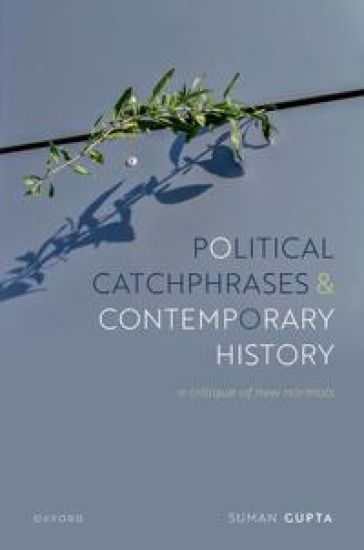
Political Catchphrases and Contemporary History presents an historical account of the period 2001-2020 by focusing on the shifting connotations of certain political catchphrases and words. These allow for a linked-up narrative covering areas such as politics and policy, business and investing, austerity and inequality, identity, climate change, crowd protests, flexible working, and online education. Key junctures are 9/11, the 2002 dot-com crash and the 2007-2008 financial crisis, the Occupy movements of 2011-2012, China's economic policy from 2014 onwards, and the COVID-19 outbreak in 2020. Half the book is devoted to the unusually pervasive usage of the catchphrase 'new normal'. Chapters are also given to 'we are the 99%' and the catchwords 'austerity' and 'resilience'. Case studies of these catchphrases and words occupy much of the book. The final chapter makes conceptual inferences and proposes both a theory of political catchphrases and a distinctive approach to contemporary history. The source materials are predominantly from the UK and USA, but refer, naturally, to issues of global moment.
Digital India and The Poor examines how the poor are evoked in contemporary Indian political discourse. It studies the ways in which the disadvantaged are accounted for in the increasingly digitised political economy, commercial and public policy, media, and academic research. This book: Interrogates the category of the poor in India and how they have come to be classified in economic and policy documents over the past few decades Explores the influential digital education technology ‘experiments’ conducted in Indian slums from the late 1990s, now popularly known as the ‘hole-in-the-wall experiments’ Discusses financial inclusion initiatives, predominantly as they converged between 2014 and 2017, such as the Jan Dhan Yojana, the Aadhaar Project, and the banknote demonetisation Presents an in-depth study of the bearing of technology on domestic employment in IndiaThe book will be of great interest to scholars and researchers of South Asian studies, politics, political science and sociology, technology studies, linguistics, and development studies.
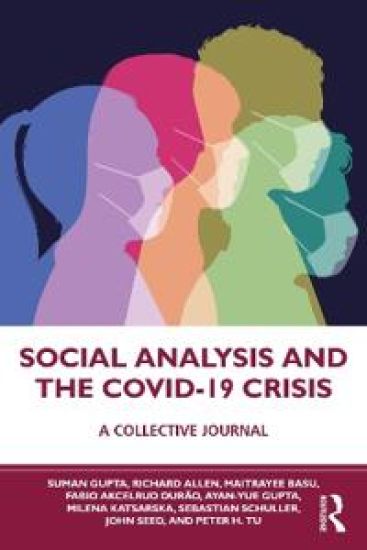
Social Analysis and the COVID-19 Crisis
Suman Gupta; Richard Allen; Maitrayee Basu; Fabio Akcelrud Durão; Ayan-Yue Gupta; Milena Katsarska; Sebastian Schuller; John Seed; Peter H. Tu
Routledge India
2020
nidottu
This book is a collective journal of the COVID-19 pandemic. With first-hand accounts of the pandemic as it unfolded, it explores the social and the political through the lens of the outbreak. Featuring contributors located in India, the United States, Brazil, the United Kingdom, Germany, and Bulgaria, the book presents us with simultaneous multiple histories of our time. The volume documents the beginning of social distancing and lockdown measures adopted by countries around the world and analyses how these bore upon prevailing social conditions in specific locations. It presents the authors’ personal observations in a lucid conversational style as they reflect on themes such as the reorganization of political debates and issues, the experience of the marginalized, theodicy, government policy responses, and shifts into digital space under lockdown, all of these under an overarching narrative of the healthcare and economic crisis facing the world. A unique and engaging contribution, this book will be useful to students and researchers of sociology, public health, political economy, public policy, and comparative politics. It will also appeal to general readers interested in pandemic literature.
Social Analysis and the COVID-19 Crisis
Suman Gupta; Richard Allen; Maitrayee Basu; Fabio Akcelrud Durão; Ayan-Yue Gupta; Milena Katsarska; Sebastian Schuller; John Seed; Peter H. Tu
Routledge India
2020
sidottu
This book is a collective journal of the COVID-19 pandemic. With first-hand accounts of the pandemic as it unfolded, it explores the social and the political through the lens of the outbreak. Featuring contributors located in India, the United States, Brazil, the United Kingdom, Germany, and Bulgaria, the book presents us with simultaneous multiple histories of our time. The volume documents the beginning of social distancing and lockdown measures adopted by countries around the world and analyses how these bore upon prevailing social conditions in specific locations. It presents the authors’ personal observations in a lucid conversational style as they reflect on themes such as the reorganization of political debates and issues, the experience of the marginalized, theodicy, government policy responses, and shifts into digital space under lockdown, all of these under an overarching narrative of the healthcare and economic crisis facing the world. A unique and engaging contribution, this book will be useful to students and researchers of sociology, public health, political economy, public policy, and comparative politics. It will also appeal to general readers interested in pandemic literature.
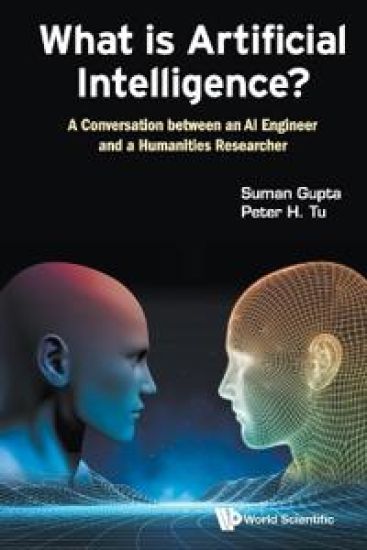
What Is Artificial Intelligence?: A Conversation Between An Ai Engineer And A Humanities Researcher
Suman Gupta; Peter H Tu
World Scientific Europe Ltd
2020
nidottu
'A light-hearted, but engaging conversation about one of the key technologies of our age. I recommend this book to anyone interested in the broader issues around Artificial Intelligence.'Richard HartleyAustralian National University, Australia This book engages with the title question: what is artificial intelligence (AI)? Instead of reiterating received definitions or surveying the field from a disciplinary perspective, the question is engaged here by putting two standpoints into conversation. The standpoints are different in their disciplinary groundings — i.e. technology and the humanities — and also in their approaches — i.e. applied and conceptual. Peter is an AI engineer: his approach is in terms of how to make AI work. Suman is a humanities researcher: his approach is in terms of what people and academics mean when they say 'AI'. A coherent argument, if not a consensus, develops by putting the two standpoints into conversation. The conversation is presented in 32 short chapters, in turn by Suman and Peter. There are two parts: Part 1, Questioning AI, and Part 2, AI and Government Policy. The first part covers issues such as the meaning of intelligence, automation, evolution, artificial and language. It outlines some of the processes through which these concepts may be technologically grounded as AI. The second part addresses policy considerations that underpin the development of AI and responds to the consequences. Themes taken up here include: rights and responsibilities; data usage and state-level strategies in the USA, UK and China; unemployment and policy futures.
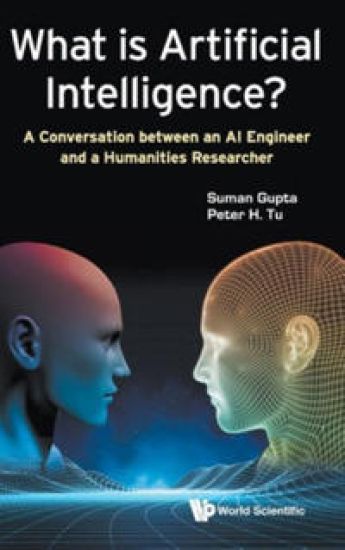
What Is Artificial Intelligence?: A Conversation Between An Ai Engineer And A Humanities Researcher
Suman Gupta; Peter H Tu
World Scientific Europe Ltd
2020
sidottu
'A light-hearted, but engaging conversation about one of the key technologies of our age. I recommend this book to anyone interested in the broader issues around Artificial Intelligence.'Richard HartleyAustralian National University, Australia This book engages with the title question: what is artificial intelligence (AI)? Instead of reiterating received definitions or surveying the field from a disciplinary perspective, the question is engaged here by putting two standpoints into conversation. The standpoints are different in their disciplinary groundings — i.e. technology and the humanities — and also in their approaches — i.e. applied and conceptual. Peter is an AI engineer: his approach is in terms of how to make AI work. Suman is a humanities researcher: his approach is in terms of what people and academics mean when they say 'AI'. A coherent argument, if not a consensus, develops by putting the two standpoints into conversation. The conversation is presented in 32 short chapters, in turn by Suman and Peter. There are two parts: Part 1, Questioning AI, and Part 2, AI and Government Policy. The first part covers issues such as the meaning of intelligence, automation, evolution, artificial and language. It outlines some of the processes through which these concepts may be technologically grounded as AI. The second part addresses policy considerations that underpin the development of AI and responds to the consequences. Themes taken up here include: rights and responsibilities; data usage and state-level strategies in the USA, UK and China; unemployment and policy futures.
Digital India and The Poor examines how the poor are evoked in contemporary Indian political discourse. It studies the ways in which the disadvantaged are accounted for in the increasingly digitised political economy, commercial and public policy, media, and academic research. This book: Interrogates the category of the poor in India and how they have come to be classified in economic and policy documents over the past few decades Explores the influential digital education technology ‘experiments’ conducted in Indian slums from the late 1990s, now popularly known as the ‘hole-in-the-wall experiments’ Discusses financial inclusion initiatives, predominantly as they converged between 2014 and 2017, such as the Jan Dhan Yojana, the Aadhaar Project, and the banknote demonetisation Presents an in-depth study of the bearing of technology on domestic employment in IndiaThe book will be of great interest to scholars and researchers of South Asian studies, politics, political science and sociology, technology studies, linguistics, and development studies.
Reconsidering English Studies in Indian Higher Education
Suman Gupta; Richard Allen; Subarno Chattarji; Supriya Chaudhuri
Routledge
2017
nidottu
This book examines the status of English Studies in India, aspirations pinned on the subject by students, teachers, policy-makers and society in general, and how these are addressed at the higher education level. It presents analytical background discussions of the history and policy environment, and offers open-ended, multi-faceted and multi-vocal accounts of particular aspects of contemporary Indian English Studies, including curriculum, pedagogy, research, employment, relation to Indian vernaculars and translation studies. Reconsidering English Studies in Indian Higher Education is an invaluable source for anyone interested in: The relevant histories and higher education policies Professional concerns, including employment, management, teaching and scholarly practices, and negotiations in terms of socio-cultural life Student attitudes, experiences and aspirations Management ethos and academic work in a comparative perspective, informed by the situation and debates in the United Kingdom and United States of America The context of global English Studies and globalization The book will be of primary interest to academic readers such as students, teachers and researchers in English Studies in India, Britain and wherever the discipline is pursued at higher education level Suman Gupta is Professor and Chair in Literature and Cultural History at The Open University. Richard Allen is Professor Emeritus at the Department of English at The Open University. Subarno Chattarji is Associate Professor at the Department of English, University of Delhi. Supriya Chaudhuri is Professor Emeritus at the Department of English, Jadavpur University, Kolkata.
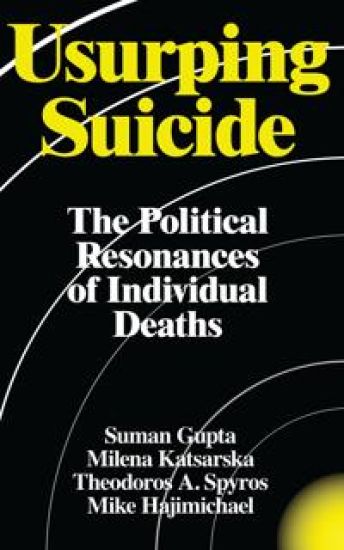
Usurping Suicide
Suman Gupta; Milena Katsarska; Theodoros A. Spyros; Mike Hajimichael
Zed Books Ltd
2017
sidottu
Can an individual act of suicide be socially significant, or does it present too many imponderable features? This book examines suicide like no other. Unconcerned with the individual dispositions that lead a person to commit such an act, Usurping Suicide focuses on the reception suicides have produced – their political, social and cultural implications. How does a particular act of suicide enable a collective significance to be attached to it? And what contextual circumstances predispose a politicised public response? From Mohamed Bouazizi’s self-immolation during regime change in Tunisia to Dimitris Christoulas’s public shooting at a time of increased political upheaval in Greece, and beyond – this remarkable work examines how the individuality of the act of suicide poses a disturbing symbolic conundrum for the dominant liberal order.
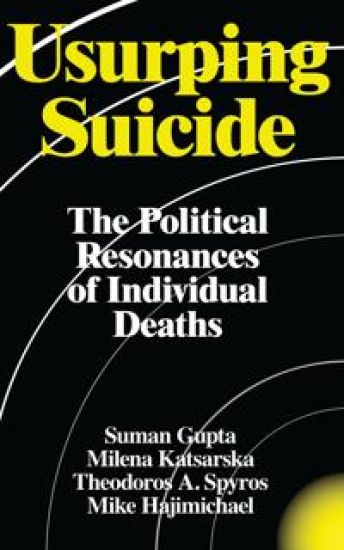
Usurping Suicide
Suman Gupta; Milena Katsarska; Theodoros A. Spyros; Mike Hajimichael
Zed Books Ltd
2017
nidottu
Can an individual act of suicide be socially significant, or does it present too many imponderable features? This book examines suicide like no other. Unconcerned with the individual dispositions that lead a person to commit such an act, Usurping Suicide focuses on the reception suicides have produced – their political, social and cultural implications. How does a particular act of suicide enable a collective significance to be attached to it? And what contextual circumstances predispose a politicised public response? From Mohamed Bouazizi’s self-immolation during regime change in Tunisia to Dimitris Christoulas’s public shooting at a time of increased political upheaval in Greece, and beyond – this remarkable work examines how the individuality of the act of suicide poses a disturbing symbolic conundrum for the dominant liberal order.
This book retraces the formation of modern English Studies by departing from philological scholarship along two lines: in terms of institutional histories and in terms of the separation of literary criticism and linguistics.
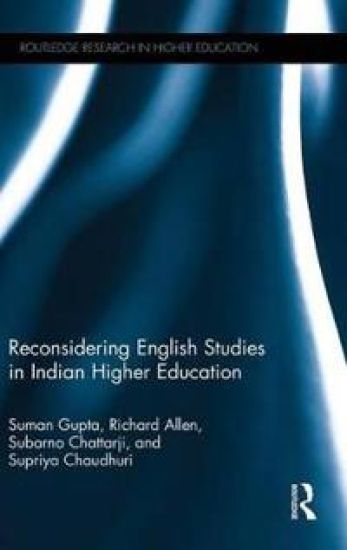
Reconsidering English Studies in Indian Higher Education
Suman Gupta; Richard Allen; Subarno Chattarji; Supriya Chaudhuri
Routledge
2015
sidottu
This book examines the status of English Studies in India, aspirations pinned on the subject by students, teachers, policy-makers and society in general, and how these are addressed at the higher education level. It presents analytical background discussions of the history and policy environment, and offers open-ended, multi-faceted and multi-vocal accounts of particular aspects of contemporary Indian English Studies, including curriculum, pedagogy, research, employment, relation to Indian vernaculars and translation studies. Reconsidering English Studies in Indian Higher Education is an invaluable source for anyone interested in: The relevant histories and higher education policies Professional concerns, including employment, management, teaching and scholarly practices, and negotiations in terms of socio-cultural life Student attitudes, experiences and aspirations Management ethos and academic work in a comparative perspective, informed by the situation and debates in the United Kingdom and United States of America The context of global English Studies and globalization The book will be of primary interest to academic readers such as students, teachers and researchers in English Studies in India, Britain and wherever the discipline is pursued at higher education level Suman Gupta is Professor and Chair in Literature and Cultural History at The Open University. Richard Allen is Professor Emeritus at the Department of English at The Open University. Subarno Chattarji is Associate Professor at the Department of English, University of Delhi. Supriya Chaudhuri is Professor Emeritus at the Department of English, Jadavpur University, Kolkata.
‘Contemporary Literature’ is among the most popular areas of literary study but it can be a difficult one to define. This book equips readers with the necessary tools to take an analytical and systematic approach to contemporary texts. The author provides answers to some of the critical questions in the field: What makes a literary text contemporary? Is it possible to have a canon of contemporary literature? How does a reader’s location affect their understanding? How do print, electronic, and audio-visual media impact upon contemporary literature? Which key concepts and themes are most prevalent? Containing diverse illustrative examples and discussing the topics which define our current sense of the contemporary, this is an ideal starting point for anyone seeking to engage critically with contemporary literature.
‘Contemporary Literature’ is among the most popular areas of literary study but it can be a difficult one to define. This book equips readers with the necessary tools to take an analytical and systematic approach to contemporary texts. The author provides answers to some of the critical questions in the field: What makes a literary text contemporary? Is it possible to have a canon of contemporary literature? How does a reader’s location affect their understanding? How do print, electronic, and audio-visual media impact upon contemporary literature? Which key concepts and themes are most prevalent? Containing diverse illustrative examples and discussing the topics which define our current sense of the contemporary, this is an ideal starting point for anyone seeking to engage critically with contemporary literature.
In the run-up to, during and after the invasion of Iraq a large number of literary texts addressing that context were produced, circulated and viewed as taking a position for or against the invasion, or contributing political insights. This book provides an in-depth survey of such texts to examine what they reveal about the condition of literature.
In the run-up to, during and after the invasion of Iraq a large number of literary texts addressing that context were produced, circulated and viewed as taking a position for or against the invasion, or contributing political insights. This book provides an in-depth survey of such texts to examine what they reveal about the condition of literature.