Kirjojen hintavertailu – 12 903 725 kirjaa ja 27 kauppaa

Kirjailija

Terry L. Alford

Kirjat ja teokset yhdessä paikassa: 4 kirjaa, julkaisuja vuosilta 2007–2012, suosituimpiin kuuluu Silver Metallization. Vertaile teosten hintoja ja tarkista saatavuus suomalaisista kirjakaupoista.

4 kirjaa

Kirjojen julkaisuvuodet: 2007–2012.

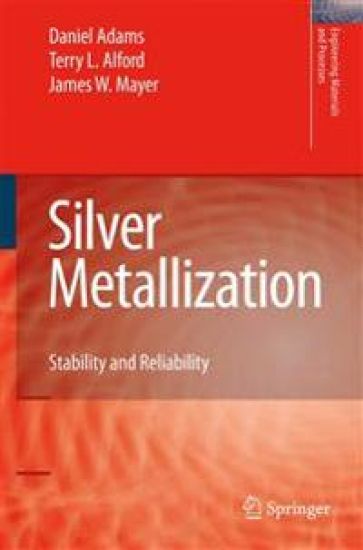
Silver Metallization

Silver Metallization

Daniel Adams; Terry L. Alford; James W. Mayer

Springer London Ltd
2012
nidottu
Silver has the lowest resistivity of all metals, which makes it an attractive interconnect material for higher current densities and faster switching speeds in integrated circuits. Over the past ten years, extensive research has been conducted to address the thermal and electrical stability, as well as processing issues which, to date, have prevented the implementation of silver as an interconnect metal. Silver Metallization: Stability and Reliability is the first book to discuss current knowledge of silver metallization and its potential as a favorable candidate for implementation as a future interconnect material for integrated circuit technology. Silver Metallization: Stability and Reliability provides detailed information on a wide range of experimental, characterization and analysis techniques. It also presents the novel approaches used to overcome the thermal and electrical stability issues associated with silver metallization. Readers will learn about the: - preparation and characterization of elemental silver thin films and silver-metal alloys; - formation of diffusion barriers and adhesion promoters; - evaluation of the thermal stability of silver under different annealing conditions; - evaluation of the electrical properties of silver thin films under various processing conditions; - methods of dry etching of silver lines and the integration of silver with low-k dielectric materials. As a valuable resource in this emerging field; Silver Metallization: Stability and Reliability will be very useful to students, scientists, engineers and technologists in the fields of integrated circuits and microelectronics research and development.
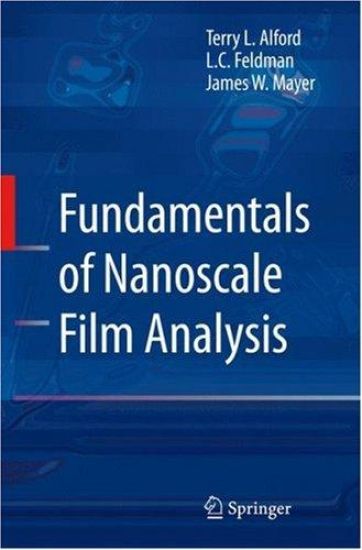
Fundamentals of  Nanoscale Film Analysis

Fundamentals of Nanoscale Film Analysis

Terry L. Alford; L.C. Feldman; James W. Mayer

Springer-Verlag New York Inc.
2010
nidottu
Modern science and technology, from materials science to integrated circuit development, is directed toward the nanoscale. From thin films to field effect transistors, the emphasis is on reducing dimensions from the micro to the nanoscale. Fundamentals of Nanoscale Film Analysis concentrates on analysis of the structure and composition of the surface and the outer few tens to hundred nanometers in depth. It describes characterization techniques to quantify the structure, composition and depth distribution of materials with the use of energetic particles and photons. The book describes the fundamentals of materials characterization from the standpoint of the incident photons or particles which interrogate nanoscale structures. These induced reactions lead to the emission of a variety of detected of particles and photons. It is the energy and intensity of the detected beams that is the basis of the characterization of the materials. The array of experimental techniques used in nanoscale materials analysis covers a wide range of incident particle and detected beam interactions. Included are such important interactions as atomic collisions, Rutherford backscattering, ion channeling, diffraction, photon absorption, radiative and nonradiative transitions, and nuclear reactions. A variety of analytical and scanning probe microscopy techniques are presented in detail.
Silver Metallization

Silver Metallization

Daniel Adams; Terry L. Alford; James W. Mayer

Springer London Ltd
2007
sidottu
Silver has the lowest resistivity of all metals, which makes it an attractive interconnect material for higher current densities and faster switching speeds in integrated circuits. Over the past ten years, extensive research has been conducted to address the thermal and electrical stability, as well as processing issues which, to date, have prevented the implementation of silver as an interconnect metal. Silver Metallization: Stability and Reliability is the first book to discuss current knowledge of silver metallization and its potential as a favorable candidate for implementation as a future interconnect material for integrated circuit technology. Silver Metallization: Stability and Reliability provides detailed information on a wide range of experimental, characterization and analysis techniques. It also presents the novel approaches used to overcome the thermal and electrical stability issues associated with silver metallization. Readers will learn about the: - preparation and characterization of elemental silver thin films and silver-metal alloys; - formation of diffusion barriers and adhesion promoters; - evaluation of the thermal stability of silver under different annealing conditions; - evaluation of the electrical properties of silver thin films under various processing conditions; - methods of dry etching of silver lines and the integration of silver with low-k dielectric materials. As a valuable resource in this emerging field; Silver Metallization: Stability and Reliability will be very useful to students, scientists, engineers and technologists in the fields of integrated circuits and microelectronics research and development.
Fundamentals of  Nanoscale Film Analysis

Fundamentals of Nanoscale Film Analysis

Terry L. Alford; L.C. Feldman; James W. Mayer

Springer-Verlag New York Inc.
2007
sidottu
Modern science and technology, from materials science to integrated circuit development, is directed toward the nanoscale. From thin films to field effect transistors, the emphasis is on reducing dimensions from the micro to the nanoscale. Fundamentals of Nanoscale Film Analysis concentrates on analysis of the structure and composition of the surface and the outer few tens to hundred nanometers in depth. It describes characterization techniques to quantify the structure, composition and depth distribution of materials with the use of energetic particles and photons. The book describes the fundamentals of materials characterization from the standpoint of the incident photons or particles which interrogate nanoscale structures. These induced reactions lead to the emission of a variety of detected of particles and photons. It is the energy and intensity of the detected beams that is the basis of the characterization of the materials. The array of experimental techniques used in nanoscale materials analysis covers a wide range of incident particle and detected beam interactions. Included are such important interactions as atomic collisions, Rutherford backscattering, ion channeling, diffraction, photon absorption, radiative and nonradiative transitions, and nuclear reactions. A variety of analytical and scanning probe microscopy techniques are presented in detail.