Kirjailija
Thomas Aquinas
Kirjat ja teokset yhdessä paikassa: 251 kirjaa, julkaisuja vuosilta 1968–2026, suosituimpiin kuuluu Complete Works of Thomas Aquinas,The. Vertaile teosten hintoja ja tarkista saatavuus suomalaisista kirjakaupoista.
251 kirjaa
Kirjojen julkaisuvuodet: 1968–2026.
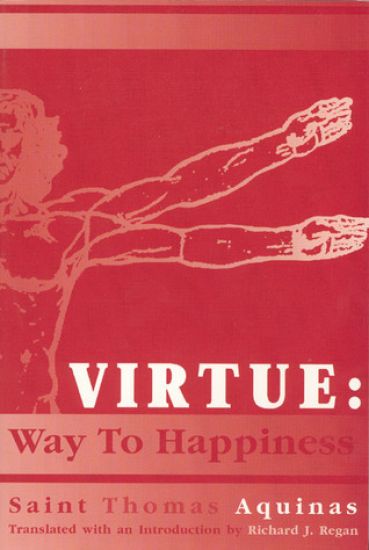
Richard J. Regan's new translation of texts from Thomas Aquinas' Summa Theologica II–II--on the virtues prudence, justice, fortitude, and temperance--combines accuracy with an accessibility unmatched by previous presentations of these texts. While remaining true to Aquinas' Latin and preserving a question-and-answer format, the translation judiciously omits references and citations unessential to the primary argument. It thereby clears a path through the original especially suitable for beginning students of Aquinas. Regan's Introduction carefully situates Aquinas' analysis of these virtues within the greater ethical system of the Summa Theologica, and each selection is introduced by a thoughtful headnote. A glossary of key terms and a select bibliography are also included.
Following a question-and-answer format, this is a translated and streamlined compilation of the texts on prudence, justice, fortitude, and temperance from the "Summa Theologica II-II". It also includes a general introduction to the moral thought of Thomas Aquinas, notes on the texts, a glossary of key terms, and a selective bibliography.
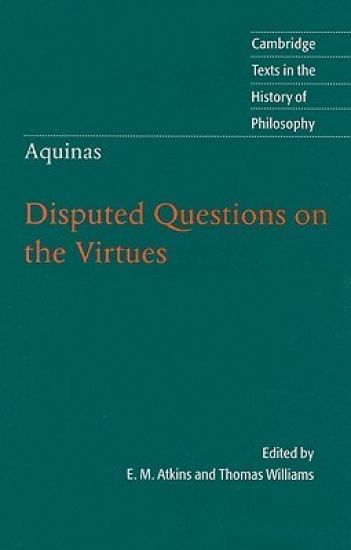
Thomas Aquinas: Disputed Questions on the Virtues
Thomas Aquinas
Cambridge University Press
2005
sidottu
The great medieval philosopher Thomas Aquinas (1224/6-1274) was Dominican regent master in theology at the University of Paris, where he presided over a series of questions - academic debates - on ethical topics. This volume offers translations of disputed questions on the nature of virtues in general, the fundamental or 'cardinal' virtues of practical wisdom, justice, courage, and temperateness, the divinely bestowed virtues of hope and charity, and the practical question of how, when and why one should rebuke a 'brother' for wrongdoing. The introduction explains how Aquinas's theory of virtue fits into his ethics as a whole, and it illuminates Aquinas's views by explaining the institutional and intellectual context in which these disputed questions were debated.
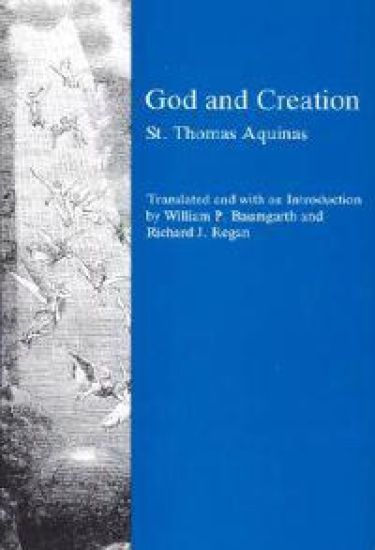
God and Creation is a new translation of St. Thomas Aquinas's treatment of these subjects in the Summa Theologiae, with introductory and explanatory material provided to assist the reader's understanding of the texts. The selected questions and articles fall within the area of what is described as natural theology or the study of truth about God that are accessible to human reason without the aid of divine revelation.
The third volume of newly translated selections from the writings of Saint Thomas Aquinas, Fr. Richard Regan turns to his thoughts on the moral dimensions of human action. Focusing on the first part of the second folume of the "Summa Theologiae," he deals with such topics as the ultimate human goal, human acts, emotions and virtues. Regan indicates that though Aquinas approaches these topics from the perspective of human reason, it is necessary for the reader to remember that his overall viewpoint is that of a believer seeking to understand his faith. All can weigh the merits of these propositions due to their clarity of language, exposition, and structure."
Sermon-Conferences of St. Thomas Aquinas on the Apostles? Creed
Thomas Aquinas
Wipf Stock Publishers
2005
pokkari
On Law, Morality, and Politics
Thomas Aquinas
Hackett Publishing Co, Inc
2003
pokkari
Halvin toimitettuna 29,80 €
The second edition of Aquinas, On Law, Morality, and Politics retains the selection of texts presented in the first edition but offers them in new translations by Richard J. Regan--including that of his Aquinas, Treatise on Law (Hackett, 2000). A revised Introduction and glossary, an updated select bibliography, and the inclusion of summarizing headnotes for each of the units--Conscience, Law, Justice, Property, War and Killing, Obedience and Rebellion, and Practical Wisdom and Statecraftfurther enhance its usefulness.
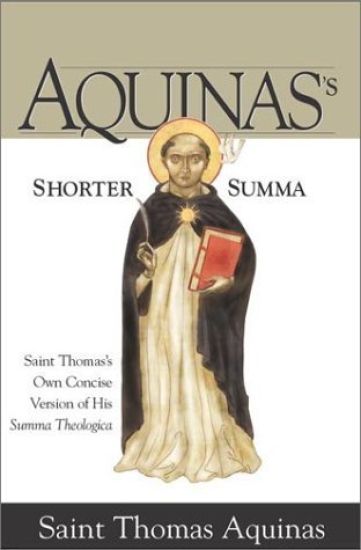
This compact collection of philosophical texts from the Summa Theologica--on God, creation, the soul, human acts, moral good and evil, love, habits, virtue, and law--is presented newly translated in abridged form and cast in a modified version of the medieval quaestio. Included are only the most important objections and Aquinas’ replies; appeals to scriptural, theological, and philosophical authorities have been omitted. Unlike the ordering of the originals, questions and answers are here presented prior to objections and replies; the result is a sharp, rich, topically organized question-answer presentation of Aquinas' major philosophical arguments within a brief compass. A general Introduction, headnotes, a glossary, an index, and a select bibliography offer expert guidance to the work of this major philosopher.
This compact collection of philosophical texts from the Summa Theologica --on God, creation, the soul, human acts, moral good and evil, love, habits, virtue, and law--is presented newly translated in abridged form and cast in a modified version of the medieval quaestio . Included are only the most important objections and Aquinas replies; appeals to scriptural, theological, and philosophical authorities have been omitted. Unlike the ordering of the originals, questions and answers are here presented prior to objections and replies; the result is a sharp, rich, topically organized question-answer presentation of Aquinas' major philosophical arguments within a brief compass. A general Introduction, headnotes, a glossary, an index, and a select bibliography offer expert guidance to the work of this major philosopher.
This series offers central philosophical treatises of Aquinas in new, state-of-the-art translations distinguished by their accuracy and use of clear and nontechnical modern vocabulary. Annotation and commentary accessible to undergraduates make the series an ideal vehicle for the study of Aquinas by readers approaching him from a variety of backgrounds and interests.
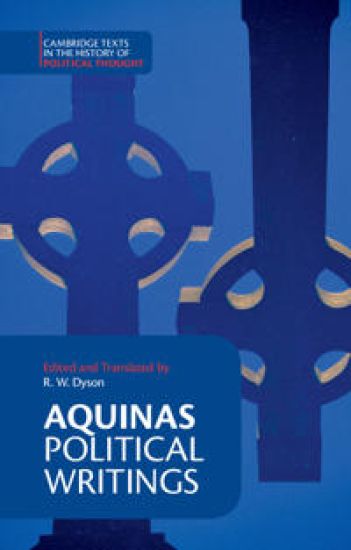
Thomas Aquinas (1225–74) is a massive figure in the history of western thought and of the Catholic church. In this major addition to the Cambridge Texts series Robert Dyson (whose modern rendition of Augustine's City of God has already been widely acclaimed) has chosen texts by Aquinas that show his development of a Christian version of the philosophy of Aristotle, its contrast with the Augustinian thought that had coloured so much political thinking in the previous eight centuries, and St Thomas's views as to the purpose of government, constitutions, and the relations between secular and ecclesiastical power. Property, slavery, and usury are fully covered, as are St Thomas's celebrated and influential writings on law. The translations are extremely accessible and the whole is supported by all of the usual series features designed to assist the student reader, including brief biographies, notes for further reading and a concise critical introduction.
Thomas Aquinas (1225–1274) is a massive figure in the history of western thought and of the Catholic church. In this major addition to the Cambridge Texts series Robert Dyson (whose modern rendition of Augustine’s City of God has already been widely acclaimed) has chosen texts by Aquinas that show his development of a Christian version of the philosophy of Aristotle, its contrast with the Augustinian thought that had coloured so much political thinking in the previous eight centuries, and St Thomas’s views as to the purpose of government, constitutions, and the relations between secular and ecclesiastical power. Property, slavery, and usury are fully covered, as are St Thomas’s celebrated and influential writings on law. The translations are extremely accessible and the whole is supported by all of the usual series features designed to assist the student reader, including brief biographies, notes for further reading and a concise critical introduction.
This new translation offers fidelity to the Latin in a readable version that will prove useful to students of the natural law tradition in ethics, political theory, and jurisprudence, as well as to students of the Western intellectual tradition.
This new translation of the Treatise on Law offers fidelity to the Latin in a readable new version that will prove useful to students of the natural law tradition in ethics, political theory, and jurisprudence, as well as to students of Western intellectual history.
This volume brings you all of St. Thomas's known prayers and hymns in their Latin originals, along with new English translations. The translations render the originals with precision and soul-fortifying eloquence.
The 'Physics is the initial work in Aristotle's natural philisophy and, to paraphrase the Philosopher, a little clarity in the beginning magnifies as study continues. From the outset of his career, Thomas recognized the importance of the 'Physics'. In the youthful 'Principles of Nature', he shows a mastery of Aristotle's teaching on the constitution of physical objects. But the importance of 'Physics' is by no means exhausted by its role within natural philosophy. Without physics there can be no metaphysics. The fundamental affinity betwwen Thomas and Aristotle is nowhere clearer than in the shared conviction that it is only on the basis of knowledge of the things around us, the things that come to be and pass away, physical things, that we can hope to have knowledge of things whose existence is not material. This commentary exhibits the familiar technique of the commentaries on Aristotle, a technique to be found in Thomas's biblical commentaries as well. The order of the division of the text is the principle of manifestation. The primary purpose is to get clear as to what Aristotle taught and why. As commentator, Thomas is both objective and empathetic. The commentary continues the discourse in the text.