Kirjojen hintavertailu – 12 859 819 kirjaa ja 27 kauppaa
Kirjailija
Thomas Aquinas
Kirjat ja teokset yhdessä paikassa: 251 kirjaa, julkaisuja vuosilta 1968–2026, suosituimpiin kuuluu Complete Works of Thomas Aquinas,The. Vertaile teosten hintoja ja tarkista saatavuus suomalaisista kirjakaupoista.
The Sentences of Peter Lombard was the standard theological text from the twelfth through the fifteenth century;Thomas Aquinas's Commentary on the Sentences (ca. 1252–1256), written by a young Aquinas in fulfilling the qualifications for becoming a teaching master at the University of Paris, is perhaps the most comprehensive and detailed of all his works. The Commentary on the Sentences is not a commentary in the sense of a line-by-line analysis of the Lombard's text, but instead, it is the product of lively classroom discussion, in which Aquinas enjoys the liberty to take up any inquiry inspired by the text, treating topics not found anywhere elsewhere in his opus. The first book of the Sentences is concerned with questions revolving around the mystery of the Most Holy Trinity.
This fourth volume of St. Thomas Aquinas's opuscula brings together those works of Aquinas that show him in his capacity as both a talented preacher and a loving spiritual master. For the first time, all of Aquinas's prayers, hymns, sermons, and sermon fragments have been gathered together into one volume whose contents are an invaluable service to both devotion and contemplation. Also included in the volume are the two offices of Corpus Christi, with both the texts and music indicated by Aquinas for the feast established in 1264: Aquinas's selections of music and texts from Scripture and Church Doctors provide rich fruit for contemplation and reveal a Saint with a deep knowledge and love of the Word in the Sacrament and in the Scriptures.
Book Three, Part 1 of the Summa Contra Gentiles series is the first part of a treatise on the hierarchy of creation, the divine providence over all things, and man's relation to God. The Summa Contra Gentiles is not merely the only complete summary of Christian doctrine that St. Thomas has written, but also a creative and even revolutionary work of Christian apologetics composed at the precise moment when Christian thought needed to be intellectually creative in order to master and assimilate the intelligence and wisdom of the Greeks and the Arabs. In the Summa Aquinas works to save and purify the thought of the Greeks and the Arabs in the higher light of Christian Revelation, confident that all that had been rational in the ancient philosophers and their followers would become more rational within Christianity. Book 1 of the Summa deals with God; Book 2, Creation; and Book 4, Salvation.
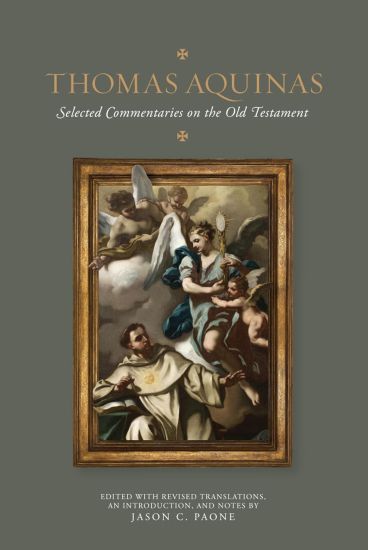
Thomas Aquinas's Old Testament commentaries remain some of his most neglected writings due partly to the widely varying quality of both the commentaries themselves and their English translations, which often retain the terseness and opacity of the original Latin manuscripts. Nevertheless, Thomas's corpus of Old Testament commentaries contains some of his finest biblical exegesis and theology. Within them, we find dimensions of his thought and literary personality that do not appear in any of his other writings. This volume aims to promote appreciation for Thomas's Old Testament exegesis by making his best commentaries more accessible. To this end, it offers a topically organized selection of the most theologically profound lectures from his premier Old Testament commentaries--those on the Psalms, Job, and Isaiah. Moreover, the translations used in this collection have undergone extensive editing and revision to enhance their accuracy, elegance, clarity, stylistic consistency, and overall readability. Lastly, hundreds of explanatory footnotes have been added to facilitate study, along with two indices and a bibliography. Together with its companion volume, Thomas Aquinas: Selected Commentaries on the New Testament, this collection offers a curated introduction to Thomas's biblical commentaries, suitable for newcomers, students, and scholars alike.
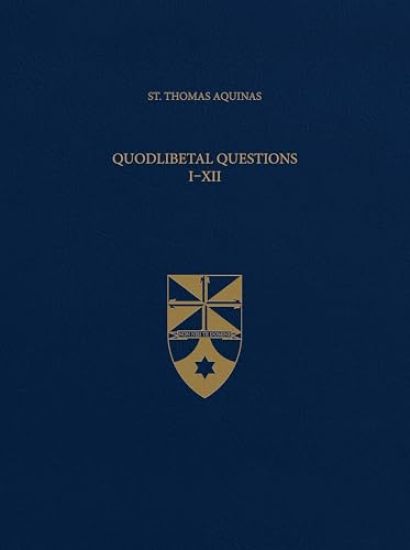
Quodlibetal disputes were formal university debates, held twice a year during Advent and Lent, in which questions on any topic could be brought forward by those in attendance; supporting and opposing arguments were discussed and then ultimately resolved by the presiding master. Thomas Aquinas presided over twelve quodlibetal disputes, which covered a range of topics, both speculative and practical; the Quodlibets here are considerably edited reports of these debates. Quodlibets VII–XI are from Aquinas's first teaching period in Paris (1256–1259), and Quodlibets I–VI, XII are from his second teaching period in Paris (1269–1272).
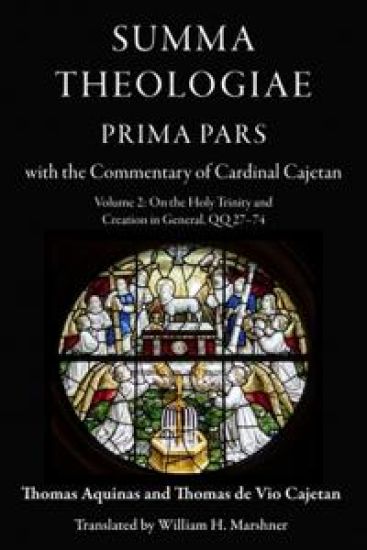
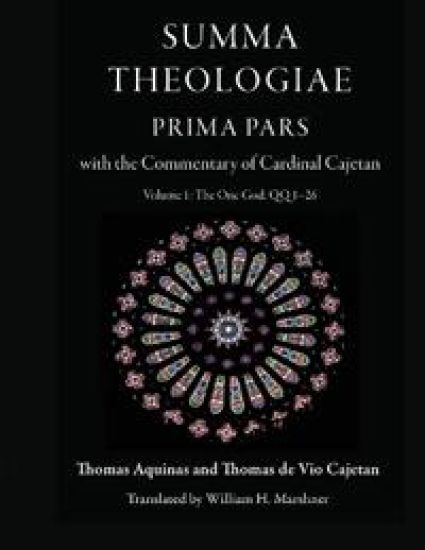
When Leo XIII promulgated Aeterni Patris in 1879, he stipulated that the "Leonine," or official, edition of the Summa should always be printed in conjunction with Cajetan's Commentary. For five hundred years they were studied together. Generations were trained by reading through the Summa article by article with Cajetan's commentaries in hand. Early printed editions of the Summa typically included them in a Talmudic arrangement, as marginal text running around each article by Aquinas. This edition imitates that example. Recently, serious thinkers of all denominations—and none—have found new reasons to be interested in St. Thomas. His text is deceptively simple, yet important issues are handled in every article, sometimes below the surface. Cajetan extracts these hidden issues, and explains and elaborates on them with remarkable affinity to modern analytical philosophy. Part of that affinity lies in the use of modal logic, a tool whose importance was overlooked between the Renaissance and the twentieth century. The time is ripe for an analytically-inspired translation of Thomas: hence this volume. Never until now has Cajetan's Commentary been put into English in its entirety. William Marshner's translation is consistent with fidelity to the technical force of the original. The translator's footnotes acknowledge what empirical science has made obsolete in the work of St. Thomas, and also make clear how much today's science would have saved Thomas useless labor. This volume will, for the first time, make Cajetan's help available to the modern reader.
When Leo XIII promulgated Aeterni Patris in 1879, he stipulated that the "Leonine," or official, edition of the Summa should always be printed in conjunction with Cajetan's Commentary. For five hundred years they were studied together. Generations were trained by reading through the Summa article by article with Cajetan's commentaries in hand. Early printed editions of the Summa typically included them in a Talmudic arrangement, as marginal text running around each article by Aquinas. This edition imitates that example. Recently, serious thinkers of all denominations—and none—have found new reasons to be interested in St. Thomas. His text is deceptively simple, yet important issues are handled in every article, sometimes below the surface. Cajetan extracts these hidden issues, and explains and elaborates on them with remarkable affinity to modern analytical philosophy. Part of that affinity lies in the use of modal logic, a tool whose importance was overlooked between the Renaissance and the twentieth century. The time is ripe for an analytically-inspired translation of Thomas: hence this volume. Never until now has Cajetan's Commentary been put into English in its entirety. William Marshner's translation is consistent with fidelity to the technical force of the original. The translator's footnotes acknowledge what empirical science has made obsolete in the work of St. Thomas, and also make clear how much today's science would have saved Thomas useless labor. This volume will, for the first time, make Cajetan's help available to the modern reader.
Thomas Aquinas's commentary on Aristotle's On the Soul is chronologically the first of his commentaries on Aristotle's works, written while Aquinas was still in Rome, between 1267–1268. It seems probable then that it was written at the same time as his composition of qq. 75–89 of the Prima Pars of the Summa theologiae, for Aquinas later adopted this same technique while writing the Secunda Pars, commentating simultaneously on Aristotle's Nicomachean Ethics. It is hard to over-emphasize the importance of this text in revealing Aquinas's deep, developed understanding of the human person. Though already familiar with the text, Aquinas here applies his intellect to grappling with a new translation of On the Soul (together with Themistius's paraphrase), which had just been completed by William of Moerbeke. This first of Aquinas's commentaries on Aristotle was followed shortly thereafter by his commentaries on Aristotle's On Sense and What is Sensed and On Memory and Recollection, also included in this volume.
On the Power of God is a set of disputed questions written around 1265–1266, towards the beginning of Thomas Aquinas's time in Rome and just prior to the composition of the Prima Pars of the Summa theologiae. "Disputed questions" are considerably edited reports of school debates, or disputationes, on various questions or topics, in which supporting and opposing arguments on a given theme were discussed and then resolved by the presiding master. The disputed questions in this volume take their title from the first question but are more loosely unified; qq. 1–6 are on the topic of the power of God, but qq. 7–10 deal more proximately with Trinitarian theology.
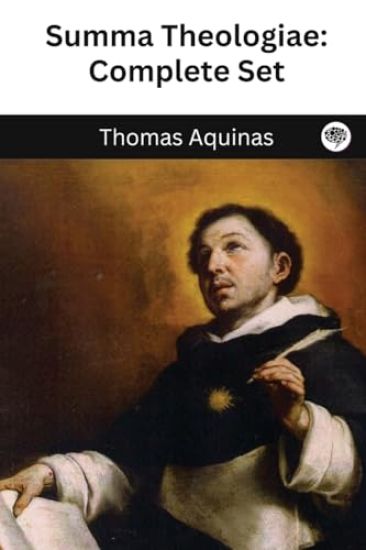
Embark on an intellectual journey of unparalleled magnitude with "The Summa Theologica of St. Thomas Aquinas" - a monumental work that remains a cornerstone of Western philosophy and theology. Spanning five volumes, this magnum opus offers a comprehensive exploration of Christian doctrine and moral philosophy, as Aquinas grapples with the deepest questions of existence and God's nature. With extraordinary erudition and logic, he examines matters of faith, ethics, and the human condition, bridging the gap between faith and reason. A pinnacle of medieval thought, Aquinas's Summa continues to inspire scholars and seekers of truth alike, as a profound testament to the unyielding pursuit of knowledge and understanding the divine.
A translation into modern English of Aquinas unfinished commentary on Aristotle's Politics, this title follows the Leonine text of Aquinas and reproduces in English those passages of William of Moerbeke's famously accurate yet elliptical translation of the "Politics" from which Aquinas worked.
The philosophical and theological works of St. Thomas Aquinas are held in universal esteem. His commentaries on Scripture and the role of Scripture in his theological works have garnered considerable attention. Yet Thomas's academic sermons delivered on Sundays and special occasions have been widely overlooked. Considering that Thomas was a Dominican, a member of the Order of Preachers, and that he held the position of Magister in Sacra Pagina at the University of Paris—wherein preaching was a required task—the oversight is remarkable. Though hundreds of medieval sermons are attributed to Thomas Aquinas, the Leonine Commission has identified only 20 as his. This book features all 20 sermons, and one whose authenticity has been debated, translated from the original Latin texts, five of which have never been published before. An introduction and notes accompany the first-ever English translation. Readers will gain insight into the way in which Thomas expressed his exegetical insights in his sermons. The sermons cover an array of topics, among them Advent, the Holy Spirit, the Trinity, the Exaltation of the Cross, Mary, other saints, and ordinary Sundays. Thus, from different angles readers will have a better view of Thomas's spirituality and also of the way in which he translated his theological and spiritual thought into consequences for an authentic Christian life, the religious life, doing good to one's neighbor, and pastoral work. The Academic Sermons will fascinate readers as it presents Thomas's unique style of preaching and how he skillfully communicated the fruits of his contemplation. With this book, Thomas the preacher comes to the fore.
The commentaries on Jeremiah and Lamentations were likely written near the end of Thomas Aquinas's time with Albert the Great in Cologne, before Aquinas left to teach in Paris in 1252. Perhaps even more so than his commentary on Isaiah, these commentaries are "cursory", succinct and focused on an understanding of the literal meaning of the text. But, as Aquinas himself explains in the prologues to these commentaries, the literal sense of these texts is filled with written wisdom - a divine wisdom that aids us in the attainment of our end of living well and our ultimate end of the glory of immortality. The commentary on Jeremiah also includes collationes, collections of scriptural texts connected with the passage at hand and useful for prayer, study, and preaching.
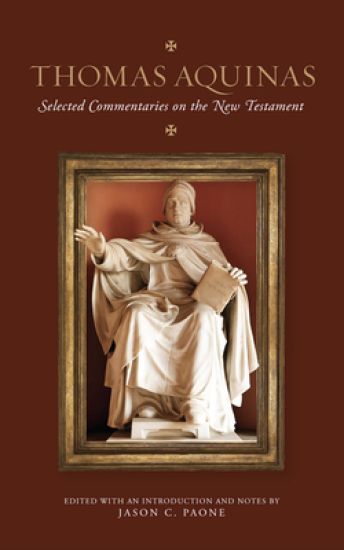
Thomas Aquinas: Selected Commentaries on the New Testament is a selective anthology of Thomas Aquinas' New Testament commentaries, collected and organized to reflect the centrality of Christ in the saint's profoundly theological approach to the Bible. Complete with an introduction, explanatory footnotes, patristic source citations, and other research utilities, this volume offers an introduction to Thomas' biblical theology suitable for students and independent readers at any level of exposure to his thought.
One of his earliest writings and perhaps the very first of his theological works, Thomas's commentary on Isaiah was likely composed while Thomas was staying with Albert the Great in Cologne, before Thomas arrived to teach at Paris as a bachelor in 1252. The commentary's focus is on the literal meaning of the text, but also includes the collationes, or collections of scriptural texts connected with the passage at hand, which make for a rich and rewarding commentary, fruitful for both spiritual growth and preaching.
Thomas's commentaries on Aristotle were written around 1266–1272, and his commentary on the Physics was likely written towards the beginning of his second period of teaching in Paris (1268–1269). The work as a whole is a treatment of the science of nature: beginning with the principles of coming to be, Thomas masterfully builds on Aristotle's treatment of matter and form, place and void, motion and time, before finally concluding with the demonstration of the existence of the First Unmoved Mover.
The inaugural lectures Rigans Montes and Hic est liber were delivered by a young St. Thomas Aquinas upon his reception of the license to teach at Paris in 1256. Together, they discourse on the communication of Sacred Doctrine, with the second of the lectures dwelling on Sacred Scripture in particular and concluding with a division of its texts. Thomas's Commentary on the Psalms, on the other hand, is thought to be the reportatio of one of his final courses (c. 1253), never brought to completion; though this dense report may be limited to the essentials of Thomas's teaching, it is nonetheless packed with thoughtful, rich expository.