Kirjojen hintavertailu – 12 859 819 kirjaa ja 27 kauppaa

Kirjailija

Thomas Aquinas

Kirjat ja teokset yhdessä paikassa: 251 kirjaa, julkaisuja vuosilta 1968–2026, suosituimpiin kuuluu Complete Works of Thomas Aquinas,The. Vertaile teosten hintoja ja tarkista saatavuus suomalaisista kirjakaupoista.

251 kirjaa

Kirjojen julkaisuvuodet: 1968–2026.

On Prayer and the Contemplative Life

On Prayer and the Contemplative Life

Thomas Aquinas

Createspace Independent Publishing Platform
2013
nidottu
THE present generation in the fervour of its repentance is like to cast off too much. So many false principles and hasty deductions have been offered to its parents and grandparents in the name of science that it is becoming unduly suspicious of the scientific method. A century ago men's minds were sick unto death from too much science and too little mysticism. To-day the danger is that even the drawing-rooms are scented with a mysticism that anathematizes Science. At no time since the days of S. Thomas was the saint's scientific method more lacking. Everywhere there is need for a mystic doctrine, which in itself is neither hypnotism nor hysteria, and in its expression is neither superlative nor apostrophic, lest the hungered minds of men die of surfeit following on starvation. The message and method of S. Thomas are part of that strange rigidity of the thirteenth century which is one of the startling paradoxes of the ages of faith. It is surely a consolation that these ages of a faith which moved mountains, or at least essayed to remove the Turk. were minded to express their beliefs in the coat of mail of human reason. The giants of those days, who in the sphere of literature were rediscovering verse and inventing rhyme, and who in every sphere of knowledge were bringing forth the sixteenth and nineteenth centuries, were not so blinded by the white light of vision as to disown the Greeks. They made the Ethics of Aristotle the four-square walls of the city of God; they expressed the mysteries of the Undivided Three in terms of the Syllogism. Thus they refused to cut themselves off from the aristocracy of human genius. They laid hands-but not violent hands-on the heritage of the ages. No philosophers have ever equalled their bold and lowly-minded profession of faith in the solidarity of human reason For this cause S. Thomas, who is their spokesman, has now become an absolute necessity of thought. Unless the great Dumb Ox is given a hearing, our mysticism will fill, not the churches, but the asylums and the little self-authorized Bethels where every man is his own precursor and messiah. That S. Thomas is to be accepted as a master of mysticism may be judged from the following facts in the life of a mystic of the mystics, S. John of the Cross: It has been recorded that during his studies he particularly relished psychology-; this is amply borne out by his writings. S. John was not what one could term a scholar. He was, however, intimately acquainted with the Summa of S. Thomas Aquinas, as almost every page of his works proves . . . . He does not seem to have ever applied himself to the study of the Fathers. . .. As has already been stated, the whole work (The Ascent of Mount Carmel) is based upon the view S. Thomas Aquinas takes of the essence and operations of the senses and of the faculties of the soul, and upon his treatise on the virtues."l S. Thomas hardly needs an imprimatur after six centuries of full trust. But in the hard matters of mysticism, which he has treated as a scholar should, it is reassuring to know that he has the approval, not only of the scholars, but of the mystics
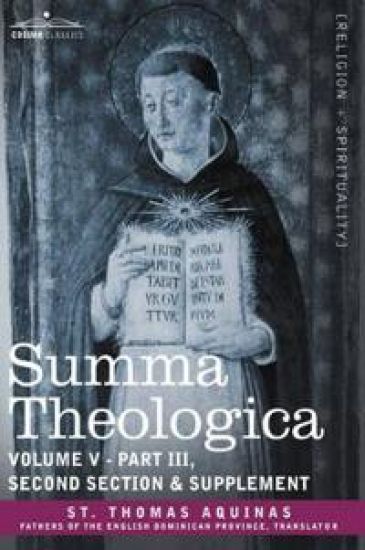
Summa Theologica, Volume 5 (Part III, Second Section & Supplement)
"The Summa Theologica is the best-known work of Italian philosopher, scholar, and Dominican friar SAINT THOMAS AQUINAS (1225 1274), widely considered the Catholic Church s greatest theologian. Famously consulted (immediately after the Bible) on religious questions at the Council of Trent, Aquinas s masterpiece has been considered a summary of official Church philosophy ever since. Aquinas considers approximately 10,000 questions on Church doctrine covering the roles and nature of God, man, and Jesus, then lays out objections to Church teachings and systematically confronts each, using Biblical verses, theologians, and philosophers to bolster his arguments. In Volume V, Aquinas addresses: penance, contrition, and confession excommunication matrimony and divorce slavery judgment purgatory and much more This massive work of scholarship, spanning five volumes, addresses just about every possible query or argument that any believer or atheist could have, and remains essential, more than seven hundred years after it was written, for clergy, religious historians, and serious students of Catholic thought."
Summa Theologiae Prima Pars, 1-49

Summa Theologiae Prima Pars, 1-49

Thomas Aquinas; Laurence Shapcote

Emmaus Academic
2012
sidottu
The most important work of the towering intellectual of the Middle Ages, Thomas Aquinas's Summa Theologiae remains one of the great seminal works of philosophy and theology, while extending to subjects as diverse as law and government, sacraments and liturgy, and psychology and ethics. In his third and final part of the Summa Theologiae, Thomas Aquinas begins to address the life of Christ, lived out both in Jesus himself, and in each of the baptized through the sacraments.
Commentary on the Letter of Saint Paul to the Romans
Although Thomas Aquinas's influence over philosophy endures to this day, the medieval genius did not consider himself a philosopher, but a Scripture scholar. The Aquinas Institute's hardcover Latin-English editions of Aquinas's commentaries on the Letters of St. Paul make many of these commentaries available in English for the first time. The bilingual format makes the work of this intellectual giant accessible to a broader audience than ever before in history. Aquinas's commentaries on the Pauline letters is a great gift for pastors, seminarians, or anyone who seeks a deeper intellectual reflection on Scripture.
The Little Flowers, and on Man: The Great Books, Readings for Discussion, Fifth Year, V3

The Little Flowers, and on Man: The Great Books, Readings for Discussion, Fifth Year, V3

St Francis of Assisi; Thomas Aquinas

Literary Licensing, LLC
2012
sidottu
The Little Flowers, And On Man: The Great Books, Readings For Discussion, Fifth Year, V3 is a book written by St. Francis of Assisi. It is a collection of stories and teachings about the life of St. Francis and his followers, known as the Franciscans. The book is divided into two parts: The Little Flowers and On Man. The Little Flowers is a collection of stories about the miracles and teachings of St. Francis and his followers. It includes stories about St. Francis preaching to birds, taming a fierce wolf, and healing the sick. On Man is a series of teachings about the nature of humanity and the relationship between humans and God. The book is intended to be used as a tool for discussion and reflection, and is part of a series of Great Books readings for discussion. It is the fifth year of the series and is the third volume. The book is written in English and is accessible to readers of all levels. It is a valuable resource for anyone interested in the life and teachings of St. Francis of Assisi and the Franciscan order. Fifth Year Course In Eight Volumes. Volume 1, Medea, Hippolytus, The Trojan Women, By Euripides, Thoactetus, By Plato, Physics, Book 4, Selections By Aristotle; Volume 2, The Aeneid, By Virgil; Volume 3, The Little Flowers, By St. Francis Of Assisi And On Man, By St. Thomas Aquinas; Volume 4, The Divine Comedy, By Dante; Volume 5, The Dignity Of Man, By Pice Della Mirandola, Principles Of Human Knowledge, By Berkley, Mathematical Principles, Selections By Newton; Volume 6, Life Of Johnson, Selections By Reswell, And Prologomona, By Kant; Volume 7, Journal, By Woolman And Relativity, By Einstein; Volume 8, Moby Dick, By Melville. This scarce antiquarian book is a facsimile reprint of the old original and may contain some imperfections such as library marks and notations. Because we believe this work is culturally important, we have made it available as part of our commitment for protecting, preserving, and promoting the world's literature in affordable, high quality, modern editions, that are true to their original work
Exposition of the Physics of Aristotle, Books 1-2: A Summary

Exposition of the Physics of Aristotle, Books 1-2: A Summary

Thomas Aquinas; Aristotle

Literary Licensing, LLC
2011
sidottu
Exposition Of The Physics Of Aristotle, Books 1-2: A Summary by Aquinas, Thomas is a comprehensive and detailed analysis of Aristotle's Physics. Thomas Aquinas, a renowned medieval philosopher and theologian, provides a summary of the first two books of Aristotle's Physics, which cover fundamental concepts such as motion, time, space, and causation. In this book, Aquinas breaks down Aristotle's complex ideas into clear and concise explanations, making it accessible to readers who may not have a background in philosophy or physics. He also provides his own insights and interpretations, highlighting the relevance of Aristotle's theories to contemporary discussions in science and philosophy. Overall, Exposition Of The Physics Of Aristotle, Books 1-2: A Summary by Aquinas, Thomas is a valuable resource for anyone interested in understanding Aristotle's Physics, as well as the historical and philosophical context in which it was written. This scarce antiquarian book is a facsimile reprint of the old original and may contain some imperfections such as library marks and notations. Because we believe this work is culturally important, we have made it available as part of our commitment for protecting, preserving, and promoting the world's literature in affordable, high quality, modern editions, that are true to their original work.
Providence and Predestination: Truth, Questions 5 and 6

Providence and Predestination: Truth, Questions 5 and 6

Thomas Aquinas

Literary Licensing, LLC
2011
sidottu
Providence And Predestination: Truth, Questions 5 And 6 is a book by St. Thomas Aquinas that delves into the topics of divine providence and predestination. The book is based on Aquinas' teachings and writings, and provides a comprehensive exploration of the concepts of providence and predestination in the context of Christian theology. The book is divided into two main sections, with the first section exploring the concept of divine providence. Aquinas discusses the idea that God has a plan for the world and that everything that happens is part of that plan. He also examines the role of free will in the context of divine providence and how human choices can impact the unfolding of God's plan. The second section of the book focuses on the concept of predestination, which is the belief that God has already determined the fate of every individual. Aquinas explores the different interpretations of predestination and provides his own perspective on the topic. He also discusses the relationship between predestination and human free will, and how the two concepts can coexist. Throughout the book, Aquinas provides a detailed analysis of the arguments and counterarguments surrounding these complex theological concepts. He draws on his extensive knowledge of Christian doctrine and philosophy to provide a nuanced and insightful perspective on these topics. Overall, Providence And Predestination: Truth, Questions 5 And 6 is a thought-provoking and comprehensive exploration of two fundamental concepts in Christian theology. It is a valuable resource for anyone interested in deepening their understanding of these important topics. This scarce antiquarian book is a facsimile reprint of the old original and may contain some imperfections such as library marks and notations. Because we believe this work is culturally important, we have made it available as part of our commitment for protecting, preserving, and promoting the world's literature in affordable, high quality, modern editions, that are true to their original work.