Kirjojen hintavertailu – 12 859 819 kirjaa ja 27 kauppaa
Kirjailija
Thomas Carlyle
Kirjat ja teokset yhdessä paikassa: 1 353 kirjaa, julkaisuja vuosilta 1850–2026, suosituimpiin kuuluu The Carlyle anthology. Vertaile teosten hintoja ja tarkista saatavuus suomalaisista kirjakaupoista.
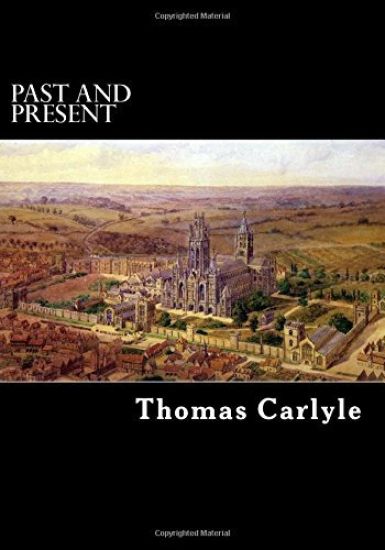
Past and Present is a work of history and criticism, first published in 1843, written by Scottish essayist and historian Thomas Carlyle. It combines medieval history with criticism on 19th century Britain. It was written by Carlyle in seven weeks, as he was writing his work on Cromwell. He took inspiration from the recently published Chronicles of the Abbey of Saint Edmund's Bury, by Jocelin of Brakelond at the end of the 12th century.
Thomas Carlyle (4 December 1795 - 5 February 1881) was a Scottish philosopher, satirical writer, essayist, historian and teacher. 1] Considered one of the most important social commentators of his time, he presented many lectures during his lifetime with certain acclaim in the Victorian era. One of those conferences resulted in his famous work On Heroes, Hero-Worship, and The Heroic in History where he explains that the key role in history lies in the actions of the "Great Man", claiming that "History is nothing but the biography of the Great Man". A respected historian, his 1837 book The French Revolution: A History was the inspiration for Dickens' 1859 novel A Tale of Two Cities, and remains popular today. Carlyle's 1836 Sartor Resartus is a notable philosophical novel
Thomas Carlyle (4 December 1795 - 5 February 1881) was a Scottish philosopher, satirical writer, essayist, historian and teacher. Considered one of the most important social commentators of his time, he presented many lectures during his lifetime with certain acclaim in the Victorian era. One of those conferences resulted in his famous work On Heroes, Hero-Worship, and The Heroic in History where he explains that the key role in history lies in the actions of the "Great Man", claiming that "History is nothing but the biography of the Great Man". A respected historian, his 1837 book The French Revolution: A History was the inspiration for Dickens' 1859 novel A Tale of Two Cities, and remains popular today. Carlyle's 1836 Sartor Resartus is a notable philosophical novel. A great polemicist, Carlyle coined the term "the dismal science" for economics. He also wrote articles for the Edinburgh Encyclopaedia, and his Occasional Discourse on the Negro Question (1849) remains controversial. Once a Christian, Carlyle lost his faith while attending the University of Edinburgh, later adopting a form of Deism. His philosophy, combined with his appreciation of the German culture, the Norse mythology and his anti-democratic views, is considered a form of proto-fascism. In mathematics, he is known for the Carlyle circle, a method used in quadratic equations and for developing ruler-and-compass constructions of regular polygons.
Sartor Resartus (meaning 'The tailor re-tailored') is an 1836 novel by Thomas Carlyle, first published as a serial in 1833-34 in Fraser's Magazine. The novel purports to be a commentary on the thought and early life of a German philosopher called Diogenes Teufelsdrockh (which translates as 'god-born devil-dung'), 1] author of a tome entitled "Clothes: Their Origin and Influence", but was actually a poioumenon ("product"). 2] Teufelsdr ckh's Transcendentalist musings are mulled over by a skeptical English Reviewer (referred to as Editor) who also provides fragmentary biographical material on the philosopher. The work is, in part, a parody of Hegel, and of German Idealism more generally. However, Teufelsdr ckh is also a literary device with which Carlyle can express difficult truths. The novel takes the form of a long review by a somewhat cantankerous unnamed Editor for the English Publication Fraser's Magazine (in which the novel was first serialized without any distinction of the content as fictional) who is upon request, reviewing the fictional German book Clothes, Their Origin and Influence by the fictional philosopher Diogenes Teufelsdr ckh (Professor of "Things in General" at Weissnichtwo University). The Editor is clearly flummoxed by the book, first struggling to explain the book in the context of contemporary social issues in England, some of which he knows Germany to be sharing as well, then conceding that he knows Teufelsdr ckh personally, but that even this relationship does not explain the curiosities of the book's philosophy. The Editor remarks that he has sent requests back to the Teufelsdrockh's office in Germany for more biographical information hoping for further explanation, and the remainder of Book One contains summaries of Teufelsdr ckh's book, including translated quotations, accompanied by the Editor's many objections, many of them buttressed by quotations from Goethe and Shakespeare. The review becomes longer and longer due to the Editor's frustration at the philosophy, but desire to expose its outrageous nature. At the final chapter of Book One, the Editor has received word from the Teufelsdr ckh's office in the form of several bags of paper scraps (rather esoterically organized into bags based on the signs of the Latin Zodiac) on which are written autobiographical fragments. At the writing of Book Two, the Editor has somewhat organized the fragments into a coherent narrative. As a boy, Teufelsdr ckh was left in a basket on the doorstep of a childless couple in the German country town of Entepfuhl ("Duck-Pond"); his father a retired Sergeant of Frederick the Great and his mother a very pious woman, who to Teufelsdr ckh's gratitude, raises him in utmost spiritual discipline. In very flowery language, Teufelsdr ckh recalls at length the values instilled in his idyllic childhood, the Editor noting most of his descriptions originating in intense spiritual pride. Teufelsdr ckh eventually is recognized as being clever, and sent to Hinterschlag (slap-behind) Gymnasium. While there, Teufelsdr ckh is intellectually stimulated, and befriended by a few of his teachers, but frequently bullied by other students. His reflections on this time of his life are ambivalent; glad for his education, but critical of that education's disregard for actual human activity and character; for both his own treatment, and his education's application to politics. While at University, Teufelsdr ckh encounters the same problems, but eventually gains a small teaching post some favour and recognition from the German nobility. While interacting with these social circles, Teufelsdr ckh meets a woman he calls Blumine (Goddess of Flowers; the Editor assumes this to be a pseudonym), and abandons his teaching post to pursue her...... Thomas Carlyle (4 December 1795 - 5 February 1881) was a Scottish philosopher, satirical writer, essayist, historian and teacher.
On Heroes, Hero-Worship, and The Heroic in History is a book by Thomas Carlyle, published with James Fraser, London, in 1841. It is a collection of six lectures given in May 1840. 1. (5 May) The Hero as Divinity. Odin. Paganism: Scandinavian Mythology 2. (8 May) The Hero as Prophet. Muhammad: Islam 3. (12 May) The Hero as Poet. Dante; Shakespeare 4. (15 May) The Hero as Priest. Luther; Reformation: Knox; Puritanism 5. (19 May) The Hero as Man of Letters. Johnson, Rousseau, Burns 6. (22 May) The Hero as King. Cromwell. Napoleon: Modern Revolutionism... Thomas Carlyle (4 December 1795 - 5 February 1881) was a Scottish philosopher, satirical writer, essayist, historian and teacher. Considered one of the most important social commentators of his time, he presented many lectures during his lifetime with certain acclaim in the Victorian era. One of those conferences resulted in his famous work On Heroes, Hero-Worship, and The Heroic in History where he explains that the key role in history lies in the actions of the "Great Man", claiming that "History is nothing but the biography of the Great Man". A respected historian, his 1837 book The French Revolution: A History was the inspiration for Dickens' 1859 novel A Tale of Two Cities, and remains popular today. Carlyle's 1836 Sartor Resartus is a notable philosophical novel. A great polemicist, Carlyle coined the term "the dismal science" for economics. He also wrote articles for the Edinburgh Encyclopaedia, and his Occasional Discourse on the Negro Question (1849) remains controversial. Once a Christian, Carlyle lost his faith while attending the University of Edinburgh, later adopting a form of Deism. His philosophy, combined with his appreciation of the German culture, the Norse mythology and his anti-democratic views, is considered a form of proto-fascism citation needed]. In mathematics, he is known for the Carlyle circle, a method used in quadratic equations and for developing ruler-and-compass constructions of regular polygons.