Kirjojen hintavertailu – 12 903 725 kirjaa ja 27 kauppaa
Kirjailija
Thomas Szasz
Kirjat ja teokset yhdessä paikassa: 46 kirjaa, julkaisuja vuosilta 1984–2022, suosituimpiin kuuluu Pain and Pleasure. Vertaile teosten hintoja ja tarkista saatavuus suomalaisista kirjakaupoista.
With this book James Hillman initiated the "soul movement" in psychotherapy more than fifty years ago. Soul and suicide are dominant issues of this new millennium; soul because it cannot be reduced to genes and chromosomes; suicide because it raises fundamental religious, political, and legal conflicts. As Hillman writes in the Postscript to the second edition: "The individual consists of more than his or her personal individuality. Something besides 'myself' inhabits the soul, takes part in its life and has a say in its death... We need a...definition of self as the interiorization of community. Suicide, literally 'self-killing, ' now would mean both a killing of community and involvement of community in the killing." Hillman's book tries to carry Jung's ideas of a soul-informed psychology into the most wrenching agony of therapeutic practice: the suicide of the patient. It goes to the heart of therapy. Since we are each in a silent therapy with ourselves, the issue of suicide reaches into the heart of each of us. Suicide and the Soul resurrects "soul" from its reliquary in spiritual churchiness and instills the idea with the passion-laden daily life of soul food, soul music, soul brother, soul sister, and soul death. This new edition is introduced by the eminent psychiatrist and pioneering social critic Thomas Szasz.
Among the disciplines which are growing at the most accelerated pace is psychiatry, and understandably so. Intimately involved with psychology, general biology, neurology, sociology, cultural changes of any kind, it is constantly enriched by these fields and many others, which all converge toward a greater knowledge of man in health and mental illness. This Book is edited by Thomas Szasz, Javad Nurbakhsh, Hamideh Jahangiri, Haraton Davidian, Levon Davidian, Silvano Arieti, Eugene B. Brody, Morton F. Reiser, Daniel X. Freedman, Jarl E. Dyrud, David A. Hamburg, Keith Brodie, Ian Alger, Heinz L. Ansbacher, E. James Anthony, Kenneth Appel, Jack Bemporad, Jules R. Bemporad, Therese Benedek, Viola W. Bernard, Donald A. Bloch, Henry Brill, Robert N. Butler, Nancy Datan, Katrina De Hirsch, Marvin G. Drellich, Abraham Edel, Leon Edel, Henri F. Ellenberger, James L. Foy, Eugene A. Friedmann, Richard A. Gardner, Kurt Goldstein, Ralph R. Greenson, Harry Guntrip, Joseph L. Henderson, John W. Higgins, Irene M. Josselyn, Bernard Kaplan, Kenneth Keniston, Nolan D. C. Lewis, Theodore Lidz, Bruce Mazlish, Rev. James R. MacColl, R. E. Money-Kyrle, George Mora, Wendell S. Muncie, Simon H. Nagler, Harold I
For more than a half century Thomas Szasz has devoted much of his career to a thorough and provocative critique of the practice of psychiatry. In many ways his latest work, Psychiatry: The Science of Lies, is a culmination of his life's work: to portray the integral role of deception in the history and practice of psychiatry. Szasz argues that the diagnosis and treatment of mental illness stands in the same relationship to the diagnosis and treatment of bodily illness that the forgery of a painting stands to the original masterpiece. Art historians, museum directors, private collectors, and the legal system all seek to distinguish forgeries from originals. Those concerned with medicine on the other hand--physicians, patients, politicians, health insurance providers, and legal professionals--take the opposite stance when faced with the challenge of distinguishing everyday problems in living from diseases of the body, systematically authenticating nondiseases as diseases. The boundary between disease and nondisease - genuine and imitation, original and copy, truth and falsehood -- thus becomes arbitrary, shifting, and uncertain. With a wealth of well-researched new evidence, Szasz examines the ways in which dishonesty and misrepresentation have permeated all aspects of psychiatric practice: the doctors, the patients, and even at times those who work to uncover psychiatric abuse. Delivering his sophisticated analysis in lucid prose and with a sharp wit, Szasz continues to engage and challenge readers of all backgrounds.
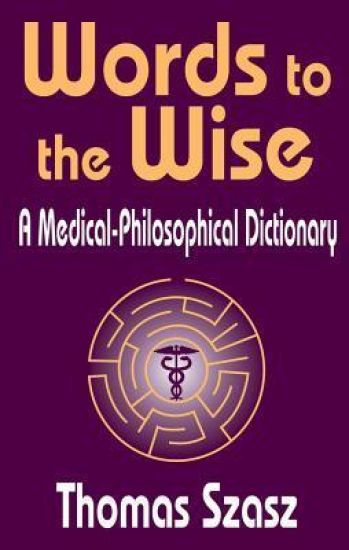
The human mind abhors the absence of explanation, but full understanding is never possible. Human understanding is likely to be incomplete at best and, more often, utterly fallacious. To make matters worse, it is likely to be supported as truth and wisdom by religious and scientific authority, intellectual fashion and social convention. In Words to the Wise, Thomas Szasz offers a compendium of thoughts, observations, and aphorisms that address our understanding of a broad range of subjects, from birth to death. In this book, Szasz tackles a problem intrinsic to the human condition. What problem? In the words of the American humorist Josh Billings: "The trouble with people is not what they don't know but that they know so much that ain't so." Many of Thomas Szasz's books have been devoted to exposing what "ain't so" about mental illness and psychiatry. Here, Szasz applies the same skeptical spirit to the larger problem of people knowing much that "ain't so." About addiction, Szasz observes: "If a person ingests a drug prohibited by legislators and claims that it makes him feel better, that proves he is an addict; if he ingests a drug prescribed by a psychiatrist and claims that it makes him feel better, that proves that mental illness is a biomedical disease." About beauty: "Beauty is in the eye of the beholder; ugliness is in the personality of the beholden." About libertarians: "Libertarians regard liberty as contingent on the right to property; scientists regard disease as contingent on pathological alteration of the body. All libertarians reject the notion of 'socialist liberty,' yet many accept the notion of 'mental disease.'" Or about power: "Many of my critics say I am hostile to medicine and physicians. They are wrong. I am hostile only to the power of the medical profession and of physicians." Szasz notes that despite enormous social pressure for a shared perspective on how the world works and how we ought to live, every person'saunderstanding, not only of himself, but of the world about him, is different from every other person's. This volume shows how the quest for truth is a never-ending challenge, and must presuppose an honest acceptance of questions, problems, and uncertainty.
The libertarian philosophy of freedom is characterized by two fundamental beliefs: the right to be left alone and the duty to leave others alone. Psychiatric practice routinely violates both of these beliefs. It is based on the notion that self-ownership—exemplified by suicide—is a not an inherent right, but a privilege subject to the review of psychiatrists as representatives of society. In Faith in Freedom, Thomas Szasz raises fundamental questions about psychiatric practices that inhibit an individual's right to freedom. His questions are fundamental. Is suicide an exercise of rightful self-ownership or a manifestation of mental disorder? Does involuntary confinement under psychiatric auspices constitute unjust imprisonment, or is it therapeutically justified hospitalization? Should forced psychiatric drugging be interpreted as assault and battery on the person or is it medical treatment? The ethical standards of psychiatric practice mandate that psychiatrists employ coercion. Forgoing such "intervention" is considered a dereliction of the psychiatrists' "duty to protect." How should friends of freedom—especially libertarians—deal with the conflict between elementary libertarian principles and prevailing psychiatric practices? In Faith in Freedom, Thomas Szasz addresses this question more directly and more profoundly than in any of his previous works.
In Western thought, suicide has evolved from sin to sin-and-crime, to crime, to mental illness, and to semilegal act. A legal act is one we are free to think and speak about and plan and perform, without penalty by agents of the state. While dying voluntarily is ostensibly legal, suicide attempts and even suicidal thoughts are routinely punished by incarceration in a psychiatric institution. Although many people believe the prevention of suicide is one of the duties the modern state owes its citizens, Szasz argues that suicide is a basic human right and that the lengths to which the medical industry goes to prevent it represent a deprivation of that right. Drawing on his general theory of the myth of mental illness, Szasz makes a compelling case that the voluntary termination of one’s own life is the result of a decision, not a disease. He presents an in-depth examination and critique of contemporary antisuicide policies, which are based on the notion that voluntary death is a mental health problem, and systematically lays out the dehumanizing consequences of psychiatrizing suicide prevention. If suicide be deemed a problem, it is not a medical problem. Managing it as if it were a disease, or the result of a disease, will succeed only in debasing medicine and corrupting the law. Pretending to be the pride of medicine, psychiatry is its shame.
More than fifty years ago, Thomas Szasz showed that the concept of mental illness - a disease of the mind - is an oxymoron, a metaphor, a myth. Disease, in the medical sense, affects only the body. He also demonstrated that civil commitment and the insanity defense, the paradigmatic practices of psychiatry, are incompatible with the political values of personal responsibility and individual liberty. The psychiatric establishment's rejection of Szasz's critique posed no danger to his work: its defense of coercions and excuses as ""therapy"" supported his argument regarding the metaphorical nature of mental illness and the transparent immorality of brutal psychiatric control masquerading as humane medical care. In the late 1960s, the launching of the so-called antipsychiatry movement vitiated Szasz's effort to present a precisely formulated conceptual and political critique of the medical identity of psychiatry and of psychiatric coercions and excuses. Led by the Scottish psychiatrist R. D. Laing, the antipsychiatrists used the term to attract attention to themselves and deflect attention from what they did, which included coercions and excuses based on psychiatric principles and power. For this reason, Szasz rejected, and continues to reject, psychiatry and antipsychiatry with equal vigor. Subsuming his work under the rubric of antipsychiatry betrays and negates it just as surely and effectively as subsuming it under the rubric of psychiatry. In ""Antipsychiatry: Quackery Squared"", Szasz powerfully argues that his writings belong to neither psychiatry nor antipsychiatry. They stem from conceptual analysis, social-political criticism, and common sense.
For more than half a century Thomas Szasz has devoted much of his career to a radical critique of psychiatry. His latest work, ""Psychiatry: The Science of Lies"", is a culmination of his life's work: to portray the integral role of deception in the history and practice of psychiatry. Szasz argues that the diagnosis and treatment of mental illness stands in the same relationship to the diagnosis and treatment of bodily illness that the forgery of a painting does to the original masterpiece. Art historians and the legal system seek to distinguish forgeries from originals. Those concerned with medicine, on the other hand - physicians, patients, politicians, health insurance providers, and legal professionals - take the opposite stance when faced with the challenge of distinguishing everyday problems in living from bodily diseases, systematically authenticating nondiseases as diseases. The boundary between disease and nondisease - genuine and imitation, truth and falsehood - thus becomes arbitrary and uncertain. There is neither glory nor profit in correctly demarcating what counts as medical illness and medical healing from what does not. Individuals and families wishing to protect themselves from medically and politically authenticated charlatanry are left to their own intellectual and moral resources to make critical decisions about human dilemmas miscategorized as 'mental diseases' and about medicalized responses misidentified as 'psychiatric treatments.' Delivering his sophisticated analysis in lucid prose and with a sharp wit, Szasz continues to engage and challenge readers of all backgrounds.
Defining ""medicalization"" as the perception of nonmedical conditions as medical problems and nondiseases as diseases, Thomas Szasz has devoted much of his career to exposing the dangers of ""medicalizing"" the conditions of some who simply refuse to conform to society's expectations. Szasz argues that modern psychiatry's tireless ambition to explain the human condition has led to the treatment of life's difficulties and oddities as clinical illnesses rather than as humanity revealed in its fullness. This collection of impassioned essays, published between 1973 and 2006, chronicles the author's long campaign against the orthodoxies of psychiatry. From ""Medicine to Magic"" to ""Medicine as Social Control,"" the book delves into the fascinating history of medicalization, including ""The Discovery of Drug Addiction,"" ""Persecutions for Witchcraft and Drugcraft,"" and ""Food Abuse and Foodaholism."" In a society that has little tolerance for those who live outside its rules, Dr. Szasz's writings are as relevant today as ever.
The vast literature on Virginia Woolf's life, work, and marriage falls into two groups. A large majority is certain that she was mentally ill, and a small minority is equally certain that she was not mentally ill but was misdiagnosed by psychiatrists. In this daring exploration of Woolf's life and work, Thomas Szasz--famed for his radical critique of psychiatric concepts, coercions, and excuses--examines the evidence and rejects both views. Instead, he looks at how Virginia Woolf, as well as her husband Leonard, used the concept of madness and the profession of psychiatry to manage and manipulate their own and each other's lives. Do we explain achievement when we attribute it to the fictitious entity we call "genius"? Do we explain failure when we attribute it to the fictitious entity we call "madness"? Or do we deceive ourselves the same way that the person deceives himself when he attributes the easy ignition of hydrogen to its being "flammable"? Szasz interprets Virginia Woolf's life and work as expressions of her character, and her character as the "product" of her free will. He offers this view as a corrective against the prevailing, ostensibly scientific view that attributes both her "madness" and her "genius" to biological-genetic causes. We tend to attribute exceptional achievement to genius, and exceptional failure to madness. Both, says Szasz, are fictitious entities.
The libertarian philosophy of freedom is characterized by two fundamental beliefs: the right to be left alone and the duty to leave others alone. Psychiatric practice routinely violates both of these beliefs. It is based on the notion that self-ownership—exemplified by suicide—is a not an inherent right, but a privilege subject to the review of psychiatrists as representatives of society. In Faith in Freedom, Thomas Szasz raises fundamental questions about psychiatric practices that inhibit an individual's right to freedom. His questions are fundamental. Is suicide an exercise of rightful self-ownership or a manifestation of mental disorder? Does involuntary confinement under psychiatric auspices constitute unjust imprisonment, or is it therapeutically justified hospitalization? Should forced psychiatric drugging be interpreted as assault and battery on the person or is it medical treatment? The ethical standards of psychiatric practice mandate that psychiatrists employ coercion. Forgoing such "intervention" is considered a dereliction of the psychiatrists' "duty to protect." How should friends of freedom—especially libertarians—deal with the conflict between elementary libertarian principles and prevailing psychiatric practices? In Faith in Freedom, Thomas Szasz addresses this question more directly and more profoundly than in any of his previous works.
The human mind abhors the absence of explanation, but full understanding is never possible. Human understanding is likely to be incomplete at best and, more often, utterly fallacious. To make matters worse, it is likely to be supported as truth and wisdom by religious and scientific authority, intellectual fashion and social convention. In Words to the Wise, Thomas Szasz offers a compendium of thoughts, observations, and aphorisms that address our understanding of a broad range of subjects, from birth to death. In this book, Szasz tackles a problem intrinsic to the human condition. What problem? In the words of the American humorist Josh Billings: "The trouble with people is not what they don't know but that they know so much that ain't so." Many of Thomas Szasz's books have been devoted to exposing what "ain't so" about mental illness and psychiatry. Here, Szasz applies the same skeptical spirit to the larger problem of people knowing much that "ain't so." About addiction, Szasz observes: "If a person ingests a drug prohibited by legislators and claims that it makes him feel better, that proves he is an addict; if he ingests a drug prescribed by a psychiatrist and claims that it makes him feel better, that proves that mental illness is a biomedical disease." About beauty: "Beauty is in the eye of the beholder; ugliness is in the personality of the beholden." About libertarians: "Libertarians regard liberty as contingent on the right to property; scientists regard disease as contingent on pathological alteration of the body. All libertarians reject the notion of 'socialist liberty,' yet many accept the notion of 'mental disease.'" Or about power: "Many of my critics say I am hostile to medicine and physicians. They are wrong. I am hostile only to the power of the medical profession and of physicians." Szasz notes that despite enormous social pressure for a shared perspective on how the world works and how we ought to live, every person'saunderstanding, not only of himself, but of the world about him, is different from every other person's. This volume shows how the quest for truth is a never-ending challenge, and must presuppose an honest acceptance of questions, problems, and uncertainty.
Thomas Szasz suggests that governments have overstepped their bounds in labeling and prohibiting certain drugs as ""dangerous"" substances and incarcerating drug ""addicts"" in order to cure them. Szasz asserts that such policies scapegoat illegal drugs and the persons who use and sell them, and discourage the breaking of drug habits by pathologizing drug use as ""addiction."" Readers will find in Szasz's arguments a cogent and committed response to a worldwide debate.
The modern penchant for transforming human problems into ""diseases"" and judicial sanctions into ""treatments,"" replacing the rule of law with the rule of medical discretion, leads to a type of government social critic Thomas Szasz calls ""pharmacracy."" He warns that the creeping substitution of democracy for pharmacracyprivate personal concerns increasingly perceived as requiring a medical-political responseinexorably erodes personal freedom and dignity.