
Kirjailija
Thomas Taylor
Kirjat ja teokset yhdessä paikassa: 235 kirjaa, julkaisuja vuosilta 1992–2027, suosituimpiin kuuluu Cornwall Parish Registers. Marriages (Volume Vi). Vertaile teosten hintoja ja tarkista saatavuus suomalaisista kirjakaupoista.
235 kirjaa
Kirjojen julkaisuvuodet: 1992–2027.
Introduction to the Philosophy and Writings of Plato
Thomas Taylor
Salzwasser-Verlag Gmbh
2018
sidottu

Excerpt from The Celtic Christianity of Cornwall: Divers Sketches and Studies N one of the most brilliant of modern books its author 1 calls attention to the common fallacy which assumes that if you can find a principle which gives an adequate explanation of three different facts it is more likely to correspond with the truth than three different principles which give adequate explanations of the same facts severally. About the Publisher Forgotten Books publishes hundreds of thousands of rare and classic books. Find more at www.forgottenbooks.com This book is a reproduction of an important historical work. Forgotten Books uses state-of-the-art technology to digitally reconstruct the work, preserving the original format whilst repairing imperfections present in the aged copy. In rare cases, an imperfection in the original, such as a blemish or missing page, may be replicated in our edition. We do, however, repair the vast majority of imperfections successfully; any imperfections that remain are intentionally left to preserve the state of such historical works.
Introduction to the Philosophy and Writings of Plato
Thomas Taylor
Salzwasser-Verlag Gmbh
2018
pokkari



![Proclus: Commentary on the Timaeus of Plato: Containing a Treasury of Pythagoric and Platonic Physiology [two volumes in one]](/covers/9781973844983.jpg)
Proclus: Commentary on the Timaeus of Plato: Containing a Treasury of Pythagoric and Platonic Physiology [two volumes in one]
Thomas Taylor
Createspace Independent Publishing Platform
2017
nidottu
The present volume is a reprint of Thomas Taylor's 1820 translation of Proclus' Commentaries on the Tim us of Plato, which remains to this day arguably the most important and insightful commentary on any of Plato's dialogues. Proclus' commentary provides us with, as Hegel says, the "culmination of Neo-Platonic thought." Combined with Proclus' "On the Theology of Plato," we are provided with a solid foundation in the Platonic tradition, and are able to trace several of the most fundamental points of doctrine more clearly and systematically than is to be found from just about any other source. Students looking for an introduction to the theological elements described in this volume are encouraged to also read Taylor's General Introduction to the Philosophy and Writings of Plato along with his translations of the complete Works of Plato. For more on the mathematical elements, one may look to Taylor's translation of The Philosophical and Mathematical Commentaries of Proclus on the First Book of Euclid's Elements. As Proclus grounds much of his thought in the Chaldean system, one will also benefit from the fragments of the Chaldean Oracles collected and translated also by Taylor. For more on the Pythagorean ideas, see Taylor's edition of The Life of Pythagoras, and for more on the Orphic system see The Hymns of Orpheus. These (and other available works) combine to present the student with a much greater and more profound context for the ideas examined by Proclus in the present work.
Proclus: The Elements of Theology
Thomas Taylor
Createspace Independent Publishing Platform
2017
nidottu
Halvin toimitettuna 23,30 €
![Proclus: On the Theology of Plato: with The Elements of Theology [two volumes in one]](/covers/9781546302902.jpg)
Proclus: On the Theology of Plato: with The Elements of Theology [two volumes in one]
Thomas Taylor
Createspace Independent Publishing Platform
2017
nidottu
The present volume is a reprint of Thomas Taylor's 1816 translation of Proclus' "On the Theology of Plato", by far the most exhaustive and complete survey of the theological elements of Plato's teachings. In the original edition of this work, Taylor included additional materials, including Proclus' "Elements of Theology", along with fragments from treatises on Providence, Fate and Evil. Of these, only the Elements of Theology have been included in the present volume, while the others await reprinting in a separate volume. The Elements of Theology and the Theology of Plato together allow the reader a greater possibility of grasping the overall scheme of Platonic theology. As Taylor notes in his Introduction, "the Elements of Theology . . . render s] the treatise On the Theology of Plato more complete, and . . . assist s] the reader who wishes to penetrate the depths of that most abstruse and sublime work; for the former elucidates, and is elucidated by the latter." Students wishing for an introduction to the theology described in this volume are encouraged to also read Taylor's General Introduction to the Philosophy and Writings of Plato along with his translations of the complete Works of Plato. "I rejoice in the opportunity which is afforded me of presenting the truly philosophic reader, in the present work, with a treasure of Grecian theology; of a theology, which was first mystically and symbolically promulgated by Orpheus, afterwards disseminated enigmatically through images by Pythagoras, and in the last place scientifically unfolded by Plato and his genuine disciples. The peculiarity indeed of this theology is that it is no less scientific than sublime; and that by a geometrical series of reasoning originating from the most self-evident truths, it develops all the deified progressions from the ineffable principle of things, and accurately exhibits to our view all the links of that golden chain of which deity is the one extreme, and body the other."-Thomas Taylor, from the Introduction
Plato: The Republic: A Dialogue Concerning Justice
Thomas Taylor
Createspace Independent Publishing Platform
2016
nidottu
Plato: The First Alcibiades: A Dialogue Concerning the Nature of Man; with Additional Notes drawn from the MS Commentary of Proclus
Thomas Taylor
Createspace Independent Publishing Platform
2016
nidottu
Halvin toimitettuna 19,40 €
The present edition of Plato's "First Alcibiades" is a reproduction of the translation completed by Thomas Taylor and Floyer Sydenham. Stephanus numbers have been added to the original text for easy reference, and Taylor's "Additional Notes," drawn from the MS Commentary of Proclus on this dialogue, has been included immediately following the translation. This is the second book in a series of publications reproducing the Works of Plato. The first volume in this series reproduced Taylor's "General Introduction to the Philosophy and Writings of Plato" (ISBN: 9781530752379) From the Foreword: "The most peculiar and firm principle of all the dialogues of Plato, and of the whole theory of that philosopher, is the knowledge of our own nature, and such pure and genuine knowledge of ourselves, circumscribed in scientific boundaries, must be considered as the most proper principle of all philosophy. "The design of all that has been said in the First Alcibiades is to purify our diano tic part i.e. our reasoning power] from two-fold ignorance, and to remove all that impedes our resumption of true science. For we are ignorant of ourselves in consequence of being involved in oblivion produced by the realms of generation, and agitated by the tumult of the irrational forms of life. In the mean time, we think that we know many things of which we are ignorant. This dialogue therefore is the beginning of all philosophy, in the same manner as the knowledge of ourselves." (Proclus on the First Alcibiades) The First Alcibiades makes for the perfect opening to the Platonic dialogues, being somewhat of a preface in itself to the full study of Plato's philosophy. As Taylor notes: "The First Alcibiades . . . may be called, and appears to have been generally considered by the ancients, an introduction to the whole of Plato's philosophy." This is naturally apparent to any keen student of philosophy who considers the most basic requisites for wisdom. Before one can hope to gain much from the study of Plato, one must have grasped and put into practice the primary purpose of Socrates's initial discourse with Alcibiades. This purpose is summed up perfectly by Proclus in the above quotation. According to Plato, two-fold ignorance is the dreadful state or disease of the multitude, in which we are not only ignorant with respect to the sublimest knowledge, but even ignorant of our own ignorance "Two-fold ignorance takes place when a man is ignorant that he is ignorant; and this was the case with Alcibiades in the first part of this dialogue, and is the disease of the multitude." (Taylor) We must liberate ourselves from this state if we are to even begin the real study of nature and ourselves. We must first admit to ourselves that we do not know that which we do not know, and step out of the delusion that we know that which we do not know. Once this initial step is taken, we will have moved from "two-fold ignorance" into "simple ignorance," which is the rightful state for the beginning of our study. For "no one would attempt to investigate that which he thinks he knows. It is necessary, therefore, that simple ignorance should be the beginning of investigation. For investigation is a desire of knowledge in things of which we suspect that we are ignorant." It is thus rather useless to begin a study of the Platonic philosophy if we haven't yet addressed this state of darkness we find ourselves in. And it is this liberation from our two-fold ignorance that is the design of the First Alcibiades. On this basis, we believe the choice to open the study of Plato with this dialogue was a wise choice adopted by Thomas Taylor in his five-volume collection, and would be a wise choice for any student of Plato.
General Introduction to the Philosophy and Writings of Plato: from The Works of Plato
Thomas Taylor
Createspace Independent Publishing Platform
2016
nidottu
The General Introduction contained in the present volume is drawn from Thomas Taylor's five-volume set of the complete Works of Plato, originally published in 1804. With that great task completed, Taylor became the first to translate the whole of the genuine works of Plato (his 55 dialogues and 12 epistles) into English. That work is a timeless masterpiece not solely because of the quantity of works translated or the sublimity of those works, but due also to Taylor's ability to elucidate the principles of that philosophy as no other has done in the English tongue. In his introduction Taylor gives us an overview of the fundamental principles of the philosophy and theology of Plato, guiding us on a journey transcending the mundane particulars of our sensory lives upwards to the summit of all things, the principle of principles and fountain of all that is. Through this journey, and with careful thought and consideration, the student may gather enough of an outline to begin assembling his own conception of that system, from which he may later begin his efforts towards a recollection of divine truths. Following Taylor's overview of Plato's philosophy, he provides an outline of that great philosopher's writings, from their structure and organization, down to Plato's style of writing. Lastly, Taylor introduces us to the full set of his translations, providing the reasoning used in his arrangement of the dialogues along with references to previous translations and commentaries he relied upon in his efforts. In his five-volume set, Taylor followed this Introduction with a short glossary of terms peculiar to the Platonic philosophy, which we have here reproduced along with several additional terms and definitions drawn from two of Taylor's other publications. Concluding this volume, and Taylor's introductory material for his translations, is his rendering of the biography of Plato by Olympiodorus. This biography is rather concise in itself, but provides some general sense of the life of the man. These introductory materials ought to furnish the sincere student with the necessaries to begin an earnest study of philosophy, not as it is so commonly presented in our modern times, stripped of all substance in the name of ever expanding sophistry, but imbibed with the life-essence of that great wisdom that underlies the genuine Grecian system, from Orpheus to Pythagoras, Plato and beyond. To begin this study is to ask the aid of that golden chain of philosophers in the effort of seeking real knowledge of ourselves, such that we may practice and embody the highest virtue. The present volume is the first in a series of publications reproducing the Works of Plato. It is highly recommended that the student follow Taylor's arrangement of the dialogues in their initial study of the philosophy, in order that they may gain the most from such sincere efforts towards wisdom. If the student is desirous of this, the first dialogue in that arrangement is the First Alcibiades. In that dialogue, one will encounter the first, and most critical step in the life of a philosopher: that of liberation from the disease of two-fold ignorance. Only once liberated may one truly benefit from further study of Plato's sublime philosophy. It is further recommended that the sincere student open themselves to a wider study of the Grecian philosophy, theology and mythology as presented throughout the translations and original works of Thomas Taylor. From the Egyptian Mysteries, the Chaldean Oracles, the Hymns of Orpheus, to the Life of Pythagoras, and onwards through the works of Plato, Aristotle and the later Platonists (in particular, that of Proclus), Taylor's translations, as well as his introductions and copious notes, shed clear white light on this vast and sublime wisdom tradition. The study of Plato is but one thread in this divine tapestry.
The Life of Pythagoras, or Pythagoric Life: Accompanied by Fragments of the Writings of the Pythagoreans
Thomas Taylor
Createspace Independent Publishing Platform
2016
nidottu
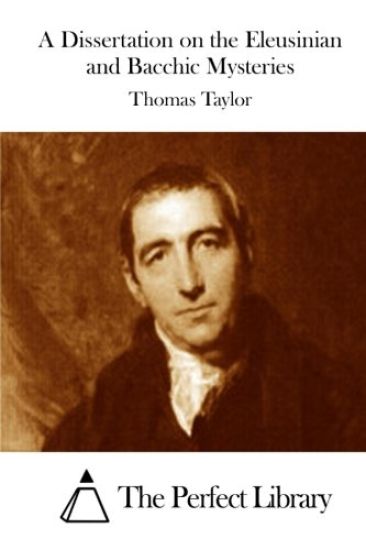
A Dissertation on the Eleusinian and Bacchic Mysteries
Thomas Taylor
Createspace Independent Publishing Platform
2016
nidottu
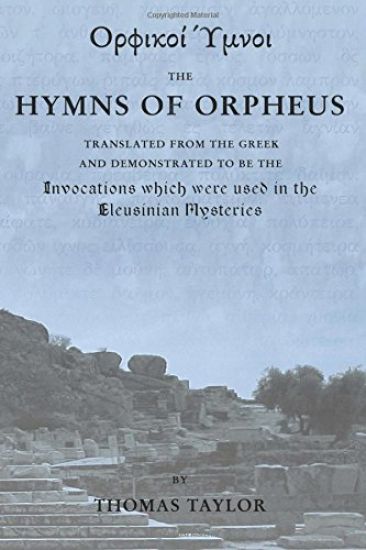
The Mystical Hymns of Orpheus: The Invocations used in the Eleusinian Mysteries
Thomas Taylor
Createspace Independent Publishing Platform
2015
nidottu
Halvin toimitettuna 22,30 €
The present volume is a verbatim reproduction of Thomas Taylor's 2nd Edition of his Hymns of Orpheus. This 2nd edition (1824) represents Taylor's effort to significantly emend, alter and add to his 1st edition (1787). However, the former, superseded edition has been recirculated both online and in print in previous years, clearly in ignorance that a 2nd edition exists-an edition which in many ways renders the first obsolete.37 years of study and translation work occurred between Taylor's 1st and 2nd editions, during which time he translated the complete works of Plato, the complete works of Aristotle, much of the work of Proclus, Iamblicus and others of the later Platonists, along with several other works of Greek philosophy. Thus the difference between the 1st and 2nd editions of this text is the difference between the work of a young, eager and gifted, but relatively new philosopher on the one hand, and the work of one of, if not the most knowledgeable English Platonists ever to have lived. For this reason alone, it is rather worthless to continue printing and circulating the 1787 edition; all such editions ought to be left to expire in favour of Taylor's own extensively revised 2nd Edition. Indeed, we can be confident in suggesting that Taylor would not have committed the time and energy required to produce his 2nd edition had he not himself recognized the need for significantly revising his first effort (a facsimile reprint would otherwise have sufficed). There are several changes between the 1st and 2nd editions: the numbering of the hymns, the introduction, notes, and significant changes to the translation itself. In the present volume, the formatting of the original has been changed in order to render the text more easily readable. The copious footnotes found in the original have been collected and placed in order at the end of the Hymns, allowing for a more easily readable layout for each individual hymn. In the margins we have added the pagination of the original edition, so that all references made to the original over the intervening centuries may be easily traced in the present volume, despite its altered pagination. Besides these changes, and minor changes in formatting style, the text has not been altered, except in cases where certain Greek characters were in need of modernization." The Grecian theology, which originated from Orpheus, was not only promulgated by him, but also by Pythagoras and Plato; who, for their transcendent genius, will always be ranked by the intelligent among the prodigies of the human race. By the first of these illustrious men, however, it was promulgated mystically and symbolically; by the second, enigmatically, and through images; and scientifically by the third. That this theology, indeed, was derived from Orpheus is clearly testified by those two great philosophic luminaries Iamblichus and Proclus. From this golden chain of philosophers, as they have been justly called, my elucidations of the present mystic hymns are principally derived: for I know of no other genuine sources, if it be admitted (and it must by every intelligent reader), that the theology of Orpheus is the same as that of Pythagoras and Plato."-Thomas Taylor