Kirjailija
Thomas Taylor
Kirjat ja teokset yhdessä paikassa: 235 kirjaa, julkaisuja vuosilta 1992–2027, suosituimpiin kuuluu Cornwall Parish Registers. Marriages (Volume Vi). Vertaile teosten hintoja ja tarkista saatavuus suomalaisista kirjakaupoista.
235 kirjaa
Kirjojen julkaisuvuodet: 1992–2027.

"A gap is an opening; an opening is a space between barriers; a space between barriers makes for tremendous vulnerability. At the first sign of a gap, it should be shored up, or repelled, or stopped, or hidden, or overwhelmed. These are called the principles of stopping gaps." - The Master of Demon Valley, ancient Chinese classic. STOP GAPS explores the tactics and strategies for a high level protective detail, and the value of protectors to "find and stop gaps" in their rings of protection before they are exploited by their adversaries. When an unknown intruder penetrates the security surrounding the Missouri Governor's Mansion, Lieutenant Kacey Underwood and her team in the Governor's Security Division try to determine the intruder's identity, motive, and future intentions, before he can strike again. As investigators close in, the intruder takes the initiative, and Underwood and her team will be tested to the limits of their training and abilities.

There are tickles everywhere in this house. From Mum's swirly-whirly tummy button tickles to Dad's great big side-grabbers, there's no escape for this brother and sister. Young children will be bursting with laughter and raring to join in with the tickles in this funny, playful book.

Adjoint-based techniques can provide the sensitivity of an objective function to any number of parameters of a simulation inexpensively at roughly the cost of a single additional flow calculation. This information can be used to perform sensitivity analyses, aerodynamic shape optimization, and to estimate the error in an objective function due to the numerical discretization. Existing approaches to derive the numerically discretized adjoint equations involve the so-called discrete and continuous methods, which differ in the order at which the discretization and linearization steps are performed. The effect of these contrasting approaches is that they have both strengths and weaknesses over each other in the form of the complexity of the formulation and the computational expense of the solution. In this work a hybrid approach is developed that combines elements of the continuous and discrete methods with the intention of capturing the advantages of both: reducing the time spent on mathematical derivation of the continuous adjoint equations, lowering the computational requirements of the discrete adjoint equations, and generally improving the quality of the adjoint solution.
Select Works of Plotinus is a book that contains a selection of works by the philosopher Plotinus, translated into English by Thomas Taylor. Plotinus was a major figure in the development of Neoplatonism, a philosophical movement that sought to reconcile the teachings of Plato with those of Aristotle and other ancient thinkers. The works included in this book cover a range of topics, including metaphysics, ethics, and theology. They are presented in a clear and accessible style, making them suitable for both scholars and general readers interested in philosophy and ancient wisdom. Taylor's translation is highly regarded for its accuracy and faithfulness to the original texts, and his introduction provides valuable context and background information on Plotinus and his philosophy. Overall, Select Works of Plotinus is a valuable resource for anyone interested in exploring the ideas of one of the most important philosophers of the ancient world. This is a new release of the original 1929 edition. This scarce antiquarian book is a facsimile reprint of the old original and may contain some imperfections such as library marks and notations. Because we believe this work is culturally important, we have made it available as part of our commitment for protecting, preserving, and promoting the world's literature in affordable, high quality, modern editions, that are true to their original work.
Introduction to the Philosophy and Writings of Plato
Thomas Taylor
Createspace Independent Publishing Platform
2013
nidottu

A follower of the Occupy movement has decided to take out four high profile public figures who belong to the "evil One Percent," the most weathy segment of Americans. When the Governor's Security Division (GSD) determines their protectee, Governor William Ulysses Stovall, might be in the assassin's crosshairs, they implement high level protective measures to keep him safe. But their efforts are undermined by an aggressive reporter, who decides to reveal GSD's most protective secrets, including their new armored Cadillac Escalade codenamed Achilles. As the risk to Stovall escalates, GSD finds their protectee pushing them back to apease the press. LAST CAME ANARCHY explores the tactics and strategies of a high level protective detail, and the importance an armored vehicle brings to any protective operation. Inspired by actual events, LAST CAME ANARCHY takes on the heated issues of Safety vs Exposure, the "protector's responsibility of safety" vs the "public's right to know."

Introduction To The Philosophy And Writings Of Plato
Thomas Taylor
Createspace Independent Publishing Platform
2012
nidottu

It's nearly two years after the Arch attack in St. Louis, and the Governor's Security Division (GSD) again finds itself embroiled in controversy. When Lieutenant Kacey Underwood becomes involved in a headlines-grabbing incident, she finds herself in the middle of an internal investigation that could cost her job ... or worse. TIGER'S HEART explores the tactics and strategies of a high-level protective detail, and the challenges of a world-class female operative to exist in that world. Thomas A. Taylor knows executive protection operations. As a member of the Missouri Highway Patrol for 30 years, he protected four different governors over much of his career. He served as president of the National Governor's Security Association (NGSA) and commanded GSD for eight years.
Fragments of the Lost Writings of Proclus
Thomas Taylor
Createspace Independent Publishing Platform
2011
nidottu
Proclus was born Feb. 8, 412 AD (his birth date is deduced from a horoscope cast by a disciple, Marinus) in Constantinople to a family of high social status in Lycia (his father Patricius was a high legal official, very important in the Byzantine Empire's court system) and raised in Xanthus. He studied rhetoric, philosophy and mathematics in Alexandria, with the intent of pursuing a judicial position like his father. Before completing his studies, he returned to Constantinopole when his rector, his principal instructor (one Leonas), had business there. Proclus became a successful practicing lawyer. However, the experience of the practice of law made Proclus realize that he truly preferred philosophy. He returned to Alexandria, and began determinedly studying the works of Aristotle under Olympiodorus the Elder (he also began studying mathematics during this period as well with a teacher named Heron (no relation to Hero of Alexandria who was also known as Heron). Eventually, this gifted student became dissatisfied with the level of philosophical instruction available in Alexandria, and went to Athens, the preeminent philosophical center of the day, in 431 to study at the Neoplatonic successor of the famous Academy founded 800 years (in 387 BC) before by Plato; there he was taught by Plutarch of Athens, Syrianus, and Asclepigenia; he succeeded Syrianus as head of the Academy, and would in turn be succeeded on his death by Marinus of Neapolis. He lived in Athens as a vegetarian bachelor, prosperous and generous to his friends, until the end of his life, except for a voluntary one year exile, which was designed to lessen the pressure put on him by his political-philosophical activity, little appreciated by the Christian rulers; he spent the exile traveling and being initiated into various mystery cults as befitted his universal approach to religion, trying to become "a priest of the entire universe". His house has been discovered recently in Athens, under the pavement, south of Acropolis, opposite the theater of Dionysus. He had a great devotion to the Goddess Athena, whom he believed guided him at key moments in his life. Marinus reports that when Christians removed the statue of the Goddess from the Parthenon, a beautiful woman appeared to Proclus in a dream and announced that the "Athenian Lady" wished to stay at his home. Proclus died aged 73, and was buried near Mount Lycabettus in a tomb.
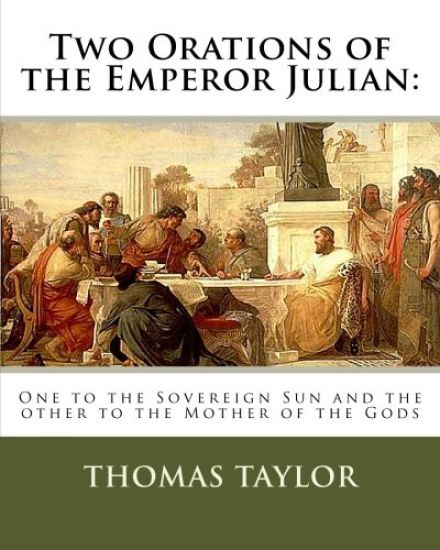
Two Orations of the Emperor Julian: : One to the Sovereign Sun and the other to the Mother of the Gods
Thomas Taylor
Createspace Independent Publishing Platform
2011
nidottu
The History of Animals of Aristotle, and His Treatise on Physiognomy, Translated from the Greek. by Thomas Taylor.
Thomas Taylor
British Library, Historical Print Editions
2011
pokkari
Title: The History of Animals of Aristotle, and his Treatise on Physiognomy, translated from the Greek. By Thomas Taylor. Publisher: British Library, Historical Print EditionsThe British Library is the national library of the United Kingdom. It is one of the world's largest research libraries holding over 150 million items in all known languages and formats: books, journals, newspapers, sound recordings, patents, maps, stamps, prints and much more. Its collections include around 14 million books, along with substantial additional collections of manuscripts and historical items dating back as far as 300 BC. The HISTORY OF PHILOSOPHY & ETHICS collection includes books from the British Library digitised by Microsoft. The works in this collection include expositions and scholarly analyses of philosophy and ethics for the earliest recorded Western religious and secular works. Documents concern prehistoric, medieval, and modern times, with background and historical narratives on Western thought. The collection provides insights into how philosophies have changed through history, what has driven these changes, and to what degree philosophical texts from prior eras are understood in the contemporary times of the authors. ++++The below data was compiled from various identification fields in the bibliographic record of this title. This data is provided as an additional tool in helping to insure edition identification: ++++ British Library Aristotle.; Taylor, Thomas; 1809. xxi, 487 p.; 4 . 520.l.5.