Kirjojen hintavertailu – 12 903 724 kirjaa ja 27 kauppaa

Kirjailija

U. S. Air Force

Kirjat ja teokset yhdessä paikassa: 263 kirjaa, julkaisuja vuosilta 1968–2019, suosituimpiin kuuluu Pearl to V-J Day: World War II in the Pacific. Vertaile teosten hintoja ja tarkista saatavuus suomalaisista kirjakaupoista.

Nimi esiintyy myös muodoissa: U S Air Force, U.S. Air Force

263 kirjaa

Kirjojen julkaisuvuodet: 1968–2019.

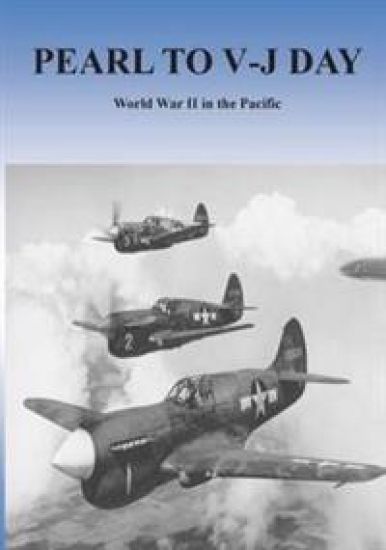
Pearl to V-J Day: World War II in the Pacific

Pearl to V-J Day: World War II in the Pacific

U. S. Air Force; Office of Air Force History

Createspace Independent Publishing Platform
2015
nidottu
In observance of the fiftieth anniversary of the end of World War II, the Air Force History and Museums Program sponsored several commemorative events. One, co-sponsored by the Air Force Historical Foundation was a symposium on the War in the Pacific, held at the Bethesda, Maryland, Naval Officers' Club. The gathering offered a unique opportunity for its guest panelists-participants in that war or historians of it-to reflect on a variety of subjects: Japanese objectives; American military preparedness and grand strategy; the interaction between U. S. Army, Air, and Navy leaders; combined operations; political and diplomatic intrigue; the challenges of ground, air, and sea warfare within differing Pacific theaters; military science and technology; the essential role of intelligence; the proposed Allied invasion of the Japanese home islands; and the use of the atomic bombs. For the United States, World War II began and ended in the Pacific, from Japan's aerial attack on Pearl Harbor, on December 7, 1941, to its surrender in Tokyo Bay, on September 2, 1945. During those years, for all but five months, Americans and their Allies were compelled to hold the line in Asia, doggedly opposing the imperialistJapan while a "Europe First" policy against Nazi Germany and fascist Italy prevailed in the Atlantic and the Mediterranean. The United States operated over huge distances, from China, Burma, and India, to countless Pacific islands from the Aleutians to the Coral Sea. It sent its Army, Navy, Marine, and Air forces into gruelling and horrific battles against a Japan bent at all costs on expanding its empire across thousands of miles and exploiting human and natural resources wherever it conquered. The momentous Allied victory in World War II made the United States the superpower it has been for half a century and, in large measure, determined its military planning into the present day. The War in the Pacific in particular proved that American military personnel fought bravely in many climes, on many fronts, against the odds, with amazing ingenuity and purpose. The discussions on World War II in general and the War in the Pacific in particular presented herein deal frankly with a time that tested America's resolve as it was never tested before and has not been tested since
Frank M. Andrews: Marshall's Airman

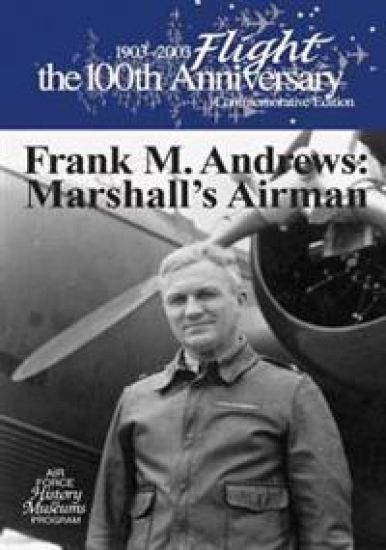
Frank M. Andrews: Marshall's Airman

U. S. Air Force; Office of Air Force History

Createspace Independent Publishing Platform
2015
nidottu
As we conclude our year-long recognition of the 100th anniversary of powered flight, we take this opportunity to recognize and pay tribute to airmenof the past and present. We do this with an eye toward inspiring airmen of the future. General Frank M. Andrews was an inspirational figure in our history and it is fitting that we highlight his accomplishments and contributions in the creation, shaping, and development of the United States Air Force. As the organizer and commander of the prewar General Headquarters (GHQ) Air Force, he was the first airman to have centralized nationwide command of Air Corpsbombardment, attack, and pursuit units. The advent of GHQ Air Force marked one of the first decisive steps on the road to the birth of a separate air service. Nevertheless, likely due to his personal modesty and untimely death in a B-24crash in, May 1943, while commanding the European Theater of Operations, he has been a background figure in our history. General George C. Marshall, wartime Chief of Staff of the Army, captured the magnitude of his tragic loss to the Allied war effort by characterizing Andrews as one of the nation's "few great captains." As we celebrate the Centennial of Flight, I'd like to encourage the use of upcoming venues to spread-the word about lesser-known, selfless warriors, such as General Andrews, who epitomize the values we highlight to airmen today. On March 7, 2003, we formally named the Air Combat Command headquarters building after General Andrews. We are also close to establishing anendowed scholarship fund in his memory for Air Force Academy Preparatory School Cadets and creation of a permanent "Andrews" exhibit in the USAF Museum at Wright-Patterson AFB. Additionally, we plan to integrate his story into our professional military education programs. Memorializing General Andrews is one example of how we can commemorate the Centennial of Flight, emphasizing the tremendous impact anindividual's efforts and contributions can have on aviation and the Air Force. Thank you for your support of this important project for aviation, the United States Air Force, and our nation.
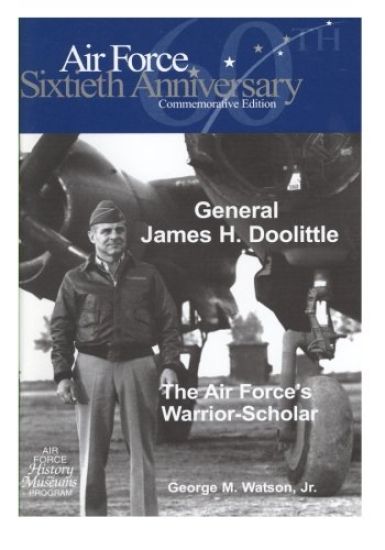
General James H. Doolittle: The Air Force's Warrior-Scholar

General James H. Doolittle: The Air Force's Warrior-Scholar

U. S. Air Force; Office of Air Force History

Createspace Independent Publishing Platform
2015
nidottu
Picture a man who was born before the flight of the first airplane, who spent time in Alaska during its early twentieth-century gold rush, and whobecame a superb pugilist, holding his own against ranked professionals. This same man joined the Army Air Service during World War I and made hisfirst solo flight after just a few hours of training. Several years later, he earned academic degrees at one of the Nation's most prestigious institutions, and, while setting all types of speed records in a multitude of aircraft, was involved in designing and testing many innovative aviation enhancements. During World War II, this same man flew the lead bomber in a flight that delivered the first retaliatory blow against the Japanese home islands. As commander of the Twelfth Air Force, he was involved in the North African campaign, striking at the Third Reich from the Mediterranean. Then, as commander of the "mighty" Eighth Air Force, he headed to England, where his fighter pilots achieved air superiority over the Luftwaffe. Lastly, in September 1945, he witnessed the Japanese surrender on the battleship Missouri. Following the war, he served on the boards of many private corporations and government agencies and became the director of Shell Oil Company. He received his fourth star in 1985 from President Ronald Reagan, and, three years later, the Presidential Medal of Freedom fromPresident George H. W. Bush. This was not Walter Mitty or Forrest Gump, but a real person who lived for nearly a century. He was the United StatesAir Force's true Renaissance man, James H. Doolittle
Personnel - Awards and Memorialization Program (Air Force Manual 36-2806)
This manual implements Air Force Policy Directive (AFPD) 36-28, Awards and Decorations Programs; and AFPD 36-31, Personal Affairs. This manual governs the Air Force special trophies, awards, decorations and memorialization programs. It applies to Regular Air Force, Air Force Reserve and Air National Guard personnel; and where specified applies to Air Force civilian employees paid through appropriated funds. In collaboration with the Chief of Air Force Reserve (AF/RE) and Director of the Air National Guard (NGB/CF), the Deputy Chief of Staff for Manpower, Personnel, and Services (AF/A1) develops personnel policy for the Air Force Awards and Memorialization Program. Ensure all records created as a result of processes prescribed in this publication are maintained in accordance with Air Force Manual (AFMAN) 33-363, Management of Records, and disposed of in accordance with the Air Force Records Disposition Schedule located in the Air Force Records Information Management System.
Operations - Air Force Incident Management System (AFIMS) Standards and Procedures (Air Force Manual 10-2502)
This manual complements Air Force Policy Directive 10-2, Readiness; Air Force Policy Directive 10-25, Emergency Management; and Air Force Instruction 10-2501, Air Force Emergency Management Program. It aligns the Air Force Emergency Management Program with Homeland Security Presidential Directive (HSPD)-5, Management of Domestic Incidents, Presidential Policy Directive (PPD)-8, National Preparedness, the National Incident Management System, and the National Response Framework. This manual incorporates the National Incident Management System methodology and aligns Air Force Emergency Management planning and response with the National Response Framework as directed by Homeland Security Presidential Directive-5. This publication applies to all Regular Air Force, Air Force Reserve, and Air National Guard of the United States, Department of the Air Force civilian personnel, and contractors, if included in the applicable contract, tasked with the responsibility for emergency and incident management.
Operations - Command Posts (Air Force Material Command - Supplement) Air Force Manual 10-207
1.1.1. Command post operations furthers AFPD 10-25 guidance by serving as the focal point for Command and Control for commanders during routine operations, emergencies, contingencies, and increased readiness. The Command Post is a direct representative of the commander and serves as the sole agency responsible for executing Command Post-related Command and Control activities. 1.1.2. The installation Command Post is a wing staff agency organized directly under the wing function. Command Post Managers are tasked with the responsibility of operating the Command Post on behalf of the wing commander. As such, either the wing commander, vice wing commander, or Director of Staff will be the reporting official for the Chief, Command and Control Operations or Superintendent if there is no Chief assigned (T-2).
Personnel: Fitness Program - Air Force Instruction 36-2905
It is every Airman's responsibility to maintain the standards set forth in this AFI 365 days a year. Being physically fit allows you to properly support the Air Force mission. The goal of the Fitness Program (FP) is to motivate all members to participate in a year-round physical conditioning program that emphasizes total fitness, to include proper aerobic conditioning, muscular fitness training, and healthy eating. An active lifestyle will increase productivity, optimize health, and decrease absenteeism while maintaining a higher level of readiness. Commanders and supervisors must incorporate fitness into the Air Force culture establishing an environment for members to maintain physical fitness and health to meet expeditionary mission requirements. The Fitness Assessment (FA) provides commanders with a tool to assist in the determination of overall fitness of their military personnel. Commander-driven physical fitness training is the backbone of the Air Force Fitness Program and an integral part of...
The First Sergeant - Air Force Instruction 36-2113
This instruction sets the policy for management of first sergeants and implements AFPD 36-21, Utilization and Classification of Air Force Military Personnel. It applies to all Air Force personnel. This instruction is applicable to RegAF, Air National Guard (ANG) and the Air Force Reserve (AFR). However, selected sections of this publication apply to only specific components as indicated. In collaboration with the Chief of Air Force Reserve and the Director of the Air National Guard, the Deputy Chief of Staff for Manpower, Personnel and Services develops policy for The First Sergeant. This publication may be supplemented at any level; all supplements must be routed to the OPR of this publication for coordination and must be approved by the Human Resource Management Strategic Board (HSB) prior to certification and approval. Refer recommended changes and questions about this publication to the Office of Primary Responsibility (OPR) using the AF form 847, Recommendation for Change of Publication...
Suicide Prevention Program - Air Force Instruction 90-505
This instruction implements AFPD 90-5, Community Action and Information Board and AFPD 44-1, Medical Operations. It establishes requirements to conduct education and training to prevent acts of harm to self and raise awareness to prevent suicide and suicidal behavior in Air Force (AF) communities. This instruction applies to all Regular Air Force (RegAF) personnel as well as personnel of the Air Reserve Component (ARC)-the Air Force Reserve (AFR) and the Air National Guard (ANG), and Air Force civilian employees. This AFI may be supplemented at any level, but all supplements must be routed to AFMSA/SG3OQ for coordination prior to certification and approval. The authorities to waive wing/unit level requirements in this publication are identified with a Tier (T-1) number following the compliance statement.
Cyber Warfare Operations 7- CFETP 1B4X1 (Parts I and II)
1. This Career Field Education and Training Plan (CFETP) is a comprehensive education and training document that identifies life-cycle education/training requirements, training support resources and minimum core task requirements for this specialty. The CFETP will provide personnel a clear career path to success and instill rigor in all aspects of career field training. 2. The CFETP documents the career field training program and consists of two parts. Management uses both parts in conjunction with Training Business Area (TBA) to plan, manage and control training within the career field. NOTE: Civilians occupying associated positions will use Part II to support duty position qualification training.
Officer And Enlisted Evaluation Systems - Air Force Instruction 36-2406
This publication implements Air Force Policy Directive (AFPD) 36-24, Military Evaluations. It provides guidance and procedures for implementing Air Force (AF) Evaluation Systems policy for the Officer Evaluation System (OES) and Enlisted Evaluation System (EES). It describes how to prepare, submit, and manage Air Force Forms (AF Forms) prescribed by this Air Force Instruction (AFI). Waivers to this instruction are authorized and shall be processed IAW AFI 33-360, Publications and Forms Management. Waiver requests will be submitted using the AF Form 679, Air Force Publication Compliance Item Waiver Request/Approval, or via e-mail or memorandum if the form is unavailable. For unit-level compliance items, waivers must be approved by AFPC/DP3SP. AFPC/DP3SP is the waiver approving authority for non-tiered requirements in this publication.
Dress and Personal Appearance of Air Force Personnel - AFI36-2903 -AFGM2018-02
This memorandum provides policy and guidance for all military personnel serving in the United States Air Force, including those serving in the Reserve and Guard components of the Air Force as identified herein. The specific changes to AFI 36-2903 are listed in the attachment. The paragraphs listed replace the corresponding paragraphs in AFI 36-2903 or add new paragraphs. Failure to observe the mandatory provisions in paragraphs 3.4.1 and 3.4.2 of this memorandum by Regular Air Force military members, Air Force Reserve military members on active duty or inactive duty for training, and Air National Guard military members in Title 10 status is a violation of Article 92 of the Uniform Code of Military Justice. Air National Guard members in Title 32 status performing full-time National Guard duty or inactive duty for training, who violate the mandatory provisions of this instruction, may be held accountable through similar provisions of their respective State Military Codes.
Protocol - Air Force Instruction 34-1201
This instruction implements Department of Defense Instruction (DoDI) 1005.06, Display of the National Flag at Half-staff and Air Force Policy Directive (AFPD) 34-12, Air Force Protocol, and AFPD 65-6, Budget. This instruction applies to all Regular Air Force (RegAF) units and members including the Air National Guard (ANG) and Air Force Reserve (AFR) units and members. Ensure all records created because of processes prescribed in this publication are maintained in accordance with Air Force Manual (AFMAN) 33-363, Management of Records, and disposed of in accordance with the Air Force Records Disposition Schedule (RDS) located in the Air Force Records Information Management System (AFRIMS). Any requests for records or documents will be processed under the Freedom of Information Act guidelines outlined in AFI 33-332, Privacy Act and Civil Liberties Program, DoD 5400.7-R, Department of Defense Freedom of Information Act Program, and AFMAN 33-302, Freedom of Information Act Program.
Drill and Ceremonies - Air Force Manual 36-2203 (19 June 2018)
This manual implements Air Force Policy Directive (AFPD) 36-26, Total Force Development. It describes the movements and procedures for saluting, drill, ceremonies, reviews, and parades. This manual is for general use throughout the US Air Force and is a guide for persons teaching, learning, or participating in drill and ceremonies (see Air Force Instruction (AFI) 34-1201, Protocol). This manual applies to all Regular Air Force units and members including the Air National Guard and Air Force Reserve units and members. Ensure that all records created as a result of processes prescribed in this publication are maintained IAW Air Force Manual (AFMAN) 33-363, Management of Records, and disposed of IAW the Air Force Records Disposition Schedule (RDS) in the Air Force Records Information Management System (AFRIMS).
Occupational and Environmental Health Program - Air Force Instruction 48-145
This Air Force Instruction (AFI) is consistent with Air Force Policy Directive (AFPD) 48-1, Aerospace Medicine Enterprise, DoD Instruction (DoDI) 6055.05, Occupational and Environmental Health and is consistent with AFPD 90-8, Environment, Safety, and Occupational Health (ESOH) Management and Risk Management. It establishes procedures consistent with the guidance in AFI 91-202, The US Air Force Mishap Prevention Program, for medical support requirements. This publication applies to all Air Force (AF) active duty personnel, civilian employees, Air Force Reserve Command (AFRC) Units and the Air National Guard (ANG). This Instruction does not apply to employees working under government contract. Contractors are solely responsible for compliance with Occupational Safety and Health Administration (OSHA) standards and the protection of their employees unless otherwise provided by law or regulation to be specified in the contract.
Air Force Handbook 1

Air Force Handbook 1

U S Air Force

Lulu.com
2018
pokkari
This handbook implements AFPD 36-22, Air Force Military Training. Information in this handbook is primarily from Air Force publications and contains a compilation of policies, procedures, and standards that guide Airmen's actions within the Profession of Arms. This handbook applies to the Regular Air Force, Air Force Reserve and Air National Guard. This handbook contains the basic information Airmen need to understand the professionalism required within the Profession of Arms. Attachment 1 contains references and supporting information used in this publication. This handbook is the sole source reference for the development of study guides to support the enlisted promotion system. Enlisted Airmen will use these study guide to prepare for their Promotion Fitness Examination (PFE) or United States Air Force Supervisory Examination (USAFSE).
Airfield Marking and Striping After Major Attack (AFTTP 3-32.13)
PURPOSE: To provide an alternate airfield marking and striping sequence to meet the Air Component Commander's Air Tasking Order (ATO) after a major enemy attack. This publication implements Air Force Instruction (AFI) 10-210, Prime Base Engineer Emergency Force (BEEF) Program; and supports AFI 10-209, RED HORSE Program; Air Force Pamphlet (AFPAM) 10-219, Volume 4, Airfield Damage Repair Operations, and Air Force Doctrine Annex 3-34, Engineer Operations. Ensure that all records created as a result of processes prescribed in this publication are maintained in accordance with (IAW) Air Force Manual (AFMAN) 33-363, Management of Records, and disposed of IAW the Air Force Records Information Management System (AFRIMS) Records Disposition Schedule (RDS). Refer recommended changes and questions about this publication to the Office of Primary Responsibility (OPR) using the AF Form 847, Recommendation for Change of Publication; route AF Forms 847 from the field through the appropriate functional chain of command.
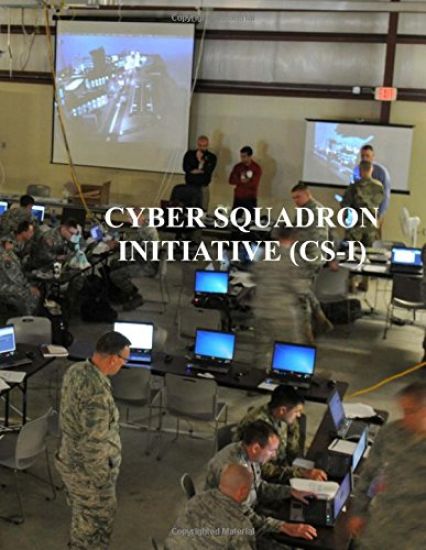
Cyber Squadron Initiative (CS-I): AFGM2017 AFi 10-1703

Cyber Squadron Initiative (CS-I): AFGM2017 AFi 10-1703

U. S. Air Force

Createspace Independent Publishing Platform
2017
nidottu
This book pulls together 4 key Air Force publications on the Cyber Squadron Initiative (CS-I). The Cyber Squadron Initiative (CS-I) is a transformational program to align Air Force communications units to evolving joint and service Cyberspace Operations doctrine, and to support major commands in effectively organizing, training and equipping the Cyberspace Operations Workforce. CS-I will refocus and strengthen traditional Air Force communications units in delivering enhanced mission assurance of wing-level assigned and attached weapons and mission systems to maintain operational advantage across the Air Force's five core missions. AFGM2017-17-01 CYBER SQUADRON INITIATIVE (CS-I) 11 Oct 2017 AFI 10-1703, VOL. 1 CYBERCREW TRAINING 2 Apr 2014 AFI 10-1703, VOL. 2 CYBERCREW STANDARDIZATION AND EVALUATION PROGRAM 15 Oct 2014 AFI 10-1703, VOL. 3 CYBERSPACE OPERATIONS AND PROCEDURES 6 May 2015 AFI 10-1703 ensures all cybercrew members obtain and maintain the certification/qualification and proficiency needed to effectively perform their unit's mission. It applies to cybercrew positions that are designated mission ready/combat mission ready (MR/CMR). It establishes the Cybercrew Standardization and Evaluation (Stan/Eval) Program that supports Air Force objectives and provides guidance on how to structure and monitor a stan/eval program. It also establishes procedures for personnel assigned to Air Force cyber weapon systems. If your organization is not following this guidance, then you are at a severe disadvantage. Air Force has been doing this for a while and they provide defensive and operational guidance that can be followed universally to protect critical computer networks. Why buy a book you can download for free? We print this book so you don't have to. First you gotta find a good clean (legible) copy and make sure it's the latest version (not always easy). Some documents found on the web are missing some pages or the image quality is so poor, they are difficult to read. We look over each document carefully and replace poor quality images by going back to the original source document. We proof each document to make sure it's all there - including all changes. If you find a good copy, you could print it using a network printer you share with 100 other people (typically its either out of paper or toner). If it's just a 10-page document, no problem, but if it's 250-pages, you will need to punch 3 holes in all those pages and put it in a 3-ring binder. Takes at least an hour. It's much more cost-effective to just order the latest version from Amazon.com This book is published by 4th Watch Publishing Co. and includes copyright material. We publish compact, tightly-bound, full-size books (8 1/2 by 11 inches), with large text and glossy covers. 4th Watch Publishing Co. is a Service Disabled Veteran-Owned Small Business (SDVOSB). If you like the service we provide, please leave positive review on Amazon.com. Without positive feedback from the community, we may discontinue the service and y'all can go back to printing these books manually yourselves. A full copy of over 300 cybersecurity standards is loaded on our CyberSecurity Standards Library DVD which is available at Amazon.com. For more titles published by 4th Watch Publishing Co., please visit: cybah.webplus.net Other related titles we publish: Network Attack System (NAS) Vol. 1, 2 & 3 Air Force Cyberspace Defense (ACD) Vol. 1, 2 & 3 Air Force Cyberspace Training Publications Vol. 1, 2 & 3 Air Force Cyberspace Operations Air Force Cyberspace Security and Control Systems (CSCS) Vol. 1, 2 & 3 Air Force Cyberspace Defense Analysis (CDA)