Kirjojen hintavertailu – 12 903 724 kirjaa ja 27 kauppaa
Kirjailija
U. S. Environmental Protection Agency
Kirjat ja teokset yhdessä paikassa: 363 kirjaa, julkaisuja vuosilta 2003–2017, suosituimpiin kuuluu Costs Claimed by the Alaska Native Tribal Health Consortium Under EPA Interagency Agreement DW 75-95754001. Vertaile teosten hintoja ja tarkista saatavuus suomalaisista kirjakaupoista.
Nimi esiintyy myös muodoissa: U S Environmental Protection Agency
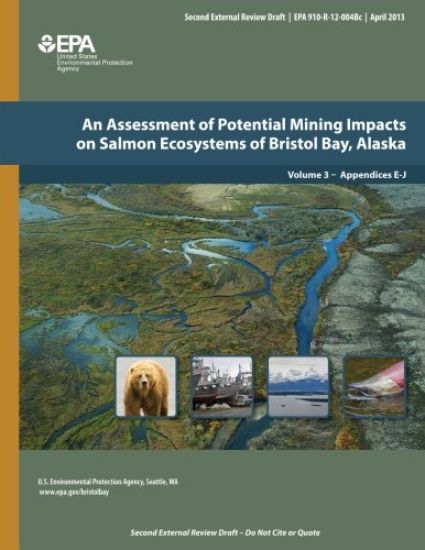
The objective of this report is to characterize the baseline levels of economic activity and related ecosystem services values for the Bristol Bay wild salmon ecosystem. The overarching purpose of this report is to provide baseline economic information to the Environmental Protection Agency in order to inform review of mining proposals in the Nushugak and Kvichak drainages. Both regional economic significance and social net economic accounting frameworks are described in this report. This study reviews and summarizes existing economic research on the key sectors in this area and reports findings based on original survey data on expenditures and net benefits. This report combines efforts on the part of Bioeconomics, Inc. and the University of Alaska Institute of Social and Economic Research. John Duffield and Chris Neher compiled the report and authored the executive summary, Sections 1, 2, and 5. Gunnar Knapp wrote Section 3 (commercial fisheries), and Tobias Schw rer, Ginny Fey and Scott Goldsmith wrote Section 4. The major components of the total value of the Bristol Bay area watersheds include subsistence use, commercial fishing, sport fishing and other recreation, and the preservation values (or indirect values) held by users and the U. S. resident population. The overall objectives of this study is to estimate the share of the total regional economy (expenditures, income, and jobs) that is dependent on these essentially pristine wild salmon ecosystems and to provide a preliminary but relatively comprehensive estimate of the total economic value (from an applied welfare economics perspective) that relies on a healthy ecosystem.
The U. S. Environmental Protection Agency (EPA) developed a year 2007 air quality modeling platform in support of the Tier 3 Motor Vehicle Emission and Fuel Standards. The air quality modeling platform consists of all of the emissions inventories, ancillary files needed for emissions modeling, and the meteorological, initial condition, and boundary condition files needed to run the air quality model. This platform uses all Criteria Air Pollutants (CAPs) and a select set of Hazardous Air Pollutants (HAPs). This document focuses on the emissions modeling components of the 2007 platform, including the emission inventories and the ancillary data and the approaches used to transform emission inventories for use in air quality modeling. The Tier 3 modeling platform was developed by implementing specific modifications to the "CAP-BAFM 2007-Based Platform, Version 5", also known as the "2007v5" platform. The 2007v5 platform was used to support the Regulatory Impact Assessment (RIA) for the 2012 Final National Ambient Air Quality Standards (NAAQS) for particulate matter less than 2.5 microns (PM2.5). The Technical Support Document (TSD) "Preparation of Emissions Inventories for the Version 5.0, 2007 Emissions Modeling Platform" contains many additional details on the aspects of the Tier 3 and 2007v5 platforms that are shared. The TSD is available from the Emissions Modeling Clearinghouse website, http: //www.epa.gov/ttn/chief/emch/, under the section entitled "Particulate Matter (PM) NAAQS (2007v5) Platform". The appendices available for the 2007v5 TSD that do not reference the specific PM NAAQS modeling cases are also relevant to the "Tier 3" platform. Many emissions inventory components of the Tier 3 air quality modeling platform are based on the 2008 National Emissions Inventory version 2, hereafter referred to as the "2008 NEI", with updated inventory data for some emission sectors. In particular, a version of the Motor Vehicle Emissions Simulator (MOVES) designed to represent the impacts of the Tier 3 Motor Vehicle Emission and Fuel Standards (MOVESTier3FRM) was used to generate emission factors for onroad mobile sources. The emissions modeling tool used to create the air quality model-ready emissions from the emission inventories was the Sparse Matrix Operator Kernel Emissions (SMOKE) modeling system (http: //www.smoke- model.org/index.cfm) version 3.5 beta. Emissions were created for 36 km and 12 km national grids. The gridded meteorological model used for Tier 3 is the Weather Research and Forecasting Model (WRF, http: //wrf-model.org) version 3.3, Advanced Research WRF (ARW) core (Skamarock, et al., 2008). The WRF Model is a mesoscale numerical weather prediction system developed for both operational forecasting and atmospheric research applications. WRF was run for 2007 over a domain covering the continental United States at a 36 km and 12 km resolution with 35 vertical layers2. This meteorological run was different than the one used for the 2007v5 platfo