Kirjojen hintavertailu – 12 903 724 kirjaa ja 27 kauppaa

Kirjailija

Walter Lippmann

Kirjat ja teokset yhdessä paikassa: 95 kirjaa, julkaisuja vuosilta 1920–2026, suosituimpiin kuuluu A Preface to Morals. Vertaile teosten hintoja ja tarkista saatavuus suomalaisista kirjakaupoista.

95 kirjaa

Kirjojen julkaisuvuodet: 1920–2026.

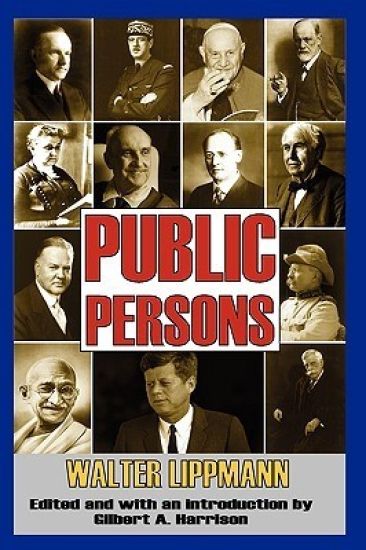
Public Persons

Public Persons

Walter Lippmann

AldineTransaction
2010
nidottu
This set of brief pieces examines the relation of power to knowledge. Lippmann paid little homage to the innate wisdom of the people. While he had no wish to disenfranchise citizens, he believed elites drove the engines of power. His point was that liberty and democracy require government that will, when necessary, "swim against the tides of private feelings." Because the public is too divided, poorly informed, and too self-regarding, authority has to be delegated, perhaps to "intelligence bureaus," or at least to those who are wiser than the many that have the power to decide vexing questions on their own merits. Lippmann knew that in the real world we cannot expect to be ruled by philosopher-kings. While ready to settle for less, he was not ready to settle for politicians who get ahead "only as they placate, appease, bribe, seduce, bamboozle and otherwise manage to manipulate demanding and threatening elements in their constituencies." The seducers and bamboozlers were generally in charge, and because they were in an age "rich with varied and generous passions" they had become disorderly and deranged. Public Persons is the informal side of The Public Philosophy. Lippmann tries to account for the decline of Western democracies and prescribe for their revival. He concludes that it is not possible to discover by rational inquiry the conditions that must be met if there is to be a good society. Lippmann saw tension between private impulses and transcendent truth as the "inexhaustible theme of human discourse." The occasional harmonies in the lives of saints and the deeds of heroes and the excellence of genius are glorious. But glory was the exception, wretchedness the rule. In this casual volume both are given a human face.

The Stakes of Diplomacy

The Stakes of Diplomacy

Walter Lippmann

AldineTransaction
2008
nidottu
Walter Lippmann is arguably the most influential journalist in American history. From the time of Woodrow Wilson to the time of Lyndon Johnson, what Walter Lippmann said mattered. His word was valued because of his exceptional capacity for analysis, and because he had the rare ability to make complex ideas and problems manageable and understandable. Lippmann combined the practical and the theoretical and saw them as inseparable. He savored the life of the mind and relished the arena of politics. He was political philosopher, social commentator, political advisor and activist-intellectual. As the country grappled with an impressive influx of European ideas and with the threatening press of European problems, so did Lippmann. Like President Wilson, he came to believe that the condition of the modern world required that America either act or be acted upon. New methods of communication and propaganda meant that ideas contrary to America's would be widely heard. Reformed liberalism and the projection of that liberalism into a troubled world were the best hedge against totalitarian schemes and imperialist aggression. The Stakes of Diplomacy resulted from Lippmann's assignment by Wilson's Secretary of War Baker, to a project for studying possible terms of peace and ways to influence the world in a liberal-democratic direction. The Stakes of Diplomacy ends both with admiration for the peaceful nature of democracies and a plea for their further influence in the world, and with an understanding that democracy's influence will depend partly upon its physical might and geopolitical collaboration. Lippmann stands as a prominent figure in America's twentieth-century quest for power with honor. He concludes this volume with the warning that there is no safe way and no morally feasible way to turn back from our dangerous mission: "Unless the people who are humane and sympathetic, the people who wish to live and let live, are masters of the situation, the world faces an indefinite vista of conquest and terror."
Liberty and the News

Liberty and the News

Walter Lippmann; Ronald Steel; Sidney Blumenthal

Princeton University Press
2007
pokkari
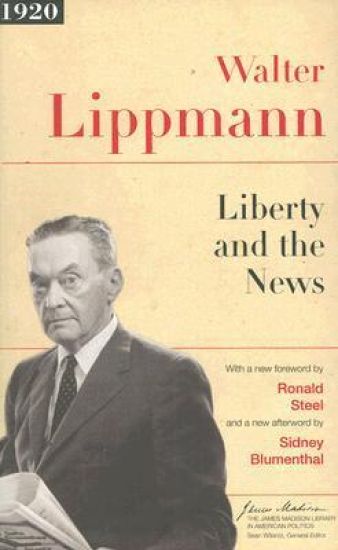
Liberty and the News is Walter Lippman's classic account of how the press threatens democracy whenever it has an agenda other than the free flow of ideas. Arguing that there is a necessary connection between liberty and truth, Lippman excoriates the press, claiming that it exists primarily for its own purposes and agendas and only incidentally to promote the honest interplay of facts and ideas. In response, Lippman sought to imagine a better way of cultivating the news. A brilliant essay on a persistent problem of American democracy, Liberty and the News is still powerfully relevant despite the development of countless news sources unimagined when Lippman first published it in 1920. The problems he identifies--the self-importance of the press, the corrosion of rumors and innuendo, and the spinning of the news by political powers--are still with us, and they still threaten liberty. By focusing on the direct and necessary connection between liberty and truth, Lippmann's work helps to clarify one of the most pressing predicaments of American democracy today.