
Kirjailija
Walter Lippmann
Kirjat ja teokset yhdessä paikassa: 95 kirjaa, julkaisuja vuosilta 1920–2026, suosituimpiin kuuluu A Preface to Morals. Vertaile teosten hintoja ja tarkista saatavuus suomalaisista kirjakaupoista.
95 kirjaa
Kirjojen julkaisuvuodet: 1920–2026.


A penetrative study of democratic theory and the role of citizens in a democracy, this classic by a two-time Pulitzer Prize-winner offers a prescient view of the media's function in shaping public perceptions. It changed the nature of political science as a scholarly discipline and introduced concepts that continue to influence political theory.
The Good Society is a critical text in the history of liberalism. Initially a series of articles published in a variety of Lippmann's favorite magazines, as the whole evolved, it became a frontal assault against totalitarian tendencies within American society. Lippmann took to task those who sought to improve the lot of mankind by undoing the work of their predecessors and by undermining movements in which men struggle to be free. This book is a strong indictment of programs of reform that are at odds with the liberal tradition, and it is critical of those who ask people to choose between security and liberty. The Good Society falls naturally into two segments. In the first, Lippmann shows the errors and common fallacies of faith in government as the solution to all problems. He says, "from left to right, from communist to conservative. They all believe the same fundamental doctrine. All the philosophies go into battle singing the same tune with slightly different words." In the second part of the book, Lippmann offers reasons why liberalism lost sight of its purpose and suggests the first principles on which it can flourish again. Lippmann argues that liberalism's revival is inevitable because no other system of government can work, given the kind of economic world mankind seeks. He did not write The Good Society to please adherents of any political ideology. Lippmann challenges all philosophies of government, and yet manages to present a positive program. Bewildered liberals and conservatives alike will find this work a successful effort to synthesize a theory of liberalism with the practice of a strong democracy. Gary Dean Best has provided the twenty-first century reader a clear-eyed context for interpreting Lippmann's defense of classical liberalism. The Good Society is the eleventh in a series of books written by Walter Lippmann reissued by Transaction with new introductions and in a paperback format. As with other major figures of the twentieth century such as Thorstein Veblen, Peter Drucker, Margaret Mead, and Richard Hoggart, these are classic books with contemporary perspectives.
The acclaim for Lippmann the political thinker has at times obscured the equally impressive accomplishments of Lippmann the journalist. His output was prodigious, his influence on journalism significant. According to James Reston: "He has given a generation of newspapermen a wider vision of their duty." Early Writings provides a unique opportunity to rediscover this journalistic Lippmann and to observe the formative years of a brilliant mind. In 1913, just three years out of Harvard, Lippmann was asked by Herbert Croly to help plan and edit a new "weekly of ideas," the New Republic. Beginning with its first issue in 1914 and continuing through the following six years, Lippmann wrote numerous signed and unsigned articles. Here are the best of them, written during the exciting political era that began with the trauma of World War I and ended in the stasis of Republican Normalcy. Pulitzer Prize-winning historian, Arthur Schlesinger, Jr., places Lippmann in historical context while recreating the intellectual ambiance of the Wilsonian era. His annotations identify little-remembered personages and clarify issues that time has befogged. But in another sense, the issues and personages of 1910-1920 are only too familiar. Our world is still a world of war, ineffectual international political organizations, disappointed idealism, nerve-wracking platitudes, social unrest, and slinking politicians.
In Public Opinion, what is widely considered the most influential book ever written by Walter Lippmann, the late journalist and social critic provides a fundamental treatise on the nature of human information and communication. Public Opinion is Walter Lippmann's is of enduring significance for communications scholars, historians, sociologists, and political scientists.
This little gem of a book, which first appeared in 1920, was written in Walter Lippmann's thirtieth year. He was still full of the passionate faith in democracy that was evident in his writings before the First World War. From today's point of view, Lippmann's argument seems unusually prescient. He was troubled by distortions in newspaper journalism, but was also deeply aware of the need to protect a free press. Lippmann believed that toleration of alternative beliefs was essential to maintaining the vitality of democracy. Liberty and the News is a key transitional work in the corpus of Lippmann's writings. For it is here that he proposes that public opinion is largely a response not to truths but rather to a "pseudo-environment" which exists between people and the external world. Lippmann was worried that if the beliefs that get exchanged between people are hollow, and bear only a purely accidental relationship to the world as it truly is, then the entire case for democracy is in danger of having been built on sand. His concerns remain very much alive and important.
In an era disgusted with politicians and the various instruments of "direct democracy," Walter Lippmann's The Phantom Public remains as relevant as ever. It reveals Lippmann at a time when he was most critical of the ills of American democracy. Antipopulist in sentiment, this volume defends elitism as a serious and distinctive intellectual option, one with considerable precursors in the American past. Lippmann's demythologized view of the American system of government resonates today. The Phantom Public discusses the "disenchanted man" who has become disillusioned not only with democracy, but also with reform. According to Lippmann, the average voter is incapable of governance; what is called the public is merely a "phantom." In terms of policy-making, the distinction should not be experts versus amateurs, but insiders versus outsiders. Lippmann challenges the core assumption of Progressive politics as well as any theory that pretends to leave political decision making in the hands of the people as a whole. In his biography Walter Lippmann and the American Century, Ronald Steel praised The Phantom Public as "one of Lippmann's most powerfully argued and revealing books. In it he came fully to terms with the inadequacy of traditional democratic theory." This volume is part of a continuing series on the major works of Walter Lippmann. As more and more Americans are inclined to become apathetic to the political system, this classic will be essential reading for students, teachers, and researchers of political science and history.
American Inquisitors is one of the small gems among Walter Lippmann's larger books. Written in response to the trials of John Scopes and William McAndrew in 1925 and 1927, this volume contains a succinct analysis of a basic problem of democracy: the conflict between intellectual freedom and majority rule. In both cases, the state, acting in the name of popular sovereignty, sought to suppress teaching that was contrary to the tenets of religious fundamentalism and patriotic tradition. In distilling the arguments surrounding both trials, Lippmann sounds a warning against the tyranny of the majority and challenges people to rethink their theories of liberty and democracy. American Inquisitors consists of five related dialogues, each exploring a different dilemma at the heart of democratic political theory. The first two establish the principles of majority rule and freedom of the mind in the persons of William Jennings Bryan and Thomas Jefferson, with Socrates urging a reexamination of all principles.. These dialogues debate the will and the rational capacity of the people to rule and demonstrate the relative nature of freedom in democratic society. The third and fourth dialogues set a fundamentalist against a modernist and an Americanist against a scholar. Lippmann resists easy stereotyping and puts challenging insights and plausible arguments into the mouths of all the parties. These dialogues ask whether commitment to community comes before intellectual inquiry, 'or whether the search for truth precedes identity. The final dialogue, between Socrates and a conscientious teacher, attempts to define the mission of teaching and determine when and how to face the consequences of truth. Lippmann concludes that the program of liberty is to deprive the sovereign of absolute and arbitrary rule. Taken as a whole, the dialogues constitute an essential consistency within Lippmann's political thought, and delineate a recurring problem hi American politcal culture. American Inquisitors will be of special interest to political scientists, historians, sociologists, and American studies specialists.
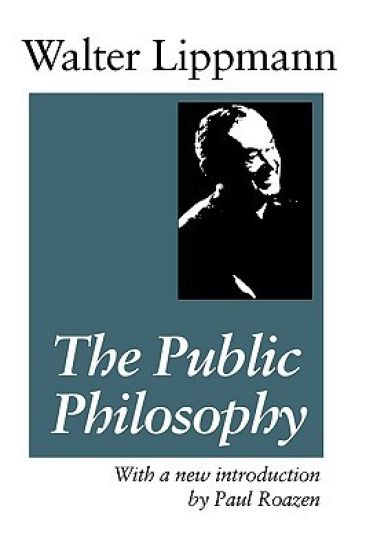
Begun in 1938 and completed only in 1955, The Public Philosophy offers as much a glimpse into the private philosophy of America's premier journalist of the twentieth century as it does a public philosophy. The basis of Lippmann's effort is "that there is a deep disorder in our society which comes not from the machinations of our enemies and from the adversaries of the human condition but from within ourselves." He also provides a special sort of legacy to liberalism in its broadest sense - as the root approach to human existence that could provide civility and accommodation against incivilities and extremism, and that uniquely stood against the totalitarian counter-revolutions from Jacobism to Leninism. This work is a masterful defense of the public philosophy as a constitutional tradition, and can be easily read as such today. Paul Roazen, long identified with the analysis of Lippmann's work, points out that no matter how trenchantly Lippmann dissected democracy, and the populist faith in the people's wisdom, he still sought to study the world in order to help govern it. His constant flow of journalistic writing had the educative intent of raising the level of the public's knowledge. His rationalist conviction that clearheadedness on public matters can be effectively relayed to people is nowhere more evident than in The Public Philosophy. In this sense it is an argument for the democratic ideal that people can be rallied in defense of the public interest.
After an eloquent and moving analysis of what he sees as the disillusion of themodern age, Lippmann posits as the central dilemma of liberalism its inability to find an appropriate substitute for the older forms of authority - church, state, class, family, law, custom - that it has denied. Lippmann attempts to find a way out of this chaos through the acceptance of a higher humanism and a way of life inspired by the ideal of "disinterestedness" in all things. In his new introduction to the Transaction edition, John Patrick Diggins marks A Preface to Morals, originally published in 1929, as a critical turning point in Lippmann's intellectual career. He also provides an excellent discussion of the enduring value of this major twentieth-century work by situating it within the context of other intellectual movements.
This set of brief pieces examines the relation of power to knowledge. Lippmann paid little homage to the innate wisdom of the people. While he had no wish to disenfranchise citizens, he believed elites drove the engines of power. His point was that liberty and democracy require government that will, when necessary, "swim against the tides of private feelings." Because the public is too divided, poorly informed, and too self-regarding, authority has to be delegated, perhaps to "intelligence bureaus," or at least to those who are wiser than the many that have the power to decide vexing questions on their own merits. Lippmann knew that in the real world we cannot expect to be ruled by philosopher-kings. While ready to settle for less, he was not ready to settle for politicians who get ahead "only as they placate, appease, bribe, seduce, bamboozle and otherwise manage to manipulate demanding and threatening elements in their constituencies." The seducers and bamboozlers were generally in charge, and because they were in an age "rich with varied and generous passions" they had become disorderly and deranged. Public Persons is the informal side of The Public Philosophy. Lippmann tries to account for the decline of Western democracies and prescribe for their revival. He concludes that it is not possible to discover by rational inquiry the conditions that must be met if there is to be a good society. Lippmann saw tension between private impulses and transcendent truth as the "inexhaustible theme of human discourse." The occasional harmonies in the lives of saints and the deeds of heroes and the excellence of genius are glorious. But glory was the exception, wretchedness the rule. In this casual volume both are given a human face.
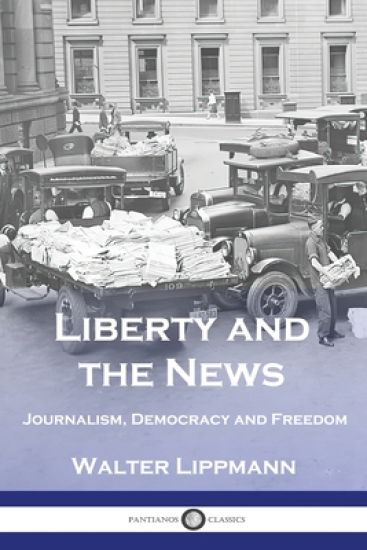
Liberty and the News: Journalism, Democracy and Freedom
Walter Lippmann
Pantianos Classics
1920
nidottu
Walter Lippmann's poignant analysis of the news media, its relationship to democracy, and the exercise of personal liberty and free thought, remains a classic of its field. Although brief and more than a century old, Lippmann's examination of the media and its influence upon democratic government in the United States remains valuable. This title consists of three essays, all of which revolve around the relationship between the news media, the public, and the government. In the assessment of Lippmann, the media became a mouthpiece of the government during World War I; an entity which seeks not to simply report events, but to instruct and influence public opinion in a manner beneficial to the nation's government. Such circumstances are directly against the idea of a free press, and this usurpation is what Lippmann condemns in these essays. How and to what extent the media is in thrall to the state, and how this connection affects the quality and veracity of its news reports, remain poignant questions in the modern day. Thus the pointed criticisms and constructive suggestions expressed in this book retain relevance and importance, to students and individuals interested in how the news is created, and how its realities conflict with its ideals.