Kirjojen hintavertailu – 12 903 725 kirjaa ja 27 kauppaa

Kirjailija

Willi Semmler

Kirjat ja teokset yhdessä paikassa: 30 kirjaa, julkaisuja vuosilta 1989–2024, suosituimpiin kuuluu Sustainable Macroeconomics, Climate Risks and Energy Transitions. Vertaile teosten hintoja ja tarkista saatavuus suomalaisista kirjakaupoista.

30 kirjaa

Kirjojen julkaisuvuodet: 1989–2024.

Sustainable Macroeconomics, Climate Risks and Energy Transitions

Sustainable Macroeconomics, Climate Risks and Energy Transitions

Unurjargal Nyambuu; Willi Semmler

Springer International Publishing AG
2024
nidottu
Given the industrialized world’s historical dependence on fossil fuel-based energy resources and the now-realized perils of moving beyond the earth’s carbon budget, this book explores the myriad challenges of climate change and in reaching a low-carbon economy. Reconciling the medium-term competing, yet frequently complementary, needs for transition policies, the book provides guidelines for complex and often conflicting climate policy tasks. The book presents empirical trends in the use of carbon-emitting resources and evaluates market-driven short-termism and its adverse impact on resource use and the environment; it emphasizes a medium-term macroeconomic perspective for the transition. The authors attempt a paradigm shift towards a framework of sustainable macroeconomics. They survey relevant historical models, conduct empirical and numerical analyses ofthe climate change-relevant dynamic models, provide empirical illustrations, and evaluate diverse policy options and implementations together with their historical evolution. New analytical issues are also considered, e.g., strategic behavior in the energy and resource sectors, energy competition and the dynamics of market shares in new energy technology, and supporting policies for dealing with the tipping points encountered in climate change. The authors suggest a multitude of market-based strategies and public fiscal, monetary, and financial policies, and longer-run planning for resource extraction -all suitable for driving sustainable growth and a transformation of the energy sector. The book also examines the multiple delaying forces slowing the transition to a low-carbon economy; these typically arise from short-termism, lock-ins, irreversibility, leakages, non-cooperative games, and other political strategies. Thus, they explain the snail’s pace evolution of current national and global climate policies. The book will appeal to scholars and students of economics and environmental science. It is also relevant for policymakers and practitioners in multilateral institutions, research institutions as well as governments and ministries of countries interested in alternative energy sources, climate economists, and those who study the implementation of sustainable and low carbon-based policies.
Sustainable Macroeconomics, Climate Risks and Energy Transitions

Sustainable Macroeconomics, Climate Risks and Energy Transitions

Unurjargal Nyambuu; Willi Semmler

Springer International Publishing AG
2023
sidottu
Given the industrialized world’s historical dependence on fossil fuel-based energy resources and the now-realized perils of moving beyond the earth’s carbon budget, this book explores the myriad challenges of climate change and in reaching a low-carbon economy. Reconciling the medium-term competing, yet frequently complementary, needs for transition policies, the book provides guidelines for complex and often conflicting climate policy tasks. The book presents empirical trends in the use of carbon-emitting resources and evaluates market-driven short-termism and its adverse impact on resource use and the environment; it emphasizes a medium-term macroeconomic perspective for the transition. The authors attempt a paradigm shift towards a framework of sustainable macroeconomics. They survey relevant historical models, conduct empirical and numerical analyses ofthe climate change-relevant dynamic models, provide empirical illustrations, and evaluate diverse policy options and implementations together with their historical evolution. New analytical issues are also considered, e.g., strategic behavior in the energy and resource sectors, energy competition and the dynamics of market shares in new energy technology, and supporting policies for dealing with the tipping points encountered in climate change. The authors suggest a multitude of market-based strategies and public fiscal, monetary, and financial policies, and longer-run planning for resource extraction -all suitable for driving sustainable growth and a transformation of the energy sector. The book also examines the multiple delaying forces slowing the transition to a low-carbon economy; these typically arise from short-termism, lock-ins, irreversibility, leakages, non-cooperative games, and other political strategies. Thus, they explain the snail’s pace evolution of current national and global climate policies. The book will appeal to scholars and students of economics and environmental science. It is also relevant for policymakers and practitioners in multilateral institutions, research institutions as well as governments and ministries of countries interested in alternative energy sources, climate economists, and those who study the implementation of sustainable and low carbon-based policies.

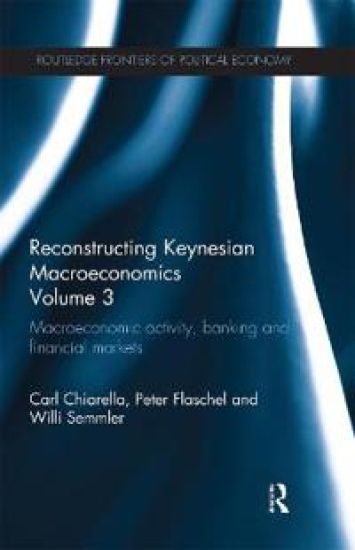
Reconstructing Keynesian Macroeconomics Volume 3

Reconstructing Keynesian Macroeconomics Volume 3

Carl Chiarella; Peter Flaschel; Willi Semmler

Routledge
2020
nidottu
This book represents the third of three volumes offering a complete reinterpretation and restructuring of Keynesian macroeconomics and a detailed investigation of the disequilibrium adjustment processes characterizing the financial, the goods and the labour markets and their interaction. This book offers a full treatment of the interlinkages between the real and the financial markets, including an analysis of banking, credit, and endogenous money and asset markets. It remains critical of quite frequently used conventional macro models that have dropped the tradition of studying the macroeconomic feedback channels, well-known in the history of macroeconomics. Those feedback mechanisms are known to have the potential for instabilities with respect to real markets, price dynamics and financial markets. In this volume a particular emphasis is given to the financial-real interaction. The research in this book with its focus on Keynesian propagation mechanisms provides a unique alternative to the black-box shock-absorber approaches that dominate modern macroeconomics. The main conclusion of the work is that policy makers need to reconsider Keynesian ideas, but in the modern form in which they are expressed in this volume. Reconstructing Keynesian Macroeconomics will be of interest to students and researchers who want to look at alternatives to the mainstream macrodynamics that emerged from the Monetarist critique of Keynesianism. This book will also engage central bankers and macroeconomic policy makers.
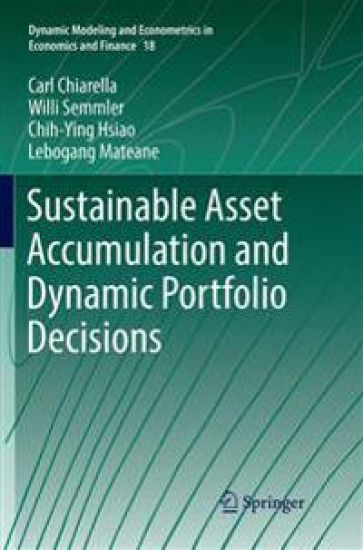
Sustainable Asset Accumulation and Dynamic Portfolio Decisions

Sustainable Asset Accumulation and Dynamic Portfolio Decisions

Carl Chiarella; Willi Semmler; Chih-Ying Hsiao; Lebogang Mateane

Springer-Verlag Berlin and Heidelberg GmbH Co. K
2018
nidottu
This book examines sustainable wealth formation and dynamic decision-making. The global economy experienced a veritable meltdown of asset markets in the years 2007-9, where many funds were overexposed to risky returns and suffered considerable losses. On the other hand, the long-term upswing in the stock market since 2010 has led to asset price booms and some new, but also uneven, wealth formation. In this book a broader set of constraints and guidelines for asset management and wealth accumulation is developed. The authors investigate how wealth formation and the proper management of financial funds can help to adequately buffer income risk and obtain sufficient risk-free income at a later stage of life, while also being socially and environmentally sustainable. The book explores behavioral and institutional rules for decision-making that reflect such constraints and guidelines, without necessarily being optimal in the narrow sense. The authors explain the need for such a dynamic decision-making and dynamic re-balancing of portfolios, by putting forward dynamic programming as an approach to dynamic decision-making that can allow sustainable wealth accumulation and dynamic asset allocation to be successfully integrated. This book provides a clear and comprehensive treatment of asset accumulation and dynamic portfolio models with an emphasis on long term and sustainable wealth formation. An important concern in public debate is the sustainability of our economy and this book employs cutting edge quantitative techniques and models to highlight important facts that cannot be disputed under any reasonable assumptions. It has the potential to become a standard reference for both academic researchers and quantitatively trained practitioners. Eckhard Platen, Professor of Quantitative Finance, University of Technology Sydney, AustraliaThis book should be read by both academics and practitioners alike. The former will find intellectually rigorous discussions and innovative solutions. The latter may find a few of the concepts a bit challenging. Yet, theory and technology are there to help simplify the work of those who worry about what time it is rather than how to make a watch--- but they do need a watch. Jean Brunel, Founder of Brunel Associates and Editor of The Journal of Wealth Management
Sustainable Asset Accumulation and Dynamic Portfolio Decisions

Sustainable Asset Accumulation and Dynamic Portfolio Decisions

Carl Chiarella; Willi Semmler; Chih-Ying Hsiao; Lebogang Mateane

Springer-Verlag Berlin and Heidelberg GmbH Co. K
2016
sidottu
This book examines sustainable wealth formation and dynamic decision-making. The global economy experienced a veritable meltdown of asset markets in the years 2007-9, where many funds were overexposed to risky returns and suffered considerable losses. On the other hand, the long-term upswing in the stock market since 2010 has led to asset price booms and some new, but also uneven, wealth formation. In this book a broader set of constraints and guidelines for asset management and wealth accumulation is developed. The authors investigate how wealth formation and the proper management of financial funds can help to adequately buffer income risk and obtain sufficient risk-free income at a later stage of life, while also being socially and environmentally sustainable. The book explores behavioral and institutional rules for decision-making that reflect such constraints and guidelines, without necessarily being optimal in the narrow sense. The authors explain the need for such a dynamic decision-making and dynamic re-balancing of portfolios, by putting forward dynamic programming as an approach to dynamic decision-making that can allow sustainable wealth accumulation and dynamic asset allocation to be successfully integrated. This book provides a clear and comprehensive treatment of asset accumulation and dynamic portfolio models with an emphasis on long term and sustainable wealth formation. An important concern in public debate is the sustainability of our economy and this book employs cutting edge quantitative techniques and models to highlight important facts that cannot be disputed under any reasonable assumptions. It has the potential to become a standard reference for both academic researchers and quantitatively trained practitioners. Eckhard Platen, Professor of Quantitative Finance, University of Technology Sydney, AustraliaThis book should be read by both academics and practitioners alike. The former will find intellectually rigorous discussions and innovative solutions. The latter may find a few of the concepts a bit challenging. Yet, theory and technology are there to help simplify the work of those who worry about what time it is rather than how to make a watch--- but they do need a watch. Jean Brunel, Founder of Brunel Associates and Editor of The Journal of Wealth Management
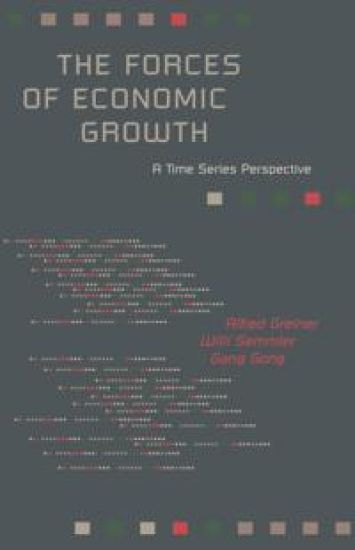
The Forces of Economic Growth

The Forces of Economic Growth

Alfred Greiner; Willi Semmler; Gang Gong

Princeton University Press
2016
pokkari
In economics, the emergence of New Growth Theory in recent decades has directed attention to an old and important problem: what are the forces of economic growth and how can public policy enhance them? This book examines major forces of growth--including spillover effects and externalities, education and formation of human capital, knowledge creation through deliberate research efforts, and public infrastructure investment. Unique in emphasizing the importance of different forces for particular stages of development, it offers wide-ranging policy implications in the process. The authors critically examine recently developed endogenous growth models, study the dynamic implications of modified models, and test the models empirically with modern time series methods that avoid the perils of heterogeneity in cross-country studies. Their empirical analyses, undertaken with newly constructed time series data for the United States and some core countries of the Euro zone, show that models containing scale effects, such as the R&D model and the human capital model, are compatible with time series evidence only after considerable modifications and nonlinearities are introduced. They also explore the relationship between growth and inequality, with particular focus on technological change and income disparity. The Forces of Economic Growth represents a comprehensive and up-to-date empirical time series perspective on the New Growth Theory.
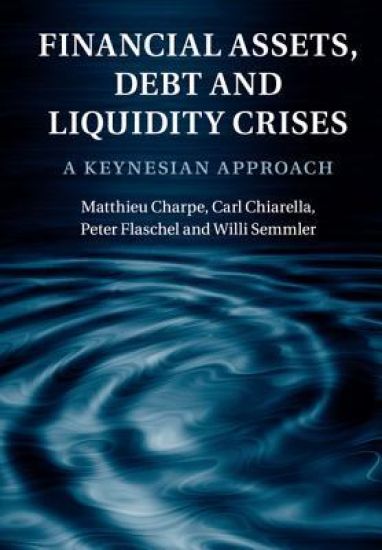
Financial Assets, Debt and Liquidity Crises

Financial Assets, Debt and Liquidity Crises

Matthieu Charpe; Carl Chiarella; Peter Flaschel; Willi Semmler

Cambridge University Press
2015
pokkari
The macroeconomic development of most major industrial economies is characterised by boom-bust cycles. Normally such boom-bust cycles are driven by specific sectors of the economy. In the financial meltdown of the years 2007–9 it was the credit sector and the real-estate sector that were the main driving forces. This book takes on the challenge of interpreting and modelling this meltdown. In doing so it revives the traditional Keynesian approach to the financial-real economy interaction and the business cycle, extending it in several important ways. In particular, it adopts the Keynesian view of a hierarchy of markets and introduces a detailed financial sector into the traditional Keynesian framework. The approach of the book goes beyond the currently dominant paradigm based on the representative agent, market clearing and rational economic agents. Instead it proposes an economy populated with heterogeneous, rationally bounded agents attempting to cope with disequilibria in various markets.
Reconstructing Keynesian Macroeconomics Volume 2

Reconstructing Keynesian Macroeconomics Volume 2

Carl Chiarella; Peter Flaschel; Willi Semmler

Routledge
2015
nidottu
This book represents the second of three volumes offering a complete reinterpretation and restructuring of Keynesian macroeconomics and a detailed investigation of the disequilibrium adjustment processes characterizing the financial, the goods and the labour markets and their interaction. In this second volume the authors present a detailed analysis and comparison of two competing types of approaches to Keynesian macroeconomics, one that integrates goods, labour and financial markets, and another from the perspective of a conventional type of LM-analysis or interest-rate policy of the central bank. The authors employ rigorous dynamic macro-models of a descriptive and applicable nature, which will be of interest to all macroeconomists who use formal model-building in their investigations. The research in this book with its focus on Keynesian propagation mechanisms provides a unique alternative to the black-box shock-absorber approaches that dominate modern macroeconomics. The main conclusion of the work is that policy makers need to reconsider Keynesian ideas, but in the modern form in which they are expressed in this volume. Reconstructing Keynesian Macroeconomics will be of interest to students and researchers who want to look at alternatives to the mainstream macrodynamics that emerged from the Monetarist critique of Keynesianism. This book will also engage central bankers and macroeconomic policy makers.
The Oxford Handbook of the Macroeconomics of Global Warming

The Oxford Handbook of the Macroeconomics of Global Warming

Willi Semmler

Oxford University Press Inc
2015
sidottu
The first World Climate Conference, which was sponsored by the World Meteorological Organization in Genève in 1979, triggered an international dialogue on global warming. From the 1997 United Nations-sponsored conference-during which the Kyoto Protocol was signed-through meetings in Copenhagen, Cancún, Durban, and most recently Doha (2012) and Warsaw (2013), worldwide attention to the issue of global warming and its impact on the world's economy has rapidly increased in intensity. The consensus of these debates and discussions, however, is less than clear. Optimistically, many geoscience researchers and members of the Intergovernmental Panel on Climate Change (IPCC) have supported CO2 emission reduction pledges while maintaining that a 2°C limit in increased temperature by the year 2100 is achievable through international coordination. Other observers postulate that established CO2 reduction commitments such as those agreed to at the Copenhagen United Nations Climate Change Conference (2009) are insufficient and cannot hold the global warming increase below 2°C. As experts theorize on precisely what impact global warming will have, developing nations have become particularly alarmed. The developed world will use energy to mitigate global warming effects, but developing countries are more exposed by geography and poverty to the most dangerous consequences of a global temperature rise and lack the economic means to adapt. The complex dynamics that result from this confluence of science and geopolitics gives rise to even more complicated issues for economists, financial planners, business leaders, and policy-makers. The Oxford Handbook of the Macroeconomics of Global Warming analyzes the economic impact of issues related to and resulting from global warming, specifically the implications of possible preventative measures, various policy changes, and adaptation efforts as well as the different consequences climate change will have on both developing and developed nations. This multi-disciplinary approach, which touches on issues of growth, employment, and development, elucidates for readers state-of-the-art research on the complex and far-reaching problem of global warming.
Reconstructing Keynesian Macroeconomics Volume 3

Reconstructing Keynesian Macroeconomics Volume 3

Carl Chiarella; Peter Flaschel; Willi Semmler

Routledge
2014
sidottu
This book represents the third of three volumes offering a complete reinterpretation and restructuring of Keynesian macroeconomics and a detailed investigation of the disequilibrium adjustment processes characterizing the financial, the goods and the labour markets and their interaction. This book offers a full treatment of the interlinkages between the real and the financial markets, including an analysis of banking, credit, and endogenous money and asset markets. It remains critical of quite frequently used conventional macro models that have dropped the tradition of studying the macroeconomic feedback channels, well-known in the history of macroeconomics. Those feedback mechanisms are known to have the potential for instabilities with respect to real markets, price dynamics and financial markets. In this volume a particular emphasis is given to the financial-real interaction. The research in this book with its focus on Keynesian propagation mechanisms provides a unique alternative to the black-box shock-absorber approaches that dominate modern macroeconomics. The main conclusion of the work is that policy makers need to reconsider Keynesian ideas, but in the modern form in which they are expressed in this volume. Reconstructing Keynesian Macroeconomics will be of interest to students and researchers who want to look at alternatives to the mainstream macrodynamics that emerged from the Monetarist critique of Keynesianism. This book will also engage central bankers and macroeconomic policy makers.
Asset Prices, Booms and Recessions

Asset Prices, Booms and Recessions

Willi Semmler

Springer-Verlag Berlin and Heidelberg GmbH Co. K
2014
nidottu
The financial market melt-down of the years 2007-2009 has posed great challenges for studies on financial economics. This financial economics text focuses on the dynamic interaction of financial markets and economic activity. The financial market to be studied here encompasses the money and bond market, credit market, stock market and foreign exchange market; economic activity includes the actions and interactions of firms, banks, households, governments and countries. The book shows how economic activity affects asset prices and the financial market, and how asset prices and financial market volatility and crises impact economic activity. The book offers extensive coverage of new and advanced topics in financial economics such as the term structure of interest rates, credit derivatives and credit risk, domestic and international portfolio theory, multi-agent and evolutionary approaches, capital asset pricing beyond consumption-based models, and dynamic portfolio decisions. Moreover a completely new section of the book is dedicated to the recent financial market meltdown of the years 2007-2009. Emphasis is placed on empirical evidence relating to episodes of financial instability and financial crises in the U. S. and in Latin American, Asian and Euro-area countries. Overall, the book explains what researchers and practitioners in the financial sector need to know about the financial-real interaction, and what practitioners and policy makers need to know about the financial market.
Reconstructing Keynesian Macroeconomics Volume 1

Reconstructing Keynesian Macroeconomics Volume 1

Carl Chiarella; Peter Flaschel; Willi Semmler

Routledge
2014
nidottu
This book represents the first of three volumes offering a complete reinterpretation and restructuring of Keynesian macroeconomics and a detailed investigation of the disequilibrium adjustment processes characterizing the financial, the goods and the labour markets and their interaction. It questions in a radical way the evolution of Keynesian macroeconomics after World War II and focuses on the limitations of the traditional Keynesian approach until it fell apart in the early 1970s, as well as the inadequacy of the new consensus in macroeconomics that emerged from the Monetarist critique of Keynesianism. Professors Chiarella, Flaschel and Semmler investigate basic methodological issues, the pitfalls of the Rational Expectations School, important feedback channels in the tradition of Tobin’s work, and theories of the wage-price spiral and the evidences for them. The book uses primarily partial approaches, the integration of which will be the subject of subsequent volumes. With its focus on Keynesian propagation mechanisms, the research in this book provides a unique alternative to the black-box shock-absorber approaches that dominate modern macroeconomics. Reconstructing Keynesian Macroeconomics should be of interest to students and researchers who want to look at alternatives to the mainstream macrodynamics that emerged from the Monetarist critique of Keynesianism.
Reconstructing Keynesian Macroeconomics Volume 2

Reconstructing Keynesian Macroeconomics Volume 2

Carl Chiarella; Peter Flaschel; Willi Semmler

Routledge
2012
sidottu
This book represents the second of three volumes offering a complete reinterpretation and restructuring of Keynesian macroeconomics and a detailed investigation of the disequilibrium adjustment processes characterizing the financial, the goods and the labour markets and their interaction. In this second volume the authors present a detailed analysis and comparison of two competing types of approaches to Keynesian macroeconomics, one that integrates goods, labour and financial markets, and another from the perspective of a conventional type of LM-analysis or interest-rate policy of the central bank. The authors employ rigorous dynamic macro-models of a descriptive and applicable nature, which will be of interest to all macroeconomists who use formal model-building in their investigations. The research in this book with its focus on Keynesian propagation mechanisms provides a unique alternative to the black-box shock-absorber approaches that dominate modern macroeconomics. The main conclusion of the work is that policy makers need to reconsider Keynesian ideas, but in the modern form in which they are expressed in this volume. Reconstructing Keynesian Macroeconomics will be of interest to students and researchers who want to look at alternatives to the mainstream macrodynamics that emerged from the Monetarist critique of Keynesianism. This book will also engage central bankers and macroeconomic policy makers.
Monetary Policy and Unemployment

Monetary Policy and Unemployment

Willi Semmler

Routledge
2012
nidottu
This book pulls together papers presented at a conference in honour of the 1981 Nobel Prize Winner for Economic Science, the late James Tobin. Among the contributors are Olivier Blanchard, Edmund Phelps, Charles Goodhart and Marco Buti. One of the main aims of the conference was to discuss what potential role monetary policy has on economic activity and unemployment reduction in three key currency zones - the United States, European Union and Japan.
Financial Markets and the Macroeconomy

Financial Markets and the Macroeconomy

Carl Chiarella; Peter Flaschel; Reiner Franke; Willi Semmler

Routledge
2012
nidottu
The financial instability and its spillover to the real sector have become a great challenge to macro-economic theory. The book takes a Keynesian theoretical perspective, representing an attempt to revive what Keynes stressed in his General Theory, namely the role of the financial market in macroeconomic outcomes. Although this book is inspired and motivated by the Asian currency and financial crises in the years 1997-8 and the experiences of the currently evolving U. S. financial disruptions, it also focuses on reviving a modeling tradition that provides a theoretical framework that throws light on recent financial market episodes and disturbances and their macroeconomic effects. It brings to the forefront, as Keynes has suggested, the role of financial market stability for growth and macroeconomics. It criticizes theories that see economic disruptions and shocks rooted solely in the real side of the economy. It stresses the financial real interaction as the major source for macroeconomic instability and disruptions. This important new book from a group of Keynesian, but nonetheless technically oriented economists would be of most interest to specialists and graduate students in macroeconomics and financial economics, especially those with an interest in US and European financial markets, emerging market analysis, and dynamic economic modeling.
Disequilibrium, Growth and Labor Market Dynamics

Disequilibrium, Growth and Labor Market Dynamics

Carl Chiarella; Peter Flaschel; Gangolf Groh; Willi Semmler

Springer-Verlag Berlin and Heidelberg GmbH Co. K
2011
nidottu
In this book on disequilibrium, growth and labor market dynamics we take predominantly a macroeconomic perspective. We present a working model that can easily be varied in different directions in order to subsume innovations in the literature on macroeconomics, old and new, and to contribute to important currently discussed macroeconomic issues. Our working model is set up in a way that there is a close relationship between our presented dynamic models and modern macro econometric models with disequilibrium both in the labor and the goods markets. One of our objectives is, therefore, to narrow the gap between theoretical and applied structural macrodynamic model building. We hope that the book will be a useful reference for all researchers, academic teachers and practitioners of macroeconomic and macro econometric model building who are interested in economic dynamics, independently of whether they use equilibrium or disequilibrium methods in their own research. We base this hope on the fact that our approach contains a number of unique features. The emphasis on the identification and analysis of the basic feedback mechanisms at work in modern macro economies. A detailed study of the partial as well as integrated dynamic interaction between these feedback mechanisms that consti­ tute the interdependence of markets and sectors of the modern macro economy. The rela­ tionship between the macroeconomic framework of our working model and the Walrasian, Non-Walrasian and New-Keynesian reformulations of macroeconomics.
Reconstructing Keynesian Macroeconomics Volume 1

Reconstructing Keynesian Macroeconomics Volume 1

Carl Chiarella; Peter Flaschel; Willi Semmler

Routledge
2011
sidottu
This book represents the first of three volumes offering a complete reinterpretation and restructuring of Keynesian macroeconomics and a detailed investigation of the disequilibrium adjustment processes characterizing the financial, the goods and the labour markets and their interaction. It questions in a radical way the evolution of Keynesian macroeconomics after World War II and focuses on the limitations of the traditional Keynesian approach until it fell apart in the early 1970s, as well as the inadequacy of the new consensus in macroeconomics that emerged from the Monetarist critique of Keynesianism. Professors Chiarella, Flaschel and Semmler investigate basic methodological issues, the pitfalls of the Rational Expectations School, important feedback channels in the tradition of Tobin’s work, and theories of the wage-price spiral and the evidences for them. The book uses primarily partial approaches, the integration of which will be the subject of subsequent volumes. With its focus on Keynesian propagation mechanisms, the research in this book provides a unique alternative to the black-box shock-absorber approaches that dominate modern macroeconomics. Reconstructing Keynesian Macroeconomics should be of interest to students and researchers who want to look at alternatives to the mainstream macrodynamics that emerged from the Monetarist critique of Keynesianism.
Asset Prices, Booms and Recessions

Asset Prices, Booms and Recessions

Willi Semmler

Springer-Verlag Berlin and Heidelberg GmbH Co. K
2011
sidottu
The financial market melt-down of the years 2007-2009 has posed great challenges for studies on financial economics. This financial economics text focuses on the dynamic interaction of financial markets and economic activity. The financial market to be studied here encompasses the money and bond market, credit market, stock market and foreign exchange market; economic activity includes the actions and interactions of firms, banks, households, governments and countries. The book shows how economic activity affects asset prices and the financial market, and how asset prices and financial market volatility and crises impact economic activity. The book offers extensive coverage of new and advanced topics in financial economics such as the term structure of interest rates, credit derivatives and credit risk, domestic and international portfolio theory, multi-agent and evolutionary approaches, capital asset pricing beyond consumption-based models, and dynamic portfolio decisions. Moreover a completely new section of the book is dedicated to the recent financial market meltdown of the years 2007-2009. Emphasis is placed on empirical evidence relating to episodes of financial instability and financial crises in the U. S. and in Latin American, Asian and Euro-area countries. Overall, the book explains what researchers and practitioners in the financial sector need to know about the financial-real interaction, and what practitioners and policy makers need to know about the financial market.
Topics in Applied Macrodynamic Theory

Topics in Applied Macrodynamic Theory

Peter Flaschel; Gangolf Groh; Christian Proano; Willi Semmler

Springer-Verlag Berlin and Heidelberg GmbH Co. K
2010
nidottu
This book is about the study of topics in macro dynamics from an applied, empirical perspective. The modeling philosophy behind most of the chapters ofthisbookisofKeynesiannature,representinganattempttorevivethist- oreticalperspectiveontheworkingofthemacroeconomy. Themacroeconomic research pursued here is somewhat di?erent from the mainstream literature using the Dynamic Stochastic General Equilibrium (DSGE) approach as the basic modeling device. The main features of the latter are the assumptions of intertemporally optimizing agents, rational expectations, competitive m- kets and price mediated market clearing through su?ciently ?exible prices and wages. The New Keynesian approach to macroeconomics has, in the last decade or so, to a large extent, also adopted the DSGE framework, building on intertemporally optimizing agents and market clearing, but favoring more the concept of monopolistic competition, sticky wages and prices and nominal as well as real rigidities. An path breaking work of this type is the recent book by Woodford (2003). However, it is well known that the intertemporal approach of smoothly optimizing agents and fast adjustments in order to establish temporal or - tertemporal marginal conditions in the product market, labor and capital markets, has not been very successful to match certain stylized facts on those markets. A further de?ciency of those intertemporal decision models is that macroeconomic feedback e?ects—and their stabilizing or destabilizing impact on the macroeconomy—have rarely been considered in those models. Yet, those feedback mechanisms, relevant for the interaction of all three markets, have been theoretically and empirically explored since the 1930s.