Kirjojen hintavertailu – 12 903 725 kirjaa ja 27 kauppaa

Kirjailija

Willi Semmler

Kirjat ja teokset yhdessä paikassa: 30 kirjaa, julkaisuja vuosilta 1989–2024, suosituimpiin kuuluu Sustainable Macroeconomics, Climate Risks and Energy Transitions. Vertaile teosten hintoja ja tarkista saatavuus suomalaisista kirjakaupoista.

30 kirjaa

Kirjojen julkaisuvuodet: 1989–2024.

Business Fluctuations & Long-Phased Cycles in High Order Macrosystems

Business Fluctuations & Long-Phased Cycles in High Order Macrosystems

Carl Chiarella; Hing Hung; Peter Flaschel; Willi Semmler

Nova Science Publishers Inc
2009
sidottu
In this book the authors investigate, from the numerical perspective, the 18D core dynamics of a theoretical 39D representation of an applied Keynesian disequilibrium model of monetary growth of a small open economy. After considering the model from the viewpoint of national accounting, the authors provide a compact description of the intensive form of the model, its laws of motion and accompanying algebraic expressions and its unique interior steady state solution. The authors then give a survey of various types of subsystems that can be isolated from the integrated 18D dynamics by means of suitable assumptions. These subsystems and the full 18D dynamics are investigated and compared in the remainder of the paper from the perspective of bifurcation diagrams that separate situations of asymptotic stability from stable cyclical behaviour as well as pure explosiveness. In this way the authors lay the foundations for an analysis of business cycle fluctuations in applicable high order macrosystems, which will show, in contrast to what is generally believed to characterise such structural macroeconometric models, that applied integrated macrodynamical systems can have a variety of interesting more or less complex attractors which are surrounded by more or less long-phase transient behaviour. Such attractors are obtained in particular when locally explosive situations are turned into bounded dynamics by the addition of specifically tailored extrinsic behavioural non-linearities. The authors establish a Keynesian theory of endogenously generated business cycles where turning points are caused by globally non-linear behaviour, rather than by complex eigenvalues, around the steady state position of the economy.

Financial Markets and the Macroeconomy

Financial Markets and the Macroeconomy

Carl Chiarella; Peter Flaschel; Reiner Franke; Willi Semmler

Routledge
2009
sidottu
The financial instability and its spillover to the real sector have become a great challenge to macro-economic theory. The book takes a Keynesian theoretical perspective, representing an attempt to revive what Keynes stressed in his General Theory, namely the role of the financial market in macroeconomic outcomes. Although this book is inspired and motivated by the Asian currency and financial crises in the years 1997-8 and the experiences of the currently evolving U. S. financial disruptions, it also focuses on reviving a modeling tradition that provides a theoretical framework that throws light on recent financial market episodes and disturbances and their macroeconomic effects. It brings to the forefront, as Keynes has suggested, the role of financial market stability for growth and macroeconomics. It criticizes theories that see economic disruptions and shocks rooted solely in the real side of the economy. It stresses the financial real interaction as the major source for macroeconomic instability and disruptions. This important new book from a group of Keynesian, but nonetheless technically oriented economists would be of most interest to specialists and graduate students in macroeconomics and financial economics, especially those with an interest in US and European financial markets, emerging market analysis, and dynamic economic modeling.
Topics in Applied Macrodynamic Theory

Topics in Applied Macrodynamic Theory

Peter Flaschel; Gangolf Groh; Christian Proano; Willi Semmler

Springer-Verlag Berlin and Heidelberg GmbH Co. K
2008
sidottu
This book is about the study of topics in macro dynamics from an applied, empirical perspective. The modeling philosophy behind most of the chapters ofthisbookisofKeynesiannature,representinganattempttorevivethist- oreticalperspectiveontheworkingofthemacroeconomy. Themacroeconomic research pursued here is somewhat di?erent from the mainstream literature using the Dynamic Stochastic General Equilibrium (DSGE) approach as the basic modeling device. The main features of the latter are the assumptions of intertemporally optimizing agents, rational expectations, competitive m- kets and price mediated market clearing through su?ciently ?exible prices and wages. The New Keynesian approach to macroeconomics has, in the last decade or so, to a large extent, also adopted the DSGE framework, building on intertemporally optimizing agents and market clearing, but favoring more the concept of monopolistic competition, sticky wages and prices and nominal as well as real rigidities. An path breaking work of this type is the recent book by Woodford (2003). However, it is well known that the intertemporal approach of smoothly optimizing agents and fast adjustments in order to establish temporal or - tertemporal marginal conditions in the product market, labor and capital markets, has not been very successful to match certain stylized facts on those markets. A further de?ciency of those intertemporal decision models is that macroeconomic feedback e?ects—and their stabilizing or destabilizing impact on the macroeconomy—have rarely been considered in those models. Yet, those feedback mechanisms, relevant for the interaction of all three markets, have been theoretically and empirically explored since the 1930s.
Stochastic Dynamic Macroeconomics

Stochastic Dynamic Macroeconomics

Gang Gong; Willi Semmler

Oxford University Press Inc
2006
sidottu
This is a book on stochastic dynamic macroeconomics from a Keynesian perpective. It shows that including Keynesian features in intertemporal models considerably contributes to resolve major puzzles arising in the context of the Dynamic General Equilibrium (DGE) model. It also demonstrates that including microeconomic intertemporal behavior of economic agents in macroeconomics is not inconsistent with Keynesian economics. Whereas the first two parts of the book are technically and empirically oriented by elaborating on solution and estimation methods to bring dynamic macroeconomic theory closer to the time series data, the part three of the book uses those tools and addresses major issues in contemporary dynamic macroeconomics. In pursuing those issues the book stresses--as in the New Keynesian literature--nominal and real rigidities. Yet, beyond the latter type of literature--and in contrast to the DGE model --the here presented modeling approach admits open ended dynamics and multiple equilibria, more realistic asset market features, nonclearing labor market, and explores the role of both demand and technology shocks on employment. Central for those results is a new methodological idea pertaining to adaptive optimization where agents can reoptimize once they have perceived and learned about market constraints. Overall, the book is self-contained by including the appropriate solution and estimation methods which brings the theory closer to the time series data. It contains a modern treatment of dynamic macroeconomics for first and second year graduate students.
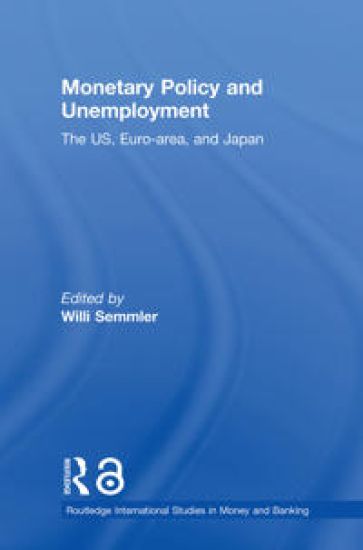
Monetary Policy and Unemployment

Monetary Policy and Unemployment

Willi Semmler

Routledge
2005
sidottu
This book pulls together papers presented at a conference in honour of the 1981 Nobel Prize Winner for Economic Science, the late James Tobin. Among the contributors are Olivier Blanchard, Edmund Phelps, Charles Goodhart and Marco Buti. One of the main aims of the conference was to discuss what potential role monetary policy has on economic activity and unemployment reduction in three key currency zones - the United States, European Union and Japan.
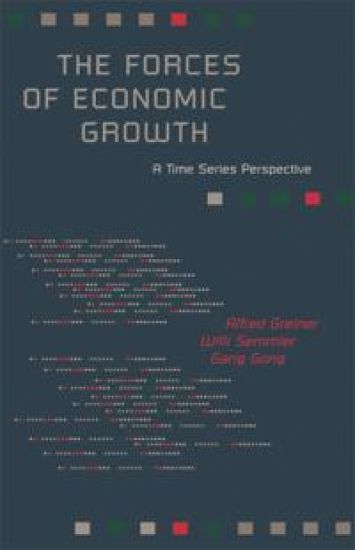
The Forces of Economic Growth

The Forces of Economic Growth

Alfred Greiner; Willi Semmler; Gang Gong

Princeton University Press
2005
sidottu
In economics, the emergence of New Growth Theory in recent decades has directed attention to an old and important problem: what are the forces of economic growth and how can public policy enhance them? This book examines major forces of growth--including spillover effects and externalities, education and formation of human capital, knowledge creation through deliberate research efforts, and public infrastructure investment. Unique in emphasizing the importance of different forces for particular stages of development, it offers wide-ranging policy implications in the process. The authors critically examine recently developed endogenous growth models, study the dynamic implications of modified models, and test the models empirically with modern time series methods that avoid the perils of heterogeneity in cross-country studies. Their empirical analyses, undertaken with newly constructed time series data for the United States and some core countries of the Euro zone, show that models containing scale effects, such as the R&D model and the human capital model, are compatible with time series evidence only after considerable modifications and nonlinearities are introduced. They also explore the relationship between growth and inequality, with particular focus on technological change and income disparity. The Forces of Economic Growth represents a comprehensive and up-to-date empirical time series perspective on the New Growth Theory.
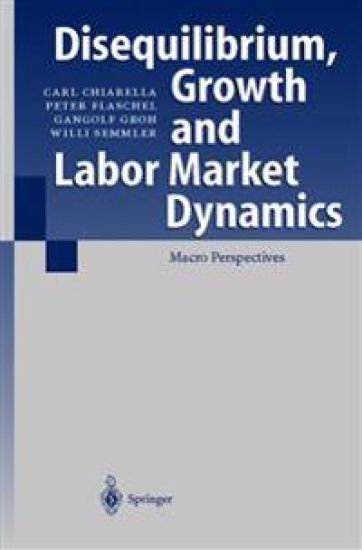
Disequilibrium, Growth and Labor Market Dynamics

Disequilibrium, Growth and Labor Market Dynamics

Carl Chiarella; Peter Flaschel; Gangolf Groh; Willi Semmler

Springer-Verlag Berlin and Heidelberg GmbH Co. K
2000
sidottu
In this book on disequilibrium, growth and labor market dynamics we take predominantly a macroeconomic perspective. We present a working model that can easily be varied in different directions in order to subsume innovations in the literature on macroeconomics, old and new, and to contribute to important currently discussed macroeconomic issues. Our working model is set up in a way that there is a close relationship between our presented dynamic models and modern macro econometric models with disequilibrium both in the labor and the goods markets. One of our objectives is, therefore, to narrow the gap between theoretical and applied structural macrodynamic model building. We hope that the book will be a useful reference for all researchers, academic teachers and practitioners of macroeconomic and macro econometric model building who are interested in economic dynamics, independently of whether they use equilibrium or disequilibrium methods in their own research. We base this hope on the fact that our approach contains a number of unique features. The emphasis on the identification and analysis of the basic feedback mechanisms at work in modern macro economies. A detailed study of the partial as well as integrated dynamic interaction between these feedback mechanisms that consti­ tute the interdependence of markets and sectors of the modern macro economy. The rela­ tionship between the macroeconomic framework of our working model and the Walrasian, Non-Walrasian and New-Keynesian reformulations of macroeconomics.
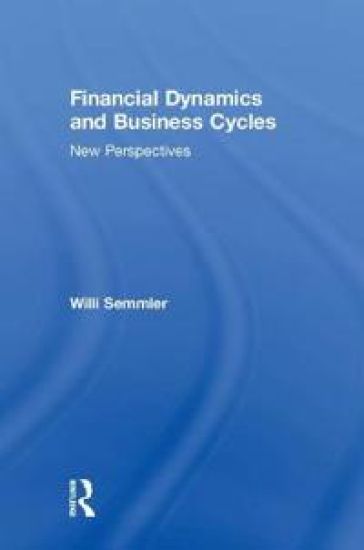
Financial Dynamics and Business Cycles
As the 55th anniversary of the bank holiday of March 1933 approached, financial instability was a main topic in the financial press. Daily reports appeared of international debt crises, of the covert bankruptcy of deposit insurance, and of the near bankruptcy of one great financial institution after another. The great stock market crash of October 19 and 20, 1987, demonstrated that extreme instability can happen. It is generally asserted that the consequences of October 19th and 20th would have been disastrous if the Federal Reserve and Treasury interventions had not set things right. In 1933, financial markets in the United States and throughout the capitalist world collapsed. In the light of historical experience, the past 55 years are the anomaly. The papers collected in this volume come from various backgrounds and research paradigms. A common theme runs through these papers that makes the collection both interesting and important: The authors take seriously the obvious evidence that capitalist economies progress through time by lurching. Whether a particular study starts from household utility maximization or from the processes by which productive structures are reproduced and expanded, the authors are united in accepting the evidence that financial instability is a significant characteristic of modern capitalism.
Financial Dynamics and Business Cycles
As the 55th anniversary of the bank holiday of March 1933 approached, financial instability was a main topic in the financial press. Daily reports appeared of international debt crises, of the covert bankruptcy of deposit insurance, and of the near bankruptcy of one great financial institution after another. The great stock market crash of October 19 and 20, 1987, demonstrated that extreme instability can happen. It is generally asserted that the consequences of October 19th and 20th would have been disastrous if the Federal Reserve and Treasury interventions had not set things right. In 1933, financial markets in the United States and throughout the capitalist world collapsed. In the light of historical experience, the past 55 years are the anomaly. The papers collected in this volume come from various backgrounds and research paradigms. A common theme runs through these papers that makes the collection both interesting and important: The authors take seriously the obvious evidence that capitalist economies progress through time by lurching. Whether a particular study starts from household utility maximization or from the processes by which productive structures are reproduced and expanded, the authors are united in accepting the evidence that financial instability is a significant characteristic of modern capitalism.