Kirjojen hintavertailu – 12 859 818 kirjaa ja 27 kauppaa
Kirjailija
William Hope Hodgson
Kirjat ja teokset yhdessä paikassa: 289 kirjaa, julkaisuja vuosilta 2001–2026, suosituimpiin kuuluu The Ghost Pirates (1909) by: William Hope Hodgson. ( horror NOVEL ). Vertaile teosten hintoja ja tarkista saatavuus suomalaisista kirjakaupoista.
The novel is presented as the transcribed testimony of Jessop, who we ultimately discover is the only survivor of the final voyage of the Mortzestus, having been rescued from drowning by the crew of the passing Sangier. It begins with Jessop's recounting how he came to be aboard the ill-fated Mortzestus and the rumors surrounding the vessel. Jessop then begins to recount the unusual events that rapidly increase in both frequency and severity. In the telling of his tale, Jessop offers only sparse interpretation of the events, spending most of the time relating the story in an almost journalistic fashion, presenting a relatively unvarnished description of the events and conversations as they occurred. He describes his confusion and uncertainty about what he believes he has seen, at times fearing for his own sanity. He eventually hears other members of the crew speak of strange events, most of which the rest of the crew pass off as either bad luck or the result of the witness being either tired or "dotty". Jessop only offers brief personal interpretation; he states that while he cannot discount the idea that the beings plaguing the ship may be ghosts, he presents his theory that they may be beings from another dimension that, while sharing the same physical space as theirs, are normally completely separated to the extent that neither dimension is aware of the existence of the other. He offers only vague, superficial suggestions as to the cause of his theorized dimensional breach.
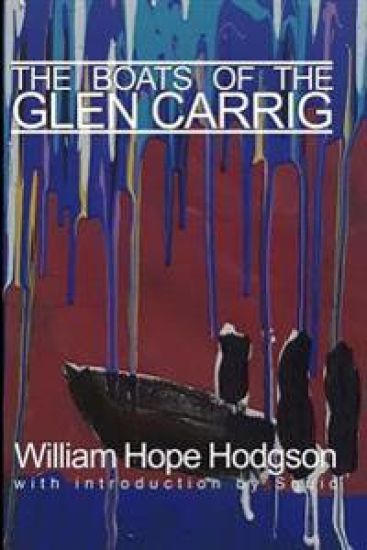
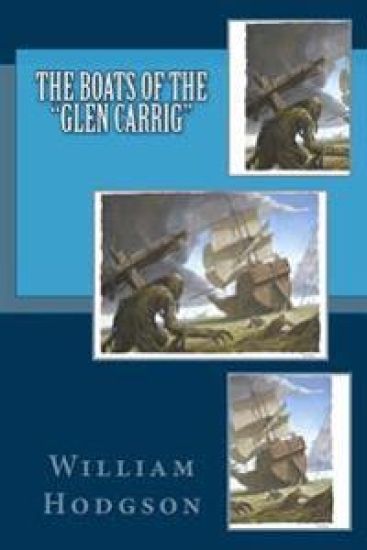
The Boats of the "Glen Carrig" is a horror novel by William Hope Hodgson. The novel is written in an archaic style, and is presented as a true account, written in 1757, of events occurring earlier. The narrator is a passenger who was traveling on the ship Glen Carrig, which was lost at sea when it struck "a hidden rock". The story is about the adventures of the survivors, who escaped the wreck in two lifeboats. Boats is primarily a survival and adventure story with elements of horror, in the form of monsters.
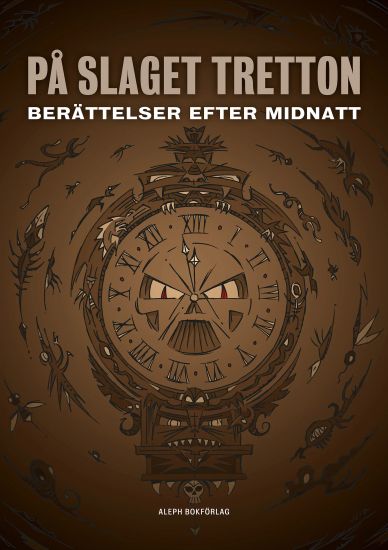
Vi satt kring sjuklingens bädd och såg den ohyggliga, pipande varelsen växa fram ur hans kropp, tills två vidriga, spindelbenssmala armar frigjorde sig. De diminutiva naglarna var perfekta, man kunde till och med urskilja de små halvmånarna vid nagelrötterna. Armarna gestikulerade och den högra handen famlade efter den döendes blonda skägg. -- Nej, jag står inte ut! skrek min vän och tog upp rakkniven... Från mörkrets mästare, en gedigen samling skräckhistorier som sällan eller aldrig bokpublicerats på svenska tidigare. Drypande djungelmysterier samsas med hemsökta herresäten, svinmonster från andra dimensioner och styggelser i urtida hålor under Gizas pyramider. Här finns också en bitterljuv spökhistoria om en blind kvinna, som i sin ensamhet fyller hemmet med spökande barn. Och därtill en essä där en av mästarna skildrar sina allt för livliga mardrömmar. Tretton skräckklassiker för finsmakaren, skrivna av H. P. Lovecraft, Gustav Meyrink, Rudyard Kipling med flera.
The beginning of the book establishes the framework in which a 17th-century gentleman, mourning the death of his beloved, Lady Mirdath, is given a vision of a far-distant future where their souls will be re-united, and sees the world of that time through the eyes of a future incarnation. The language and style used are intended to resemble that of the 17th century, though the prose has features characteristic of no period whatsoever: the almost-complete lack of dialogue and proper names, for example. Critic Ian Bell has suggested that John Milton's epic poem "Paradise Lost" (1667) is probably a partial literary inspiration for Hodgson's novel, especially due to the hellish visions of sombre intensity which mark both works, and other similarities including the use of massive structures (the Temple of Pandemonium in Milton and the Last Redoubt in The Night Land). Once into the book, the 17th century framing is mostly inconsequential. Instead, the story focuses on the future. The Sun has gone out and the Earth is lit only by the glow of residual vulcanism. The last few millions of the human race are gathered together in a gigantic metal pyramid, nearly eight miles high - the Last Redoubt, under siege from unknown forces and Powers outside in the dark. These are held back by a shield known as the "air clog", powered from a subterranean energy source called the "Earth Current". For millennia, vast living shapes-the Watchers-have waited in the darkness near the pyramid. It is thought they are waiting for the inevitable time when the Circle's power finally weakens and dies. Other living things have been seen in the darkness beyond, some of unknown origins, and others that may once have been human. To leave the protection of the Circle means almost certain death, or worse an ultimate destruction of the soul. As the story commences, the narrator establishes mind contact with an inhabitant of another, forgotten Lesser Redoubt. First one expedition sets off to succour the inhabitants of the Lesser Redoubt, whose own Earth Current has been exhausted, only to meet with disaster. After that, the narrator sets off alone into the darkness to find the girl he has made contact with, knowing now that she is the reincarnation of his past love.
"And I cannot touch her face And I cannot touch her hair, And I kneel to empty shadows- Just memories of her grace; And her voice sings in the winds And in the sobs of dawn And among the flowers at night And from the brooks at sunrise And from the sea at sunset, And I answer with vain callings ... " It was the Joy of the Sunset that brought us to speech. I was gone a long way from my house, walking lonely-wise, and stopping often that I view the piling upward of the Battlements of Evening, and to feel the dear and strange gathering of the Dusk come over all the world about me. The last time that I paused, I was truly lost in a solemn joy of the Glory of the Coming Night; and maybe I laughed a little in my throat, standing there alone in the midst of the Dusk upon the World.
One of the leading names in classic weird fiction, William Hope Hodgson remains an influential and powerful storyteller, remembered chiefly for his nautical horror stories and for his occult detective, Carnacki the Ghost-finder. Hodgson's career - cut off prematurely in World War One - was extensive and elaborate, and this book contains the cream of the crop: the Sargasso Sea Mythos, a broad selection of his best maritime horror stories, printings of his lesser known strange tales (including The Baumoff Explosive and The Goddess of Death), five of the most striking Carnacki cases, and excerpts from two of his elaborate supernatural novels. Illustrated and annotated, these stories include episodes of fantasy, science fiction, horror, and mystery: floating stone ships, derelicts teeming with man-eating rats, ghost pirates, mutant weed men, carnivorous trees, parasitic fungi, were-sharks (you read that right), a ship with a heartbeat, a cursed room that whistles in the night, a castaway who refuses to let his hideous face be seen, freakish mutations, deadly ghost ships, bloodthirsty octopi, demonic hogs, and more. Hodgson's fiction reveals a level of anguished vulnerability that blends the cynical realism with fantastic romanticism, creating a borderland - a liminal doorway - that brings the anxieties of the every-day into contact with the fantasias of the nightmarish. The landscapes of his fiction - the weed-choked Sargasso Sea, the steaming South Pacific, Irish manor houses, derelict ghost ships - act as borderlands whereby these uncomfortable thoughts and existential pangs can enter into our world - to haunt and infect it. The illustrated, annotated stories included in this unique anthology - stories of fantasy, science fiction, horror, and mystery - are among Hodgson's best and will not fail to disturb, amuse, and inhabit your imagination. TALES INCLUDED in this ANNOTATED EDITION: The Grey Seas are Dreaming of My Death The "Shamraken" Homeward-Bounder Out of the Storm From the Tideless Sea Further News from the "Homebird" The Thing in the Weeds The Finding of the "Graiken" A Tropical Horror The Mystery of the Derelict The Derelict The Stone Ship Demons of the Sea The Haunted "Pampero" Excerpts: The Boats of the Glenn Carrig Excerpts: The Ghost Pirates The Voice in the Night The Baumoff Explosive The Goddess of Death The Valley of Lost Children The Terror of the Water Tank The Gateway of the Monster The Horse of the Invisible The Searcher of the End House The Whistling Room The Hog
In response to Carnacki's usual card of invitation to have dinner and listen to a story, I arrived promptly at 427, Cheyne Walk, to find the three others who were always invited to these happy little times, there before me. Five minutes later, Carnacki, Arkright, Jessop, Taylor and I were all engaged in the "pleasant occupation" of dining. "You've not been long away, this time," I remarked as I finished my soup; forgetting momentarily, Carnacki's dislike of being asked even to skirt the borders of his story until such time as he was ready. Then he would not stint words.
The Land of Lonesomeness Now we had been five days in the boats, and in all this time made no discovering of land. Then upon the morning of the sixth day came there a cry from the bo'sun, who had the command of the lifeboat, that there was something which might be land afar upon our larboard bow; but it was very low lying, and none could tell whether it was land or but a morning cloud. Yet, because there was the beginning of hope within our hearts, we pulled wearily towards it, and thus, in about an hour, discovered it to be indeed the coast of some flat country. Then, it might be a little after the hour of midday, we had come so close to it that we could distinguish with ease what manner of land lay beyond the shore, and thus we found it to be of an abominable flatness, desolate beyond all that I could have imagined. Here and there it appeared to be covered with clumps of queer vegetation; though whether they were small trees or great bushes, I had no means of telling; but this I know, that they were like unto nothing which ever I had set eyes upon before.
Now we had been five days in the boats, and in all this time made no discovering of land. Then upon the morning of the sixth day came there a cry from the bo'sun, who had the command of the lifeboat, that there was something which might be land afar upon our larboard bow; but it was very low lying, and none could tell whether it was land or but a morning cloud. Yet, because there was the beginning of hope within our hearts, we pulled wearily towards it, and thus, in about an hour, discovered it to be indeed the coast of some flat country. Then, it might be a little after the hour of midday, we had come so close to it that we could distinguish with ease what manner of land lay beyond the shore, and thus we found it to be of an abominable flatness, desolate beyond all that I could have imagined. Here and there it appeared to be covered with clumps of queer vegetation; though whether they were small trees or great bushes, I had no means of telling; but this I know, that they were like unto nothing which ever I had set eyes upon before. So much as this I gathered as we pulled slowly along the coast, seeking an opening whereby we could pass inward to the land; but a weary time passed or ere we came upon that which we sought. Yet, in the end, we found it-a slimy-banked creek, which proved to be the estuary of a great river, though we spoke of it always as a creek. Into this we entered, and proceeded at no great pace upwards along its winding course; and as we made forward, we scanned the low banks upon each side, perchance there might be some spot where we could make to land; but we found none-the banks being composed of a vile mud which gave us no encouragement to venture rashly upon them.
First published in 1907, The Boats of the "Glen Carrig" is presented as a true account, written in 1757, of events occurring earlier. The narrator is a passenger who was traveling on the ship Glen Carrig, which was lost at sea when it struck "a hidden rock". The story is about the adventures of the survivors, who escaped the wreck in two lifeboats.