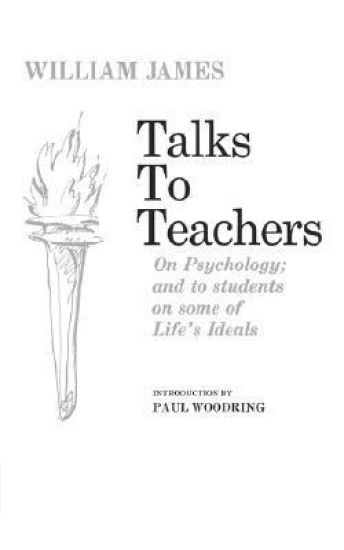
Talks to Teachers on Psychology and to Students on Some of Life's Ideals
William James
W. W. Norton Company
1958
nidottu
Chapter I. 9 PSYCHOLOGY AND THE TEACHING ART The American educational organization, -What teachers may expect from psychology, -Teaching methods must agree with psychology, but cannot be immediately deduced therefrom, -The science of teaching and the science of war, -The educational uses of psychology defined, -The teacher's duty toward child-study. Chapter II. 15 THE STREAM OF CONSCIOUSNESS Our mental life is a succession of conscious 'fields, '-They have a focus and a margin, -This description contrasted with the theory of 'ideas, '-Wundt's conclusions, note. Chapter III. 19 THE CHILD AS A BEHAVING ORGANISM Mind as pure reason and mind as practical guide, -The latter view the more fashionable one to-day, -It will be adopted in this work, -Why so?-The teacher's function is to train pupils to behavior. Chapter IV. 23 EDUCATION AND BEHAVIOR Education defined, -Conduct is always its outcome, -Different national ideals: Germany and England. Chapter V. 25 THE NECESSITY OF REACTIONS No impression without expression, -Verbal reproduction, -Manual training, -Pupils should know their 'marks'. Chapter VI. 28 NATIVE REACTIONS AND ACQUIRED REACTIONS The acquired reactions must be preceded by native ones, -Illustration: teaching child to ask instead of snatching, -Man has more instincts than other mammals. Chapter VII. 31 WHAT THE NATIVE REACTIONS ARE Fear and love, -Curiosity, -Imitation, -Emulation, -Forbidden by Rousseau, -His error, -Ambition, pugnacity, and pride. Soft pedagogics and the fighting impulse, -Ownership, -Its educational uses, -Constructiveness, -Manual teaching, -Transitoriness in instincts, -Their order of succession. Chapter VIII. 40 THE LAWS OF HABIT Good and bad habits, -Habit due to plasticity of organic tissues, -The aim of education is to make useful habits automatic, -Maxims relative to habit-forming: 1. Strong initiative, -2. No exception, -3. Seize first opportunity to act, -4. Don't preach, -Darwin and poetry: without exercise our capacities decay, -The habit of mental and muscular relaxation, -Fifth maxim, keep the faculty of effort trained, -Sudden conversions compatible with laws of habit, -Momentous influence of habits on character. Chapter IX. 48 THE ASSOCIATION OF IDEAS A case of habit, -The two laws, contiguity and similarity, -The teacher has to build up useful systems of association, -Habitual associations determine character, -Indeterminateness of our trains of association, -We can trace them backward, but not foretell them, -Interest deflects, -Prepotent parts of the field, -In teaching, multiply cues. Chapter X. 54 INTEREST The child's native interests, -How uninteresting things acquire an interest, -Rules for the teacher, -'Preparation' of the mind for the lesson: the pupil must have something to attend with, -All later interests are borrowed from original ones. Chapter XI. 59 ATTENTION Interest and attention are two aspects of one fact, -Voluntary attention comes in beats, -Genius and attention, -The subject must change to win attention, -Mechanical aids, -The physiological process, -The new in the old is what excites interest, -Interest and effort are compatible, -Mind-wandering, -No