Kirjojen hintavertailu – 12 874 939 kirjaa ja 26 kauppaa

Kirjailija

William Poundstone

Kirjat ja teokset yhdessä paikassa: 24 kirjaa, julkaisuja vuosilta 1991–2025, suosituimpiin kuuluu Are You Smart Enough to Work at Google?: Trick Questions, Zen-Like Riddles, Insanely Difficult Puzzles, and Other Devious Interviewing Techniques You. Vertaile teosten hintoja ja tarkista saatavuus suomalaisista kirjakaupoista.

24 kirjaa

Kirjojen julkaisuvuodet: 1991–2025.

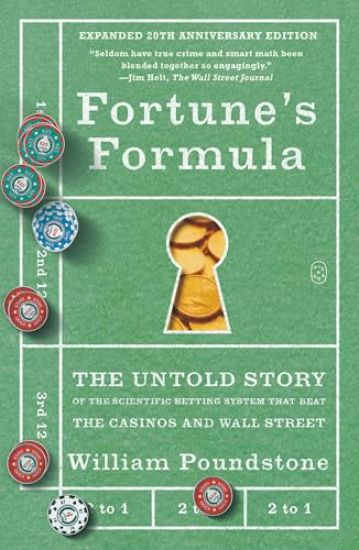
Fortune's Formula: The Untold Story of the Scientific Betting System That Beat the Casinos and Wall Street (20th Anniversary Edition)
An updated edition of the classic book that introduced the world to the controversial money-making formula known as the Kelly system. In 1956, two Bell Labs scientists discovered the scientific formula for getting rich. One was the mathematician Claude Shannon, neurotic father of our digital age, whose genius is ranked with Einstein's. The other was John L. Kelly Jr., a Texas-born, gun-toting physicist. Together they applied the science of information theory--the basis of computers and the internet--to the problem of making as much money as possible, as fast as possible. Shannon and the MIT mathematician Edward O. Thorp took the "Kelly formula" to Las Vegas. It worked. They realized that there was even more money to be made in the stock market. Thorp used the Kelly system with his phenomenally successful hedge fund, Princeton-Newport Partners. Shannon became a successful investor, too, topping even Warren Buffett's rate of return. Fortune's Formula traces how the Kelly formula sparked controversy even as it made fortunes at racetracks, casinos, and trading desks. It reveals the dark side of this alluring scheme, which is founded on exploiting an insider's edge. In the 20th anniversary edition of his now-classic book, William Poundstone offers an up-to-date take on the Kelly formula and its applications today.
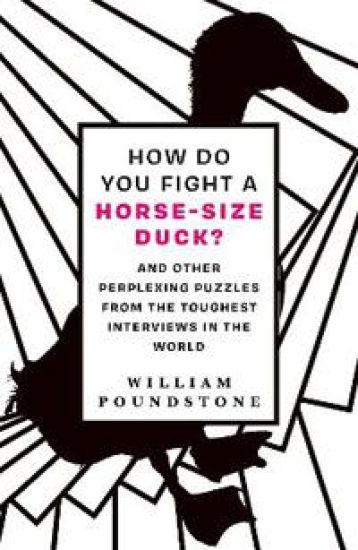
How Do You Fight a Horse-Sized Duck?

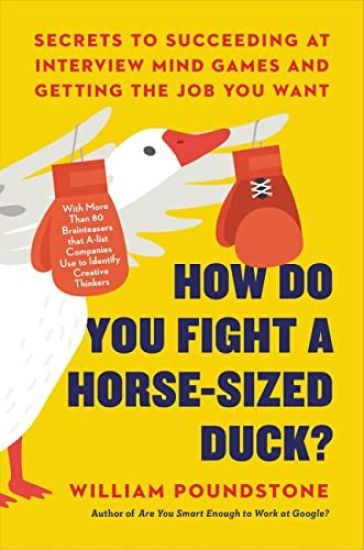
How Do You Fight a Horse-Sized Duck?

William Poundstone

Oneworld Publications
2022
pokkari
‘An entertaining book we can all enjoy… highly informative and amusing.’ Daily Mail ‘Full of valuable insight…this is a must-read for those looking to nail their next interview.’ Publishers Weekly How Do You Fight a Horse-Sized Duck? explores the new world of interviewing at A-list employers like Apple, Netflix and Amazon. It reveals more than 70 outrageously perplexing riddles and puzzles and supplies both answers and general strategy for creative problem-solving. Questions like: Today is Tuesday. What day of the week will it be 10 years from now on this date? How would you empty a plane full of Skittles? How many times would you have to scoop the ocean with a bucket to cause sea levels to drop one foot? You have a broken calculator. The only number key that works is the 0. All the operator keys work. How can you get the number 24? How many dogs have the exact same number of hairs?
How Do You Fight a Horse-Sized Duck?: Secrets to Succeeding at Interview Mind Games and Getting the Job You Want
Learn how to succeed at interview mind games and win job offers at A-list companies, with more than eighty difficult and devious questions, puzzles, and brain teasers Each year about 28 million Americans begin a search for a new job. Many more live in the age of the permanent job search, their online profiles eternally awaiting a better offer. Job seekers are more mobile and better informed than ever, aspiring to work for employers offering an appealing culture, a robust menu of perks, and opportunities for personal fulfillment and advancement. The result is that millions of applications stream to the handful of companies that regularly top listings of the best companies to work for: Apple, Netflix, Amazon, Alphabet, Disney, SpaceX, Oracle, Pricewaterhouse-Coopers, and others. Tesla has received as many as 200 applications for each open position. How do selective employers choose which people to hire? It's through interviews asking uniquely demanding questions testing imagination, persistence, and creativity, like: Can an astronaut throw a baseball so it hits Earth? If you had $2,000, how would you double it in 24 hours? How is a milk carton like a plane seat? Chicken McNuggets come in boxes of 6, 9, and 20. What's the largest number of McNuggets that McDonald's can't sell you? How many dogs in the world have the exact same number of hairs? How Do You Fight a Horse-Sized Duck? explores the new world of interviewing at A-list employers. It reveals more than eighty notoriously challenging interview questions and supplies both answers and a general strategy for creative problem-solving.
The Doomsday Calculation: How an Equation That Predicts the Future Is Transforming Everything We Know about Life and the Universe
From the author of Are You Smart Enough to Work at Google?, a fascinating look at how an equation that foretells the future is transforming everything we know about life, business, and the universe. In the 18th century, the British minister and mathematician Thomas Bayes devised a theorem that allowed him to assign probabilities to events that had never happened before. It languished in obscurity for centuries until computers came along and made it easy to crunch the numbers. Now, as the foundation of big data, Bayes' formula has become a linchpin of the digital economy. But here's where things get really interesting: Bayes' theorem can also be used to lay odds on the existence of extraterrestrial intelligence; on whether we live in a Matrix-like counterfeit of reality; on the "many worlds" interpretation of quantum theory being correct; and on the biggest question of all: how long will humanity survive? The Doomsday Calculation tells how Silicon Valley's profitable formula became a controversial pivot of contemporary thought. Drawing on interviews with thought leaders around the globe, it's the story of a group of intellectual mavericks who are challenging what we thought we knew about our place in the universe. The Doomsday Calculation is compelling reading for anyone interested in our culture and its future.
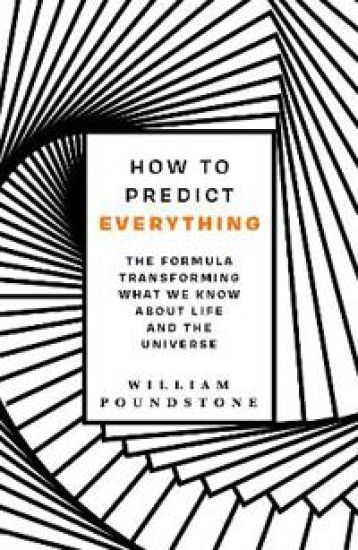
How to Predict Everything

How to Predict Everything

William Poundstone

Oneworld Publications
2020
pokkari
How do you predict something that has never happened before? There's a useful calculation being employed by Wall Street, Silicon Valley and maths professors all over the world, and it predicts that the human species will become extinct in 760 years. Unfortunately, there is disagreement over how to apply the formula, and some argue that we might only have twenty years left. Originally devised by British clergyman Thomas Bayes, the theorem languished in obscurity for two hundred years before being resurrected as the lynchpin of the digital economy. With brief detours into archaeology, philology, and overdue library books, William Poundstone explains how we can use it to predict pretty much anything. What is the chance that there are multiple universes? How long will Hamilton run? Will the US stock market continue to perform as well this century as it has for the last hundred years? And are we really all doomed?
How to Predict Everything

How to Predict Everything

William Poundstone

Oneworld Publications
2019
pokkari
How do you predict something that has never happened before? There's a useful calculation being employed by Wall Street, Silicon Valley and maths professors all over the world, and it predicts that the human species will become extinct in 760 years. Unfortunately, there is disagreement over how to apply the formula, and some argue that we might only have twenty years left. Originally devised by British clergyman Thomas Bayes, the theorem languished in obscurity for two hundred years before being resurrected as the lynchpin of the digital economy. With brief detours into archaeology, philology, and overdue library books, William Poundstone explains how we can use it to predict pretty much anything. What is the chance that there are multiple universes? How long will Hamilton run? Will the US stock market continue to perform as well this century as it has for the last hundred years? And are we really all doomed?
Head in the Cloud

Head in the Cloud

William Poundstone

Oneworld Publications
2017
pokkari
Never before have we had so much information at our fingertips. You might think that we are better-informed than ever, but there’s one thing we can’t ask Google: ‘What should I be googling?’ The way we consume information in the digital age has been blamed for driving political polarisation and leaving us unable to agree on basic facts. It’s also making us stupider. Personalised news feeds and social media echo chambers narrow our potential knowledge base. By now, we don’t even know what we don’t know. In Head in the Cloud, William Poundstone investigates the true worth of knowledge. An entertaining manifesto underpinned by big data analysis and illustrated by eye-opening anecdotes, it reveals the surprising benefits of broadening your horizons and provides an unnerving look at the consequences of being ill-informed.
Head in the Cloud: Why Knowing Things Still Matters When Facts Are So Easy to Look Up
The real-world value of knowledge in the mobile-device age. More people know who Khloe Kardashian is than who Rene Descartes was. Most can't find Delaware on a map, correctly spell the word occurrence, or name the largest ocean on the planet. But how important is it to fill our heads with facts? A few keystrokes can summon almost any information in seconds. Why should we bother learning facts at all? Bestselling author William Poundstone confronts that timely question in Head in the Cloud. He shows that many areas of knowledge correlate with the quality of our lives -- wealth, health, and happiness -- and even with politics and behavior. Combining Big Data survey techniques with eye-opening anecdotes, Poundstone examines what Americans know (and don't know) on topics ranging from quantum physics to pop culture. Head in the Cloud asks why we're okay with spelling errors on menus but not on resumes; why Fox News viewers don't know which party controls Congress; why people who know "trivia" make more money than those who don't; how individuals can navigate clickbait and media spin to stay informed about what really matters. Hilarious, humbling, and wildly entertaining, Head in the Cloud is a must-read for anyone who doesn't know everything.
Rock Breaks Scissors: A Practical Guide to Outguessing and Outwitting Almost Everybody
A practical guide to outguessing everything, from multiple-choice tests to the office football pool to the stock market. People are predictable even when they try not to be. William Poundstone demonstrates how to turn this fact to personal advantage in scores of everyday situations, from playing the lottery to buying a home. Rock Breaks Scissors is mind-reading for real life. Will the next tennis serve go right or left? Will the market go up or down? Most people are poor at that kind of predicting. We are hard-wired to make bum bets on "trends" and "winning streaks" that are illusions. Yet ultimately we're all in the business of anticipating the actions of others. Poundstone reveals how to overcome the errors and improve the accuracy of your own outguessing. Rock Breaks Scissors is a hands-on guide to turning life's odds in your favor.
How to Predict the Unpredictable

How to Predict the Unpredictable

William Poundstone

Oneworld Publications
2014
nidottu
We are hard-wired to believe that the world is more predictable than it is. We chase ‘winning streaks’ that are often just illusions, and we are all too predictable exactly when we try hardest not to be. In the 1970s, Daniel Kahneman and Amos Tversky coined the phrase ‘representativeness’ to describe the psychology of this behaviour. Since then representativeness has been used by auditors to catch people fiddling their tax returns and by hedge fund managers to reap billions from the emotions of small investors. Now Poundstone for the first time makes these techniques fun, easy, and profitable for everyone, in the everyday situations that matter. You’ll learn how to tackle multiple choice tests, what internet passwords to avoid, how to up your odds of winning the office Premier League sweepstakes, and the best ways to invest your money.
The Recursive Universe

The Recursive Universe

WIlliam Poundstone

Dover Publications Inc.
2013
nidottu

Halvin toimitettuna 20,80 €

This fascinating popular science journey explores key concepts in information theory in terms of Conway's "Game of Life" program. The author explains the application of natural law to a random system and demonstrates the necessity of limits. Other topics include the limits of knowledge, paradox of complexity, Maxwell's demon, Big Bang theory, and much more. 1985 edition.
Are You Smart Enough to Work at Google?

Are You Smart Enough to Work at Google?

William Poundstone

Oneworld Publications
2013
pokkari
You are shrunk to the height of a penny and thrown in a blender. The blades start moving in sixty seconds. What do you do? If you want to work at Google, or any of the world’s top employers, you’ll need to have a convincing answer to this and countless other baffling puzzles. Are You Smart Enough to Work at Google? Reveals the new extreme interview questions in the postcrash, hypercompetitive job-market and uncovers the extraordinary lengths to which the best companies will go to find the right staff. Bestselling author William Poundstone guides readers through the surprising solutions to over a hundred of the most challenging conundrums used in interviews, as well as covering the importance of creative thinking, what your Facebook page says about you, and what really goes on inside the Googleplex. How will you fare?
Are You Smart Enough to Work at Google?: Trick Questions, Zen-Like Riddles, Insanely Difficult Puzzles, and Other Devious Interviewing Techniques You
You are shrunk to the height of a nickel and thrown in a blender. The blades start moving in 60 seconds. What do you do? If you want to work at Google, or any of America's best companies, you need to have an answer to this and other puzzling questions. Are You Smart Enough to Work at Google? guides readers through the surprising solutions to dozens of the most challenging interview questions. The book covers the importance of creative thinking, ways to get a leg up on the competition, what your Facebook page says about you, and much more. Are You Smart Enough to Work at Google? is a must-read for anyone who wants to succeed in today's job market.
Oletko riittävän älykäs Googlelle?

Oletko riittävän älykäs Googlelle?

William Poundstone

Terra Cognita
2012
nidottu

Halvin toimitettuna 44,90 €

Nykyajan yhä ankarammin kilpailuilla työmarkkinoilla parhaissa yrityksissä on yhä vähemmän avoimia työpaikkoja, mutta niitä hakee yhä useampi. Tässä kirjassa William Poundstone esittelee, miten uusi aika on muuttanut työpaikkahaastattelun kysymyksiä huippuyhtiöissä. Poundstone kertoo nykyisten huippuyhtiöiden katalien haastattelukysymysten historian ja salaisuuksia ja esittelee niitä kymmenittäin vastauksineen. Mikä on luovan ajattelun merkitys ja miksi yhtiöt pitävät sitä arvosanoja, kokemusta ja älykkyyttä arvokkaampana? Miten kilpailussa saa edun? Mitä Facebook-sivusi sanoo haastattelijalle? Ja paljon muuta.
Priceless

Priceless

William Poundstone

Oneworld Publications
2011
pokkari

Halvin toimitettuna 17,90 €

In Priceless, bestselling author William Poundstone reveals the hidden psychology of value and explores how we react to the most pervasive persuader of all: price. Charting the burgeoning growth of price-consultants who advise retailers from Nike to Nokia, Poundstone shows how behavioural decision theory has revolutionised the pricing strategies of major corporations. Informed by fascinating behavioural experiments and packed with real-life examples, Priceless explains why prices are so important, and the tricks that companies use to sell their goods. It will prove indispensable to anyone who buys, sells, or negotiates.
Priceless: The Myth of Fair Value (and How to Take Advantage of It)

Priceless: The Myth of Fair Value (and How to Take Advantage of It)

William Poundstone

Hill Wang
2011
nidottu

Halvin toimitettuna 28,50 €

Prada stores carry a few obscenely expensive items in order to boost sales for everything else (which look like bargains in comparison). People used to download music for free, then Steve Jobs convinced them to pay. How? By charging 99 cents. That price has a hypnotic effect: the profit margin of the 99 Cents Only store is twice that of Wal-Mart. Why do text messages cost money, while e-mails are free? Why do jars of peanut butter keep getting smaller in order to keep the price the "same"? The answer is simple: prices are a collective hallucination. In Priceless, the bestselling author William Poundstone reveals the hidden psychology of value. In psychological experiments, people are unable to estimate "fair" prices accurately and are strongly influenced by the unconscious, irrational, and politically incorrect. It hasn't taken long for marketers to apply these findings. "Price consultants" advise retailers on how to convince consumers to pay more for less, and negotiation coaches offer similar advice for businesspeople cutting deals. The new psychology of price dictates the design of price tags, menus, rebates, "sale" ads, cell phone plans, supermarket aisles, real estate offers, wage packages, tort demands, and corporate buyouts. Prices are the most pervasive hidden persuaders of all. Rooted in the emerging field of behavioral decision theory, Priceless should prove indispensable to anyone who negotiates.