Kirjojen hintavertailu – 12 903 725 kirjaa ja 27 kauppaa

Kirjailija

Witold Pedrycz

Kirjat ja teokset yhdessä paikassa: 45 kirjaa, julkaisuja vuosilta 1989–2026, suosituimpiin kuuluu Automata Theory and Formal Languages. Vertaile teosten hintoja ja tarkista saatavuus suomalaisista kirjakaupoista.

45 kirjaa

Kirjojen julkaisuvuodet: 1989–2026.

Multicriteria Decision-Making Under Conditions of Uncertainty

Multicriteria Decision-Making Under Conditions of Uncertainty

Petr Ekel; Witold Pedrycz; Joel Pereira

Wiley-Blackwell
2020
sidottu
A guide to the various models and methods to multicriteria decision-making in conditions of uncertainty presented in a systematic approach Multicriteria Decision-Making under Conditions of Uncertainty presents approaches that help to answer the fundamental questions at the center of all decision-making problems: "What to do?" and "How to do it?" The book explores methods of representing and handling diverse manifestations of the uncertainty factor and a multicriteria nature of problems that can arise in system design, planning, operation, and control. The authors—noted experts on the topic—and their book covers essential questions, including notions and fundamental concepts of fuzzy sets, models and methods of multiobjective as well as multiattribute decision-making, the classical approach to dealing with uncertainty of information and its generalization for analyzing multicriteria problems in condition of uncertainty, and more. This comprehensive book contains information on "harmonious solutions" in multiobjective problem-solving (analyzing X, F> models), construction and analysis of X, R> models, results aimed at generating robust solutions in analyzing multicriteria problems under uncertainty, and more. In addition, the book includes illustrative examples of various applications, including real-world case studies related to the authors’ various industrial projects. This important resource: Explains the design and processing aspect of fuzzy sets, including construction of membership functions, fuzzy numbers, fuzzy relations, aggregation operations, and fuzzy sets transformationsDescribes models of multiobjective decision-making (X. M> models), their analysis on the basis of using the Bellman-Zadeh approach to decision-making in a fuzzy environment, and their diverse applications, including multicriteria allocation of resourcesInvestigates models of multiattribute decision-making (X, R> models) and their analysis on the basis of the construction and processing of fuzzy preference relations as well as demonstrating their applications to solve diverse classes of multiattribute problemsExplores notions of payoff matrices and fuzzy-set-based generalization and modification of the classic approach to decision-making under conditions of uncertainty to generate robust solutions in analyzing multicriteria problems Written for students, researchers and practitioners in disciplines in which decision-making is of paramount relevance, Multicriteria Decision-Making under Conditions of Uncertainty presents a systematic and current approach that encompasses a range of models and methods as well as new applications.
Pattern Recognition

Pattern Recognition

Wladyslaw Homenda; Witold Pedrycz

Wiley-Blackwell
2018
sidottu
A new approach to the issue of data quality in pattern recognition Detailing foundational concepts before introducing more complex methodologies and algorithms, this book is a self-contained manual for advanced data analysis and data mining. Top-down organization presents detailed applications only after methodological issues have been mastered, and step-by-step instructions help ensure successful implementation of new processes. By positioning data quality as a factor to be dealt with rather than overcome, the framework provided serves as a valuable, versatile tool in the analysis arsenal. For decades, practical need has inspired intense theoretical and applied research into pattern recognition for numerous and diverse applications. Throughout, the limiting factor and perpetual problem has been data—its sheer diversity, abundance, and variable quality presents the central challenge to pattern recognition innovation. Pattern Recognition: A Quality of Data Perspective repositions that challenge from a hurdle to a given, and presents a new framework for comprehensive data analysis that is designed specifically to accommodate problem data. Designed as both a practical manual and a discussion about the most useful elements of pattern recognition innovation, this book: Details fundamental pattern recognition concepts, including feature space construction, classifiers, rejection, and evaluationProvides a systematic examination of the concepts, design methodology, and algorithms involved in pattern recognitionIncludes numerous experiments, detailed schemes, and more advanced problems that reinforce complex conceptsActs as a self-contained primer toward advanced solutions, with detailed background and step-by-step processesIntroduces the concept of granules and provides a framework for granular computing Pattern recognition plays a pivotal role in data analysis and data mining, fields which are themselves being applied in an expanding sphere of utility. By facing the data quality issue head-on, this book provides students, practitioners, and researchers with a clear way forward amidst the ever-expanding data supply.
Granular Computing

Granular Computing

Witold Pedrycz

CRC Press
2017
nidottu
Information granules, as encountered in natural language, are implicit in nature. To make them fully operational so they can be effectively used to analyze and design intelligent systems, information granules need to be made explicit. An emerging discipline, granular computing focuses on formalizing information granules and unifying them to create a coherent methodological and developmental environment for intelligent system design and analysis. Granular Computing: Analysis and Design of Intelligent Systems presents the unified principles of granular computing along with its comprehensive algorithmic framework and design practices. Introduces the concepts of information granules, information granularity, and granular computingPresents the key formalisms of information granulesBuilds on the concepts of information granules with discussion of higher-order and higher-type information granulesDiscusses the operational concept of information granulation and degranulation by highlighting the essence of this tandem and its quantification in terms of the associated reconstruction errorExamines the principle of justifiable granularityStresses the need to look at information granularity as an important design asset that helps construct more realistic models of real-world systems or facilitate collaborative pursuits of system modelingHighlights the concepts, architectures, and design algorithms of granular modelsExplores application domains where granular computing and granular models play a visible role, including pattern recognition, time series, and decision makingWritten by an internationally renowned authority in the field, this innovative book introduces readers to granular computing as a new paradigm for the analysis and synthesis of intelligent systems. It is a valuable resource for those engaged in research and practical developments in computer, electrical, industrial, manufacturing, and biomedical engineering. Building from fundamentals, the book is also suitable for readers from nontechnical disciplines where information granules assume a visible position.
Data Analysis and Pattern Recognition in Multiple Databases

Data Analysis and Pattern Recognition in Multiple Databases

Animesh Adhikari; Jhimli Adhikari; Witold Pedrycz

Springer International Publishing AG
2016
nidottu
Pattern recognition in data is a well known classical problem that falls under the ambit of data analysis. As we need to handle different data, the nature of patterns, their recognition and the types of data analyses are bound to change. Since the number of data collection channels increases in the recent time and becomes more diversified, many real-world data mining tasks can easily acquire multiple databases from various sources. In these cases, data mining becomes more challenging for several essential reasons. We may encounter sensitive data originating from different sources - those cannot be amalgamated. Even if we are allowed to place different data together, we are certainly not able to analyze them when local identities of patterns are required to be retained. Thus, pattern recognition in multiple databases gives rise to a suite of new, challenging problems different from those encountered before. Association rule mining, global pattern discovery and mining patterns of select items provide different patterns discovery techniques in multiple data sources. Some interesting item-based data analyses are also covered in this book. Interesting patterns, such as exceptional patterns, icebergs and periodic patterns have been recently reported. The book presents a thorough influence analysis between items in time-stamped databases. The recent research on mining multiple related databases is covered while some previous contributions to the area are highlighted and contrasted with the most recent developments.
Data Analysis and Pattern Recognition in Multiple Databases

Data Analysis and Pattern Recognition in Multiple Databases

Animesh Adhikari; Jhimli Adhikari; Witold Pedrycz

Springer International Publishing AG
2013
sidottu
Pattern recognition in data is a well known classical problem that falls under the ambit of data analysis. As we need to handle different data, the nature of patterns, their recognition and the types of data analyses are bound to change. Since the number of data collection channels increases in the recent time and becomes more diversified, many real-world data mining tasks can easily acquire multiple databases from various sources. In these cases, data mining becomes more challenging for several essential reasons. We may encounter sensitive data originating from different sources - those cannot be amalgamated. Even if we are allowed to place different data together, we are certainly not able to analyze them when local identities of patterns are required to be retained. Thus, pattern recognition in multiple databases gives rise to a suite of new, challenging problems different from those encountered before. Association rule mining, global pattern discovery and mining patterns of select items provide different patterns discovery techniques in multiple data sources. Some interesting item-based data analyses are also covered in this book. Interesting patterns, such as exceptional patterns, icebergs and periodic patterns have been recently reported. The book presents a thorough influence analysis between items in time-stamped databases. The recent research on mining multiple related databases is covered while some previous contributions to the area are highlighted and contrasted with the most recent developments.
Granular Computing

Granular Computing

Witold Pedrycz

CRC Press Inc
2013
sidottu
Information granules, as encountered in natural language, are implicit in nature. To make them fully operational so they can be effectively used to analyze and design intelligent systems, information granules need to be made explicit. An emerging discipline, granular computing focuses on formalizing information granules and unifying them to create a coherent methodological and developmental environment for intelligent system design and analysis. Granular Computing: Analysis and Design of Intelligent Systems presents the unified principles of granular computing along with its comprehensive algorithmic framework and design practices. Introduces the concepts of information granules, information granularity, and granular computingPresents the key formalisms of information granulesBuilds on the concepts of information granules with discussion of higher-order and higher-type information granulesDiscusses the operational concept of information granulation and degranulation by highlighting the essence of this tandem and its quantification in terms of the associated reconstruction errorExamines the principle of justifiable granularityStresses the need to look at information granularity as an important design asset that helps construct more realistic models of real-world systems or facilitate collaborative pursuits of system modelingHighlights the concepts, architectures, and design algorithms of granular modelsExplores application domains where granular computing and granular models play a visible role, including pattern recognition, time series, and decision makingWritten by an internationally renowned authority in the field, this innovative book introduces readers to granular computing as a new paradigm for the analysis and synthesis of intelligent systems. It is a valuable resource for those engaged in research and practical developments in computer, electrical, industrial, manufacturing, and biomedical engineering. Building from fundamentals, the book is also suitable for readers from nontechnical disciplines where information granules assume a visible position.
Granular Computing

Granular Computing

Andrzej Bargiela; Witold Pedrycz

Springer-Verlag New York Inc.
2012
nidottu
This book is about Granular Computing (GC) - an emerging conceptual and of information processing. As the name suggests, GC concerns computing paradigm processing of complex information entities - information granules. In essence, information granules arise in the process of abstraction of data and derivation of knowledge from information. Information granules are everywhere. We commonly use granules of time (seconds, months, years). We granulate images; millions of pixels manipulated individually by computers appear to us as granules representing physical objects. In natural language, we operate on the basis of word-granules that become crucial entities used to realize interaction and communication between humans. Intuitively, we sense that information granules are at the heart of all our perceptual activities. In the past, several formal frameworks and tools, geared for processing specific information granules, have been proposed. Interval analysis, rough sets, fuzzy sets have all played important role in knowledge representation and processing. Subsequently, information granulation and information granules arose in numerous application domains. Well-known ideas of rule-based systems dwell inherently on information granules. Qualitative modeling, being one of the leading threads of AI, operates on a level of information granules. Multi-tier architectures and hierarchical systems (such as those encountered in control engineering), planning and scheduling systems all exploit information granularity. We also utilize information granules when it comes to functionality granulation, reusability of information and efficient ways of developing underlying information infrastructures.
Data Mining Methods for Knowledge Discovery

Data Mining Methods for Knowledge Discovery

Krzysztof J. Cios; Witold Pedrycz; Roman W. Swiniarski

Springer-Verlag New York Inc.
2012
nidottu
Data Mining Methods for Knowledge Discovery provides an introduction to the data mining methods that are frequently used in the process of knowledge discovery. This book first elaborates on the fundamentals of each of the data mining methods: rough sets, Bayesian analysis, fuzzy sets, genetic algorithms, machine learning, neural networks, and preprocessing techniques. The book then goes on to thoroughly discuss these methods in the setting of the overall process of knowledge discovery. Numerous illustrative examples and experimental findings are also included. Each chapter comes with an extensive bibliography. Data Mining Methods for Knowledge Discovery is intended for senior undergraduate and graduate students, as well as a broad audience of professionals in computer and information sciences, medical informatics, and business information systems.
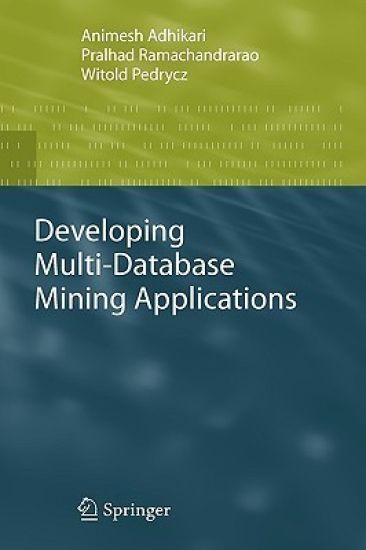
Developing Multi-Database Mining Applications

Developing Multi-Database Mining Applications

Animesh Adhikari; Pralhad Ramachandrarao; Witold Pedrycz

Springer London Ltd
2012
nidottu
Multi-database mining has been recognized recently as an important and strategically essential area of research in data mining. In this book, we discuss various issues regarding the systematic and efficient development of multi-database mining applications. It explains how systematically one could prepare data warehouses at different branches. As appropriate multi-database mining technique is essential to develop better applications. Also, the efficiency of a multi-database mining application could be improved by processing more patterns in the application. A faster algorithm could also play an important role in developing a better application. Thus the efficiency of a multi-database mining application could be enhanced by choosing an appropriate multi-database mining model, an appropriate pattern synthesizing technique, a better pattern representation technique, and an efficient algorithm for solving the problem. This book illustrates each of these issues either in the context of a specific problem, or in general.
Fuzzy Relation Equations and Their Applications to Knowledge Engineering

Fuzzy Relation Equations and Their Applications to Knowledge Engineering

Antonio Di Nola; S. Sessa; Witold Pedrycz; E. Sanchez

Springer
2010
nidottu
It took many decades for Peirce's coneept of a relation to find its way into the microelectronic innards of control systems of eement kilns, subway trains, and tunnel-digging machinery. But what is amazing is that the more we leam about the basically simple coneept of a relation, the more aware we become of its fundamental importanee and wide ranging ramifications. The work by Di Nola, Pedrycz, Sanchez, and Sessa takes us a long distanee in this direction by opening new vistas on both the theory and applications of fuzzy relations - relations which serve to model the imprecise coneepts which pervade the real world. Di Nola, Pedrycz, Sanchez, and Sessa focus their attention on a eentral problem in the theory of fuzzy relations, namely the solution of fuzzy relational equations. The theory of such equations was initiated by Sanchez in 1976, ina seminal paper dealing with the resolution of composite fuzzy relational equations. Sinee then, hundreds of papers have been written on this and related topics, with major contributions originating in France, Italy, Spain, Germany, Poland, Japan, China, the Soviet Union, India, and other countries. The bibliography included in this volume highlights the widespread interest in the theory of fuzzy relational equations and the broad spectrum of its applications.
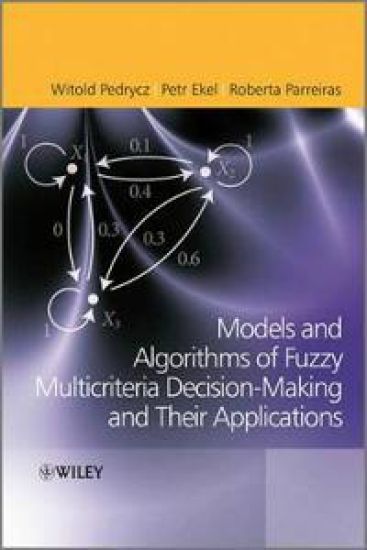
Fuzzy Multicriteria Decision-Making

Fuzzy Multicriteria Decision-Making

Witold Pedrycz; Petr Ekel; Roberta Parreiras

John Wiley Sons Inc
2010
sidottu
Fuzzy Multicriteria Decision-Making: Models, Algorithms and Applications addresses theoretical and practical gaps in considering uncertainty and multicriteria factors encountered in the design, planning, and control of complex systems. Including all prerequisite knowledge and augmenting some parts with a step-by-step explanation of more advanced concepts, the authors provide a systematic and comprehensive presentation of the concepts, design methodology, and detailed algorithms. These are supported by many numeric illustrations and a number of application scenarios to motivate the reader and make some abstract concepts more tangible. Fuzzy Multicriteria Decision-Making: Models, Algorithms and Applications will appeal to a wide audience of researchers and practitioners in disciplines where decision-making is paramount, including various branches of engineering, operations research, economics and management; it will also be of interest to graduate students and senior undergraduate students in courses such as decision making, management, risk management, operations research, numerical methods, and knowledge-based systems.
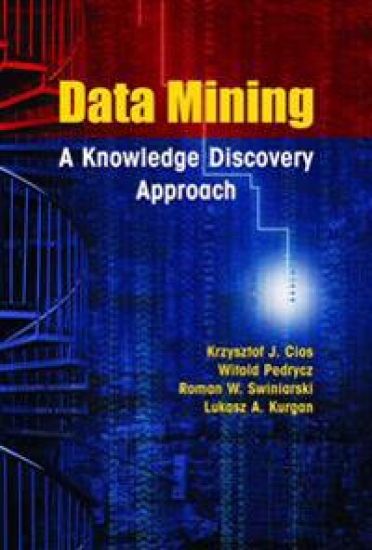
Data Mining

Data Mining

Krzysztof J. Cios; Witold Pedrycz; Roman W. Swiniarski; Lukasz Andrzej Kurgan

Springer-Verlag New York Inc.
2010
nidottu
“If you torture the data long enough, Nature will confess,” said 1991 Nobel-winning economist Ronald Coase. The statement is still true. However, achieving this lofty goal is not easy. First, “long enough” may, in practice, be “too long” in many applications and thus unacceptable. Second, to get “confession” from large data sets one needs to use state-of-the-art “torturing” tools. Third, Nature is very stubborn — not yielding easily or unwilling to reveal its secrets at all. Fortunately, while being aware of the above facts, the reader (a data miner) will find several efficient data mining tools described in this excellent book. The book discusses various issues connecting the whole spectrum of approaches, methods, techniques and algorithms falling under the umbrella of data mining. It starts with data understanding and preprocessing, then goes through a set of methods for supervised and unsupervised learning, and concludes with model assessment, data security and privacy issues. It is this specific approach of using the knowledge discovery process that makes this book a rare one indeed, and thus an indispensable addition to many other books on data mining. To be more precise, this is a book on knowledge discovery from data. As for the data sets, the easy-to-make statement is that there is no part of modern human activity left untouched by both the need and the desire to collect data. The consequence of such a state of affairs is obvious.
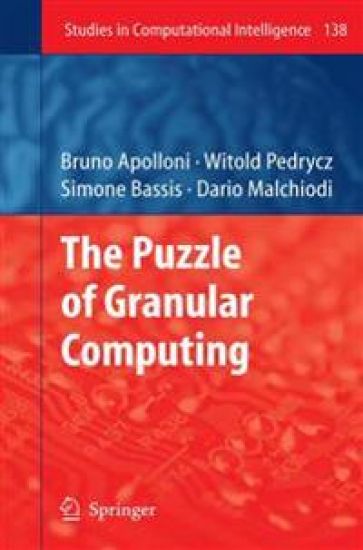
The Puzzle of Granular Computing

The Puzzle of Granular Computing

Bruno Apolloni; Witold Pedrycz; Simone Bassis; Dario Malchiodi

Springer-Verlag Berlin and Heidelberg GmbH Co. K
2010
nidottu
Rem tene, verba sequentur (Gaius J. Victor, Rome VI century b.c.) The ultimate goal of this book is to bring the fundamental issues of information granularity, inference tools and problem solving procedures into a coherent, unified, and fully operational framework. The objective is to offer the reader a comprehensive, self-contained, and uniform exposure to the subject. The strategy is to isolate some fundamental bricks of Computational Intelligence in terms of key problems and methods, and discuss their implementation and underlying rationale within a well structured and rigorous conceptual framework as well as carefully related to various application facets. The main assumption is that a deep understanding of the key problems will allow the reader to compose into a meaningful mosaic the puzzle pieces represented by the immense varieties of approaches present in the literature and in the computational practice. All in all, the main approach advocated in the monograph consists of a sequence of steps offering solid conceptual fundamentals, presenting a carefully selected collection of design methodologies, discussing a wealth of development guidelines, and exemplifying them with a pertinent, accurately selected illustrative material.
Axiomatic Fuzzy Set Theory and Its Applications

Axiomatic Fuzzy Set Theory and Its Applications

Xiaodong Liu; Witold Pedrycz

Springer-Verlag Berlin and Heidelberg GmbH Co. K
2010
nidottu
It is well known that “fuzziness”—informationgranulesand fuzzy sets as one of its formal manifestations— is one of important characteristics of human cognitionandcomprehensionofreality. Fuzzy phenomena existinnature and are encountered quite vividly within human society. The notion of a fuzzy set has been introduced by L. A. , Zadeh in 1965 in order to formalize human concepts, in connection with the representation of human natural language and computing with words. Fuzzy sets and fuzzy logic are used for mod- ing imprecise modes of reasoning that play a pivotal role in the remarkable human abilities to make rational decisions in an environment a?ected by - certainty and imprecision. A growing number of applications of fuzzy sets originated from the “empirical-semantic” approach. From this perspective, we were focused on some practical interpretations of fuzzy sets rather than being oriented towards investigations of the underlying mathematical str- tures of fuzzy sets themselves. For instance, in the context of control theory where fuzzy sets have played an interesting and practically relevant function, the practical facet of fuzzy sets has been stressed quite signi?cantly. However, fuzzy sets can be sought as an abstract concept with all formal underpinnings stemming from this more formal perspective. In the context of applications, it is worth underlying that membership functions do not convey the same meaning at the operational level when being cast in various contexts.
Developing Multi-Database Mining Applications

Developing Multi-Database Mining Applications

Animesh Adhikari; Pralhad Ramachandrarao; Witold Pedrycz

Springer London Ltd
2010
sidottu
Multi-database mining has been recognized recently as an important and strategically essential area of research in data mining. In this book, we discuss various issues regarding the systematic and efficient development of multi-database mining applications. It explains how systematically one could prepare data warehouses at different branches. As appropriate multi-database mining technique is essential to develop better applications. Also, the efficiency of a multi-database mining application could be improved by processing more patterns in the application. A faster algorithm could also play an important role in developing a better application. Thus the efficiency of a multi-database mining application could be enhanced by choosing an appropriate multi-database mining model, an appropriate pattern synthesizing technique, a better pattern representation technique, and an efficient algorithm for solving the problem. This book illustrates each of these issues either in the context of a specific problem, or in general.
Axiomatic Fuzzy Set Theory and Its Applications

Axiomatic Fuzzy Set Theory and Its Applications

Xiaodong Liu; Witold Pedrycz

Springer-Verlag Berlin and Heidelberg GmbH Co. K
2009
sidottu
It is well known that “fuzziness”—informationgranulesand fuzzy sets as one of its formal manifestations— is one of important characteristics of human cognitionandcomprehensionofreality. Fuzzy phenomena existinnature and are encountered quite vividly within human society. The notion of a fuzzy set has been introduced by L. A. , Zadeh in 1965 in order to formalize human concepts, in connection with the representation of human natural language and computing with words. Fuzzy sets and fuzzy logic are used for mod- ing imprecise modes of reasoning that play a pivotal role in the remarkable human abilities to make rational decisions in an environment a?ected by - certainty and imprecision. A growing number of applications of fuzzy sets originated from the “empirical-semantic” approach. From this perspective, we were focused on some practical interpretations of fuzzy sets rather than being oriented towards investigations of the underlying mathematical str- tures of fuzzy sets themselves. For instance, in the context of control theory where fuzzy sets have played an interesting and practically relevant function, the practical facet of fuzzy sets has been stressed quite signi?cantly. However, fuzzy sets can be sought as an abstract concept with all formal underpinnings stemming from this more formal perspective. In the context of applications, it is worth underlying that membership functions do not convey the same meaning at the operational level when being cast in various contexts.
The Puzzle of Granular Computing

The Puzzle of Granular Computing

Bruno Apolloni; Witold Pedrycz; Simone Bassis; Dario Malchiodi

Springer-Verlag Berlin and Heidelberg GmbH Co. K
2008
sidottu
Rem tene, verba sequentur (Gaius J. Victor, Rome VI century b.c.) The ultimate goal of this book is to bring the fundamental issues of information granularity, inference tools and problem solving procedures into a coherent, unified, and fully operational framework. The objective is to offer the reader a comprehensive, self-contained, and uniform exposure to the subject. The strategy is to isolate some fundamental bricks of Computational Intelligence in terms of key problems and methods, and discuss their implementation and underlying rationale within a well structured and rigorous conceptual framework as well as carefully related to various application facets. The main assumption is that a deep understanding of the key problems will allow the reader to compose into a meaningful mosaic the puzzle pieces represented by the immense varieties of approaches present in the literature and in the computational practice. All in all, the main approach advocated in the monograph consists of a sequence of steps offering solid conceptual fundamentals, presenting a carefully selected collection of design methodologies, discussing a wealth of development guidelines, and exemplifying them with a pertinent, accurately selected illustrative material.
Data Mining

Data Mining

Krzysztof J. Cios; Witold Pedrycz; Roman W. Swiniarski; Lukasz Andrzej Kurgan

Springer-Verlag New York Inc.
2007
sidottu
“If you torture the data long enough, Nature will confess,” said 1991 Nobel-winning economist Ronald Coase. The statement is still true. However, achieving this lofty goal is not easy. First, “long enough” may, in practice, be “too long” in many applications and thus unacceptable. Second, to get “confession” from large data sets one needs to use state-of-the-art “torturing” tools. Third, Nature is very stubborn — not yielding easily or unwilling to reveal its secrets at all. Fortunately, while being aware of the above facts, the reader (a data miner) will find several efficient data mining tools described in this excellent book. The book discusses various issues connecting the whole spectrum of approaches, methods, techniques and algorithms falling under the umbrella of data mining. It starts with data understanding and preprocessing, then goes through a set of methods for supervised and unsupervised learning, and concludes with model assessment, data security and privacy issues. It is this specific approach of using the knowledge discovery process that makes this book a rare one indeed, and thus an indispensable addition to many other books on data mining. To be more precise, this is a book on knowledge discovery from data. As for the data sets, the easy-to-make statement is that there is no part of modern human activity left untouched by both the need and the desire to collect data. The consequence of such a state of affairs is obvious.
Fuzzy Systems Engineering

Fuzzy Systems Engineering

Witold Pedrycz; Fernando Gomide

John Wiley Sons Inc
2007
sidottu
A self-contained treatment of fuzzy systems engineering, offering conceptual fundamentals, design methodologies, development guidelines, and carefully selected illustrative material Forty years have passed since the birth of fuzzy sets, in which time a wealth of theoretical developments, conceptual pursuits, algorithmic environments, and other applications have emerged. Now, this reader-friendly book presents an up-to-date approach to fuzzy systems engineering, covering concepts, design methodologies, and algorithms coupled with interpretation, analysis, and underlying engineering knowledge. The result is a holistic view of fuzzy sets as a fundamental component of computational intelligence and human-centric systems. Throughout the book, the authors emphasize the direct applicability and limitations of the concepts being discussed, and historical and bibliographical notes are included in each chapter to help readers view the developments of fuzzy sets from a broader perspective. A radical departure from current books on the subject, Fuzzy Systems Engineering presents fuzzy sets as an enabling technology whose impact, contributions, and methodology stretch far beyond any specific discipline, making it applicable to researchers and practitioners in engineering, computer science, business, medicine, bioinformatics, and computational biology. Additionally, three appendices and classroom-ready electronic resources make it an ideal textbook for advanced undergraduate- and graduate-level courses in engineering and science.
Ambient Intelligence, Wireless Networking, and Ubiquitous Computing

Ambient Intelligence, Wireless Networking, and Ubiquitous Computing

Witold Pedrycz; Athanasios Vasilakos

Artech House
2006
sidottu
Ambient Intelligence (AmI) is the next wave in computing and communications technology. Nano-sized sensors and computers, wireless networks, and intelligent software are being integrated to create AmI environments. One such AmI environment is an intelligent home that can sense changes in a house and its occupants to instantly track objects or call 911 in case of a fall or heart attack. Another AmI environment is an intelligent airport to effortlessly guide a traveler to a connecting flight, through customs, or to a waiting car service. This cutting-edge reference explains ways to plan for AmI service deployment, develop AmI software and networks, and further advance AmI capabilities. It looks at such nuts-and-bolts issues as security, architecture, systems integration, and quality of service. This forward-looking volume also covers such latest AmI developments as smart dust, smart personal object technology, and context-aware computing.