Kirjojen hintavertailu – 12 903 724 kirjaa ja 27 kauppaa

Kirjailija

Yi Zhang

Kirjat ja teokset yhdessä paikassa: 35 kirjaa, julkaisuja vuosilta 2016–2025, suosituimpiin kuuluu Advancing Health and Wellbeing in the Changing Urban Environment. Vertaile teosten hintoja ja tarkista saatavuus suomalaisista kirjakaupoista.

35 kirjaa

Kirjojen julkaisuvuodet: 2016–2025.

Advancing Health and Wellbeing in the Changing Urban Environment

Advancing Health and Wellbeing in the Changing Urban Environment

Franz W. Gatzweiler; Yong-Guan Zhu; Anna V. Diez Roux; Anthony Capon; Christel Donnelly; Gérard Salem; Hany M. Ayad; Ilene Speizer; Indira Nath; Jo I. Boufford; Keisuke Hanaki; Luuk C. Rietveld; Pierre Ritchie; Saroj Jayasinghe; Susan Parnell; Yi Zhang

Springer Verlag, Singapore
2018
nidottu
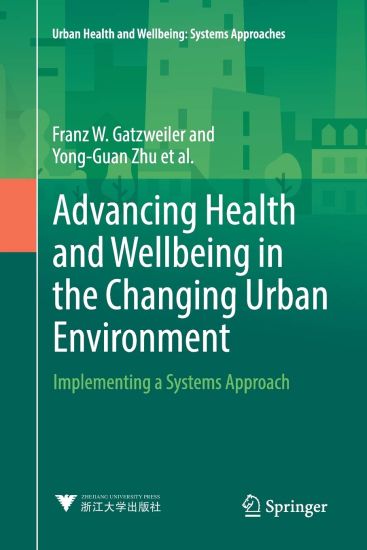
This book addresses up-to-date urban health issues from a systems perspective and provides an appealing integrated urban development strategy based on a 10-year global interdisciplinary research programme created by the International Council for Science (ICSU), and sponsored by the InterAcademy Partnership (IAP) and the United Nations University (UNU). The unique feature of this book is its “systems approach” to urban health and wellbeing: solution-oriented for science and society and not purely theoretical, it can be applied in the context of decision-making, and has the potential to unlock cities’ unused potential by promoting health and wellbeing. Furthermore, the inter- and transdisciplinary urban issues addressed in this book are examined from a cross-sectoral perspective – e.g. the transport sector is addressed in connection with air pollution, respiratory and cardiovascular diseases and the loss of productivity. The interconnected thinking to urban health and wellbeing makesthe book a particularly valuable resource. Decision makers in city administrations and civil society organizations from different geographical regions will find the book an informative and inspiring guide for delivering towards the goals of the New Urban Agenda, for which health can be the vital indicator of progress. Graduate students and researchers will be attracted by the case studies, systems methods and models provided in the book.
Advancing Health and Wellbeing in the Changing Urban Environment

Advancing Health and Wellbeing in the Changing Urban Environment

Franz W. Gatzweiler; Yong-Guan Zhu; Anna V. Diez Roux; Anthony Capon; Christel Donnelly; Gérard Salem; Hany M. Ayad; Ilene Speizer; Indira Nath; Jo I. Boufford; Keisuke Hanaki; Luuk C. Rietveld; Pierre Ritchie; Saroj Jayasinghe; Susan Parnell; Yi Zhang

Springer Verlag, Singapore
2017
sidottu
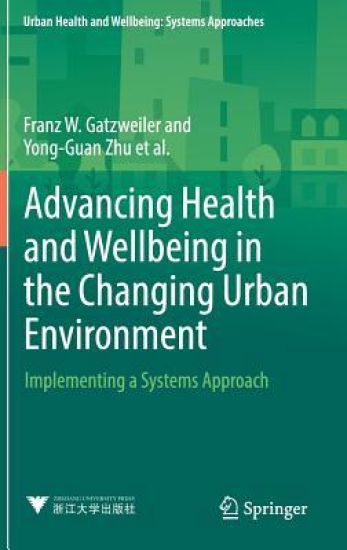
This book addresses up-to-date urban health issues from a systems perspective and provides an appealing integrated urban development strategy based on a 10-year global interdisciplinary research programme created by the International Council for Science (ICSU), and sponsored by the InterAcademy Partnership (IAP) and the United Nations University (UNU). The unique feature of this book is its “systems approach” to urban health and wellbeing: solution-oriented for science and society and not purely theoretical, it can be applied in the context of decision-making, and has the potential to unlock cities’ unused potential by promoting health and wellbeing. Furthermore, the inter- and transdisciplinary urban issues addressed in this book are examined from a cross-sectoral perspective – e.g. the transport sector is addressed in connection with air pollution, respiratory and cardiovascular diseases and the loss of productivity. The interconnected thinking to urban health and wellbeing makesthe book a particularly valuable resource. Decision makers in city administrations and civil society organizations from different geographical regions will find the book an informative and inspiring guide for delivering towards the goals of the New Urban Agenda, for which health can be the vital indicator of progress. Graduate students and researchers will be attracted by the case studies, systems methods and models provided in the book.

Beijing Model of Gifted Education and Talent Development

Beijing Model of Gifted Education and Talent Development

Zhongxiong Fang; Yi Zhang; Xiangyun Du

River Publishers
2024
nidottu
In China, talent development has been one of the key areas of attention in national focus for the development of science and technology, education, and other areas over the past three decades, and it is especially emphasized in the national outline for medium- and long-term educational reform and development. Beijing is the leading city in educational reform, especially in the area of gifted education in mainland China. Over the past 35 years, through constant exploration and research, a comprehensive gifted education system called the Beijing Model of Gifted Education and Talent Development (BMGETD) has gradually been developed. This book presents a summary of the educational practices used in, and the research done on the BMGETD over these decades. This includes several patterns for gifted education, such as acceleration in special classes, special classes without acceleration, enrichment within regular classes, and a joint program among high schools, universities, and professional academic institutions.
Smart Wireless Sensing

Smart Wireless Sensing

Zheng Yang; Kun Qian; Chenshu Wu; Yi Zhang

SPRINGER VERLAG, SINGAPORE
2022
nidottu
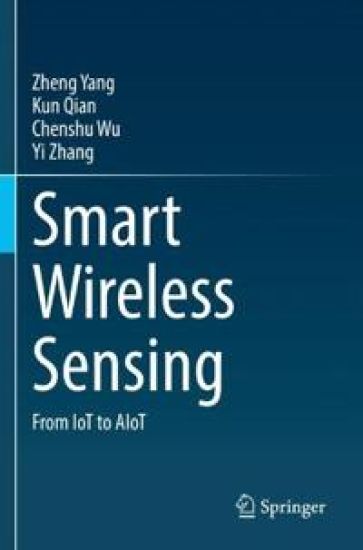
Perception of human beings has evolved from natural biosensor to powerful sensors and sensor networks. In sensor networks, trillions of devices are interconnected and sense a broad spectrum of contexts for human beings, laying the foundation of Internet of Things (IoT). However, sensor technologies have several limitations relating to deployment cost and usability, which render them unacceptable for practical use. Consequently, the pursuit of convenience in human perception necessitates a wireless, sensorless and contactless sensing paradigm. Recent decades have witnessed rapid developments in wireless sensing technologies, in which sensors detect wireless signals (such as acoustic, light, and radio frequency) originally designed for data transmission or lighting. By analyzing the signal measurements on the receiver end, channel characteristics can be obtained to convey the sensing results. Currently, significant effort is being devoted to employing the ambient Wi-Fi, RFID, Bluetooth, ZigBee, and television signals for smart wireless sensing, eliminating the need for dedicated sensors and promoting the prospect of the Artificial Intelligence of Things (AIoT). This book provides a comprehensive and in-depth discussion of wireless sensing technologies. Specifically, with a particular focus on Wi-Fi-based sensing for understanding human behavior, it adopts a top-down approach to introduce three key topics: human detection, localization, and activity recognition. Presenting the latest advances in smart wireless sensing based on an extensive review of state-of-the-art research, it promotes the further development of this area and also contributes to interdisciplinary research.
Smart Wireless Sensing

Smart Wireless Sensing

Zheng Yang; Kun Qian; Chenshu Wu; Yi Zhang

SPRINGER VERLAG, SINGAPORE
2021
sidottu
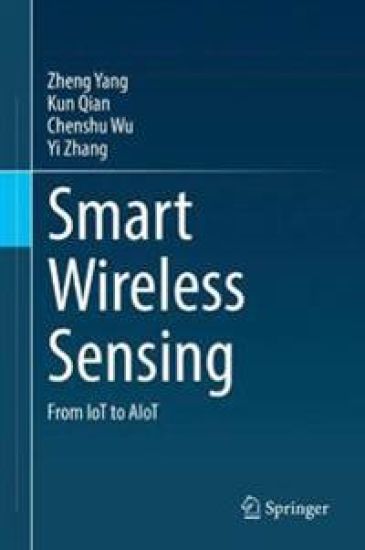
Perception of human beings has evolved from natural biosensor to powerful sensors and sensor networks. In sensor networks, trillions of devices are interconnected and sense a broad spectrum of contexts for human beings, laying the foundation of Internet of Things (IoT). However, sensor technologies have several limitations relating to deployment cost and usability, which render them unacceptable for practical use. Consequently, the pursuit of convenience in human perception necessitates a wireless, sensorless and contactless sensing paradigm. Recent decades have witnessed rapid developments in wireless sensing technologies, in which sensors detect wireless signals (such as acoustic, light, and radio frequency) originally designed for data transmission or lighting. By analyzing the signal measurements on the receiver end, channel characteristics can be obtained to convey the sensing results. Currently, significant effort is being devoted to employing the ambient Wi-Fi, RFID, Bluetooth, ZigBee, and television signals for smart wireless sensing, eliminating the need for dedicated sensors and promoting the prospect of the Artificial Intelligence of Things (AIoT). This book provides a comprehensive and in-depth discussion of wireless sensing technologies. Specifically, with a particular focus on Wi-Fi-based sensing for understanding human behavior, it adopts a top-down approach to introduce three key topics: human detection, localization, and activity recognition. Presenting the latest advances in smart wireless sensing based on an extensive review of state-of-the-art research, it promotes the further development of this area and also contributes to interdisciplinary research.