Kirjojen hintavertailu – 12 859 829 kirjaa ja 27 kauppaa

Kirjailija

Alexander Von Humboldt

Kirjat ja teokset yhdessä paikassa: 490 kirjaa, julkaisuja vuosilta 1983–2026, suosituimpiin kuuluu Stars, Mosquitoes, and Crocodiles: The American Travels of Alexander Von Humboldt. Vertaile teosten hintoja ja tarkista saatavuus suomalaisista kirjakaupoista.

490 kirjaa

Kirjojen julkaisuvuodet: 1983–2026.

Personal Narrative of Travels to the Equinoctial Regions of America, During the Year 1799-1804 - Volume 1

Personal Narrative of Travels to the Equinoctial Regions of America, During the Year 1799-1804 - Volume 1

Alexander von Humboldt; Aime Bonpland

BENEDICTION CLASSICS
2012
sidottu

Halvin toimitettuna 41,00 €

Alexander von Humboldt, sometimes called 'the last man who knew everything', was an extraordinary polymath of the late 18th and early 19th centuries. In 1798 he received unprecedented permission from the Spanish Crown to explore its American and Caribbean colonies, which he did from 1799-1804. This is the journal of those explorations, in which he extensively covers the region's topography, geology, fauna and flora, anthropology and comparative linguistics. Volume I covers his preparations, stop at Tenerife, landfall at Cuman and journeys inland in what is now Venezuela.
Tableaux de la nature

Tableaux de la nature

Alexander von Humboldt

Cambridge University Press
2012
pokkari
Alexander von Humboldt (1769–1859), 'the greatest scientific traveller who ever lived' according to Darwin, made groundbreaking contributions to the fields of geography, oceanography, climatology and ecology. In 1804, he returned from a five-year exploration of Latin America with an incredible wealth of specimens and data which provided the foundations for his theories on the natural order. He expounds them in this book, which was printed in German in 1808 before being translated by the geographer Jean-Baptiste Benoît Eyriès (1767–1846) and published in French in 1828. Humboldt does more than provide descriptions of the great features and phenomena of the Earth, ranging from the geological character of immense plains and steppes to the structure and action of volcanoes. He combines a rigorous scientific approach with his emotional and aesthetic responses to the natural world, thereby constructing a true 'philosophy of nature'.
A Geognostical Essay on the Superposition of Rocks in Both Hemispheres

A Geognostical Essay on the Superposition of Rocks in Both Hemispheres

Alexander von Humboldt

Cambridge University Press
2012
pokkari
The explorer and multi-disciplinary scientist Alexander von Humboldt (1769–1859) was a prominent figure in the European scientific community of the eighteenth and nineteenth centuries and the first to make a scientific survey of South and Central America. His travels alone brought him widespread recognition, but the extensive field notes and research he undertook were developed further on his return. Originally published in French and translated in 1823, this work brought his geological speculations to a British audience. Humboldt explores the positioning of different types of rocks across the globe, and the causes behind these formations. He also hypothesises that the flora of these areas are affected by the geology, which in turn is influenced by the thermal currents of the earth's molten core. These insights into rock formations are also key to Humboldt's theory of continental drift, now recognised as resulting from the shifting of the continental plates.
Essai géognostique sur le gisement des roches dans les deux hémisphères
Prussian explorer and naturalist Alexander von Humboldt (1769–1859) was described by Darwin as 'the greatest scientific traveller who ever lived'. His boundless curiosity as well as his scientific and cultural knowledge helped lay the foundations of physical geography, climatology, ecology and oceanography. In 1799, Humboldt embarked on a five-year trip to explore Central and South America. He devoted a large amount of time to the study of géognosie, the science of the origin and distribution of minerals and rocks forming the earth, later known as geology. In 1805, Humboldt published his first impressions of volcanoes and earthquakes in the Americas in his Personal Narrative. In this 1826 work, he makes the first systematic attempt to compare the rocks of the Old and New Worlds. This groundbreaking analysis became one of the most important geological works of its time.
Fragmens de géologie et de climatologie Asiatiques

Fragmens de géologie et de climatologie Asiatiques

Alexander von Humboldt

Cambridge University Press
2012
pokkari
Prussian explorer Alexander von Humboldt (1769–1859) was one of the most respected scientists of his day, influencing the work of Darwin. He is considered the founder of physical geography, climatology, ecology and oceanography. In 1829, the Russian government invited Humboldt to visit the gold and platinum mines in the Urals. As he studied the mountains' mineral wealth, he was the first to predict the presence of diamonds. During six months, his epic 10,000-mile expedition took him as far as the Altai Mountains and the Chinese frontier. Humboldt's observations on the geography, volcanic geology and meteorology of Central Asia, being then a largely unexplored territory, were acknowledged as pioneering contributions. The results of his journey also provided much of the data used in part of his great work Kosmos. The second volume of this book, published in 1831, deals with the hydrology and climatology of Central Asia.
Fragmens de géologie et de climatologie Asiatiques

Fragmens de géologie et de climatologie Asiatiques

Alexander von Humboldt

Cambridge University Press
2012
pokkari
Prussian explorer Alexander von Humboldt (1769–1859) was one of the most respected scientists of his day, influencing the work of Darwin. He is considered the founder of physical geography, climatology, ecology and oceanography. In 1829, the Russian government invited Humboldt to visit the gold and platinum mines in the Urals. As he studied the mountains' mineral wealth, he was the first to predict the presence of diamonds. During six months, his epic 10,000-mile expedition took him as far as the Altai Mountains and the Chinese frontier. Humboldt's observations on the geography, volcanic geology and meteorology of Central Asia, being then a largely unexplored territory, were acknowledged as pioneering contributions. The results of his journey also provided much of the data used in part of his great work Kosmos. The first volume of this book, published in 1831, deals with the mountain chains and volcanoes of Central Asia.
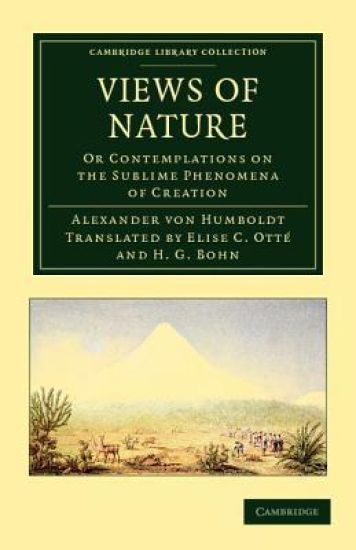
Views of Nature

Views of Nature

Alexander von Humboldt

Cambridge University Press
2011
pokkari
Alexander von Humboldt (1769–1859) was an intellectual giant: an explorer who helped lay the foundations of biogeography, a naturalist who influenced Charles Darwin, and a botanist who developed a model of the Earth's climate zones. He travelled extensively in Europe, carried out scientific explorations across the Russian Empire and in Latin America, and devoted much energy to seeking a unified view of the different branches of scientific knowledge. Ansichten der Natur, published in 1808 with a second edition in 1826, aimed to 'engage the imagination' as well as to communicate new ideas, and was translated into many European languages. This authorised translation of the third and final 1849 edition, dating from Humboldt's eightieth year, was published in 1850, though another English translation (by Mrs Sabine) had appeared the previous year. The wide coverage, including geology, geography and biology, is typical of Humboldt, as is the precise and engaging style.
Selections from the Works of the Baron de Humboldt, Relating to the Climate, Inhabitants, Productions, and Mines of Mexico
Alexander von Humboldt (1769–1859) was one of the most respected scientists of his time; Darwin called him 'the greatest scientific traveller who ever lived'. From 1799 Humboldt spent five years exploring the Americas, reporting his findings in thirty volumes, published over a period of more than twenty years from 1805. His Essai Politique, describing northern New Spain, particularly Mexico, was one of the first studies of a single country written to take account of both its history, its society and its political development. In 1824, the English mining engineer John Taylor published this abridged translation, combining it with passages from Humboldt's Geognostical Essay on the Superposition of Rocks in order to provide a focussed account of Mexico's mining concerns and opportunities. Including detailed maps, this work contains exhaustive statistics, particularly with regard to trade, agriculture and mining, alongside geographical studies and observations on the population and government.