Kirjojen hintavertailu – 12 859 829 kirjaa ja 27 kauppaa

Kirjailija

Alexander Von Humboldt

Kirjat ja teokset yhdessä paikassa: 490 kirjaa, julkaisuja vuosilta 1983–2026, suosituimpiin kuuluu Stars, Mosquitoes, and Crocodiles: The American Travels of Alexander Von Humboldt. Vertaile teosten hintoja ja tarkista saatavuus suomalaisista kirjakaupoista.

490 kirjaa

Kirjojen julkaisuvuodet: 1983–2026.

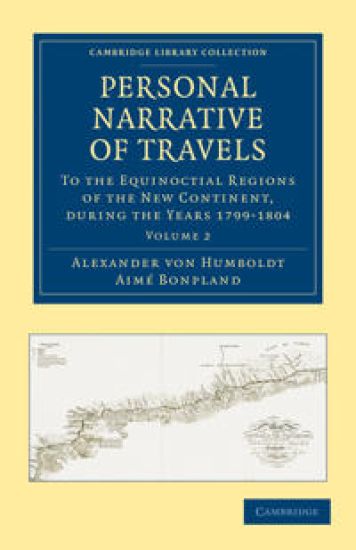
Personal Narrative of Travels to the Equinoctial Regions of the New Continent

Personal Narrative of Travels to the Equinoctial Regions of the New Continent

Alexander von Humboldt; Aimé Bonpland

Cambridge University Press
2011
pokkari
The Prussian naturalist Alexander von Humboldt (1769–1859) was one of the most famous explorers of his generation. Charles Darwin called him 'the greatest scientific traveller who ever lived'. In 1799, Humboldt and the botanist Aimé Bonpland secured permission from the Spanish crown for a voyage to South America. They left from Madrid and spent five years exploring the continent. Humboldt reported his findings in a total of thirty volumes, published in French over a period of more than twenty years beginning in 1805. This English translation by Helen Maria Williams of one important component of Humboldt's account, the Relation historique du voyage (1814–1825), consists of seven volumes and was published in London between 1814 and 1829. Volume 2 (1814) contains extensive physical observations of latitude, longitude, weather conditions and ocean temperature recorded during the voyage, and describes the expedition's arrival in Venezuela.
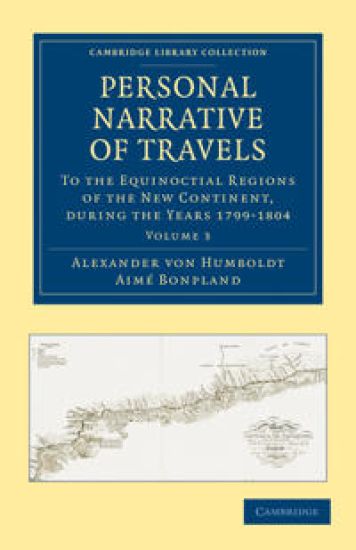
Personal Narrative of Travels to the Equinoctial Regions of the New Continent

Personal Narrative of Travels to the Equinoctial Regions of the New Continent

Alexander von Humboldt; Aimé Bonpland

Cambridge University Press
2011
pokkari
The Prussian naturalist Alexander von Humboldt (1769–1859) was one of the most famous explorers of his generation. Charles Darwin called him 'the greatest scientific traveller who ever lived'. In 1799, Humboldt and the botanist Aimé Bonpland secured permission from the Spanish crown for a voyage to South America. They left from Madrid and spent five years exploring the continent. Humboldt reported his findings in a total of thirty volumes, published in French over a period of more than twenty years beginning in 1805. This English translation by Helen Maria Williams of one important component of Humboldt's account, the Relation historique du voyage (1814–1825), consists of seven volumes and was published in London between 1814 and 1829. Volume 3 (1818) describes the mountains, flora and fauna of Venezuela, and its indigenous peoples, especially the Chayma, focusing particularly on their language.
Personal Narrative of Travels to the Equinoctial Regions of the New Continent

Personal Narrative of Travels to the Equinoctial Regions of the New Continent

Alexander von Humboldt; Aimé Bonpland

Cambridge University Press
2011
pokkari
The Prussian naturalist Alexander von Humboldt (1769–1859) was one of the most famous explorers of his generation. Charles Darwin called him 'the greatest scientific traveller who ever lived'. In 1799, Humboldt and the botanist Aimé Bonpland secured permission from the Spanish crown for a voyage to South America. They left from Madrid and spent five years exploring the continent. Humboldt reported his findings in a total of thirty volumes, published in French over a period of more than twenty years beginning in 1805. This English translation by Helen Maria Williams of one important component of Humboldt's account, the Relation historique du voyage (1814–1825), consists of seven volumes and was published in London between 1814 and 1829. Volume 4 (1819) describes an earthquake in Caracas (which Humboldt links to the volcanoes of the West Indies), and mountains, plains, hot springs and river systems observed as the expedition travelled onwards.
Personal Narrative of Travels to the Equinoctial Regions of the New Continent

Personal Narrative of Travels to the Equinoctial Regions of the New Continent

Alexander von Humboldt; Aimé Bonpland

Cambridge University Press
2011
pokkari
The Prussian naturalist Alexander von Humboldt (1769–1859) was one of the most famous explorers of his generation. Charles Darwin called him 'the greatest scientific traveller who ever lived'. In 1799, Humboldt and the botanist Aimé Bonpland secured permission from the Spanish crown for a voyage to South America. They left from Madrid and spent five years exploring the continent. Humboldt reported his findings in a total of thirty volumes, published in French over a period of more than twenty years beginning in 1805. This English translation by Helen Maria Williams of one important component of Humboldt's account, the Relation historique du voyage (1814–1825), consists of seven volumes and was published in London between 1814 and 1829. Volume 6 (1826) summarises many of Humboldt's findings about the North-East of South America, its topography and geology, and compares the societies of the mainland with those of the West Indies.
Political Essay on the Island of Cuba

Political Essay on the Island of Cuba

Alexander von Humboldt

University of Chicago Press
2011
sidottu
The research Alexander von Humboldt amassed during his five-year trek through the Americas in the early nineteenth century proved foundational to the fields of botany, geography, and geology. But his visit to Cuba during this time yielded observations that extended far beyond the natural world. "Political Essay on the Island of Cuba" is a physical and cultural study of the island nation. In it, Humboldt denounces colonial slavery on both moral and economic grounds and stresses the vital importance of improving intercultural relations throughout the Americas. Humboldt's most controversial book, "Political Essay on the Island of Cuba" was banned, censored, and willfully mistranslated to suppress Humboldt's strong antislavery sentiments. It re-emerges here, newly translated from the original two-volume French edition, to introduce a new generation of readers to Humboldt's astonishing multiplicity of scientific and philosophical perspectives. In their critical introduction, Vera M. Kutzinski and Ottmar Ette emphasize Humboldt's rare ability to combine scientific rigor with a cosmopolitan consciousness and a deeply felt philosophical humanism. The result is a work on Cuba of historical import that will attract historians of science as well as cultural historians, political scientists, and literary scholars.
Cosmos 2 Volume Paperback Set

Cosmos 2 Volume Paperback Set

Alexander von Humboldt

Cambridge University Press
2010
muu
Polymath Alexander von Humboldt (1769-1859), a self-described 'scientific traveller', was one of the most respected scientists of his time. Humboldt's wanderlust led him across Europe and to South America, Mexico, the U. S. and Russia, and his voyages and observations resulted in the discovery of many species previously unknown to Europeans. Originating as lectures delivered in Berlin and Paris (1827–1828), his two-volume Cosmos: Sketch of a Physical Description of the Universe (1845–1860) represented the culmination of his lifelong interest in understanding the physical world. As Humboldt writes, 'I ever desired to discern physical phenomena in their widest mutual connection, and to comprehend Nature as a whole, animated and moved by inward forces'. Volume 1 explains celestial and terrestrial phenomena, while Volume 2, demonstrating Humboldt's interest in representations of the natural world, examines poetic descriptions of nature, landscape painting, and how the physical universe was comprehended through history.
Cosmos

Cosmos

Alexander von Humboldt

Cambridge University Press
2010
pokkari
Polymath Alexander von Humboldt (1769–1859), a self-described 'scientific traveller', was one of the most respected scientists of his time. Humboldt's wanderlust led him across Europe and to South America, Mexico, the U. S. and Russia, and his voyages and observations resulted in the discovery of many species previously unknown to Europeans. Originating as lectures delivered in Berlin and Paris (1827–1828), his two-volume Cosmos: Sketch of a Physical Description of the Universe (1845–1860) represented the culmination of his lifelong interest in understanding the physical world. As Humboldt writes, 'I ever desired to discern physical phenomena in their widest mutual connection, and to comprehend Nature as a whole, animated and moved by inward forces'. Volume 2 (1848) reviews poetic descriptions of nature as well as landscape painting from antiquity through to modernity, before using the same time-span to examine a 'History of the Physical Contemplation of the Universe'.
Cosmos

Cosmos

Alexander von Humboldt

Cambridge University Press
2010
pokkari
Polymath Alexander von Humboldt (1769–1859), a self-described 'scientific traveller', was one of the most respected scientists of his time. Humboldt's wanderlust led him across Europe and to South America, Mexico, the U. S., and Russia, and his voyages and observations resulted in the discovery of many species previously unknown to Europeans. Originating as lectures delivered in Berlin and Paris (1827–1828), his multi-volume Cosmos: Sketch of a Physical Description of the Universe (1845–1860) represented the culmination of his lifelong interest in understanding the physical world. As Humboldt writes, 'I ever desired to discern physical phenomena in their widest mutual connection, and to comprehend Nature as a whole, animated and moved by inward forces.' Volume 1 (1846) investigates celestial and terrestrial phenomena, from nebulae to the temperature of the earth, as well as 'organic life'. Throughout, he stresses the method of, and limits to, describing the universe's physical nature.