Kirjojen hintavertailu – 12 859 829 kirjaa ja 27 kauppaa

Kirjailija

Alexander Von Humboldt

Kirjat ja teokset yhdessä paikassa: 490 kirjaa, julkaisuja vuosilta 1983–2026, suosituimpiin kuuluu Stars, Mosquitoes, and Crocodiles: The American Travels of Alexander Von Humboldt. Vertaile teosten hintoja ja tarkista saatavuus suomalaisista kirjakaupoista.

490 kirjaa

Kirjojen julkaisuvuodet: 1983–2026.

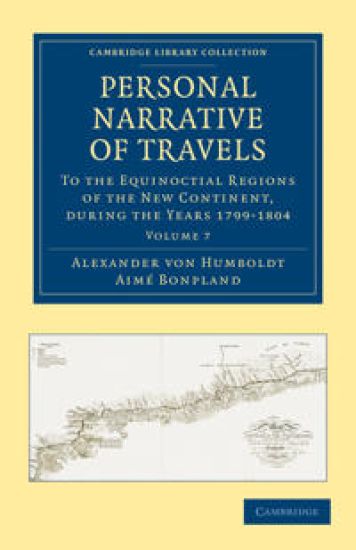
Personal Narrative of Travels to the Equinoctial Regions of the New Continent

Personal Narrative of Travels to the Equinoctial Regions of the New Continent

Alexander von Humboldt; Aimé Bonpland

Cambridge University Press
2011
pokkari
The Prussian naturalist Alexander von Humboldt (1769–1859) was one of the most famous explorers of his generation. Charles Darwin called him 'the greatest scientific traveller who ever lived'. In 1799, Humboldt and the botanist Aimé Bonpland secured permission from the Spanish crown for a voyage to South America. They left from Madrid and spent five years exploring the continent. Humboldt reported his findings in a total of thirty volumes, published in French over a period of more than twenty years beginning in 1805. This English translation by Helen Maria Williams of one important component of Humboldt's account, the Relation historique du voyage (1814–25), consists of seven volumes and was published in London between 1814 and 1829. Volume 7 (1829) focuses mainly on the geography of Cuba, its slave population and sugar production, and ends with Humboldt's experiences in Colombia.
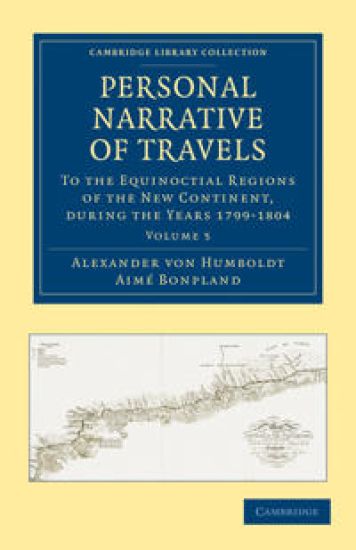
Personal Narrative of Travels to the Equinoctial Regions of the New Continent

Personal Narrative of Travels to the Equinoctial Regions of the New Continent

Alexander von Humboldt; Aimé Bonpland

Cambridge University Press
2011
pokkari
The Prussian naturalist Alexander von Humboldt (1769–1859) was one of the most famous explorers of his generation. Charles Darwin called him 'the greatest scientific traveller who ever lived'. In 1799, Humboldt and the botanist Aimé Bonpland secured permission from the Spanish crown for a voyage to South America. They left from Madrid and spent five years exploring the continent. Humboldt reported his findings in a total of thirty volumes, published in French over a period of more than twenty years beginning in 1805. This English translation by Helen Maria Williams of one important component of Humboldt's account, the Relation historique du voyage (1814–1825), consists of seven volumes and was published in London between 1814 and 1829. Volume 5 (1821) describes Humboldt's travels through the Orinoco basin and across several sets of rapids, and the indigenous people, missionaries, animals and plants he encountered on the journey.
Personal Narrative of Travels to the Equinoctial Regions of the New Continent

Personal Narrative of Travels to the Equinoctial Regions of the New Continent

Alexander von Humboldt; Aimé Bonpland

Cambridge University Press
2011
pokkari
The Prussian naturalist Alexander von Humboldt (1769–1859) was one of the most famous explorers of his generation. Charles Darwin called him 'the greatest scientific traveller who ever lived'. In 1799, Humboldt and the botanist Aimé Bonpland secured permission from the Spanish crown for a voyage to South America. They left from Madrid and spent five years exploring the continent. Humboldt reported his findings in a total of thirty volumes, published in French over a period of more than twenty years beginning in 1805. This English translation by Helen Maria Williams of one important component of Humboldt's account, the Relation historique du voyage (1814–1825), consists of seven volumes and was published in London between 1814 and 1829. Volume 1 describes the beginning of the expedition, its departure from Spain, experiments conducted on board ship, and the scientists' arrival in the Canary Islands and exploration of Tenerife.
Researches, Concerning the Institutions and Monuments of the Ancient Inhabitants of America, with Descriptions and Views of Some of the Most Striking Scenes in the Cordilleras!
Alexander von Humboldt (1769–1859) was an internationally respected scientist and explorer whose meticulous approach to scientific observation greatly influenced later research. He travelled the world, once staying at the White House as a guest of Thomas Jefferson, and is commemorated in the many species and places which bear his name. This two volume work, published in French in 1810 as Vue des Cordillères, and in this English translation in 1814, was one of the many publications that resulted from Humboldt's expedition to Latin America in 1799–1804. It describes geographical features such as volcanoes and waterfalls, and aspects of the indigenous cultures including architecture, sculpture, art, languages and writing systems, religions, costumes and artefacts. This approachable, closely observed travelogue vividly recounts a huge variety of impressions and experiences, and reveals Humboldt's boundless curiosity as well as his scientific and cultural knowledge.

Researches, Concerning the Institutions and Monuments of the Ancient Inhabitants of America, with Descriptions and Views of Some of the Most Striking Scenes in the Cordilleras!
Alexander von Humboldt (1769–1859) was an internationally respected scientist and explorer whose meticulous approach to scientific observation greatly influenced later research. He travelled the world, once staying at the White House as a guest of Thomas Jefferson, and is commemorated in the many species and places which bear his name. This two volume work, published in French in 1810 as Vue des Cordillères, and in this English translation in 1814, was one of the many publications that resulted from Humboldt's expedition to Latin America in 1799–1804. It describes geographical features such as volcanoes and waterfalls, and aspects of the indigenous cultures including architecture, sculpture, art, languages and writing systems, religions, costumes and artefacts. This approachable, closely observed travelogue vividly recounts a huge variety of impressions and experiences, and reveals Humboldt's boundless curiosity as well as his scientific and cultural knowledge.