Kirjojen hintavertailu – 12 859 819 kirjaa ja 27 kauppaa
Kirjailija
Annie Besant
Kirjat ja teokset yhdessä paikassa: 481 kirjaa, julkaisuja vuosilta 1887–2026, suosituimpiin kuuluu May a Christian Believe in Reincarnation?. Vertaile teosten hintoja ja tarkista saatavuus suomalaisista kirjakaupoista.
Annie Besant was a writer, lecturer, prominent Theosophist and women's rights activist of her time. She was a frequent contributor to various Theosophical publications of her day. This particular piece dates to 1913, and she's writing about the Ancient Mysteries as compared to the modern religions of the world. She also discusses the Great White Brotherhood, Initiation, the Rosicrucians, Madame Blavatsky and other related topics. Also included is the essay The Value of Devotion
Annie Besant was a prolific author and lecturer within the Theosophy movement. Here she looks for the lost mystical tradition that was once a larger part of Christianity, sometimes known as the Lesser Mysteries, and she examines clues showing that there is still a hidden tradition within the surviving teachings.
Annie Besant was a prolific author and lecturer of Theosophy, as well as an early Feminist icon for many. Here she examines the story of Christ from several different perspectives and gives the reader a lot of philosophical food for thought.
This work has been selected by scholars as being culturally important and is part of the knowledge base of civilization as we know it. This work is in the public domain in the United States of America, and possibly other nations. Within the United States, you may freely copy and distribute this work, as no entity (individual or corporate) has a copyright on the body of the work. Scholars believe, and we concur, that this work is important enough to be preserved, reproduced, and made generally available to the public. To ensure a quality reading experience, this work has been proofread and republished using a format that seamlessly blends the original graphical elements with text in an easy-to-read typeface. We appreciate your support of the preservation process, and thank you for being an important part of keeping this knowledge alive and relevant.
This work has been selected by scholars as being culturally important and is part of the knowledge base of civilization as we know it. This work is in the public domain in the United States of America, and possibly other nations. Within the United States, you may freely copy and distribute this work, as no entity (individual or corporate) has a copyright on the body of the work. Scholars believe, and we concur, that this work is important enough to be preserved, reproduced, and made generally available to the public. To ensure a quality reading experience, this work has been proofread and republished using a format that seamlessly blends the original graphical elements with text in an easy-to-read typeface. We appreciate your support of the preservation process, and thank you for being an important part of keeping this knowledge alive and relevant.
This book has been considered by academicians and scholars of great significance and value to literature. This forms a part of the knowledge base for future generations. So that the book is never forgotten we have represented this book in a print format as the same form as it was originally first published. Hence any marks or annotations seen are left intentionally to preserve its true nature.
Annie Besant was a writer, lecturer, prominent Theosophist and women's rights activist of her time. She was a frequent contributor to various Theosophical publications of her day. This particular piece dates to 1910, and she takes a philosophical examination of the mysteries of evil, as she puts it. She explains that there is a necessity for evil to exist, that it serves certain purposes, which she goes into detail about. She breaks evil into four categories: the origin of evil, the relativity of evil, the use of evil and the ending of evil.
The book, Death--and After?, has been considered important throughout the human history, and so that this work is never forgotten we have made efforts in its preservation by republishing this book in a modern format for present and future generations. This whole book has been reformatted, retyped and designed. These books are not made of scanned copies of their original work and hence the text is clear and readable.
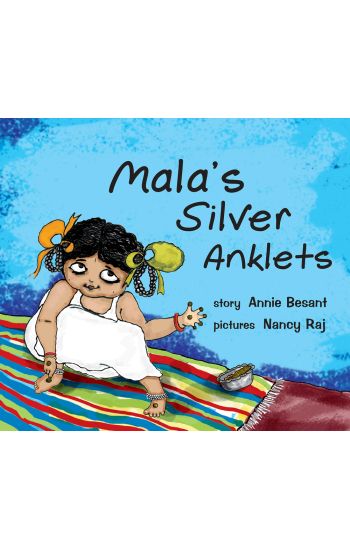
Age range 3+Impish little Mala loves creeping up from behind and scaring everyone. Then her mother gives her a pair of pretty silver anklets...so now she goes chik chik chum, and everyone gets to know when she's coming! What does Mala do next?
We have often heard it said that thoughts are things, and there are many among us who are persuaded of the truth of this statement. Yet very few of us have any clear idea as to what kind of thing a thought is, and the object of this little book is to help us to conceive this. Man, the Thinker, is clothed in a body composed of innumerable combinations of the subtle matter of the mental plane, this body being more or less refined in its constituents and organised more or less fully for its functions, according to the stage of intellectual development at which the man himself has arrived. The mental body is an object of great beauty, the delicacy and rapid motion of its particles giving it an aspect of living iridescent light, and this beauty becomes an extraordinarily radiant and entrancing loveliness as the intellect becomes more highly evolved and is employed chiefly on pure and sublime topics. Every thought gives rise to a set of correlated vibrations in the matter of this body, accompanied with a marvellous play of colour, like that in the spray of a waterfall as the sunlight strikes it, raised to the nth degree of colour and vivid delicacy. The body under this impulse throws off a vibrating portion of itself, shaped by the nature of the vibrations-as figures are made by sand on a disk vibrating to a musical note-and this gathers from the surrounding atmosphere matter like itself in fineness from the elemental essence of the mental world. We have then a thought-form pure and simple, and it is a living entity of intense activity animated by the one idea that generated it. If made of the finer kinds of matter, it will be of great power and energy, and may be used as a most potent agent when directed by a strong and steady will. Into the details of such use we will enter later. When the man's energy flows outwards towards external objects of desire, or is occupied in passional and emotional activities, this energy works in a less subtle order of matter than the mental, in that of the astral world. What is called his desire-body is composed of this matter, and it forms the most prominent part of the aura in the undeveloped man. Where the man is of a gross type, the desire-body is of the denser matter of the astral plane, and is dull in hue, browns and dirty greens and reds playing a great part in it. Through this will flash various characteristic colours, as his passions are excited. A man of a higher type has his desire-body composed of the finer qualities of astral matter, with the colours, rippling over and flashing through it, fine and clear in hue. While less delicate and less radiant than the mental body, it forms a beautiful object, and as selfishness is eliminated all the duller and heavier shades disappear. This desire (or astral) body gives rise to a second class of entities, similar in their general constitution to the thought-forms already described, but limited to the astral plane, and generated by the mind under the dominion of the animal nature.
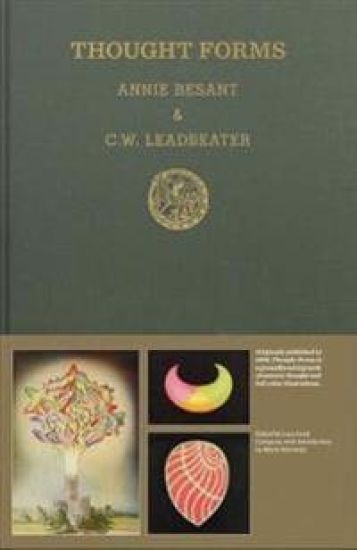
First released in 1901, Thought-Forms was an in-depth exploration on the visual manifestations of thoughts and the notion that they exist as objects. Conceived by renowned theosophists Annie Besant and C. W. Leadbeater, the book consists of 58 illustrations based on Besant and Leadbeater's clairvoyant observations on how music, emotions, experiences, and colors affect thought forms. Expanding beyond its original readership, the book would have great influence on twentieth-century art and go on to inspire many artists including Wassily Kandinsky, Hilma af Klint, Piet Mondrian, and Paul Klee. This updated edition features a new introduction by famed occult author, Mitch Horowitz.