Kirjojen hintavertailu – 12 859 827 kirjaa ja 27 kauppaa
Kirjailija
Charles Dickens
Kirjat ja teokset yhdessä paikassa: 4 944 kirjaa, julkaisuja vuosilta 1843–2027, suosituimpiin kuuluu Saiturin joulu. Vertaile teosten hintoja ja tarkista saatavuus suomalaisista kirjakaupoista.
While the three ghosts that visited Ebenezer Scrooge was Charles Dickens' most famous apparitions, his interest in the supernatural did not end there. Three Ghost Stories is just that: a collection of three different stories that are true Gothic classics. The three stories, The Signal Man, The Haunted House and The Trial for Murder were sensational for their time and continue to hold up well, thanks to Charles Dickens' superb skills at storytelling. The Signal Man is the most well known of the three, chronicling the haunting of a railroad signal man who is visited by a ghost just before a tragic event is to happen on the railway. If you like Dickens and tales of spectres and the supernatural, you'll love Three Ghost Stories.
A Christmas Carol: Special Edition By Charles Dickens A Christmas Carol in Prose, Being a Ghost-Story of Christmas, commonly known as A Christmas Carol, is a novella by Charles Dickens, first published in London by Chapman & Hall in 1843; the first edition was illustrated by John Leech. A Christmas Carol tells the story of Ebenezer Scrooge, an old miser who is visited by the ghost of his former business partner Jacob Marley and the Ghosts of Christmas Past, Present and Yet to Come. After their visits Scrooge is transformed into a kinder, gentler man. Dickens wrote A Christmas Carol at a time when the British were examining and exploring Christmas traditions from the past, such as carols, as well as new customs such as Christmas trees. He was influenced by experiences from his own past, and from the Christmas stories of other authors, including Washington Irving and Douglas Jerrold. Dickens had written three Christmas stories prior to the novella, and was inspired to write the story following a visit to the Field Lane Ragged school, one of several establishments for London's half-starved, illiterate street children. The treatment of the poor and the ability of a self-interested man redeeming himself by transforming into a more sympathetic character are the key themes of the story. There is discussion among academics as to whether this was a fully secular story, or if it is a Christian allegory. We are delighted to publish this classic book as part of our extensive Classic Library collection. Many of the books in our collection have been out of print for decades, and therefore have not been accessible to the general public. The aim of our publishing program is to facilitate rapid access to this vast reservoir of literature, and our view is that this is a significant literary work, which deserves to be brought back into print after many decades. The contents of the vast majority of titles in the Classic Library have been scanned from the original works. To ensure a high quality product, each title has been meticulously hand curated by our staff. Our philosophy has been guided by a desire to provide the reader with a book that is as close as possible to ownership of the original work. We hope that you will enjoy this wonderful classic work, and that for you it becomes an enriching experience.
Rare and elegant classic cream paper edition. The "two cities" are Paris in the time of the French Revolution, and London. Dr. Manette, a French physician, having been called in to treat a young peasant and his sister, realizes that they have been cruelly abused by the Marquis de St. Evremonde and his brother. To ensure Dr. Manette's silence, the Marquis has him confined for eighteen years in the Bastille. The doctor has just been released, demented, when the story opens. He is brought to England where he gradually recovers his health and his sanity. Charles Darnay, concealing under that false name his identity as the nephew of the cruel Marquis, has left France and renounced his heritage. He falls in love with Lucie, Dr. Manette's daughter, and they are happily married. During the Terror, he goes to Paris to save a servant condemned by the mob. Darnay himself is arrested, condemned to death, and is saved at the last moment by Sydney Carton, a reckless wastrel who acts out of devotion to Lucie. Carton smuggles Darnay out of prison and takes his place on the scaffold, declaring "It's a far, far better thing I do than I have ever done before," surely one of the most quoted lines in all the history of literature.
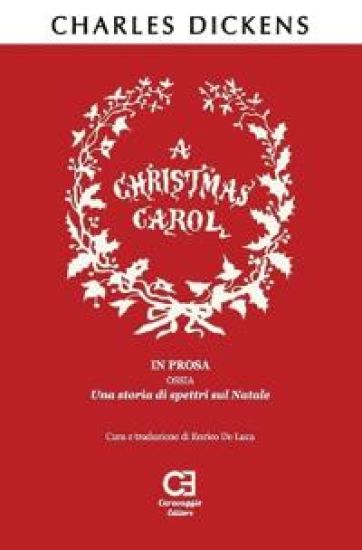
A Scrooge, vecchio e insensibile usuraio, poco importa del Natale e del bene che potrebbe fare agli altri, da Fred, suo unico nipote, a Bob Cratchit, suo misero e sfruttato impiegato. Ma proprio la notte di Natale gli appare lo spettro del defunto socio in affari, Jacob Marley, il quale, dopo averlo aspramente rimproverato per la sua riprovevole condotta, gli preannuncia la visita di tre fantasmi. Essi gli permetteranno di viaggiare nel Natale passato, presente e futuro e di osservare il suo se stesso com'era un tempo non molto lontano, come fosse profondamente cambiato e a cosa sarebbe andato incontro. Scrooge, provato e colpito da questo viaggio psichico, riesce a comprendere una verit insospettata: solo l'amore pu dare un significato alla vita di ogni essere umano. A Christmas Carol, inaugurale racconto natalizio, conserva intatto ancora oggi il suo potere di commuovere e di additare all'umanit un esempio di fratellanza e un cammino di speranza. Mi chiedo se per caso hai letto i Racconti di Natale di Dickens. ...] Io ne ho letti due, e ho pianto come un bambino, ho fatto uno sforzo incredibile per smettere. Quanto vero Dio, sono meravigliosi, e mi sento cos bene dopo averli letti. Voglio uscire a far del bene a qualcuno ...]. Oh, come bello che un uomo abbia potuto scrivere libri come questi riempiendo di compassione il cuore delle persone . Cos si esprimeva Robert Luis Stevenson, autore dell'Isola del Tesoro, riferendosi ad una delle opere pi celebri e lette di Dickens, A Christmas Carol, che risulta essere indubbiamente un piccolo grande libro al fascino del quale difficile sottrarsi e che, per la prima volta in Italia, offerto ai lettori moderni col titolo originale in una nuova, integrale e commentata edizione a cura di Enrico De Luca. La copertina riprende la grafica della prima edizione del 1843. ***
Regarded as one of Charles Dickens's masterpieces, Great Expectations is the story of the orphan Pip and his growth to adulthood. Supported by a mysterious anonymous benefactor, Pip travels to London to be educated as a gentleman and make himself worthy of the hand of the beautiful Estella, the ward of the reclusive Miss Havisham. But Pip finds life in London more dangerous and unpredictable than he could have imagined, and his future prospects turn out to be very different from what his great expectations had prepared him for.
The Mystery of Edwin Drood is the final novel by Charles Dickens. The novel was unfinished at the time of Dickens's death (9 June 1870) and his ending for it is unknown. Though the novel is named after the character Edwin Drood, the story focuses on Drood's uncle, precentor, choirmaster and opium addict, John Jasper, who is in love with his pupil, Rosa Bud. Miss Bud, Drood's fianc e, has also caught the eye of the high-spirited and hot-tempered Neville Landless, who comes from Ceylon with his twin sister, Helena. Landless and Drood take an instant dislike to one another. Drood later disappears under mysterious circumstances. The story is set in Cloisterham, a lightly disguised Rochester. Mr Crisparkle, for example, lives in a clergy house in Minor Canon Corner, which corresponds to a genuine address within the precincts of Rochester Cathedral, namely Minor Canon Row.
In an overgrown churchyard, a grizzled convict springs upon an orphan boy named Pip. The convict terrifies Pip and threatens to kill him unless the boy helps further his escape. Later, Pip finds himself in a ruined garden where he meets the embittered and crazy Miss Havisham and her foster child, Estella, with whom he instantly falls in love. After a secret benefactor gives him a fortune, Pip moves to London, where he cultivates great expectations for a life that would allow him to discard his impoverished beginnings and socialize with members of the idle upper class. As Pip struggles to become a gentleman, he slowly learns the truth about himself and his illusions, and is tormented endlessly by the beautiful Estella. Written in the last decade of Dickens's life, Great Expectations reveals the author's dark attitudes toward Victorian society, its inherent class structure, and its materialism. Yet it persists as one of Dickens's most popular novels. Richly comic and immensely readable, Great Expectations is a tapestry woven of vividly drawn characters, moral maelstroms, and the sorrow and pity of love.
This book is also available in a variety of formats including dyslexia-friendly and annotation-friendly editions. See firestonebooks.com for more information - including bulk discounts for schools.
Upon its publication in 1857, Little Dorrit immediately outsold any of Dickens's previous books. The story of William Dorrit, imprisoned for debt in Marshalsea Prison, and his daughter and helpmate, Amy, or Little Dorrit, the novel charts the progress of the Dorrit family from poverty to riches. In his Introduction, David Gates argues that "intensity of imagination is the gift from which Dickens's other great attributes derive: his eye and ear, his near-universal empathy, his ability to entertain both a sense of the ridiculous and a sense of ultimate significance."
Charles Dickens' Dombey and Son tells the story of the wealthy owner of a shipping company, Paul Dombey, who dreams of having a son to carry on the family business. It deals with themes such as marriage for financial gain, cruelty towards children, family relationships, pride, arrogance, betrayal and the destructive effects of industrialization.
A Christmas Carol in Prose, Being a Ghost-Story of Christmas, commonly known as A Christmas Carol, is a novella by Charles Dickens, first published in London by Chapman & Hall in 1843. A Christmas Carol tells the story of Ebenezer Scrooge, an old miser who is visited by the ghost of his former business partner Jacob Marley and the Ghosts of Christmas Past, Present and Yet to Come. After their visits Scrooge is transformed into a kinder, gentler man. Dickens wrote A Christmas Carol at a time when the British were examining and exploring Christmas traditions from the past, such as carols, as well as new customs such as Christmas trees.
The story concerns Paul Dombey, the wealthy owner of the shipping company of the book's title, whose dream is to have a son to continue his business. The book begins when his son is born and Dombey's wife dies shortly after giving birth. Following the advice of Mrs. Louisa Chick, his sister, Dombey employs a wet nurse named Mrs. Richards (Toodle). Dombey already has a six-year-old daughter Florence, but, bitter at her not having been the desired boy, he neglects her continually. One day, Mrs. Richards, Florence, and her maid, Susan Nipper, secretly pay a visit to Mrs. Richard's house in Staggs's Gardens so that Mrs. Richards can see her children. During this trip, Florence becomes separated from them and is kidnapped for a short time by Good Mrs. Brown, before being returned to the streets. She makes her way to Dombey and Son's offices in the City and there is found and brought home by Walter Gay, an employee of Mr. Dombey, who first introduces her to his uncle, the navigation instrument maker Solomon Gills, at his shop The Wooden Midshipman. The child, named Paul after his father, is a weak and sickly child, who does not socialise normally with others; adults call him "old fashioned". He is intensely fond of his sister Florence, who is deliberately neglected by her father as irrelevant and a distraction. He is sent to the seaside at Brighton for his health, where he and Florence lodge with the ancient and acidic Mrs. Pipchin. Finding his health beginning to improve there, Mr. Dombey keeps him at Brighton and has him educated there at Dr. and Mrs. Blimber's school, where he and the other boys undergo both an intense and arduous education under the tutelage of Mr. Feeder, B. A. and Cornelia Blimber. It is here that Paul is befriended by a fellow pupil, the amiable but weak-minded Mr. Toots. Here, Paul's health declines even further in this 'great hothouse' and he finally dies, still only six years old. Dombey pushes his daughter away from him after the death of his son, while she futilely tries to earn his love. In the meantime, young Walter sent off to fill a junior position in the firm's counting house in Barbados through the manipulations of Mr Dombey's confidential manager, Mr James Carker, 'with his white teeth', who sees him as a potential rival through his association with Florence. His boat is reported lost and he is presumed drowned. Walter's uncle leaves to go in search of Walter, leaving his great friend Captain Edward Cuttle in charge of The Midshipman. Meanwhile, Florence is now left alone with few friends to keep her company.