Kirjojen hintavertailu – 12 903 727 kirjaa ja 27 kauppaa

Kirjailija

Charles River

Kirjat ja teokset yhdessä paikassa: 4 673 kirjaa, julkaisuja vuosilta 2013–2022, suosituimpiin kuuluu William Powell and Myrna Loy: The Lives and Careers of One of Classical Hollywood's Most Iconic Duos. Vertaile teosten hintoja ja tarkista saatavuus suomalaisista kirjakaupoista.

4 673 kirjaa

Kirjojen julkaisuvuodet: 2013–2022.

The Advent of Early Modern Warfare: The History of the Transition from Medieval Military Tactics to the Age of Gunpowder
*Includes pictures *Includes accounts of medieval battles *Includes online resources and a bibliography for further reading In the time period between the fall of Rome and the spread of the Renaissance across the European continent, many of today's European nations were formed, the Catholic Church rose to great prominence, some of history's most famous wars occurred, and a social class system was instituted that lasted over 1,000 years. A lot of activity took place during a period frequently labeled derogatively as the "Dark Ages," and while that period of time is mostly referred to as the "Middle Ages" instead of the Dark Ages today, it has still retained the stigma of being a sort of lost period of time in which Western civilization made no worthwhile progress after the advances of the ancient civilizations of Greece and Rome. In reality, this oversimplification of the Middle Ages overlooks the progress made in the studies of sciences and philosophy, especially during the High Middle Ages. It also ignores the fact that one of the most important inventions of the last millennium was created in Germany during the Late Middle Ages, the printing press, which allowed the Renaissance to move across the continent and help position Western Europe as the wealthiest region in the world. If anything, the one aspect of the Middle Ages that has been romanticized is medieval warfare. Indeed, the Middle Ages have long sparked people's imaginations thanks to imagery of armored knights battling on horseback and armies of men trying to breach the walls of formidable castles. What is generally forgotten is that medieval warfare was constantly adapting to the times as leaders adopted new techniques and technology, and common infantry became increasingly important throughout the period. Starting around 1000 CE, there was a gradual consolidation of power in the region after the fragmentation of the Early Middle Ages, and it brought about the rise of more centralized states that could field large armies. The Normans, one of the first groups to do this, were notable for their discipline and organization, and it's little surprise that they were the last foreigners to successfully invade Britain under William the Conqueror in the mid-11th century. Meanwhile, political and technological progress led to continuous change of tactics and equipment. Cavalry became ascendant, only to be later replaced by infantry as their weapons improved. By the end of the period, warfare was radically changing thanks to the rise of gunpowder weapons such as the handgonne and the bombard.

Opus Dei and the Jesuits: The History and Legacy of the Roman Catholic Church's Most Famous Orders
*Includes pictures *Includes descriptions of the groups *Includes online resources and a bibliography for further reading Thanks to Dan Brown's bestselling novel turned blockbuster mega-hit, The Da Vinci Code, in which audiences were introduced to Silas, the villainous, self-whipping monk, corporal mortification is now a term most often associated with Opus Dei. A creepy, deranged, and blood-thirsty albino monk, Silas is most remembered for viciously whipping himself with a nail-embedded cilice. For added suspense, various falsehoods of the real-life order have been propagated by the literary masterpiece; in fact, the character of Silas contains one of the foremost bloopers, as there were never any monks in the order. Hollywood magic aside, the Opus Dei describes itself as a Catholic-based organization composed of "ordinary" Christian laymen and a small fraction of priests who have dedicated their lives to spreading the word and love of God. Its founder, Josemar a Escriv , has since been inducted into the sainthood. Though some have taken the sinister portrayals of the Opus Dei in good humor, much the way similar conspiracy theories hound the Freemasons, the depiction of the order has left a bad taste in the mouths of many, including the Opus Dei themselves. Members of the powerful Catholic organization have risen to their own defense. Having said that, while there are indeed a trove of glittering claims that can be quickly disproven, some of the scandals the group has found itself involved in have left plenty of people stroking their chins. On top of allegations of connections and unfair favoritism from the Vatican, chronicles of stories from former members have continuously surfaced over the years. Of all of the important Catholic men and women who have been venerated over the last 2,000 years, one of the faith's most popular and influential men also lived one of the most unique lives. Like Roman Emperor Constantine the Great, St. Ignatius of Loyola (1491-1556) found God about as far away from church as possible; it was during military service that he underwent a remarkable conversion. A Spanish knight who hailed from a noble Basque family, Ignatius seemed destined for military glory until he was badly wounded in 1521 during the Battle of Pamplona. While convalescing, Ignatius began reading De Vita Christi by Ludolph of Saxony, after which he began a tireless career in service of the Catholic Church. After spending several years studying the faith, Ignatius formed the Society of Jesus in 1539, and as its Superior General, he sent followers as missionaries across Europe to create schools, colleges, and seminaries. On September 27, 1540, Pope Paul issued a Papal Bull recognizing the church's newest religious order not as the Company of Jesus but as the Society of Jesus. The one thing that is clear is that neither Pope Paul, nor Ignatius, ever intended for members of the order to be known as the Jesuits. This term was initially given to them by their critics and was a derogatory term applied to those who spent too much time, in the opinion of those coining the phrase, speaking of Jesus in their conversations. It was only years later that the term became a popular and acceptable nickname for the Society of Jesus, and the Jesuits remain active across the world nearly 500 years later. Opus Dei and the Jesuits: The History and Legacy of the Roman Catholic Church's Most Famous Orders examines the founding of the organizations, their worldwide expansion, and the ongoing scandals that seem to emanate from them. Along with pictures depicting important people, places, and events, you will learn about Opus Dei and the Jesuits like never before.
Frank Lloyd Wright: The Life and Buildings of America's Most Famous Architect

Frank Lloyd Wright: The Life and Buildings of America's Most Famous Architect

Charles River

Createspace Independent Publishing Platform
2017
nidottu
"The architect must be a prophet... a prophet in the true sense of the term... if he can't see at least ten years ahead don't call him an architect." - Frank Lloyd WrightPerhaps America's most innovative and prolific architect, the works of Frank Lloyd Wright are almost too vast and diverse to list. Recognized for designing unique churches and distinctive commercial buildings, and admired for his geometric style house designs, Wright has been widely imitated, and his work continues to influence architecture not only in the United States but around the world. Laymen often think they know the definition of "a Frank Lloyd Wright," but they probably don't fully understand the brilliant mind of the man, nor the intricacies of his Prairie Style. Yet it endures because he has made it so. In many ways, Wright's architectural career has overshadowed other aspects of his life. In the course of creating innovative kinds of offices, churches, schools, skyscrapers, hotels, and museums, not to mention furniture and stained glass decorations, Wright wrote over a dozen books and toured America and Europe at large, often giving widely acclaimed speeches. Despite a somewhat hardscrabble start to life in the Midwest, Wright became known for his flamboyant and entertaining lifestyle, which included multiple marriages and scandals like the murders at his Taliesin studio in 1914. But through it all, Wright continued working nearly up until his death, and in 1991 the American Institute of Architects recognized him as "the greatest American architect of all time"Frank Lloyd Wright: The Life and Buildings of America's Most Famous Architect looks at the life and works of one of history's greatest builders. Along with pictures of important people, places, and events, you will learn about Frank Lloyd Wright like never before.
The Dynasties of Ancient Egypt: The History and Legacy of the Pharaohs from the Beginning of Egyptian Civilization to the Rise of Rome
*Includes pictures *Includes ancient accounts *Includes online resources and a bibliography for further reading Africa may have given rise to the first human beings, and Egypt probably gave rise to the first great civilizations, which continue to fascinate modern societies across the globe nearly 5,000 years later. From the Library and Lighthouse of Alexandria to the Great Pyramid at Giza, the Ancient Egyptians produced several wonders of the world, revolutionized architecture and construction, created some of the world's first systems of mathematics and medicine, and established language and art that spread across the known world. With world-famous leaders like King Tut and Cleopatra, it's no wonder that today's world has so many Egyptologists. What makes the accomplishments of the Ancient Egyptians all the more remarkable is that Egypt was historically a place of great political turbulence. Its position made it both valuable and vulnerable to tribes across the Mediterranean and the Middle East, and Ancient Egypt had no shortage of its own internecine warfare. Its most famous conquerors would come from Europe, with Alexander the Great laying the groundwork for the Hellenic Ptolemy line and the Romans extinguishing that line after defeating Cleopatra and driving her to suicide. Perhaps the most intriguing aspect of ancient Egyptian civilization was its inception from the ground up, as the ancient Egyptians had no prior civilization which they could use as a template. In fact, ancient Egypt itself became a template for the civilizations that followed. The Greeks and the Romans were so impressed with Egyptian culture that they often attributed many attributes of their own culture (usually erroneously) to the Egyptians. With that said, some minor elements of ancient Egyptian culture were, indeed, passed on to later civilizations. Egyptian statuary appears to have had an initial influence on the Greek version, and the ancient Egyptian language continued long after the pharaonic period in the form of the Coptic language. Although the Egyptians may not have passed their civilization directly on to later peoples, the key elements that comprised Egyptian civilization - their religion, early ideas of state, and art and architecture - can be seen in other pre-modern civilizations. For instance, civilizations far separated in time and space, such as China and Mesoamerica, possessed key elements that were similar to those found in ancient Egypt. Indeed, since Egyptian civilization represented some fundamental human concepts, a study of pharaonic culture can be useful when trying to understand many other pre-modern cultures. Thus, anyone who reads about ancient Egyptian civilization in this regard is best served by looking at its earliest phases: the Early Dynastic Period and the Old Kingdom. By examining the Old Kingdom and the period immediately preceding it, attributes considered quintessentially "Egyptian" in later periods will become clearer. The end of the Ptolemies also happened to coincide with the most famous period of Roman history. In the latter 1st century BCE, men like Julius Caesar, Mark Antony, and Octavian participated in two civil wars that would spell the end of the Roman Republic and determine who would become the Roman emperor. In the middle of it all was history's most famous woman, Cleopatra, who famously seduced both Caesar and Antony and thereby positioned herself as one of the most influential people in a world of powerful men. Cleopatra was a legendary figure even to contemporary Romans and the ancient world, and she was a controversial figure who was equally reviled and praised through the years, depicted both as a benevolent ruler and an evil seductress (occasionally at the same time). The Dynasties of Ancient Egypt: The History and Legacy of the Pharaohs from the Beginning of Egyptian Civilization to the Rise of Rome chronicles the tumultuous history of Ancient Egy
Olaudah Equiano: The Life and Legacy of the Freed Slave Whose Autobiography Fueled Britain's Abolitionist Movement
*Includes pictures *Includes Equiano's quotes about his life and work *Includes online resources and a bibliography for further reading "I believe there are few events in my life which have not happened to many; it is true the incidents of it are numerous, and, did I consider myself an European, I might say my sufferings were great; but when I compare my lot with that of most of my countrymen, I regard myself as a particular favorite of heaven, and acknowledge the mercies of Providence in every occurrence of my life." - Olaudah Equiano The slave trade that brought African captives to Europe and the Americas was established in the 15th century by merchants controlling Portugal's booming trade routes, but the perception of the non-white as an unconscious, undeveloped being had been prevalent in more ancient times. By the time Britain's European neighbors and the American colonies had fully invested in the African as a beast of burden fit only for servitude, little had changed over the parade of empires that had come and gone. Accounts of rhetorical exchanges and messages from the pulpits of the 17th century are said to have contested the idea of whether Africans were in possession of souls. In the minds of some, colonial slaves shared this distinction with women of any color. The movement to abolish slavery in Britain, the continent, and subsequently, the New World, began to gain traction with the British community by the early 18th century. This took place some years before similar uprisings in the Americas but was hampered by the fact that neither the typical Briton nor the average American ever saw the inner-workings of the slave trade world. The stealing of humans from the African coast, the domestic marketplace, and the infamously cruel shipment of human cargo to the West was not witnessed by most people, living apart as they did from the stealing, buying, and selling. Abolitionists, such as Thomas Clarkson and numerous others, took it upon themselves to break down the walls of the African myth and reveal to the white citizenry the slave trade's central process in graphic images and descriptions. Such an effort won its share of supporters over time, however, when an African man and freed slave wrote his own autobiographical narrative, speaking to learned audiences as their equal, the paradigm was rocked to its foundations. Olaudah Equiano challenged the image of the unconscious African beast with such intellect, philosophical refinement, public presence, and elegant writing, that standard British perceptions began to unravel. It is rational to assume that with his emergence as a respected world traveler, abolition of the slave trade was pushed forward by an incalculable number of years. Within his life, Equiano was to become the first black British politician, with a constituency of slaves and freemen enjoying representation for the first time in their cultural history. Equiano's written account of his birth and early childhood has been met with some controversy, and in the absence of written records, the precise details may never be known. That he lived much of his life as a slave is irrefutable, and many historians discount the importance of his early childhood. Equiano claims to have been born in the Eboe province of modern-day Nigeria, more specifically in Epsaka of the Igbo culture. Doubts over this claim stem from two written documents in what is now South Carolina in the U. S., one a birth record, the other a naval muster roll for an American ship. Various reasons are offered for their veracity or lack thereof, and several instances are cited under which Equiano might have found it necessary to alter his origins. Apart from these disagreements, everything else in the detailed autobiography is verifiable.
Los Grandes Escapes de la Segunda Guerra Mundial: La Historia de los Intentos de Escape Más Legendarios de los Prisioneros de Guerra
La guerra siempre ha tenido como resultado a prisioneros. En la antiguedad, muchos fueron convertidos en esclavos por los ejercitos victoriosos, mientras que en la Europa medieval, a menudo eran devueltos a sus familias a cambio de un rescate, lo cual llevaba a la fortuna o a la pobreza dependiendo del bando en el que se encontraba. En la era napoleonica, a medida que los ejercitos crecian en tamano y profesionalidad, muchos de ellos se quedaban en campamentos durante los combates, permitiendo a sus captores controlar la cantidad de hombres que sus enemigos disponian, poniendo sobre la balanza el destino de las naciones. En la primera mitad del siglo XX, la guerra estallo a escala mundial e industrial. Millones de hombres fueron arrojados a la trituradora de la Primera y Segunda Guerra Mundial, lo que condujo a un numero proporcionalmente grande de prisioneros de guerra (POWs en ingles). Se construyeron campamentos para albergar a miles de cautivos, con sus propios cuarteles, barracas, zonas de desfiles e incluso granjas. Algunos de estos prisioneros fueron utilizados para trabajos forzados, especialmente por los regimenes del Eje en la Segunda Guerra Mundial, mientras que otros fueron dejados para entretenerse por si mismos mientras esperaban a que terminara la guerra. A lo largo de la guerra, muchos de estos hombres no permanecieron ociosos. Muchos pasaron su tiempo preparando elaborados planes de escape con la esperanza de regresar a sus paises de origen y volver a la lucha. Despues de la Primera Guerra Mundial, se publicaron varios libros que relataban romanticamente los escapes exitosos. Inspirados por ellos, la Segunda Guerra Mundial provoco una serie de grandes fugas de prisioneros de guerra, que se celebraron desde entonces en libros y peliculas. Al mismo tiempo, los fugitivos de la Segunda Guerra Mundial no actuaron solos. Las redes de valientes voluntarios trabajaron para ver que los cautivos o potenciales cautivos se abrieran camino hacia la libertad, y se establecieron organizaciones secretas en los corazones gubernamentales con el objetivo de alentar y ayudar los intentos de fuga. El mayor numero de fugas exitosas fue realizado por las tropas aliadas en Europa, incluyendo los soldados que quedaron atras despues de la caida de Francia y los aviadores derribados en bombardeos, pero las fugas ocurrieron por todo el mundo, desde trenes canadienses hasta castillos alemanes, y desde las montanas de Italia hasta las selvas de Australia. Tanto las tropas del Eje como las tropas Aliadas hicieron sus apuestas por la libertad, manteniendo a ambos bandos en el limite. Todo el mundo buscaba hacer el siguiente gran escape. La Segunda Guerra Mundial estuvo llena de historias de escape, algunas audaces, otras tragicas y la mayoria llenas de coraje e ingenio. Hubo momentos de insensatez, como la historia de un italiano huyendo en Australia que fue sorprendido ordenando vino tinto con un acento muy marcado. Pero tambien hubo hazanas increibles, como la construccion encubierta de un planeador en el atico de Colditz. Por todas partes, la gente buscaba volver a la guerra o ayudar a otros a hacerlo. Sus historias no solo formaban parte de la lucha general, sino que anadian una dimension muy humana a una guerra con un alcance tan grande que todavia desafia la imaginacion. Los Grandes Escapes de la Segunda Guerra Mundial: La Historia de los Intentos de Escape Mas Legendarios de la Guerra narra algunas de las fugas mas audaces llevadas a cabo durante la guerra. Ademas de las fotos que muestran a personas, lugares y eventos importantes, Ud. aprendera sobre los grandes escapes de la Segunda Guerra Mundial como nunca antes.
Vladimir Putin: The Controversial Life of Russia's President

Vladimir Putin: The Controversial Life of Russia's President

Charles River

Createspace Independent Publishing Platform
2017
nidottu
*Includes pictures. *Includes footnotes and a bibliography for further reading. "There is no such thing as a former KGB man." - Vladimir Putin Despite serving as the President of Russia from 2000 to 2008 following Boris Yeltsin's regime, and again since the spring of 2012, remarkably little is known of enigmatic former KGB spy Vladimir Putin, other than the most mainstream life statistics and some minimally revealing fragments of memoirs and anecdotal observations. Putin has served as Russia's Prime Minister as well, in a calculated political tango with Dmitri Medvedev for the purpose of overcoming term limits for the Russian presidency, thereby allowing him to remain a dominant politician well into the 21st century. Putin rose to power in 1999, when Boris Yeltsin dismissed his entire cabinet and fourth Prime Minister in seventeen months, Sergy Stapashin. Fearing that he might be prosecuted once out of office, the exhausted outgoing president drew upon the most loyal resource he had by bringing Lieutenant-Colonel Putin, a former Soviet intelligence agent, out of the remnants of the KGB and into the new intelligence network, the Federal Security Service, before offering him leadership of the Kremlin. When Yeltsin needed it most, "Putin pulled out all the stops...bullying the parliament with a threatening speech, and using an embarrassing video tape to discredit the Russian Prosecutor-General." Thus, at 47 years of age, Putin became the youngest head-of-state in Russia during modern times, even though he had never held public office in his life. On the face of his administrations, Russia has enjoyed both an economic resurgence and the return of a confident national identity following the break-up of the Soviet Union. Others cite his "systematic efforts to dismantle the country's democracy and independent media." Masha Gessen, an author, historian and journalist living in Russia, speaks openly of Vladimir Gushinsky's arrest, a removal of the most powerful figure in the country's private media. She speaks as well of suspicious murders, such as that of Anna Politkovskaya, who wrote significant pieces on the crisis in Chechnya, a sensitive subject to Putin's Kremlin. With many years spent as a covert figure in the KGB, Putin, to this day, remains a silent tactician who represents the perfect poker face to the outside world, or as one historian put it, "a professional non-descript." It is unknown to what degree he grieves for the dismantled Soviet system, but he has been described as "a clever and ruthless political operator with a hunger for Russian power, and not much concern for the niceties of democracy or diplomacy." In recent years, Putin has startled those from within and without through carefully prepared actions. In the first administration, he reformed the regional system, making it possible for governors to be fired by the president. Those he dismissed were replaced with officers from the old KGB. In a real sense, Russia is still guided by the former agency, at the top and mid-level. During Putin's early presidency, the KGB led an "aggressive redistribution of assets...re-nationalization of Yukos, once the world's largest private oil company," control of railroads, and state corporations (Rosneft, the state oil company, and Rosoboronexport, state defense technology exporter). In daily life, it is said that the simplest transactions have become problematic in present-day Russia - "from getting a driver's license to getting a license for importing anything...is unpredictable and humiliating. You're taken for bribes, contracts are broken, there is violence and] businesses are taken away." Whatever the realities of Vladimir Vladimriovich Putin's inner mind, foreign journalists who have covered him for years agree that he can be analyzed by "deduction, more than first-hand observation."
Hattusa: The History and Legacy of the Ancient Hittites' Capital City

Hattusa: The History and Legacy of the Ancient Hittites' Capital City

Charles River

Createspace Independent Publishing Platform
2017
nidottu
*Includes pictures *Includes ancient descriptions of Hattusa and the Hittites *Includes online resources and a bibliography for further reading "Whoever after me becomes king resettles Hattusas, let the Stormgod of the Sky strike him " - A Hittite inscription found at Hattusa In 1595 BCE, a mysterious new army struck Babylon without warning, spreading terror throughout the city. These warriors would cross the ancient Near East, destroying anything in their way with ruthless efficiency. In a time of war and conquest, they were the mightiest military power of their age. They were the Hittites, a warlike civilization that rose in central Anatolia from the capital city of Hattusa. At its height from around 1400 to 1200 BCE, the Hittite empire extended over a wide area of modern day Turkey and northern Syria. Hattusa was different from the other major cities of the ancient Near East in one major respect: it was landlocked and not located on a major river. At first glance, such a situation may seem like a liability, which it was in terms of trade, but for the most part its central position meant that the Hittites could move their armies more efficiently from one theater of operations to another (Macqueen 2003, 56). As a landlocked capital, Hattusa was also safe from naval attacks from other kingdoms, so if the Hittites' enemies wanted to invade their capital, they would have to trek through the middle of the kingdom to get there, which was most unlikely. As Hittite power grew during the Old Kingdom, the royal city of Hattusa became more important and even wealthier. From his citadel overlooking Hattusa, Hattusili I launched the first major Hittite attacks into the Near East, first conquering the cities between Hattusa and the Mediterranean (Macqueen 2003, 36). The Hittites' mission was to become the greatest empire the world had ever seen, yet once they had succeeded, this ruthless army and the vast empire it had created, simply disappeared as mysteriously as it had emerged. The Hittites imposed themselves upon the strange and remote mountains of central Anatolia, where they built the capital city of Hattusa, intending for it to last forever, but it was so remote that no other great civilization settled in the same location thereafter. As there was no one else to pass on the Hittites' great myths and legends, their history died with their exodus from the capital in 1200 BCE. Over time, the stones of Hattusa were buried, and its name was forgotten. For 3,000 years, all traces of the Hittites and their capital city were lost, from the history books to myths and legends, until, one by one, fragments from their lost world began to emerge. The rediscovery of this civilization through its texts and material remains represents one of the major achievements of archaeology in the 20th century. These tantalizing remains have opened up a world of mysteries and secret codes, a fortress city built to last forever, an unstoppable war machine, and a mighty empire that at one point was greater than the contemporary one in Egypt. Even today, after all the research that's been done, when compared to some of their contemporaries - including the Egyptians, Assyrians, and Babylonians - the Hittites are considered somewhat distant both culturally and geographically. The Hittites were an Indo-European speaking in an ocean of Afro-Asiatic and Semitic groups, their homeland was to the north of Mesopotamia, and it contained no major river like the Nile, Tigris, or Euphrates Rivers. The Hittite empire was also far less enduring than its neighbors, considerably shorter than most of the other major kingdoms of the Near East. Hattusa: The History and Legacy of the Ancient Hittites' Capital City looks at how the Hittite city was built, its importance, and its collapse. Along with pictures depicting important people, places, and events, you will learn about Hattusa like never before.
Napoleon Bonaparte's Most Decisive Land Battles: The History of Austerlitz, the French Invasion of Russia, Leipzig, and Waterloo
*Includes pictures *Includes accounts of the battles *Includes online resources and a bibliography for further reading For those questioning why generals continued using tactics from the Napoleonic Era even as technology changed the battlefield, the Battle of Austerlitz may provide the best answer. Napoleon is regarded as one of history's greatest generals, and Austerlitz was his greatest victory. In 1805, Britain, Austria, and Russia allied together to form the Third Coalition against the French, and the Third Coalition's forces consisted of armies from Austria and Russia, with Britain providing naval support as well as its financial powers. The Battle of Austerlitz was a tactical masterpiece that saw Napoleon actually invite an attack on his army by the bigger Coalition army, and over the course of about 9 hours, the French successfully defended their right flank while counterattacking in the center and splitting the Russo-Austrian army in two, allowing the French to hit the flank of the advancing left wing of the enemy. The result was a decisive victory that virtually annihilated the Third Coalition's army and made Napoleon the master of the European continent. By 1812, he had succeeded in subduing most of his enemies - though in Spain, the British continued to be a perpetual thorn in his flank that drained the Empire of money and troops - but his relationship with Russia, never more than one of mutual suspicion at best, had now grown downright hostile. On July 23rd, 1812, he launched his army across the border, despite the protestations of many of his Marshals. The Russian Campaign had begun, and it would turn out to be Napoleon's biggest blunder. Russia's great strategic depth already had a habit of swallowing armies, a fact many would-be conquerors learned the hard way. Napoleon, exceptional though he was in so many regards, proved that even military genius can do little in the face of the Russian winter and the resilience of its people. By the time the Grande Armee had reached the Berezina, it had been decimated: of the over 450,000 fighting men that had invaded Russia that autumn, less than 40,000 remained. These factors set the stage for the second setback, which essentially sealed the fate of Napoleon's empire. The four-day Battle of Leipzig in October 1813, romantically but accurately dubbed the "Battle of the Nations," proved the decisive encounter of the War of the Sixth Coalition and essentially determined the course the Napoleonic Wars took from that moment forward. The resultant collision was the single largest field action of the Napoleonic Wars, dwarfing Waterloo in size, complexity, and overall importance. The Battle of Leipzig was probably the combat which involved the highest concentration of men on a single extended battlefield on the planet up to that point in history, and would not be exceeded until the vast struggles of the First World War almost precisely a century later. Waterloo is the most famous battle in modern history if not all of history, and appropriately so. Gathering an army of 100,000 men, Napoleon marched into what is now Belgium, intent on driving his force between the advancing British army under the Duke of Wellington and the Prussian forces under Marshal Blucher. It was the kind of daring strategy that only Napoleon could pull off, as he had at places like Jena and Austerlitz. At Waterloo, however, it would end disastrously, as Napoleon's armies were unable to dislodge Wellington and unable to keep the Prussians from linking up with the British. The battle would end with the French suffering nearly 60% casualties, the end of Napoleon's reign, and the restructuring of the European map. Simply put, the next 200 years of European history can be traced back to the result of the battle that day in 1815.
Everything You Need to Know About The Iliad and The Odyssey

Everything You Need to Know About The Iliad and The Odyssey

Charles River

Createspace Independent Publishing Platform
2017
nidottu
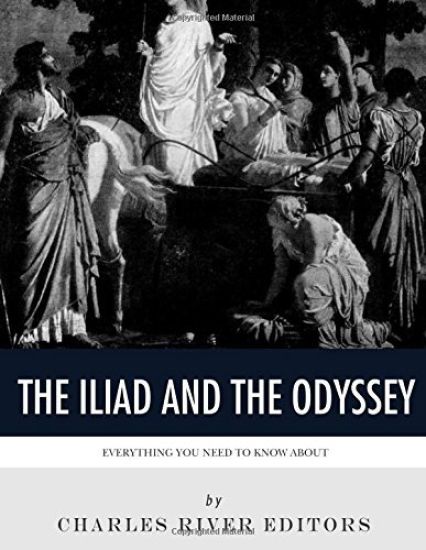
*Explains the major themes, characters, and plots of both epics. *Includes historic artwork depicting important scenes in The Iliad and The Odyssey. *Discusses the historical basis of Homer, the Trojan War, and Ancient Greek culture. "Like leaves on trees the race of man is found, - Now green in youth, now withering on the ground; Another race the following spring supplies: They fall successive, and successive rise." - The Iliad "Tell me, Muse, of the man of many wiles." - The Odyssey, Book I, Line 1 Perhaps the most famous epic poems ever written, The Iliad and the Odyssey have been read for nearly 3,000 years, making it also one of the oldest written works in the Western world. The poems made characters like Paris, Helen, Odysseus, Achilles, Hector, and Ajax instantly recognizable, and they also influenced other ancient poets like Virgil, whose Aeneid is clearly modeled after them. The epic poems also literally put Troy on the map, motivating Heinrich Schliemann to search for and ultimately find the city of Troy in the 19th century. Believed to be penned around the 7 or 8th century B. C, the Iliad and the Odyssey served as both entertainment and a moral guidebook of sorts for ancient Greeks, as well as the foundation for Western literature. Although there is some scholarly debate regarding the epic's authorship, It is generally attributed to a poet named Homer. Given that he lived nearly 2800 years ago, not much is actually known about Homer. His birthplace is debated, but due to the dialect of Greek in which the works attributed to him were written, it is generally believed that he lived in Iona. The only other aspect of Homer's life that is generally agreed upon is that he was a blind poet, possibly also a bard. That naturally raises the question of how he wrote his epic poetry, but scholars assume he probably dictated them to a scribe, as the format suggests they were comprised from various shorter forms of oral poetry. In addition to the Iliad and Odyssey, Homer also wrote the popular "Homeric Hymns," which depict the various myths regarding the origins of the Gods. While the Iliad covered the final fighting of the Trojan War, The Odyssey covers the burning of Troy and chronicles Odysseus' 10 year long return home to Ithaca after the war, including the adventures his crew experiences as they combat sirens, gods, and a Cyclops. It also deals with the issues surrounding his family, who have understandably believed after 20 years away that Odysseus was dead. The poem is also considered revolutionary for the fact that it has a non-linear plot and features women and servants as major characters. Everything You Need to Know About The Iliad and The Odyssey is the perfect resource for understanding Homer's famous epics, including an introduction that looks at the historical basis of the Trojan War, and a comprehensive explanation of the poems' characters, plot, themes, and legacy. Get caught up quickly with this resourceful guide.
Frank Sinatra & Dean Martin: Show Business Icons

Frank Sinatra & Dean Martin: Show Business Icons

Charles River

Createspace Independent Publishing Platform
2017
nidottu
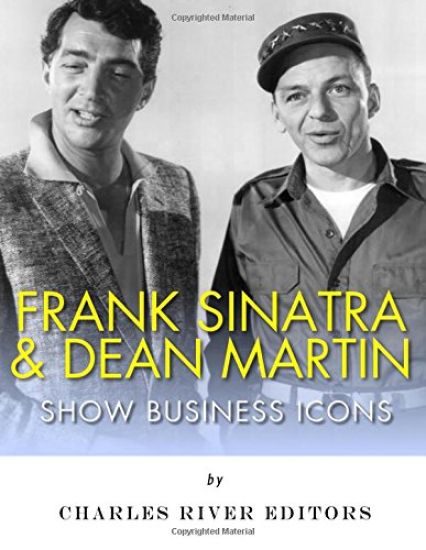
*Includes pictures. *Includes both men's most colorful quotes. *Discusses their relationship and the Rat Pack. *Includes bibliographies of both men for further reading. "May you live to be 100 and may the last voice you hear be mine." - Frank Sinatra "If people want to think I get drunk and stay out all night, let 'em. That's how I got here, you know." - Dean Martin America has always celebrated its star entertainers, but Frank Sinatra remains a unique American legend. A pop culture fixture for over half a century, Sinatra's music is still cherished, and his persona remains its own archetype of the quintessential American star. Sinatra transcended genres to the extent that his music stands alone as its own kind of American music, with songs like "New York, New York," "Chicago," and "Come Fly With Me" instantly recognizable among all Americans. Of course, there was also the life that went with the music. The cultural identity of the Rat Pack, epitomized in the 1960 film Ocean's Eleven, further contributed to his fame, and everyone knows and appreciates the image of easy living, smooth voice and exuberant starpower that Sinatra represents. If anything, Sinatra's ability to make so many people feel happy and good about themselves was one of the main ingredients of his success. And as evidence of the fact that Americans don't mind their stars doing a little dirt, Sinatra's rap sheet and relationship with the mob are practically a celebrated part of his life. Like Frank Sinatra, Dean Martin is an American legend for his longevity and success across a garden variety of different platforms. Martin began as a nightclub singer, performed in a comedy act, starred in films, recorded hit albums, and capped his career by serving as a television host. In fact, there may be no star who was better able to transcend the different avenues of entertainment. Martin's life and career are often compared to his close friend and contemporary Frank Sinatra, and for good reason. Both came from proud Italian families, both were cohorts in the famed Rat Pack in the 1960s, and they each maintained success even late in their careers. However, Sinatra's career was filled with far more ups and downs than Martin, and his public image experienced highs and lows along with it. It's also somewhat ironic that it was Martin who Anglicized his name but remained a bigger Italian icon than Sinatra. They each began their careers as Italian crooners, but Martin maintained his style while Sinatra adopted a brasher, more "All-American" singing method. Martin never strayed far from his humble background, even as he became one of America's biggest stars. Show Business Icons profiles the life and career of two of America's most famous performers. Along with pictures of important people, places, and events, you will learn about Ol' Blue Eyes and the King of Cool like never before.
Flying Saucers: The Mysterious History of the UFO Phenomenon

Flying Saucers: The Mysterious History of the UFO Phenomenon

Charles River

Createspace Independent Publishing Platform
2017
nidottu
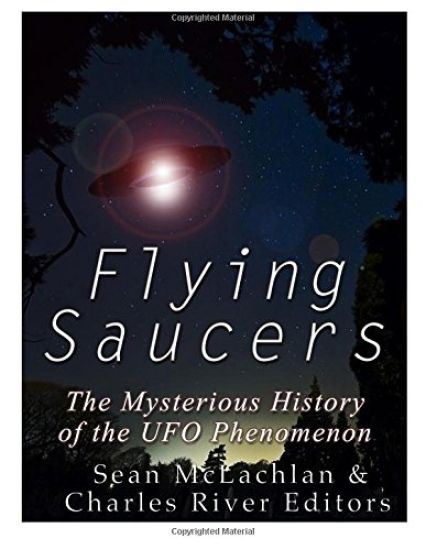
*Includes pictures *Includes accounts of purported UFO sightings and Roswell *Includes online resources and a bibliography for further reading *Includes a table of contents "The point is that the idea of space vehicles shaped like flying saucers was imprinted in the national psyche for many years prior to 1947, when the Roswell incident took place. It didn't take much stretching for the first observers of UFOs to assume that the unknown objects hovering in the sky had the same disk shape as the science fictional vehicles." - Frank Wu, illustrator for science fiction magazines When people think about unidentified flying objects (UFOs), they tend to think of flying discs piloted by gray beings with large heads and enormous eyes. They tend to think that these sightings only started relatively recently and that belief in UFOs is some sort of modern religion brought on, perhaps, by the very justifiable fears of a nuclear age. But a study of the phenomenon quickly reveals that humanity has been seeing UFOs since the beginning of recorded history and perhaps a lot longer than that. Modern Ufology focuses on mysterious lights on Ceres or tales of alien abduction, but this wasn't always the case. Looking at how belief in the UFO phenomenon has changed and how it has stayed the same sheds new light on how culture and belief changes over time. You don't have to believe humans are actually being visited by aliens from another planet to recognize the importance of UFOs in human society. Any widespread belief that endures for centuries is worthy of study, and as always, cases exist that can't be explained away as simple "belief" ... Everyone is familiar with theories about UFOs, or "flying saucers" as they were often called then, but even this name dates back only to 1947. Before that time, they were called "ghost rockets" or "ghost airplanes" or "ghost airships." Before the age of flight, the flying objects were called various things such as "flying chariots." No matter what terminology is used, every generation has clearly had its own belief that mankind is not alone. For example, few things in American history are as controversial as the Roswell Crash. The one undeniable fact is that something happened near Roswell, New Mexico, in 1947, but beyond that, the facts become murky as memories and evidence lose their luster over the years. That said, the impact of an unidentified object continues to mystify residents, visitors and the curious, and it has not only put Roswell on the map but has kept it there for thousands of tourists. Nonetheless, skepticism about the official version of the incident prevails, and a countless number of people continue to believe the American government covered up a crash landing by aliens. As John B. Alexander, Ph. D., a former project manager at the Los Alamos National Laboratory and consultant to the CIA, put it, "Attempting to come to any complete resolution of the incident is a fool's errand, as whatever the truth may have been has become so distorted over time that facts have merged inextricably with fiction." Flying Saucers: The Mysterious History of the UFO Phenomenon looks at the unidentified flying object craze. Along with pictures of important people, places, and events, you will learn about flying saucers like never before, in no time at all.
King Philip's War and Pontiac's War: The History and Legacy of the American Colonies' Most Famous Native American Uprisings
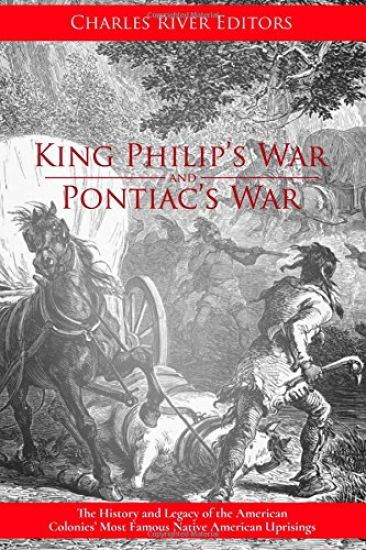
*Includes pictures *Includes accounts of the fighting *Includes online resources and a bibliography for further reading What was the bloodiest war in American history? Most people with at least a little knowledge of history would quickly say that it was the Civil War (1861-65), and they would certainly be correct overall. In recently-updated numbers, it is thought that over 750,000 Americans died in the Civil War from battle wounds, diseases and other causes. In a single day at the battle of Antietam on September 17, 1862, almost 27,000 soldiers were killed, wounded and missing. However, when historians go farther back in time and include colonial wars and look at casualties per capita, the correct answer would be the much-lesser known conflict known as "King Philip's War" (1675-76). While a significant 2.5% of the U. S. population perished in the Civil War, 5% of New England's white settler population died during King Philip's War, during which 13 towns were destroyed and 600 dwellings were burned by the natives. A larger, indeterminate number of the native population also died in the war. A hundred thousand pounds, an enormous sum of money in those days, was expended by the colonies in defeating the Indians. Throughout history, there have been men of war and men of peace, but few have actually had a war named after them. One of them was Pontiac, also known as Obwandiyag, an Odawa chief who left his mark on history by continuing the battle against the British after their official triumph during the French and Indian War. While modern historians question how important Pontiac's role was in shaping America's destiny, his leadership during Pontiac's War was seen at that time as important enough to warrant significant articles and even a few 18th century books. Since these books were written by the British, or at least men who supported their cause, the descriptions of Pontiac were often not complimentary. Likewise, 19th century authors tended to portray him as something of an evil genius who plotted against the British and then drove his people into battle. Not surprisingly, 20th century scholarship depicted him differently, portraying Pontiac as an important leader who had more influence over his own local band of Native Americans than over some vast army. When it comes to Pontiac, a few facts are certain. For one thing, he certainly led the first major attack of Pontiac's War in May 1763, when he and 300 of his men attacked Fort Detroit in what is now the city by the same name. Unfortunately for his cause, Pontiac failed to gauge just how strong the British presence there was, and his attack was quickly repelled. On the other hand, he was not a man who gave up easily, so instead of retreating, he and his warriors would lay siege to the British stronghold. In the days that followed, word spread of his efforts, and in short order nearly 1,000 men from various tribes in the area had joined him. They remained camped around the fort throughout the summer before finally giving up the siege. While Pontiac and his ever-growing band of men were laying siege to Fort Detroit, other tribes heard of his efforts to keep the fight going and began to attack other settlements and enclaves. Thus, even after he did give up on the fort, Pontiac continued to fight, next attacking area in the Illinois Country, an area that included much of what is now the Midwestern United States. As time went, on his popularity and power increased to the point that the British ultimately sought him out to make peace. That is how, in July 1766, Pontiac came to meet with Sir William Johnson, the British Superintendent of Indian Affairs for the colonies. Together, the two men carved out a peace treaty that held for the remainder of the British presence in the region.
The Canaanites and Philistines: The History and Legacy of the Ancient Israelites' Enemies in the Land that Became Israel
*Includes pictures *Includes ancient accounts *Includes online resources and a bibliography for further reading Individuals who decide to take up learning about the Old Testament of the Bible are immediately faced with the difficult proposition of identifying the various peoples that the Hebrews met and sometimes came into conflict with when they entered the territory that eventually became Israel. The Moabites and Edomites were just two of the many Canaanite groups that the Hebrews dealt with, often violently, but there were dozens of other Canaanite groups, which were all for the most part identified through the names of their respective cities. In fact, before the Hebrews established a kingdom and before the Phoenicians colonized much of the Mediterranean, the Canaanites were the most important group in the Levant for much of the Bronze Age and into the early Iron Age. Although the Canaanites never created a unified nation-state or kingdom, their importance in the ancient Near East cannot be understated. It was at least partially because of that fact that the Canaanites were unable to resist their larger and more powerful neighbors that the average person today knows so little about their history, but modern studies have revealed that they developed a unique religion that influenced non-Canaanite peoples and continued to be practiced in some form centuries after the Canaanites ceased to be an identifiable people. Furthermore, during the height of the Bronze Age the Canaanites provided important resources to the Egyptian and Hittite Empires and played a key role in the geopolitical game of chess between those two kingdoms. It also goes without saying that the Canaanites were also a factor in the establishment of the Kingdom of Israel, as the battles they lost to the Hebrews later became the foundation of the Jewish kingdom. Today, the term "Philistine" is often used as a euphemism for a person who is particularly uncouth, uncultured, ignorant, and possibly violent. Most people probably do not know the etymology of the word when they use it, and those that do probably only know the Philistines as villains from the Old Testament who were the eternal enemies of the Hebrews prior to and immediately after the latter formed the kingdom of Israel. Others may know the Philistines from the Biblical story of David and Goliath, as the "giant" was not only much larger than David but also a Philistine leader who commanded a large host of men. Although the Old Testament provides a credible source for some aspects of Philistine culture, it naturally paints a picture of them as a group of bloodthirsty warriors whose one purpose was to oppress the Hebrews/Israelites. When corroborated with ancient Egyptian and Mesopotamian sources, along with modern archaeological studies, an examination reveals that the reputation that the Philistines earned from the Old Testament was partially warranted, but that there was also much more to Philistine culture. In fact, evidence indicates that while the Philistines were a warrior society who fought with the Israelites for a number of years, they also developed advanced aspects of their culture, including sophisticated government, a unique religion, and art (especially pottery). The Philistines may not have developed an extensive empire as the Egyptians, Babylonians, and Assyrians did, but their contributions to the history of the Ancient Near East was not minimal either. The Philistines' presence and influence on the history of the ancient Near East was brief, and their departure from the historical record was especially quick, but while they were around they were a force to be reckoned with in the region. The Canaanites and Philistines: The History and Legacy of the Ancient Israelites' Enemies in the Land that Became Israel looks at the various groups and their impact on the region and subsequent cultures.
The Ancient Libyans and Nubians: The History and Legacy of Ancient Egypt's Most Prominent Neighbors in Africa
*Includes pictures *Includes ancient accounts *Includes online resources and a bibliography for further reading During the several centuries that ancient Egypt stood as one of the greatest, if not the greatest, civilizations of the ancient world, conflicts with its neighbors often played a central role in hieroglyphic texts and art from temples and tombs. The three primary enemies of the Egyptians were the Libyans who occupied the Western Desert and its oases, the so-called Asiatics who lived in the Levant, and finally the Nubians to Egypt's south. Among the three peoples, the Nubians were the most "Egyptianized" and at times were integral to the development of Egyptian history. Truly, the Nubians were the greatest of all sub-Saharan peoples in pre-modern times and deserve to be studied in their own right, apart from ancient Egyptian history. Unfortunately, it is often difficult for scholars to separate aspects of ancient Nubian culture that were truly unique and "Nubian" from those elements that were Egyptian, as the Nubians borrowed heavily in terms of culture from their northern neighbor. One historian noted, "As expected, strong Nubian features and dark coloring are seen in their sculpture and relief work. This dynasty ranks as among the greatest, whose fame far outlived its actual tenure on the throne. Especially interesting, it was a member of this dynasty that decreed that no Nehsy (riverine Nubian of the principality of Kush), except such as came for trade or diplomatic reasons, should pass by the Egyptian fortress and cops at the southern end of the Second Nile Cataract. Why would this royal family of Nubian ancestry ban other Nubians from coming into Egyptian territory? Because the Egyptian rulers of Nubian ancestry had become Egyptians culturally; as pharaohs, they exhibited typical Egyptian attitudes and adopted typical Egyptian policies." Robert S. Bianchi went even further: "It is an extremely difficult task to attempt to describe the Nubians during the course of Egypt's New Kingdom, because their presence appears to have virtually evaporated from the archaeological record. The result has been described as a wholesale Nubian assimilation into Egyptian society. This assimilation was so complete that it masked all Nubian ethnic identities insofar as archaeological remains are concerned beneath the impenetrable veneer of Egypt's material culture." The Canaanites and Nubians received the most attention as Egypt's enemies and occasional trading partners, but it was the Libyans-the final third of Egypt's traditional enemies-who influenced later Egyptian culture most. Unlike the Nubians and Canaanites, the Libyans were nearly always at war with the Egyptians. The reasons for the near constant warfare between the Libyans and Egyptians are difficult to discern, but more than likely stem from the fact that Libya was poor in resources, so the Egyptians had little reason to trade with the Libyans. On the other hand, the Libyans coveted Egypt's material wealth. The result was numerous putative campaigns by the Egyptians into Libya and raids by the Libyans into Egypt. The wars between the Libyans and Egyptians reached a fevered pitch during the New Kingdom when the Libyans organized anti-Egyptian coalitions, and even formed an alliance with the mysterious Sea Peoples. By the Late New Kingdom, Egypt was an armed camp, yet it was ultimately unable to stem the tide of Libyan migration. The Libyans used their numbers to their advantage, eventually conquering Egypt and establishing two dynasties. Their ancestors created another two. The relationship between the Libyans and Egyptians was truly complicated, and an in-depth survey of Libyan history from the Neolithic Period until the middle of the 6th century BCE demonstrates just how important the Libyans were in the ancient world.
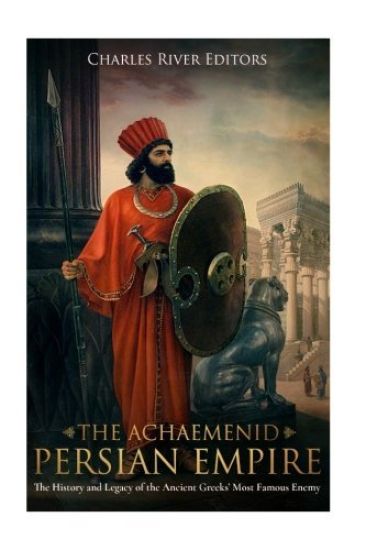
The Achaemenid Persian Empire: The History and Legacy of the Ancient Greeks' Most Famous Enemy
*Includes pictures *Includes ancient accounts *Includes online resources and a bibliography for further reading "By the favor of Ahuramazda these are the countries which I got into my possession along with this Persian people, which felt fear of me and bore me tribute: Elam, Media, Babylonia, Arabia, Assyria, Egypt, Armenia, Cappadocia, Lydia, the Greeks who are of the mainland and those who are by the sea, and countries which are across the sea, Sagartia, Parthia, Drangiana, Aria, Bactria, Sogdia, Chorasmia, Sattagydia, Arachosia, Hindus, Gandara, Sacae, Maka." - An inscription on a terrace wall in Persepolis, circa 521 CE Lying in the middle of a plain in modern day Iran is a forgotten ancient city: Persepolis. Built two and a half thousand years ago, it was known in its day as the richest city under the sun. Persepolis was the capital of Achaemenid Persian Empire, the largest empire the world had ever seen, but after its destruction, it was largely forgotten for nearly 2,000 years, and the lives and achievements of those who built it were almost entirely erased from history. Alexander the Great's troops razed the city to the ground in a drunken riot to celebrate the conquest of the capital, after which time and sand buried it for centuries. It was not until the excavations of the 1930s that many of the relics, reliefs, and clay tablets that offer so much information about ancient Persian life could be studied for the first time. Through archaeological remains, ancient texts, and work by a new generation of historians, a picture can today be built of the Achaemenid Persian empire and their capital city of Persepolis. Although the city had been destroyed, the legacy of the Persians survived, even as they mostly remain an enigma to the West and are not nearly as well understood as the Greeks, Romans, or Egyptians. In a sense, the Achaemenid Persian Empire holds some of the most enduring mysteries of ancient civilization. Of course, one of the reasons the Persians aren't remembered like the Greeks is because of the way the Greco-Persian Wars ended. The Ancient Greeks have long been considered the forefathers of modern Western civilization, but the Golden Age of Athens and the spread of Greek influence across much of the known world only occurred due to the Greeks' victory in two of history's most important wars. In 491 BCE, following a successful invasion of Thrace over the Hellespont, the Persian emperor Darius sent envoys to the main Greek city-states, including Sparta and Athens, demanding tokens of earth and water as symbols of submission, but Darius didn't exactly get the reply he sought. According to Herodotus in his famous Histories, "Xerxes however had not sent to Athens or to Sparta heralds to demand the gift of earth, and for this reason, namely because at the former time when Dareios had sent for this very purpose, the one people threw the men who made the demand into the pit and the others into a well, and bade them take from thence earth and water and bear them to the king." The Achaemenid Persian Empire: The History and Legacy of the Ancient Greeks' Most Famous Enemy looks at one of history's largest empires. Along with pictures depicting important people, places, and events, you will learn about the first Persian empire like never before.
Vladimir Lenin, Joseph Stalin & Leon Trotsky: The Soviet Union's Big Three

Vladimir Lenin, Joseph Stalin & Leon Trotsky: The Soviet Union's Big Three

Charles River

Createspace Independent Publishing Platform
2017
nidottu
*Includes pictures of Lenin, Stalin, Trotsky and important people, places, and events in their lives. *Explains each man's role in the Revolution and its aftermath. *Discusses the conspiracy theories surrounding Stalin's death and how Stalin came to power against Lenin's wishes. *Includes a bibliography for further reading. Among the leaders of the 20th century, arguably none shaped the course of history as much as Vladimir Lenin (1870-1942), the Communist revolutionary and political theorist who led the Bolshevik Revolution that established the Soviet Union. In addition to shaping the Marxist-Leninist political thought that steered Soviet ideology, he was the first Soviet premier until his death and set the Soviet Union on its way to becoming one of the world's two superpowers for most of the century, in addition to being the West's Cold War adversary. As it turned out, the creation of the Soviet Union came near the end of Lenin's life, as he worked so hard that he had burned himself out by his 50s, dying in 1924 after a series of strokes had completely debilitated him. Near the end of his life, he expressly stated that the regime's power should not be put in the hands of the current General Secretary of the Communist Party, Joseph Stalin. Of course, Stalin managed to do just that, modernizing the Soviet Union at a breakneck pace on the backs of millions of poor laborers and prisoners. If Adolf Hitler had not inflicted the devastation of World War II upon Europe, it's quite likely that the West would consider Joseph Stalin (1878-1953) the 20th century's greatest tyrant. Before World War II, Stalin consolidated his position by frequently purging party leaders (most famously Leon Trotsky) and Red Army leaders, executing hundreds of thousands of people at the least. In one of history's greatest textbook examples of the idea that the enemy of my enemy is my friend, Stalin's Soviet Union allied with Britain and the United States to defeat Hitler in Europe, with the worst of the war's carnage coming on the eastern front during Germany's invasion of Russia. Nevertheless, the victory in World War II established the Soviet Union as of the world's two superpowers for nearly 50 years, in addition to being the West's Cold War adversary. Along with Vladimir Lenin, Trotsky led the October Bolshevik Revolution of 1917 and held crucial posts in the early Soviet governments, but after Lenin's death Trotsky was exiled, persecuted and finally murdered at the behest of his arch-rival, Joseph Stalin. For the final decade of his life, Trotsky was a man trapped in between two worlds. A communist seeking refuge in the capitalist West, Trotsky was deemed a secret agent of the capitalist powers by Stalin's propaganda, but the Soviet Union's enemies also viewed him with suspicion. In the initial aftermath of Lenin's death, Trotsky had been his ally's heir apparent, and for those inclined to believe the Soviet experiment had started promisingly but gone astray, Trotsky became the embodiment of the betrayed promise of the early Bolshevik revolution. There were certain ironies in this widespread sympathetic interpretation of Trotsky's legacy. For the Marxists and Marxist sympathizers appalled by Stalin's paranoid police state, Gulag concentration camps, and strict suppression of dissent, Trotsky was viewed as a humane and cosmopolitan opposite to Stalin. But Trotsky himself had overseen and spearheaded campaigns of persecution against Russians suspected of "counterrevolutionary" leanings, and he had written a long tract defending these "terroristic" measures as necessary safeguards of the revolution. The Soviet Union's Big Three explores the lives and legacies of Lenin, Trotsky and Stalin before the Bolshevik Revolution, as well as the crucial roles they played in establishing the Soviet Union and turning it into a modern superpower.
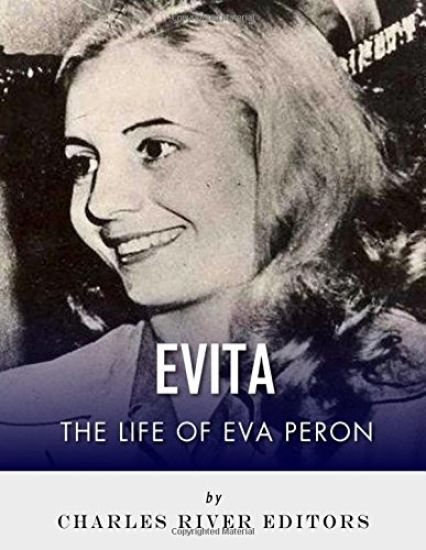
Evita: The Life of Eva Peron

Evita: The Life of Eva Peron

Charles River

Createspace Independent Publishing Platform
2017
nidottu
*Includes pictures. *Comprehensively covers Evita's life and legacy, including the ways she has been depicted in media over the last 60 years. *Includes a Bibliography for further reading. Maria Eva Duarte de Peron, known to the world as Evita, stands with Jesus Christ as a highly influential historical figure who lived only 33 years. The similarities do not end there: as Argentine novelist Tomas Eloy Martinez has observed, Evita came to "symbolize certain naive, but effective, beliefs: the hope for a better world; a life sacrificed on the altar of the disinherited, the humiliated, the poor of the earth . . . myths which somehow reproduce the image of Christ." During her life she was elevated to the status of "spiritual leader" of her country, Argentina, and after death she was regarded there as a martyr and a saint by her many followers. A visit to the museum dedicated to Evita's legacy in the Botanico neighborhood of Buenos Aires reveals the spirit of quasi-religious devotion that surrounds her: more than simply a collection of historical displays, the museum stands as a shrine to her legacy and intends to imbue its viewers with the spirit and beliefs of the deceased First Lady. In one of the rooms, the visitor stands in the presence of one of her most famous dresses in a centrally placed glass case, with the scent of roses artificially pumped into the air. Like many of the other objects, the dress is presented much as were the relics of medieval saint. Evita's tomb in the same city's Recoleta cemetery, constantly garlanded with fresh bouquets and notes of gratitude from pilgrims who have come to pay their respects, provides further evidence of her revered presence in Argentine culture. At the same time, the presence of the major artifacts of Evita's person in these particular locations is also ironic and revealing of the great social divisions over which she presided. Botanico is a prestigious and wealthy neighborhood, and the Recoleta is the burial place of Argentina's oligarchy; Eva Peron prided herself on having antagonized and earned the hatred of precisely these social classes. Over 50 years after her death, Peronism, the political philosophy devised by her and her husband Juan Domingo Peron, remains a potent force in Argentine politics (the current president identifies herself closely with the Perons and their legacy), but it also continues to inspire deep enmity. While a large portion of the country sees Evita as a symbol of national pride, there is also a significant sector that sees her as an impostor and a demagogue whose brilliant but irresponsible manipulation of mass politics helped sink the country into chaos. Whereas some controversial political figures tend to become more broadly and neutrally admired as the distance from their lifespan grows, within her own country Evita remains as much a lightning rod as ever. Since her death, the mythology and legend of Evita have grown monumentally. Though millions worshipped Eva, who nearly became the Vice-President of Argentina before her premature death, opinions of her still vary between two extremes. While some think of her as an angelic woman who sought to uplift women and the poor, others view her as a self-serving, egotistical, and embittered woman who used sex to rise up Argentina's social and political ladder and seek vengeance on the upper classes. Evita: The Life of Eva Peron humanizes the youngest of 5 siblings who once had more modest ambitions as Eva Duarte, and it explores the mythology and legacy that have grown around Evita, examining her representations in literature, film, and theatre to uncover the truth behind her enigmatic existence.
Everything You Need to Know About Atlas Shrugged and The Fountainhead

Everything You Need to Know About Atlas Shrugged and The Fountainhead

Charles River

Createspace Independent Publishing Platform
2017
nidottu
Includes an introduction with a short biography about Ayn Rand. Comprehensively explains Rand's philosophy, Objectivism, and the plots, characters, themes, symbols, and philosophy of Rand's classic novels. Includes a Bibliography for further reading. "Government 'help' to business is just as disastrous as government persecution... the only way a government can be of service to national prosperity is by keeping its hands off." - Ayn Rand The seminal events in Ayn Rand's life occurred when she witnessed firsthand the Bolshevik Revolution and the ultimate Communist victory as a teenager. Rand's experience with the maelstrom of this revolutionary zeal and cultural breakdown greatly contributed toward the formation of Rand's philosophy of objectivism, individualism and anti-religious ideas. During her last year of high school, she was introduced to the history of the United States and immediately decided to make America her model of what an ideal society should look like. Rand came to the United States as a young woman for a visit in 1925, and, as fate would have it, she never returned to Russia. When Rand first embarked on writing The Fountainhead, her first major literary success, she intended to deliver a book that incorporated her philosophies on 20th century society while telling a story that was less politically inclined than her initial novel, We the Living, which was set in post-revolutionary Russia and promoted her tough, unwavering stand against communism. In The Fountainhead, Rand took many of the seeds of individualism that she sowed in We the Living, enhancing and heightening them into her new book's dominant theme. The Fountainhead clearly represents Rand's disdain for and rejection of the notion of collectivism, and holds not merely individualism but also objectivism, a philosophy attributed to the writer herself, as components critical to man's ideal state. Her objectivist posture, given its basic foundation in self-service and the belief that the pursuit of one's own happiness alone reigns supreme over any other human activity, was certainly polarizing. Supporters claimed that it was a natural progression from existentialism, while opponents asserted that it was systematically self-interested and therefore bordered on amorality. Rand began her most famous novel, Atlas Shrugged, in 1946. The novel consumed her, and in 1951, she moved back to New York City to devote herself to its completion. Atlas Shrugged was published in 1957 and is still considered her greatest work, as it touches upon a variety of social and philosophical topics such as metaphysics and epistemology while addressing the more "pop culture" areas of sex and politics. The book also sealed her association with the philosophical concept of Objectivism, which she called a methodology for "living on earth." The Objectivism movement caught fire, inspiring Rand to establish Objectivist periodicals from 1962 to 1976. Though Atlas Shrugged had been a popular title when Ayn Rand published it in 1957, it's quite possible that the only reference to it that many Americans heard before 2009 came from the hit series Mad Men. However, this staple of conservative and libertarian reader took on new life as the new Obama Administration sought to use government resources to fix financial problems. In 2009, with the global economy hemorrhaging jobs, and Western governments pouring hundreds of billions of dollars in taxpayer money to "bail out" troubled financial firms and large companies, frustrated people and political analysts turned to a book written over 50 years earlier as a guide out of the abyss. With Ayn Rand and her work as relevant as ever, Everything You Need to Know About Atlas Shrugged and The Fountainhead will get you caught up quickly on Rand's classic novels.
History's Greatest Artists: The Life and Legacy of Renoir

History's Greatest Artists: The Life and Legacy of Renoir

Charles River

Createspace Independent Publishing Platform
2017
nidottu
*Includes pictures *Includes Renoir's quotes about his life and work *Includes online resources and a bibliography for further reading *Includes a table of contents "To my mind, a picture should be something pleasant, cheerful, and pretty, yes pretty There are too many unpleasant things in life as it is without creating still more of them." - Renoir Pierre-Auguste Renoir stands alongside Claude Monet at the very peak of Impressionist painting, and though neither of them can be credited with founding the movement (that honor likely goes to Edouard Manet or Edgar Degas), Renoir and Monet remain inextricably tied to the key characteristics of Impressionism: loose brushwork; outdoor painting; an emphasis on capturing natural light and shadow; and a focus on remaining in Paris and the surrounding countryside. Yet if Monet and Renoir are each remembered for their affiliation with these descriptors, differences nevertheless distinguish them, especially the fact that Renoir concentrated less on nature than did Monet, attending instead to scenes depicting Parisian leisure activity. This thematic concern for depicting scenes of idyllic Parisian enjoyment, such as rowing in boats or grand luncheons, imbues Renoir with a greater sense of joie-de-vivre than Monet or perhaps any of the other members of the Impressionist cohort. Even though Renoir's art shares much in common with his Impressionist colleagues, both his handling of paint and even his subject matter contain significant differences that render him truly unique as a painter. That Renoir captured scenes of leisure better than any of his contemporaries was surprising and unlikely considering the background in which he was raised. Denied the opportunity for a proper education, Renoir's painting, which started at a young age, was borne more out of a need to work than in pursuit of a lifelong passion. Renoir certainly loved to paint, but like Monet, painting always remained his profession, and he treated it as such. Famed art dealer Ambrose Vollard summarized this aspect of the great painter, noting, "He went to his studio just as punctually as a clerk to his office. In the evening, after a game of checkers or dominoes with Madame Renoir, he went to bed early; he was afraid it would affect his work the next day if he stayed up late. All his life, painting was his only pleasure, his only relaxation." These remarks point not only to Renoir's love for painting but also the professionalism that he brought toward the endeavor. Even after becoming financially stable, and even after acquiring arthritis late in life, Renoir continued to paint with the same drive that he displayed as a young artist. Of course, it is not unusual for famous artists to paint until they're physically unable to do so, but Renoir's undying obligation to his profession speaks to the extent to which he absorbed the humble values impressed upon him during his blue-collar upbringing. Indeed, Renoir possessed a supreme gift for painting, but his work ethic should not be overlooked in the narrative charting his rise to fame. History's Greatest Artists: The Life and Legacy of Renoir looks at the personal background that led to him becoming an artist and the cultural climate in which he rose to fame. Renoir's formal technique and artistic legacy are also analyzed, including his working methods and education. Along with pictures of important people, places, and events, you will learn about Renoir like never before, in no time at all.