Kirjojen hintavertailu – 12 903 727 kirjaa ja 27 kauppaa
Kirjailija
Charles River
Kirjat ja teokset yhdessä paikassa: 4 673 kirjaa, julkaisuja vuosilta 2013–2022, suosituimpiin kuuluu William Powell and Myrna Loy: The Lives and Careers of One of Classical Hollywood's Most Iconic Duos. Vertaile teosten hintoja ja tarkista saatavuus suomalaisista kirjakaupoista.
*Includes a list of Chavez's most colorful and controversial quotes. *Includes pictures of Chavez and important people, places, and events in his life. "Yesterday, ladies and gentlemen, from this rostrum, the president of the United States, the gentleman to whom I refer as the devil, came here, talking as if he owned the world. Truly. As the owner of the world." - Hugo Ch vez, Address to the United Nations, September 20, 2006. The above quote is quintessentially Ch vez - controversial, shocking, and designed to cause a stir. He shared his words with the entire United Nations General Assembly at a time when the United States was embroiled in two failing war efforts and its banks were inching ever closer towards the economic crisis of 2008. Yet Ch vez shared his beliefs fearlessly, confident enough with his presidency and his role on the world's stage to criticize the US president in a way that had never been done before at the UN. Understandably, Ch vez is one of the most divisive and controversial political figures in Latin American history. He has been in power since 1999 and is South America's longest serving head of state. The leader of the movement towards Twenty-first Century Socialism, Ch vez has sought to bring socialist reform to Venezuela through what he calls the Bolivarian Revolution. His goal has been to shift power from the nation's traditional oligarchy to the neglected poor. Ch vez's past is a complicated one, rife with military coups, troubled relationships, and political betrayal. During his presidency, he has written and implemented a new constitution, instituted democratic councils, and nationalized important industries. His admirers worship him as if he were Venezuela's very own messiah, while his critics view him as a monstrous, power-hungry demagogue who has trampled on human rights and the freedom of expression while fomenting class warfare. Latin American Revolutionaries: The Life and Legacy of Hugo Ch vez chronicles the controversial life and rule of Ch vez, objectively portraying the man who is a savior to some and a demagogue to others. Along with pictures of important people, places, and events in his life, you will learn about Hugo Ch vez like you never have before, in no time at all.
*Includes pictures *Includes contemporary accounts of the slave trade *Includes online resources and a bibliography for further reading "It is certain that large numbers of slaves were exported from eastern Africa; the best evidence for this is the magnitude of the Zanj revolt in Iraq in the 9th century, though not all of the slaves involved were Zanj. There is little evidence of what part of eastern Africa the Zanj came from, for the name is here evidently used in its general sense, rather than to designate the particular stretch of the coast, from about 3 N. to 5 S., to which the name was also applied." - Ghada Hashem Talhami "The Zanj Rebellion Reconsidered". The International Journal of African Historical Studies. 10 (3): 443-461. (1977). It has often been said that the greatest invention of all time was the sail, which facilitated the internationalization of the globe and thus ushered in the modern era. Columbus' contact with the New World, alongside European maritime contact with the Far East, transformed human history, and in particular the history of Africa. It was the sail that linked the continents of Africa, Asia, and Europe, and thus it was also the sail that facilitated the greatest involuntary human migration of all time. The Transatlantic Slave Trade was founded by the Portuguese in the 15th century for the specific purpose of supplying the New World colonies with African slave labor. It was soon joined by all the major trading powers of Europe, and it reached its peak in the 18th century with the founding and development of plantation economies that ran from the South American mainland through the Caribbean and into the southern states of the United States. Toward the end of the 18th century, it began to fall into decline, and by the beginning of the 19th century, various abolition movements heralded its eventual outlawing. It was, throughout its existence, however, a purely commercial phenomenon, supplying agricultural power to vast plantations on an industrial scale. In every respect, it was unaffected and uninfluenced by history, sentimentality, tradition, or common law. Slaves transported across the Atlantic Ocean remained a commodity with a codified value, like a horse or a steam engine, existing often within an equation of obsolescence and replacement that was cheaper than nurturing and maintenance. The East African Slave Trade on the other hand, or the Indian Ocean Slave Trade as it was also known, was a far more complex and nuanced phenomenon, far older, significantly more widespread, rooted in ancient traditions, and governed by rules very different to those in the western hemisphere. It is also often referred to as the Arab Slave Trade, although this, specifically, might perhaps be more accurately applied to the more ancient variant of organized African slavery, affecting North Africa, and undertaken prior to the advent of Islam and certainly prior to the spread of the institution south as far as the south/east African coast. It also involved the slavery of non-African races and was, therefore, more general in scope. The African slave trade is a complex and deeply divisive subject that has had a tendency to evolve according the political requirements of any given age, and is often touchable only with the correct distribution of culpability. It has for many years, therefore, been deemed singularly unpalatable to implicate Africans themselves in the perpetration of the institution, and only in recent years has the large-scale African involvement in both the Atlantic and Indian Ocean Slave Trades come to be an accepted fact. There can, however, be no doubt that even though large numbers of indigenous Africans were liable, it was European ingenuity and greed that fundamentally drove the industrialization of the Transatlantic slave trade in response to massive new market demands created by their equally ruthless exploitation of the Americas.
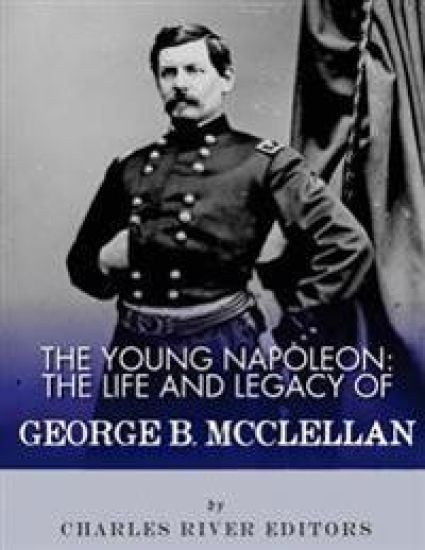
*Includes pictures of McClellan and other important people, places, and events in his life. *Includes maps of battles like Antietam. "McClellan is to me one of the mysteries of the war." - Ulysses S. Grant Over the last 150 years, historians and Americans have endlessly debated over the Civil War, including its causes and the best and worst generals. Nowhere has there been a sharper debate than over the career and legacy of George McClellan, with a majority viewing him as the North's biggest goat and a small but vocal minority insisting that McClellan was a very good general who was made a scapegoat by the Lincoln Administration and its supporters. Many members of the "McClellan Society" continue to assert that McClellan would have ended the war in 1862 without the Administration's interference. In 1861, McClellan was looked upon as a hero and even possibly a savior. Dubbed "The Young Napoleon", the 35 year old had been a prodigy at West Point, finishing in second place in the Academy's most famous class, the Class of 1846. After earning praise for his service in the Mexican-American War, McClellan had a short but successful career in the railroad industry and had been a foreign observer at the siege of Sevastopol.during the Crimean War. At the outbreak of the Civil War, there was no question that McClellan was one of the brightest and most experienced of the North's generals. Ultimately, of course, McClellan went from hero to goat, at least in the eyes of President Lincoln, who famously wrote that McClellan "has the slows". It was a sharp critique of McClellan's cautious movements, but McClellan was also faulted for conservative battlefield leadership in the Peninsula Campaign and at Antietam. McClellan also constantly overestimated his opponent's manpower, at times thinking the Confederates had double his Army of the Potomac when the exact opposite was the case. It was after Antietam and his bickering with the War Department over why he wasn't chasing Lee's battered Army of Northern Virginia that Lincoln finally sacked him, effectively ending his Civil War career. McClellan is best remembered for 1862, but he was also a Governor of New Jersey, Lincoln's opponent in the 1864 presidential election, and a writer seeking to reestablish his reputation before his untimely death. The Young Napoleon addresses the controversies and battles McClellan fought both on and off the field, but it also humanizes a man who was almost universally loved by the veterans of the Army of the Potomac and who wrote his most candid remarks to his wife. Along with pictures of McClellan and other important people, places and events in his life, you will learn about the "Young Napoleon" like you never have before, in no time at all.
Quando arque logos americanos descobriram uma cole o de tabuletas cuneiformes no Iraque, ao final do s culo XIX, eles se depararam com uma linguagem e um povo que, naquela poca, era pouco conhecido at mesmo pelos estudiosos mais instru dos da antiga Mesopot mia: os sum rios. As explora es e conquistas de outros povos mesopot micos, como os ass rios e babil nios, j eram conhecidas por um grande segmento da popula o atrav s do Antigo Testamento, e o campo nascente de estudos do Oriente Pr ximo havia revelado o enigma da l ngua acadiana, que era amplamente utilizada na regi o em tempos antigos; no entanto, a descoberta das tabuletas sum rias trouxe luz a exist ncia da cultura sum ria, a mais antiga de todas as culturas da Mesopot mia. Um exame de fontes prim rias relacionadas a Ur, bem como escava es arqueol gicas feitas na cidade antiga, revelam que a mesma fora um baluarte cultural por milhares de anos. Ur surgiu como uma cidade de import ncia secund ria, mas rapidamente cresceu para tornar-se a cidade mais importante da Sum ria. Em seu auge, Ur foi o centro da grande dinastia que controlava diretamente a maior parte da Mesopot mia, atrav s de um ex rcito e burocracia bem administrados - al m disso, as reas que n o estavam sob seu controle direto foram influenciadas por diplomatas e ideias religiosas de Ur. O presente estudo tamb m revelar que Ur era uma cidade verdadeiramente resistente, pois sobrevivera queda dos sum rios, destrui o completa nas m os dos elamitas, e s ocupa es posteriores por diversos outros povos, que, mais recentemente, inclu ram Saddam Hussein. Ur inspirou a imagina o dos povos antigos, mas tamb m extasiou as mentes dos povos modernos, que trabalharam por mais de 150 anos para desvendar os mist rios da cidade. Verdadeiramente, quando se trata de importantes cidades antigas, Ur deveria ser contada entre as maiores. Nenhum local melhor representa a import ncia dos sum rios do que a cidade de Uruk. Entre o quarto e o terceiro mil nio a. C., Uruk era uma das diversas cidades-estado da terra da Sum ria, localizada no extremo sul do Crescente F rtil, entre os dois grandes rios Tigre e Eufrates. Descoberta ao final do s culo XIX pelo arque logo brit nico William Loftus, o local que revelou muito do que hoje conhecido sobre os povos sum rios, acadianos e neo-sum rios. Embora Uruk n o tenha sido a nica cidade constru da pelos sum rios pelos durante o per odo, era de longe a mais grandiosa e tamb m a fonte da maioria das evid ncias arqueol gicas e escritas no que diz respeito cultura sum ria prim ria (Kuhrt 2010, 1:23). Uruk passou de primeira cidade do mundo para primeiro centro pol tico e cultural mais importante do Oriente Pr ximo em relativamente pouco tempo. Por volta de 3200 a. C., a cultura de Uruk come ou a expandir-se al m das fronteiras da Sum ria, o que coincidiu com a emerg ncia da escrita (Kuhrt 2010, 1:23). A forma de escrita desenvolvida pelos sum rios tornou-se conhecida por seu nome grego, "cuneiforme", pelos caracteres em estilo de cunha que a mesma empregava (Van de Mieroop 2007, 28). A escrita, assim como diversas outras inven es ao longo da hist ria do mundo, parece ter sido criada por necessidade; medida que a cultura de Uruk crescia, os sum rios precisavam desenvolver uma forma sofisticada de manter registros, o que apenas poderia ser feito atrav s da escrita (Van de Mieroop 2007, 28). Apesar de ter sido usado exclusivamente para a linguagem sum ria a princ pio, o sistema de escrita cuneiforme foi posteriormente adaptado e usado por uma s rie de diferentes l nguas do Antigo Oriente, como a acadiana, a hitita, e a persa antiga (Dalby 1986, 475).
*Includes pictures of important people and places. *Includes a Bibliography for further reading. From the "Trail of Tears" to Wounded Knee and Little Bighorn, the narrative of American history is incomplete without the inclusion of the Native Americans that lived on the continent before European settlers arrived in the 16th and 17th centuries. Since the first contact between natives and settlers, tribes like the Sioux, Cherokee, and Navajo have both fascinated and perplexed outsiders with their history, language, and culture. In Charles River Editors' Native American Tribes series, readers can get caught up to speed on the history and culture of North America's most famous native tribes in the time it takes to finish a commute, while learning interesting facts long forgotten or never known. The Seminole tribe is one of the best known Native American tribes, and one of the most feared among 19th century Americans and Spaniards. In fact, the origin of the term Seminole comes from a Spanish description of them as "wild", which belies the fact that the Seminole had friendly relations with the British and Spanish during the colonial era. With the Spanish Empire foundering during the mid-19th century, the young United States sought to take possession of Florida. President Andrew Jackson's notorious policy of Indian Removal led to the Seminole Wars in the 1830s, and that was already after General Andrew Jackson had led American soldiers against the Seminole in the First Seminole War a generation earlier. The Seminole Wars ultimately pushed much of the tribe into Oklahoma, and the nature of some of the fighting remains one of the best known aspects of Seminole history among Americans. Native American Tribes: The History and Culture of the Seminole comprehensively covers the Native American tribe from its origins to today. Along with pictures and a bibliography, you will learn about the Seminole like you never have before, in no time at all.
*Includes pictures *Includes historic descriptions of the cathedral *Includes online resources and a bibliography for further reading "Notre Dame de Paris, in particular, is a curious specimen of this variety. Every surface, every stone of this venerable pile, is a page of the history not only of the country, but of science and of art. Thus-to mention here only a few of the chief details-whereas the small Porte Rouge almost touches the limits of fifteenth century Gothic delicacy, the pillars of the nave, by their massiveness and great girth, reach back to the Carlovingian Abbey of Saint-Germain-des-Pr s. One would imagine that six centuries lay between that door and those pillars." With these words, the famous 19th century novelist Victor Hugo attempted to introduce his readers to the backdrop of his seminal work, later known as The Hunchback of Notre Dame. This, it should be noted, was not the name that Hugo gave to his work; instead, he called it simply Notre Dame, after the building in which he set it. This location was no accident, for, perhaps more than any other city in Europe, Paris has seen every kind of trouble and happiness that can befall a place. It may be called the "City of Lights," but it also frequently saw its leaders' blood spilled in the streets. It is the symbol of romance, but also a place where the famed Napoleon divorced the love of his life in order to have a son. It is famed for its art and culture, but it hosted Nazis during four long years of occupation. Most of all, it is a city of building up and tearing down and building up again, where life is ever-changing. Yet, in the midst of this history of turmoil and chaos, one place has survived largely unchanged, a symbol to Christian believers of the unchanging truths of faith. Notre-Dame has stood as a monumental, though silent, witness to much of Paris' history. As Hugo pointed out, "This generative Mother-Church is, among the other ancient churches of Paris, a sort of Chimera: she has the head of one, the limbs of another, the body of a third-something of all. These hybrid edifices are, we repeat, by no means the least interesting to the artist, the antiquary, and the historian... They let us realize to how great a degree architecture is a primitive matter, in that they demonstrate...that the greatest productions of architecture are not so much the work of individuals as of a community; are rather the offspring of a nation's labour than the out-come of individual genius; the deposit of a whole people; the heaped-up treasure of centuries; the residuum left by the successive evaporations of human society; in a word, a species of formations. Each wave of time leaves its coating of alluvium, each race deposits its layer on the monuments, each individual contributes his stone to it." Notre-Dame de Paris: The History and Legacy of France's Most Famous Cathedral chronicles the remarkable history of the Parisian cathedral. Along with pictures depicting important people, places, and events, you will learn about Notre-Dame like never before.
"La Revoluci n Industrial fue otro de esos saltos en la historia de la civilizaci n." -Stephen Gardiner Entre el siglo 18 y principios del 19, la Gran Breta a experiment unos saltos masivos en el avance tecnol gico, cient fico y econ mico. Este per odo poderoso ha sido desde entonces inmortalizado como la gran Revoluci n Industrial, durante la cual la Gran Breta a se convirti en una fuerza formidable que presum a de un crecimiento econ mico inigualado, de dr sticos cambios en las condiciones de vida y a n del surgimiento de una desatendida clase social. Vastas porciones de territorios rurales fueron transformadas en ciudades interconectadas, complejas y con diferentes tareas. Docenas de inventos innovadores y de productos fueron producidos en serie y vendidos a las masas por primera vez. Algunos de los m s grandes pensadores e inventores se arriesgaron a salir de las sombras. Los cient ficos, los ingenieros, los comerciantes y los productores por igual estaban en su mejor momento, nutridos por una cultura que abrazaba la visi n de crecimiento, progreso y unidad industrial. La Revoluci n Industrial vio como la Gran Breta a se elevaba a la cumbre y se convert a en la envidia de las m s prestigiosas naciones del mundo. Al mismo tiempo, esta era fundamental estaba muy lejos de ser perfecta, presentando unos oscuros puntos d biles y un ej rcito de h roes an nimos. La Revoluci n Industrial: Historia y legado de los r pidos avances cient ficos y tecnol gicos que dieron comienzo al mundo moderno examina la historia y legado de una de las pocas m s importantes de la historia moderna. Junto con fotos de gente importante, lugares y eventos, usted conocer la Revoluci n Industrial como nunca antes.
*Includes pictures *Includes ancient descriptions of the goddess and myths *Includes online resources and a bibliography for further reading "However impious the apotheosis of sexuality may seem in the light of the Christian tradition, modern sensibility can nevertheless also appreciate how in the experience of love the loved one and indeed the whole world appears transfigured and joyously intensified, making all else seem insignificant, a tremendous power is revealed, a great duty." Attempting to cover all the forms the "Goddess of Love" encapsulates is no small affair. The roles she played in romance, marriage, procreation, and all of the other desires of humanity were myriad, but the aim of this book is to paint a slightly different, perhaps more esoteric version of Aphrodite from the usual image of her in mythology books. The fact is that Aphrodite, as an ancient Greek goddess, was not the anthropomorphic personage modern aficionados see painted on canvas and hewn out of stone. In addition to that, she was also so much more, which can be a difficult concept for the modern reader to discern. In fact, it was difficult for certain ancient readers to discern too; the 5th century BCE philosopher Plato expressed disgust at the idea that his gods would debase themselves in the adulterous, murderous, and mischievous ways they were said to have in their myths. However, it is important to remember that Plato represented a very small proportion of ancient Athenian society, and the rest of the populace didn't seem to have much of a problem including the "personal" anthropomorphic aspect of the gods into their more "elemental" and "essential" beings. As the scholar Leopold Schmidt put it, "For anyone born a Greek and thinking like a Greek, the idea of a clean antithesis between unity and plurality is put aside where the supernatural beings are concerned. He has no difficult in conceiving unity of action divorced from any unity of person." This is a very important point to remember when considering any of the ancient Greek gods, which can help the modern reader realize the depth of "character" that Aphrodite embodied for the ancient Greeks. Hers was more than the wooing gifts, more than the marriage bed, and more than the "propriety of women". She was an elemental force and not one to be underestimated. Aphrodite: The Origins and History of the Greek Goddess of Love looks at the story of the legendary deity and the various roles she played in Greek mythology. Along with pictures depicting important people, places, and events, you will learn about Aphrodite like never before.
*Includes pictures of McClellan and other important people, places, and events in his life. *Includes maps of battles like Antietam. "McClellan is to me one of the mysteries of the war." - Ulysses S. Grant Over the last 150 years, historians and Americans have endlessly debated over the Civil War, including its causes and the best and worst generals. Nowhere has there been a sharper debate than over the career and legacy of George McClellan, with a majority viewing him as the North's biggest goat and a small but vocal minority insisting that McClellan was a very good general who was made a scapegoat by the Lincoln Administration and its supporters. Many members of the "McClellan Society" continue to assert that McClellan would have ended the war in 1862 without the Administration's interference. In 1861, McClellan was looked upon as a hero and even possibly a savior. Dubbed "The Young Napoleon", the 35 year old had been a prodigy at West Point, finishing in second place in the Academy's most famous class, the Class of 1846. After earning praise for his service in the Mexican-American War, McClellan had a short but successful career in the railroad industry and had been a foreign observer at the siege of Sevastopol.during the Crimean War. At the outbreak of the Civil War, there was no question that McClellan was one of the brightest and most experienced of the North's generals. Ultimately, of course, McClellan went from hero to goat, at least in the eyes of President Lincoln, who famously wrote that McClellan "has the slows". It was a sharp critique of McClellan's cautious movements, but McClellan was also faulted for conservative battlefield leadership in the Peninsula Campaign and at Antietam. McClellan also constantly overestimated his opponent's manpower, at times thinking the Confederates had double his Army of the Potomac when the exact opposite was the case. It was after Antietam and his bickering with the War Department over why he wasn't chasing Lee's battered Army of Northern Virginia that Lincoln finally sacked him, effectively ending his Civil War career. McClellan is best remembered for 1862, but he was also a Governor of New Jersey, Lincoln's opponent in the 1864 presidential election, and a writer seeking to reestablish his reputation before his untimely death. The Young Napoleon addresses the controversies and battles McClellan fought both on and off the field, but it also humanizes a man who was almost universally loved by the veterans of the Army of the Potomac and who wrote his most candid remarks to his wife. Along with pictures of McClellan and other important people, places and events in his life, you will learn about the "Young Napoleon" like you never have before, in no time at all.