Kirjojen hintavertailu – 12 903 725 kirjaa ja 27 kauppaa
Kirjailija
Charles River
Kirjat ja teokset yhdessä paikassa: 4 673 kirjaa, julkaisuja vuosilta 2013–2022, suosituimpiin kuuluu William Powell and Myrna Loy: The Lives and Careers of One of Classical Hollywood's Most Iconic Duos. Vertaile teosten hintoja ja tarkista saatavuus suomalaisista kirjakaupoista.
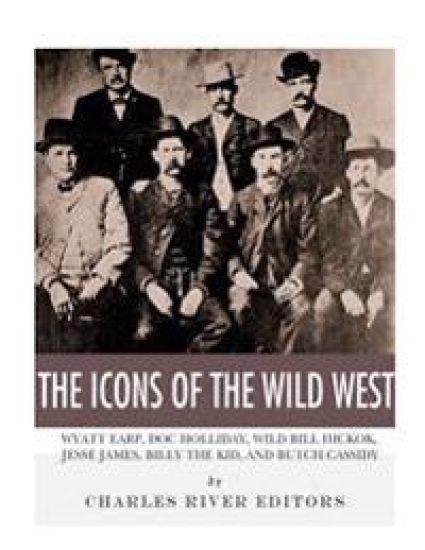
Includes pictures of important people, places, and events. Discusses the legendary deaths of Wild Bill, Jesse James, Billy the Kid, and Butch Cassidy. Discusses the myths and legends surrounding their lives and legacies. Space may be the final frontier, but no frontier has ever captured the American imagination like the "Wild West", which still evokes images of dusty cowboys, outlaws, gunfights, gamblers, and barroom brawls over 100 years after the West was settled. A constant fixture in American pop culture, the 19th century American West continues to be vividly and colorful portrayed not just as a place but as a state of mind. Among the cowboys and outlaws, the 6 most famous men included those (mostly) on the side of the law (Wild Bill, Wyatt Earp & Doc Holliday), and the era's most famous outlaws (Jesse James, Billy the Kid and Butch Cassidy). Though they were on two sides of the law, many of them had things in common. Of all the colorful characters that inhabited the West during the 19th century, the most famous of them all is Wyatt Earp (1848-1929), who has long been regarded as the embodiment of the Wild West. Considered the "toughest and deadliest gunman of his day", Earp symbolized the swagger, the heroism, and even the lawlessness of the West, notorious for being a law enforcer, gambler, saloon keeper, and vigilante. Wild Bill Hickok headed west as a fugitive of justice, yet that didn't prevent him from becoming a frontier lawman in Kansas, like Wyatt Earp. Hickok also became well known in the West for being a professional gambler and a remarkably quick draw who proved quite deadly in shootouts, like Doc Holliday. When he was killed while playing poker in the mining South Dakotan outpost of Deadwood, he put Deadwood on the map and ensured both his place and his poker hand's place in legend. The man who has earned an enduring legacy as the region's quirkiest is John Henry "Doc" Holliday (1851-1887), a dentist turned professional gambler who was widely recognized as one of the fastest draws in the West. In fact, the only thing that might have been faster than the deadly gunman's draw was his violent temper, which was easily set off when Holliday was drunk. By the early 1880s, Holliday had been arrested nearly 20 times. Holliday's quirks and sense of humor made him much like Billy the Kid, who had a bullet and a wisecrack for every man he killed. Billy's notoriety only grew when exaggerated accounts of his actions in Lincoln County eventually earned The Kid a bounty on his head. There was plenty of gunplay in the outlaw's life to help him become a well known if not celebrated figure in the West, but the legendary and controversial nature of his death has also helped him endure. The two best known robbers of the Wild West were Jesse James and Butch Cassidy. Like Wild Bill Hickok, Jesse James was a celebrity during his life. However, while Hickok was (mostly) a lawman, Jesse James was and remains the most famous outlaw of the Wild West, with both his life of crime and his death remaining pop culture fixtures. Alongside Jesse James, Butch Cassidy is one of the most notorious outlaws of the west. Though he is commonly associated with the Sundance Kid, the duo had a full-fledged gang known as the Wild Bunch conducting robberies in the Southwest, and they became legendary for their shootouts and their escapes from the law. Like Jesse James, his mysterious death and conspiracy theories that he survived continue to linger. The Icons of the Wild West chronicles the amazing lives and legacies of all 6 Western legends and discusses the facts and legends that continue to make them household names. Along with pictures, you will learn about the Icons of the Wild West like you never have before.
*Includes pictures *Includes accounts of the Resistance's activities throughout the war *Includes online resources and a bibliography for further reading *Includes a table of contents "Whatever happens, the flame of French Resistance must not be extinguished and will not be extinguished." - General Charles de Gaulle, radio broadcast from London, June 18th, 1940 (Argyle, 2014, 81). The French Army crumbled swiftly under the powerful blows delivered to it in 1940 by Adolf Hitler's self-confident Wehrmacht. Launching a massive feint into Belgium to lure mobile French armies and the British Expeditionary Force (BEF) away from the actual point of attack, the weakly protected Ardennes Forest, the Germans struck past the Maginot Line. In a lightning campaign, Guderian's panzers punched through to the coast, dividing Allied forces with a steel cordon across France and forcing the evacuation of the BEF from the port of Dunkirk. Not all French people proved willing to surrender to the Nazi invaders, however. While large numbers "collaborated" - working for German or Vichy companies to provide for themselves or their families - and some wholeheartedly backed the new regime out of opportunism, fascist conviction, or other motivations, a courageous minority operated in secret to resist their conquerors and the quisling state at Vichy: "De Gaulle described them as being bound together by a taste for risk and adventure ...] national pride sharpened by the suffering of their nation and 'an overwhelming confidence in the strength and cunning of their own plot'. ...] 'With him, it is ...] serving the Resistance and national honour, uncompromisingly demanding, ' wrote one. 'With him, we would have to get used to breathing the rarefied air of the summits.'" (Fenby, 2012, 109). The French Resistance never grew into a single unified organization. Rather, it remained divided in several major and numerous minor factions, each with their own philosophy and agenda. While these factions all shared the same goal - opposition to the Germans their Vichy pawns - they viewed each other with some suspicion and sometimes cooperated only grudgingly. During the war years, however, the Resistance kept the spirit of an independent and defiant France smoldering under the surface of Nazi domination, waiting for the opportunity to emerge again, regardless of the precise political beliefs of its members. Though exaggerated in scope and effectiveness by postwar legends seeking to minimize the widespread (usually involuntary) collaboration among the French people, the Resistance actually embodied a patriotic spirit determined to defeat Nazi totalitarianism and make France once again the nation of "libert , galit , fraternit " under the tricolor flag. Despite the faults, foibles, and occasional cruelty or criminality of individual Resistance members, the shared goal of defeating Nazi authoritarianism provided the glue needed to more or less unify the disparate factions. This defining aim also gave the movement resilience to weather the brutal suppression meted out by the Gestapo, the infamous Klaus Barbie, and the Vichy Milice. The French Resistance: The History of the Opposition Against Nazi Germany's Occupation of France during World War II looks at the legendary Resistance and its efforts to undermine Vichy France. Along with pictures of important people, places, and events, you will learn about the French Resistance like never before, in no time at all.
*Includes biographies of each famous Western icon. *Discusses the mysteries and legends of their famous lives and deaths. *Comprehensively covers legendary events like the Shootout at the OK Corral, and the murders of Wild Bill and Jesse James. *Includes a Bibliography on each person for further reading. Space may be the final frontier, but no frontier has ever captured the American imagination like the "Wild West", which still evokes images of dusty cowboys, outlaws, gunfights, gamblers, and barroom brawls over 100 years after the West was settled. A constant fixture in American pop culture, the 19th century American West continues to be vividly and colorful portrayed not just as a place but as a state of mind. The spirit of adventure, the courage, the swagger, and even the hard drinking and violence have all come to capture what it meant to be an American at the time, and with so many interesting figures straddling both sides of the law, morality has gone out the window. Colorful lawmen like Wyatt Earp and Wild Bill became known for meting out justice but also taking things into their own hands, while Doc Holliday and Calamity Jane have gone down in history as eccentric sidekicks. Outlaws like Jesse James, Billy the Kid, Butch Cassidy and the Sundance Kid remain just as well known, and they have been long associated with daring heists and conspiracies surrounding their deaths. And Buffalo Bill captured all of the sights and sounds in his famous Wild West show, bringing the West to life all over the world. Each Western icon forged their own enduring legacy, but many of them also knew each other. Wyatt Earp, the law enforcer, gambler, saloon keeper, and vigilante, forged an unlikely friendship with hot-tempered dentist turned gambler Doc Holliday that proved pivotal in some of the West's most legendary events. Wild Bill and Calamity Jane had one of the most legendary and mythologized relationship, with Jane claiming they were married and Wild Bill's friends claiming he could barely stand her. Wyatt Earp (1848-1929), the "toughest and deadliest gunman of his day", symbolized the swagger, the heroism, and even the lawlessness of the West, notorious for being a law enforcer, gambler, saloon keeper, and vigilante. Then there was John Henry "Doc" Holliday (1851-1887), a dentist turned professional gambler who was widely recognized as one of the fastest draws in the West and one of its quirkiest figures. The only thing that might have been faster than the deadly gunman's draw was his violent temper, which was easily set off when Holliday was drunk, a frequent occurrence. By the early 1880s, Holliday had been arrested nearly 20 times. And then there's Butch Cassidy and the Sundance Kid, the West's most famous outlaw duo, who will always be associated with each other despite the fact there's no indication that they had any particularly close friendship or relationship aside from being members of the same gang. The Ultimate Wild West Collection chronicles the lives, legends, myths, lies, and legacies of the West's most famous individuals, separating fact from fiction and analyzing how they have affected the past and the present. Along with pictures of important people, places, and events, bibliographies, and a Table of Contents, you will learn about these Western icons like never before.
*Includes pictures *Includes the music stars' quotes about their lives and work *Includes a bibliography for further reading In the early 20th century, Westerns were one of the most popular genres in Hollywood, and one of the young stars at the forefront was Gene Autry, a Texan whose life story made him a natural to be the country's most famous "singing cowboy". Autry would become a symbol of masculinity and morality on screen during the 1930s, but it was effortless for someone who had already grown up riding horses to school. Autry came of age at a time when the "singing cowboy" was at the apex of his popularity, and like his most famous successor, Roy Rogers, Autry actually got his start in show business as a singer. Even today, Autry might be best known for being a pioneer of country music and the author of Christmas hits "Here Comes Santa Claus", "Frosty the Snowman", and "Rudolph the Red-Nosed Reindeer". Autry would produce hundreds of recordings during his life, helping ensure the popularity of the country music genre and earning inductions into several related halls of fame. Roy Rogers came from an Ohio farm, but regardless of his background, Rogers certainly looked the part of the quintessential cowboy, along with his wife Dale Evans and his horse Trigger. His versatile singing and acting abilities made him successful both on radio and on the screen. Rogers came of age at a time when the "singing cowboy" was at the apex of his popularity, and that was favorable because he actually got his start in show business as a singer. In the early '30s, he bounced around several groups as a country music singer before earning national attention as a member of the Sons of the Pioneers, who were signed to Decca and had a couple of hits. As a result, when he first appeared in movies in 1935, it was usually in bit roles that required singing, but when Gene Autry threatened to quit acting in 1938, Rogers was viewed as a suitable replacement for lead roles. As it turned out, he became the premiere "singing cowboy" in Autry's stead, and from 1939-1954, he was one of the Top 10 Western stars in Hollywood, and a Top 10 movie star overall during some of those years. Hank Williams is considered by many to be the first American superstar of the genre and the "father" of modern country music. In the post-World War II era, at a time when country music was an insulated and regionalized cottage industry, Williams almost personally oversaw its transition into a national mania that would be later taken up by such figures as Johnny Cash and Elvis Presley, even as the musicians remained loyal to the genre's older, rural roots. But Williams remained distinctly and unapologetically Southern, thereby avoiding adoption by the larger pop world even as his remarkable sense of phrasing and authentic texts fascinated pop artists across the country. Johnny Cash, "The Man in Black", is among the most recognized and iconic vocal artists in the history of blues, country and gospel singing. During the second half of the 20th century, he produced a prolific and rarely-equaled career in the country genre as a singer, songwriter and guitarist, despite numerous struggles with alcohol and drug addiction. His trademark bass-baritone voice is instantly identifiable to listeners today, and his "parlando" style (combining an unaffected singing tone with a speech-like rhythm and pacing) has been taken up by the generation following his death in the early 21st century. While many celebrities have desperately tried to get as far away as possible from their impoverished upbringings, Dolly Parton constructed her star persona around the image of Appalachian country music culture. In many ways, Parton was raised in a quintessential Appalachian family, and while she has been resolute in expressing her affection for this background, it is impossible to deny that her upbringing posed obstacles that were difficult to overcome and related to societal and industrial le