
Kirjailija
Claude Lévi-Strauss
Kirjat ja teokset yhdessä paikassa: 59 kirjaa, julkaisuja vuosilta 1967–2026, suosituimpiin kuuluu Tropiikin kasvot (p). Vertaile teosten hintoja ja tarkista saatavuus suomalaisista kirjakaupoista.
Nimi esiintyy myös muodoissa: Claude Levi-Strauss
59 kirjaa
Kirjojen julkaisuvuodet: 1967–2026.
This volume of Lévi-Strauss's writings from 1941 to 1947 bears witness to a period of his work which is often overlooked but which was the crucible for the structural anthropology that he would go on to develop in the years that followed. Like many European Jewish intellectuals, Lévi-Strauss had sought refuge in New York while the Nazis overran and occupied much of Europe. He had already been introduced to Jakobson and structural linguistics but he had not yet laid out an agenda for structuralism, which he would do in the 1950s and 60s. At the same time, these American years were the time when Lévi-Strauss would learn of some of the world's most devastating historical catastrophes - the genocide of the indigenous American peoples and of European Jews. From the beginning of the 1950s, Lévi-Strauss's anthropology tacitly bears the heavy weight of the memory and possibility of the Shoah. To speak of 'structural anthropology zero' is therefore to refer to the source of a way of thinking which turned our conception of the human on its head. But this prequel to Structural Anthropology also underlines the sense of a tabula rasa which animated its author at the end of the war as well as the project – shared with others – of a civilizational rebirth on novel grounds. Published here in English for the first time, this volume of Lévi-Strauss’s texts from the 1940s will be of great interest to students and scholars in anthropology, sociology and the social sciences generally.
This volume of Lévi-Strauss's writings from 1941 to 1947 bears witness to a period of his work which is often overlooked but which was the crucible for the structural anthropology that he would go on to develop in the years that followed. Like many European Jewish intellectuals, Lévi-Strauss had sought refuge in New York while the Nazis overran and occupied much of Europe. He had already been introduced to Jakobson and structural linguistics but he had not yet laid out an agenda for structuralism, which he would do in the 1950s and 60s. At the same time, these American years were the time when Lévi-Strauss would learn of some of the world's most devastating historical catastrophes - the genocide of the indigenous American peoples and of European Jews. From the beginning of the 1950s, Lévi-Strauss's anthropology tacitly bears the heavy weight of the memory and possibility of the Shoah. To speak of 'structural anthropology zero' is therefore to refer to the source of a way of thinking which turned our conception of the human on its head. But this prequel to Structural Anthropology also underlines the sense of a tabula rasa which animated its author at the end of the war as well as the project – shared with others – of a civilizational rebirth on novel grounds. Published here in English for the first time, this volume of Lévi-Strauss’s texts from the 1940s will be of great interest to students and scholars in anthropology, sociology and the social sciences generally.


Wild Thought
Claude Levi-Strauss
University of Chicago Press
2021
pokkari
Halvin toimitettuna 31,80 €
Perhaps the most influential anthropologist of his generation, Claude Levi-Strauss left a profound mark on the development of twentieth-century thought, equal to that of phenomenology and existentialism. Through a fertile mixture of insights gleaned from linguistics and from sociology and ethnology, Levi-Strauss elaborated his theory of structural unity in culture and became the preeminent representative of structural anthropology. La Pensee sauvage, published in French in 1962, was his crowning achievement. Ranging over philosophies, historical periods, and human societies, it challenged the prevailing assumption of the superiority of modern Western culture and sought to explain the unity of human intellection. Unfortunately titled The Savage Mind when it first published in English in 1966, the original translation nevertheless sparked a fascination with Levi-Strauss's work among generations of Anglophone readers. Wild Thought: A New Translation of "La Pensee sauvage" rekindles that spark with a fresh and accessible new translation. Including critical annotations for the contemporary reader, it restores the accuracy and integrity of the book that changed the course of twentieth-century thought, making it an indispensable addition to any philosophical and anthropological library.
Wild Thought
Claude Levi-Strauss
University of Chicago Press
2021
sidottu
Halvin toimitettuna 83,80 €
Perhaps the most influential anthropologist of his generation, Claude Levi-Strauss left a profound mark on the development of twentieth-century thought, equal to that of phenomenology and existentialism. Through a fertile mixture of insights gleaned from linguistics and from sociology and ethnology, Levi-Strauss elaborated his theory of structural unity in culture and became the preeminent representative of structural anthropology. La Pensee sauvage, published in French in 1962, was his crowning achievement. Ranging over philosophies, historical periods, and human societies, it challenged the prevailing assumption of the superiority of modern Western culture and sought to explain the unity of human intellection. Unfortunately titled The Savage Mind when it first published in English in 1966, the original translation nevertheless sparked a fascination with Levi-Strauss's work among generations of Anglophone readers. Wild Thought: A New Translation of "La Pensee sauvage" rekindles that spark with a fresh and accessible new translation. Including critical annotations for the contemporary reader, it restores the accuracy and integrity of the book that changed the course of twentieth-century thought, making it an indispensable addition to any philosophical and anthropological library.
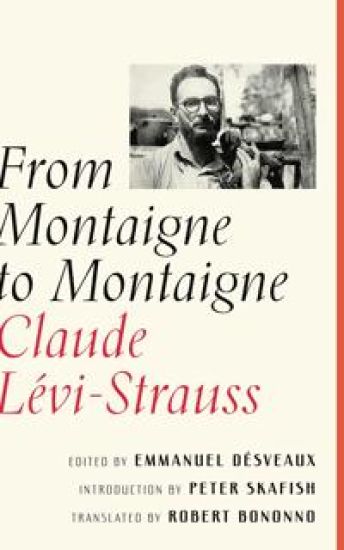
Two previously unpublished lectures charting the renowned anthropologist’s intellectual engagement with the sixteenth-century French essayist Michel de Montaigne In January 1937, between the two ethnographic trips he would describe in Tristes Tropiques, Claude LÉvi-Strauss gave a talk to the ConfÉdÉration gÉnÉrale du travail in Paris. Only recently discovered in the archives of the BibliothÈque national de France, this lecture, “Ethnography: The Revolutionary Science,” discussed the French essayist Michel de Montaigne, to whom LÉvi-Strauss would return in remarks delivered more than a half-century later, in the spring of 1992. Bracketing the career of one of the most celebrated anthropologists of the twentieth century, these two talks reveal how LÉvi-Strauss’s ethnography begins and ends with Montaigne-and how his reading of his intellectual forebear and his understanding of anthropology evolve along the way. Published here for the first time, these lectures offer new insight into the development of ethnography and the thinking of one of its most important practitioners. Essays by Emmanuel DÉsveaux, who edited the original French volume De Montaigne À Montaigne, and Peter Skafish expand the context of LÉvi-Strauss’s talks with contemporary perspectives and commentary.
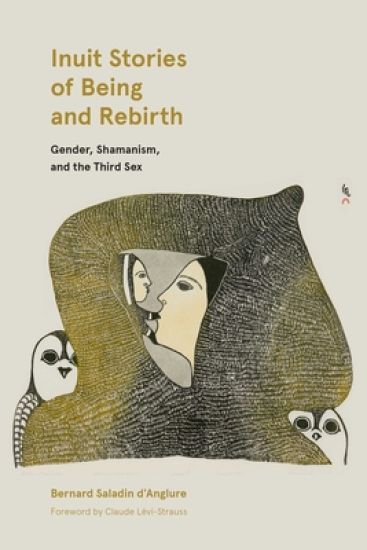
Inuit Stories of Being and Rebirth
Bernard Saladin d'Anglure; Claude Levi-Strauss
University of Manitoba Press
2018
sidottu
Ujarak, Iqallijuq, and Kupaaq were elders from the Inuit community on Igloolik Island in Nunavut. The three elders, among others, shared with Bernard Saladin d'Anglure the narratives which make up the heart of Inuit Stories of Being and Rebirth. Through their words, and historical sources recorded by Franz Boas and Knud Rasmussen, Saladin d'Anglure examines the Inuit notion of personhood and its relationship to cosmology and mythology. Central to these stories are womb memories, narratives of birth and reincarnation, and the concept of the third sex-an intermediate identity between male and female. As explained through first-person accounts and traditional legends, myths, and folk tales, the presence of transgender individuals informs Inuit relationships to one another and to the world at large, transcending the dualities of male and female, human and animal, human and spirit. This new English edition includes the 2006 preface by Claude Levi-Strauss and an afterword by Bernard Saladin d'Anglure.
Inuit Stories of Being and Rebirth
Bernard Saladin d'Anglure; Claude Lévi-Strauss
University of Manitoba Press
2018
nidottu
The small island of Igloolik lies between the Melville Peninsula and Baffin Island at the northern end of Hudson Bay north of the Arctic Circle. It has fascinated many in the Western world since 1824, when a London publisher printed the narratives by William Parry and his second-in-command, George Lyon, about their two years spent looking for the mythical Northwest Passage. Nearly a hundred and fifty years later, Bernard Saladin d'Anglure arrived in Igloolik, hoping to complete the study he had been conducting for nearly six months in Arctic Quebec (present-day Nunavik). He was supposed to spend a month on Igloolik, but on his first morning there, Saladin d'Anglure met the elders Ujarak and Iqallijuq. He learned that they had been informants for Knud Rasmussen in 1922. Moreover, they had spent most of their lives in the camps and fully remembered the pre-Christian period. Ujarak and Iqallijuq soon became Saladin d'Anglure's friends and initiated him into the symbolism, myths, beliefs, and ancestral rules of the local Inuit. With them and their families, Saladin d'Anglure would work for thirty years, gathering the oral traditions of their people. First published in French in 2006, Inuit Stories of Being and Rebirth contains an in-depth, paragraph-by-paragraph analysis of stories on womb memories, birth, namesaking, and reincarnation. This new English edition introduces this material to a broader audience and contains a new afterword by Saladin d'Anglure.
We Are All Cannibals
Claude Lévi-Strauss; Maurice Olender
Columbia University Press
2017
pokkari
Halvin toimitettuna 29,10 €
On Christmas Eve 1951, Santa Claus was hanged and then publicly burned outside of the Cathedral of Dijon in France. That same decade, ethnologists began to study the indigenous cultures of central New Guinea, and found men and women affectionately consuming the flesh of the ones they loved. "Everyone calls what is not their own custom barbarism," said Montaigne. In these essays, Claude Levi-Strauss shows us behavior that is bizarre, shocking, and even revolting to outsiders but consistent with a people's culture and context. These essays relate meat eating to cannibalism, female circumcision to medically assisted reproduction, and mythic thought to scientific thought. They explore practices of incest and patriarchy, nature worship versus man-made material obsessions, the perceived threat of art in various cultures, and the innovations and limitations of secular thought. Levi-Strauss measures the short distance between "complex" and "primitive" societies and finds a shared madness in the ways we enact myth, ritual, and custom. Yet he also locates a pure and persistent ethics that connects the center of Western civilization to far-flung societies and forces a reckoning with outmoded ideas of morality and reason.
The anthropologist Claude Levi-Strauss was one of the greatest intellectuals of the twentieth century. His work has had a profound impact not only within anthropology but also linguistics, sociology and philosophy. In this short book he examines the nature and role of myth in human history, distilling a lifetime of writing into a few sharp insights. It is a crystalline overview of many of the basic ideas underlying his work, including the theory of structuralism and the difference between 'primitive' and 'scientific' thought and shows why Levi-Strauss remains a hugely important intellectual figure. With a new foreword by Patrick Wilcken.

First published in 1987. Claude Levi-Strauss is one of the intellectual giants of the twentieth century, a leading exponent of structuralism and a great social anthropologist. His Introduction to the Work of Marcel Mauss , originally written to preface the earliest major collection of Mauss's writings, Sociologie et Anthropologie (1950), was hailed as a seminal text by leading structuralists such as Derrida, Lacan and Barthes. This edition, the first English translation to be published, should prove invaluable to anthropologists, philologists, psychologists, and all those interested in one of the most important intellectual movements generated by the twentieth century. Levi-Strauss uses an approach combining anthropology and structural linguistics to assess Marcel Mauss's achievements and intentions arguing that Mauss - who at the time represented the mainstream of French anthropology - was in fact structuralist manque. He goes on to formulate the central tenets of structuralist thought: the belief in societies being organised on immutable and unconscious laws, this foundation then providing the basis for true scientific study; multi-discplinary methodology combining anthropology, lingusitics and psychoanalysis; and a faith that a comprehensive science of communication can be made by the application of mathematical reasoning.
On Christmas Eve 1951, Santa Claus was hanged and then publicly burned outside of the Cathedral of Dijon in France. That same decade, ethnologists began to study the indigenous cultures of central New Guinea, and found men and women affectionately consuming the flesh of the ones they loved. "Everyone calls what is not their own custom barbarism," said Montaigne. In these essays, Claude Levi-Strauss shows us behavior that is bizarre, shocking, and even revolting to outsiders but consistent with a people's culture and context. These essays relate meat eating to cannibalism, female circumcision to medically assisted reproduction, and mythic thought to scientific thought. They explore practices of incest and patriarchy, nature worship versus man-made material obsessions, the perceived threat of art in various cultures, and the innovations and limitations of secular thought. Levi-Strauss measures the short distance between "complex" and "primitive" societies and finds a shared madness in the ways we enact myth, ritual, and custom. Yet he also locates a pure and persistent ethics that connects the center of Western civilization to far-flung societies and forces a reckoning with outmoded ideas of morality and reason.

Claude Lévi-Strauss var sannolikt 1900-talets mest inflytelserike socialantropolog. I sina arbeten om släktskap och myter ger han det mest fullödiga uttrycket för strukturalismen som tankeform. Det vilda tänkandet, som kom ut första gången 1962, har en aktualitet som sträcker sig långt utöver själva socialantropologin och in i den filosofiska och civilisationskritiska diskussionen. Genom att analysera så kallat primitivt tänkande vill Lévi-Strauss visa att klassificerande och systematiserande verksamhet är grundläggande för alla människor i alla samhällen. Det finns ingen skillnad i sättet att tänka mellan de mest "outvecklade" ursprungsfolk och de mest "civiliserade" storstadsbor. Inför denna nya upplaga har Jan Stolpe granskat och moderniserat sin översättning. I ett nyskrivet förord bjuder socialantropologen Christer Lindberg in läsaren i Lévi-Strauss fascinerande och epokgörande bok.