Kirjojen hintavertailu – 12 903 725 kirjaa ja 27 kauppaa

Kirjailija

David Harvey

Kirjat ja teokset yhdessä paikassa: 93 kirjaa, julkaisuja vuosilta 1989–2027, suosituimpiin kuuluu Accounting. Vertaile teosten hintoja ja tarkista saatavuus suomalaisista kirjakaupoista.

93 kirjaa

Kirjojen julkaisuvuodet: 1989–2027.

Birmingham Buses

Birmingham Buses

David Harvey

Mortons Media Group
2004
pokkari
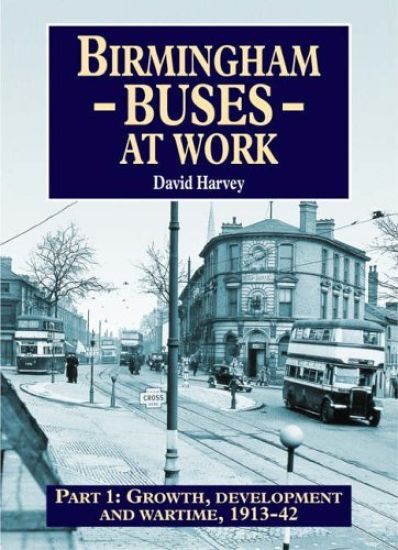
Birmingham was slow to introduce buses, but was at the forefront of vehicle development and passenger comfort in the 1920s and '30s, with one of the first top-covered fleets. This book examines the development of the Birmingham bus, and its geographical, historical and social aspects in the very varied urban landscape of the pre-war city.
Birmingham in the Age of the Tram

Birmingham in the Age of the Tram

David Harvey

Mortons Media Group
2004
pokkari
Takes readers on the 8-mile ride along the Bristol Road to the Lickey Hills, Rubery and Rednall, and to Cotteridge, Moseley and Alcester Lanes End. This title also gives the opportunity of sampling the maze of routes in Balsall Heath known as 'The Chinese Railway'.
Birmingham in the Age of the Tram

Birmingham in the Age of the Tram

David Harvey

Mortons Media Group
2004
pokkari
Takes the reader on a journey to South Yardley, Tyseley, Acocks Green, Ladywood, Lozells, Perry Barr, Witton, Short Heath, Erdington, Pype Hayes, Washwood Heath and Alum Rock, contrasting the bustle of the city centre and the grim industrial atmosphere of the inner suburbs with the city's leafy outer suburbs.
The New Imperialism

The New Imperialism

David Harvey

Oxford University Press
2003
sidottu
Is it a sign of strength of or of weakness that the US has shifted from a politics of consensus to one of coercion on the world stage? What was really at stake in the war on Iraq? What role has a sagging economy played? What difference does it make that neo-conservatives are now in power? These are the questions taken up in this title.
The Inner Circle

The Inner Circle

David Harvey; Peter Drake; Margaret Hanson

NPI Media Group
2002
nidottu
This superb new collection of over 200 archive images, while guaranteed to fascinate bus enthusiasts, will also have huge appeal to the many thousands who have travelled the inner circle route or who simply have an interest in the history of Birmingham. Known in its time as the ‘Workmen’s Special’ the number 8 route served the workers for some of Birmingham’s best known employers, such as Lucas, Ansells Brewery, HP Sauce, B. S. A. and Bulpitts. Many will remember the Victorian back-to-backs on the route, demolished years ago, where many of those same workers lived before moving away to newly built estates. Not only do the scenes and the buses show just how much times have changed, the informative captions that accompany each picture remind us of a different era. Instead of radios and CCTV the standard equipment on the first buses included rope, spark plug, whistle, matches and a candle! This was a time when conductors would actually escort younger passengers from the bus right to their front door. Recalling the history of Birmingham through this novel perspective makes for a truly enthralling read.
Spaces of Capital

Spaces of Capital

David Harvey

Routledge
2002
sidottu
David Harvey is the most influential geographer of our era, possessing a reputation that extends across the social sciences and humanities. Spaces of Capital, a collection of seminal articles and new essays spanning three decades, demonstrates why his work has had-and continues to have-such a major impact. The book gathers together some of Harvey's best work on two of his central concerns: the relationship between geographical thought and political power as well as the capitalist production of space. In addition, he chips away at geography's pretenses of "scientific" neutrality and grounds spatial theory in social justice. Harvey also reflects on the work and careers of little-noticed or misrepresented figures in geography's intellectual history-Kant, Von Thunen, Humboldt, Lattimore, Hegel, Heidegger, Darwin, Malthus, Foucault and many others.
Spaces of Capital

Spaces of Capital

David Harvey

Edinburgh University Press
2001
nidottu
David Harvey is unquestionably the most influential, as well as the most cited, geographer of his generation. His reputation extends well beyond geography to sociology, planning, architecture, anthropology, literary studies and political science. This book brings together for the first time seminal articles published over three decades on the tensions between geographical knowledges and political power and on the capitalist production of space. Classic essays reprinted here include 'On the history and present condition of geography', 'The geography of capitalist accumulation' and 'The spatial fix: Hegel, von Thunen, and Marx'. Two new chapters represent the author's most recent thinking on cartographic identities and social movements. David Harvey's persistent challenge to the claims of ethical neutrality on behalf of science and geography runs like a thread throughout the book. He seeks to explain the geopolitics of capitalism and to ground spatial theory in social justice. In the process he engages with overlooked or misrepresented figures in the history of geography, placing them in the context of intellectual history. The presence here of Kant, Von Thunen, Humboldt, Lattimore, Leopold alongside Marx, Hegel, Heidegger, Darwin, Malthus, Foucault and many others shows the deep roots and significance of geographical thought. At the same time David Harvey's telling observations of current social, environmental, and political trends show just how vital that thought is to the understanding of the world as it is and as it might be.

Accounting for Business

Accounting for Business

David Harvey; Edward McLaney; Peter Atrill

Butterworth-Heinemann Ltd
2000
nidottu
'Accounting for Business' is ideal for undergraduate students on business and accounting courses who need to understand the nuts and bolts of financial accounting. This popular textbook has always enjoyed a deserved reputation for accessibility and thoroughness. Now in its third edition, its contents have been fully updated and restructured to make them even easier to use. Readers will benefit from the coverage of current accounting practices and legislation, in addition to the range of worked examples and self-test activities throughout the book. 'Accounting for Business' clearly explains accounting information's role in making sound business decisions and focuses upon the aspects of accounting practice which are most relevant to the non-specialist manager. It is ideal for first year undergraduates of business studies, higher students and those pursuing professional accountancy qualifications. This third edition has been restructured, to further enhance its 'student centred' approach. The content has now been broken down into 25 roughly equivalent 'bite-sized' individual study topics. Each of these requires 6 hours of study time, enabling this book to support a full scale semester course with two topics a week, or a full year course at one topic a week. Includes a wide selection of topical case studies, with a broad spread of international examples.
Spaces of Hope

Spaces of Hope

David Harvey

Edinburgh University Press
2000
nidottu

Halvin toimitettuna 48,50 €

As the twentieth century drew to a close, the rich were getting richer; power was concentrated within huge corporations; vast tracts of the earth were being laid waste: three-quarters of the world's population had no control of its destiny and no claim to basic rights. There was nothing new in this. What was new was the virtual absence of any political will to do anything about it. Spaces of Hope takes issue with this. David Harvey brings an exciting perspective to two of the principal themes of contemporary social discourse; globalization and the body. Exploring the uneven geographical development of late twentieth-century capitalism , and the working body in relation to this new geography of production and consumption, he finds in Marx's writings a wealth of relevant analysis and theoretical insight. In order to make much needed changes, he maintains, we need to become the architects of a different living and working environment and learn to bridge the micro-scale of the body and the personal and the macro-scale of global political economy. Utopian movements have for centuries tried to construct a just society. David Harvey looks at their history to ask why they failed and what the ideas behind them might still have to offer. His devastating description of the existing urban environment (Baltimore is his case study) fuels his argument that we can and must use the force of utopian imagining against all who say 'there is no alternative'. He outlines a new kind of utopian thought, which he calls 'dialectical utopianism' and refocuses our attention on possible designs for a more equitable world of work and living with nature. If any political ideology or plan is to work, he argues, it must take account of our human qualities, the capacities and powers inherent in nature, and the dynamics of change. Finally, Harvey dares to sketch a very personal utopian vision in an appendix, one that leaves no doubt about his own geography of hope.
Justice, Nature and the Geography of Difference

Justice, Nature and the Geography of Difference

David Harvey

JOHN WILEY AND SONS LTD
1996
nidottu
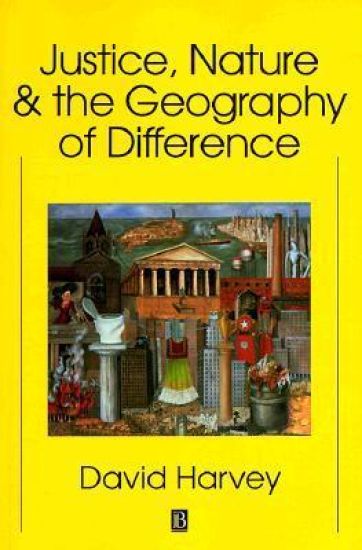
This book engages with the politics of social and environmental justice, and seeks new ways to think about the future of urbanization in the twenty-first century. It establishes foundational concepts for understanding how space, time, place and nature - the material frames of daily life - are constituted and represented through social practices, not as separate elements but in relation to each other. It describes how geographical differences are produced, and shows how they then become fundamental to the exploration of political, economic and ecological alternatives to contemporary life. The book is divided into four parts. Part I describes the problematic nature of action and analysis at different scales of time and space, and introduces the reader to the modes of dialectical thinking and discourse which are used throughout the remainder of the work. Part II examines how "nature" and "environment" have been understood and valued in relation to processes of social change and seeks, from this basis, to make sense of contemporary environmental issues. Part III, is a wide-ranging discussion of history, geography and culture, explores the meaning of the social "production" of space and time, and clarifies problems related to "otherness" and "difference". The final part of the book deploys the foundational arguments the author has established to consider contemporary problems of social justice that have resulted from recent changes in geographical divisions of labor, in the environment, and in the pace and quality of urbanization. Justice, Nature and the Geography of Difference speaks to a wide readership of students of social, cultural and spatial theory and of the dynamics of contemporary life. It is a convincing demonstration that it is both possible and necessary to value difference and to seek a just social order.
The Urban Experience

The Urban Experience

David Harvey

Johns Hopkins University Press
1989
pokkari
The city—site of high human accomplishment and of squalid human failure—embodies the inner contradictions of capitalism. In this pioneering study David Harvey offers a definitive Marxist interpretation of the urban process under capitalism. Originally published in two volumes as Consciousness and the Urban Experience and The Urbanization of Capital, Harvey's work is now available in an abridged one-volume paperback edition. Sppaning geography, sociology, economics, and politics, it offers a solid theoretical basis for understanding—and participating in—social change. The Urban Experience, write's Harvey, "is about ways of seeing the city, of reading its text and finding an interpretive frame in which to locate the million and one surprises that confront us on the street."