Kirjailija
Ezra Pound
Kirjat ja teokset yhdessä paikassa: 145 kirjaa, julkaisuja vuosilta 1957–2026, suosituimpiin kuuluu Hugh Selwyn Mauberley. Vertaile teosten hintoja ja tarkista saatavuus suomalaisista kirjakaupoista.
145 kirjaa
Kirjojen julkaisuvuodet: 1957–2026.

This book has a brief biography of the author Ezra Pound and 27 selected poems as Exultations.
Opposing the Money Lenders is a collection of writings from some of the most determined fighters against usury and the Central Banking system during the 20th Century. Those included are Arthur Nelson Field, John A. Lee, John Hargrave, Ezra Pound, Father Charles Coughlin, and Gottfried Feder, who fought and inspired mass movements that struggled to liberate their nations from the forces of what one - Gottfried Feder - aptly called "Mammonism." The subject of the supply of our money, and who controls it, is the greatest social issue that confronts humanity today. It is the "Hidden Hand" behind history. Without dealing with the problems of banking and usury, without a people having control over its own means of credit and exchange, there can be no genuine nationhood, and no real freedom, whether personal or national. Almost every individual, family, nation, indeed most of the world, is in thrall to the money lenders. Despite advances in mechanisation and technology, people are working longer hours, and are more enslaved to the economic treadmill than were their ancestors in Medieval times. At the same time, despite mass education, people today understand the economic and financial system far less than their parents and grandparents. Opposing the Money Lenders examines our parasitic financial system and the means by which it might be replaced.
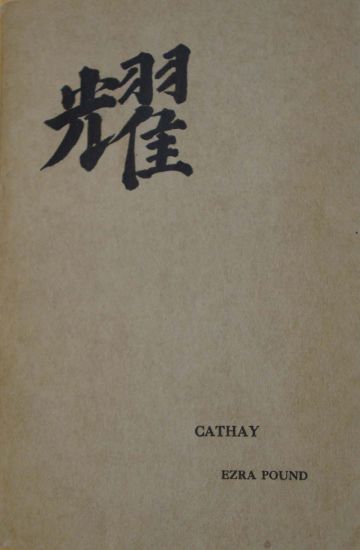
First published in 1915, Cathay, Ezra Pound's early monumental work, originally contained fourteen translations from the Chinese and a translation of the Anglo-Saxon poem "The Seafarer." Over time, these poems have been widely read and loved as both translations and original poetry. In 1916, Cathay was reprinted in the book Lustra without "The Seafarer" and with four more Chinese poems. Cathay is greatly indebted to the notes of a Harvard-trained scholar Ernest Fenollosa. "In Fenollosa's Chinese poetry materials," Pound scholar Zhaoming Qian writes, "Pound discovered a new model that at once mirrored and challenged his developing poetics." Edited by Qian, this centennial edition reproduces for the first time the text of the original publication plus the poems from Lustra and transcripts of all the relevant Fenollosa notes and Chinese texts. Also included is a new foreword by Ezra Pound's daughter Mary de Rachewiltz, providing an appreciation and fascinating background material on this pivotal work of Pound's oeuvre.
Ezra Pound and 'Globe' Magazine: The Complete Correspondence
Ezra Pound
Bloomsbury Academic
2015
sidottu
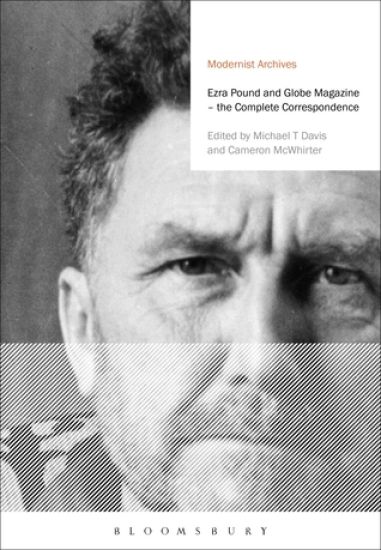
In the summer of 1936, Ezra Pound agreed to take on the role of European Correspondent for a newly launched travel journal entitled Globe: The International Magazine. Ezra Pound and 'Globe' Magazine: The Complete Correspondence collects for the first time Pound’s writings for the journal and his extensive correspondence with one of its editors, James Taylor Dunn, and the leading writers who Pound himself attempted to recruit for the magazine. Numbering almost forty letters and twenty published and unpublished articles, these writings represent a darkly significant time in Pound’s thought as his infatuation with the rise of fascism took root. Annotated throughout and supported by substantial explorations of the historical and cultural contexts of the writings, the book also includes a substantial bibliography of related writings and a biographical glossary of the major figures discussed in the correspondence and writing. Together, these texts represent an important resource for anyone interested in an important phase of 20th-Century literary modernism.
Ezra Pound's Posthumous Cantos collects unpublished pages of his great poem, drawn from manuscripts held in the archive at Yale's Beinecke Library and elsewhere. They are assembled by Pound's Italian translator, the critic and scholar Massimo Bacigalupo, into a companion book to the Cantos, running from 1917 to 1972 and including the Cantos he wrote in Italian in 1944-5. An Italian edition was published in 2002 and revised in 2012. This is the first English edition of a crucial part of the Pound canon. Posthumous Cantos is arranged to reflect the eight phases of the Cantos' composition. Pound's writing suffered the consequences of the turbulent history of his century. World War I left the cultural world he came to Europe for in ruins; and the aftermath of the World War II in which he took a contrary side, made his work, like his life, discontinuous, a sequence of brilliant moments and profound ruptures.
Ep to Lu: Nine Letters Written to Louis Untermeyer
Ezra Pound; John Albert Robbins
Literary Licensing, LLC
2012
nidottu
The Chinese Written Character as a Medium for Poetry
Ernest Fenollosa; Ezra Pound
Literary Licensing, LLC
2011
nidottu
First published in 1919 by Ezra Pound, Ernest Fenollosa's essay on the Chinese written language has become one of the most often quoted statements in the history of American poetics. As edited by Pound, it presents a powerful conception of language that continues to shape our poetic and stylistic preferences: the idea that poems consist primarily of images; the idea that the sentence form with active verb mirrors relations of natural force. But previous editions of the essay represent Pound's understanding-it is fair to say, his appropriation-of the text. Fenollosa's manuscripts, in the Beinecke Library of Yale University, allow us to see this essay in a different light, as a document of early, sustained cultural interchange between North Americaand East Asia. Pound's editing of the essay obscured two important features, here restored to view: Fenollosa's encounter with Tendai Buddhism and Buddhist ontology, and his concern with the dimension of sound in Chinese poetry. This book is the definitive critical edition of Fenollosa's important work. After a substantial Introduction, the text as edited by Pound is presented, together with his notes and plates. At the heart of the edition is the first full publication of the essay as Fenollosa wrote it, accompanied by the many diagrams, characters, and notes Fenollosa (and Pound) scrawled on the verso pages. Pound's deletions, insertions, and alterations to Fenollosa's sometimes ornate prose are meticulously captured, enabling readers to follow the quasi-dialogue between Fenollosa and his posthumous editor. Earlier drafts and related talks reveal the developmentof Fenollosa's ideas about culture, poetry, and translation. Copious multilingual annotation is an important feature of the edition. This masterfully edited book will be an essential resource for scholars and poets and a starting point for a renewed discussion of the multiple sources of American modernist poetry.
Gadfly: December, 1959
Ezra Pound; Austen Warren; Guy Davenport
Literary Licensing, LLC
2011
nidottu
The Analyst, No. 11
Ezra Pound; Anthony Manganaris-Decavalles; Robert Mayo

Literary Licensing, LLC
2011
nidottu
The Analyst, No. 1-8
Ezra Pound; E. M. Glenn; Thelma C. Balagot
Literary Licensing, LLC
2011
nidottu
The Analyst, No. 1-8
Ezra Pound; E. M. Glenn; Thelma C. Balagot
Literary Licensing, LLC
2011
sidottu
The Analyst, No. 18 is a book written by the American poet Ezra Pound. It is a collection of literary essays and critical analyses of various works of literature, including poetry, drama, and fiction. The book is divided into several sections, each of which focuses on a particular genre or theme. Pound's writing is characterized by his unique and often controversial perspectives on literature, politics, and culture. In The Analyst, No. 18, he offers insights into the works of writers such as Shakespeare, Dante, and T. S. Eliot, as well as his own poetry. The book is a valuable resource for students and scholars of literature, as well as anyone interested in Pound's contributions to modernist poetry and criticism. This scarce antiquarian book is a facsimile reprint of the old original and may contain some imperfections such as library marks and notations. Because we believe this work is culturally important, we have made it available as part of our commitment for protecting, preserving, and promoting the world's literature in affordable, high quality, modern editions, that are true to their original work.