Kirjojen hintavertailu – 12 859 824 kirjaa ja 27 kauppaa

Kirjailija

F. A. Hayek

Kirjat ja teokset yhdessä paikassa: 60 kirjaa, julkaisuja vuosilta 1978–2025, suosituimpiin kuuluu The Road to Serfdom. Vertaile teosten hintoja ja tarkista saatavuus suomalaisista kirjakaupoista.

Nimi esiintyy myös muodoissa: F.A. Hayek, F A Hayek, F.A Hayek, F. A Hayek

60 kirjaa

Kirjojen julkaisuvuodet: 1978–2025.

Frihetens grundvalar

Frihetens grundvalar

F.A. Hayek; Nils Karlson

Timbro
2025
kartonkisidos
I Frihetens grundvalar presenterar F. A. Hayek ett av historiens mest kraftfulla försvar för det fria och öppna samhället. Han utforskar frihetsbegreppets utveckling, välfärdsstatens framväxt och utvecklar den banbrytande teorin om den spontana ordning som uppstår när individer fritt får konkurrera med sina idéer. Boken är en ymnig källa till argument för frihet och mot förtryck för det småskaliga och spontana framför det storskaligt planerade. Den fungerar som en ständig påminnelse om politikens begränsningar och uppmaning att värna individens frioch rättigheter. Frihetens grundvalar är Hayeks magnum opus. Verket publicerades första gången 1960 och fick sin första svenska översättning 1983. Denna utgåva innehåller ett nyskrivet förord av Nils Karlson.
Essays on Liberalism and the Economy

Essays on Liberalism and the Economy

F.A. Hayek

TAYLOR FRANCIS LTD
2024
nidottu
Across seventeen volumes to date, the Collected Works of F. A. Hayek series has anthologized the diverse and prolific writings of the Austrian economist synonymous with classical liberalism. Essays on Liberalism and the Economy traces the author’s long and evolving writings on the cluster of beliefs he championed most: liberalism, its core tenets, and how its tradition represents the best hope for Western civilization. This deft selection includes some of Hayek’s most important and famous essays as well as unpublished and lesser-known works. It contains material from almost the entire span of Hayek’s career, the earliest from 1931 and the last from 1984. The works were written for a variety of purposes and audiences, and they include—along with conventional academic papers—encyclopedia entries, after-dinner addresses, a lecture for graduate students, a book review, newspaper articles, and letters to the editors of national newspapers. While many are available elsewhere, two have never appeared in print, and two others have not been published in English. The varied formats collected here are enriched by Hayek’s changing voice at different stages of his life. Some of the pieces resonate as high-minded and noble; others are less formal. Some see Hayek focus on expounding his own views; others are primarily critiques of the ideas of other prominent thinkers like John Maynard Keynes and John Kenneth Galbraith. All serve to distill important aspects of Hayek’s worldview.
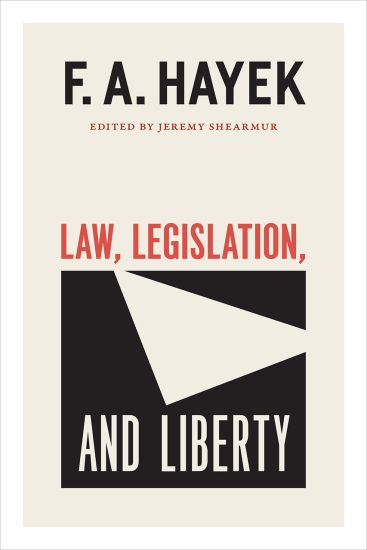
Law, Legislation, and Liberty

Law, Legislation, and Liberty

F.A. Hayek

TAYLOR FRANCIS LTD
2024
nidottu
A new edition of F. A. Hayek’s three-part opus Law, Legislation, and Liberty, collated in a single volumeIn this critical entry in the Collected Works of F. A. Hayek series, political philosopher Jeremy Shearmur collates Hayek’s three-part study of law and liberty and places Hayek’s writings in careful historical context. Incisive and unrestrained, Law, Legislation, and Liberty is Hayek at his late-life best, making it essential reading for understanding the philosopher’s politics and worldview. These three volumes constitute a scaling up of the framework offered in Hayek’s famed The Road to Serfdom. Volume 1, Rules and Order, espouses the virtues of classical liberalism; Volume 2, The Mirage of Social Justice, examines the societal forces that undermine liberalism and, with it, liberalism’s capacity to induce "spontaneous order"; and Volume 3, The Political Order of a Free People, proposes alternatives and interventions against emerging anti-liberal movements, including a rule of law that resides in stasis with personal freedom. Shearmur’s treatment of this challenging work—including an immersive new introduction, a conversion of Hayek’s copious endnotes to footnotes, corrections to Hayek’s references and quotations, and the provision of translations to material that Hayek cited only in languages other than English—lends it new importance and accessibility. Rendered anew for the next generations of scholars, this revision of Hayek’s Law, Legislation, and Liberty is sure to become the standard.
Hayek on Mill

Hayek on Mill

F. A. Hayek

LIBERTY FUND INC
2024
nidottu
Best known for reviving the tradition of classical liberalism, F. A. Hayek was also a prominent scholar of the philosopher John Stuart Mill. In this volume, Hayek showcases the fascinating intersections between two of the most prominent thinkers from two successive centuries. Hayek first published the Mill-Taylor correspondence in 1951, and his edition soon became required reading for any study of the nineteenth-century foundations of liberalism.
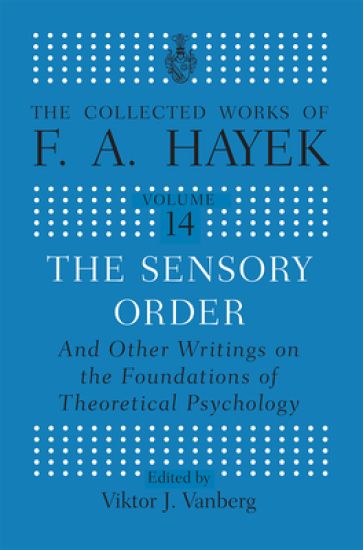
The Sensory Order and Other Writings on the Foundations of Theoretical Psychology
The Sensory Order, first published in 1952, sets forth Hayek's classic theory of mind in which he describes the mental mechanism that classifies perceptions that cannot be accounted for by physical laws. Editor Viktor Vanberg writes in the introduction that The Sensory Order provides "an essential foundation of Hayek's] comprehensive social theory, covering economics, law, politics, and philosophy" (emphasis in the original).
Capital and Interest

Capital and Interest

F A Hayek

LIBERTY FUND INC
2023
nidottu
Produced throughout the first fifteen years of Hayek's career, the writings collected in Capital and Interest see Hayekelaborate on and extend his landmark lectures that were published as Prices and Production and work toward thetechnically sophisticated line of thought seen in his later Pure Theory of Capital. Illuminating the development of Hayek's detailed contributions to capital and interest theory, the collection also shedslight on how Hayek's work related to other influential economists of the time. Highlights include the 1936 article "TheMythology of Capital"--presented here alongside Frank Knight's criticisms of the Austrian theory of capital thatprompted it--and "The Maintenance of Capital," with subsequent comments by the English economist A. C. Pigou. These and other familiar works are accompanied by lesser-known articles and lectures, including a lecture ontechnological progress and excess capacity. An introduction by the book's editor, leading Hayek scholar Lawrence H. White, places Hayek's contributions in careful historical context, with ample footnotes and citations for furtherreading.
Law, Legislation, and Liberty

Law, Legislation, and Liberty

F.A. Hayek

Routledge
2022
sidottu
A new edition of F. A. Hayek’s three-part opus Law, Legislation, and Liberty, collated in a single volumeIn this critical entry in the Collected Works of F. A. Hayek series, political philosopher Jeremy Shearmur collates Hayek’s three-part study of law and liberty and places Hayek’s writings in careful historical context. Incisive and unrestrained, Law, Legislation, and Liberty is Hayek at his late-life best, making it essential reading for understanding the philosopher’s politics and worldview. These three volumes constitute a scaling up of the framework offered in Hayek’s famed The Road to Serfdom. Volume 1, Rules and Order, espouses the virtues of classical liberalism; Volume 2, The Mirage of Social Justice, examines the societal forces that undermine liberalism and, with it, liberalism’s capacity to induce "spontaneous order"; and Volume 3, The Political Order of a Free People, proposes alternatives and interventions against emerging anti-liberal movements, including a rule of law that resides in stasis with personal freedom. Shearmur’s treatment of this challenging work—including an immersive new introduction, a conversion of Hayek’s copious endnotes to footnotes, corrections to Hayek’s references and quotations, and the provision of translations to material that Hayek cited only in languages other than English—lends it new importance and accessibility. Rendered anew for the next generations of scholars, this revision of Hayek’s Law, Legislation, and Liberty is sure to become the standard.
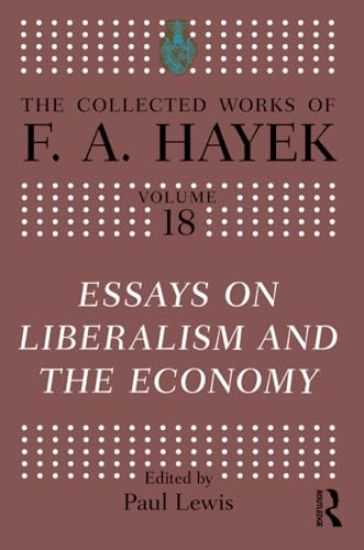
Essays on Liberalism and the Economy
Across seventeen volumes to date, the Collected Works of F. A. Hayek series has anthologized the diverse and prolific writings of the Austrian economist synonymous with classical liberalism. Essays on Liberalism and the Economy traces the author’s long and evolving writings on the cluster of beliefs he championed most: liberalism, its core tenets, and how its tradition represents the best hope for Western civilization. This deft selection includes some of Hayek’s most important and famous essays as well as unpublished and lesser-known works. It contains material from almost the entire span of Hayek’s career, the earliest from 1931 and the last from 1984. The works were written for a variety of purposes and audiences, and they include—along with conventional academic papers—encyclopedia entries, after-dinner addresses, a lecture for graduate students, a book review, newspaper articles, and letters to the editors of national newspapers. While many are available elsewhere, two have never appeared in print, and two others have not been published in English. The varied formats collected here are enriched by Hayek’s changing voice at different stages of his life. Some of the pieces resonate as high-minded and noble; others are less formal. Some see Hayek focus on expounding his own views; others are primarily critiques of the ideas of other prominent thinkers like John Maynard Keynes and John Kenneth Galbraith. All serve to distill important aspects of Hayek’s worldview.
Essays on Liberalism and the Economy, Volume 18: Volume 18

Essays on Liberalism and the Economy, Volume 18: Volume 18

F. a. Hayek

University of Chicago Press
2022
sidottu
A deft selection of unpublished and little-known works by F. A. Hayek that will serve to enlighten and enliven debates around the ever-changing face of Western liberalism Across seventeen volumes to date, the University of Chicago Press's Collected Works of F. A. Hayek series has anthologized the diverse and prolific writings of the Austrian economist synonymous with classical liberalism. Essays on Liberalism and the Economy traces the author's long and evolving writings on the cluster of beliefs he championed most: liberalism, its core tenets, and how its tradition represents the best hope for Western civilization. This volume contains material from almost the entire span of Hayek's career, the earliest from 1931 and the last from 1984. The works were written for a variety of purposes and audiences, and they include--along with conventional academic papers--encyclopedia entries, after-dinner addresses, a lecture for graduate students, a book review, newspaper articles, and letters to the editors of national newspapers. While many are available elsewhere, two have never appeared in print, and two others have not been published in English. The varied formats collected here are enriched by Hayek's changing voice at different stages of his life. Some of the pieces resonate as high-minded and noble; some are meant as cuts to "intellectuals" (a pejorative term when used by Hayek) like Keynes and Galbraith. All serve to distill important threads of his worldview.
Spontan ordning : F. A. Hayek i urval
»Lösningen på samhällets ekonomiska problem är alltid en resa mot det okända.« Varför slutar det så ofta i misär och förtryck när experter försöker planera samhället? Hur kan miljontals individers spretande viljor och motstridiga önskningar leda till civilisation och välstånd? Friedrich Hayek (1899 1992) är en av historiens viktigaste liberala tänkare, bland annat belönad med Nobelpriset i ekonomi. Hayeks ideal är ett samhälle där människor är fria att pröva olika lösningar en spontan ordning. I Spontan ordning samlas fl era av hans mest centrala texter inom nationalekonomi, filosofi , politik och idéhistoria. De flesta är aldrig tidigare utgivna på svenska. Samlingen ger både en introduktion till och en fördjupning i Hayeks tänkande.» I mina ögon är han 1900-talets överlägset främsta ekonom« Douglass North
Law, Legislation, and Liberty, Volume 19

Law, Legislation, and Liberty, Volume 19

F. A. Hayek

University of Chicago Press
2021
sidottu
A new edition of F. A. Hayek's three-part opus Law, Legislation, and Liberty, collated in a single volume In this critical entry in the University of Chicago's Collected Works of F. A. Hayek series, political philosopher Jeremy Shearmur collates Hayek's three-part study of law and liberty and places Hayek's writings in careful historical context. Incisive and unrestrained, Law, Legislation, and Liberty is Hayek at his late-life best, making it essential reading for understanding the philosopher's politics and worldview. These three volumes constitute a scaling up of the framework offered in Hayek's famed The Road to Serfdom. Volume 1, Rules and Order, espouses the virtues of classical liberalism; Volume 2, The Mirage of Social Justice, examines the societal forces that undermine liberalism and, with it, liberalism's capacity to induce "spontaneous order"; and Volume 3, The Political Order of a Free People, proposes alternatives and interventions against emerging anti-liberal movements, including a rule of law that resides in stasis with personal freedom. Shearmur's treatment of this challenging work-including an immersive new introduction, a conversion of Hayek's copious endnotes to footnotes, corrections to Hayek's references and quotations, and the provision of translations to material that Hayek cited only in languages other than English-lends it new importance and accessibility. Rendered anew for the next generations of scholars, this revision of Hayek's Law, Legislation, and Liberty is sure to become the standard.
Law, Legislation, and Liberty, Volume 19

Law, Legislation, and Liberty, Volume 19

F. A. Hayek

University of Chicago Press
2021
nidottu
A new edition of F. A. Hayek's three-part opus Law, Legislation, and Liberty, collated in a single volume In this critical entry in the University of Chicago's Collected Works of F. A. Hayek series, political philosopher Jeremy Shearmur collates Hayek's three-part study of law and liberty and places Hayek's writings in careful historical context. Incisive and unrestrained, Law, Legislation, and Liberty is Hayek at his late-life best, making it essential reading for understanding the philosopher's politics and worldview. These three volumes constitute a scaling up of the framework offered in Hayek's famed The Road to Serfdom. Volume 1, Rules and Order, espouses the virtues of classical liberalism; Volume 2, The Mirage of Social Justice, examines the societal forces that undermine liberalism and, with it, liberalism's capacity to induce "spontaneous order"; and Volume 3, The Political Order of a Free People, proposes alternatives and interventions against emerging anti-liberal movements, including a rule of law that resides in stasis with personal freedom. Shearmur's treatment of this challenging work-including an immersive new introduction, a conversion of Hayek's copious endnotes to footnotes, corrections to Hayek's references and quotations, and the provision of translations to material that Hayek cited only in languages other than English-lends it new importance and accessibility. Rendered anew for the next generations of scholars, this revision of Hayek's Law, Legislation, and Liberty is sure to become the standard.
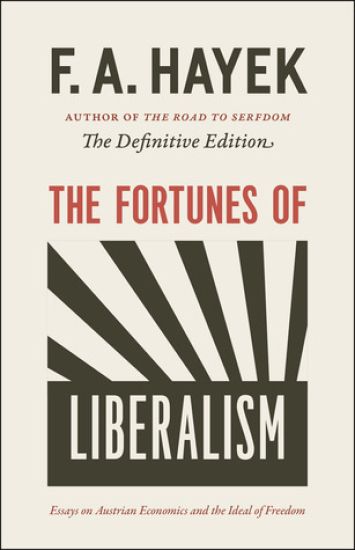
The Fortunes of Liberalism

The Fortunes of Liberalism

F a Hayek

University of Chicago Press
2021
nidottu
The Reagan and Thatcher revolutions. The collapse of Eastern Europe dramatically captured in the tearing down of the Berlin Wall. F. A. Hayek, grand old man of capitalism and founder of the classical liberal, free-market revival which ignited and inspired these world events, forcefully predicted their occurrence in writings such as The Road to Serfdom, first published in 1944. Hayek's well-known social and political philosophy--in particular his long-held pessimistic view of the prospects of socialism, irrefutably vindicated by the recent collapse of the Eastern bloc--is fully grounded in the Austrian approach to economics. In this new collection, Hayek traces his intellectual roots to the Austrian school, the century-old tradition founded at the University of Vienna by Carl Menger, and links it to the modern rebirth of classical liberal or libertarian thought. As Hayek reminds us, the cornerstone of modern economics--the theory of value and price--represents a consistent continuation of the fundamental principles handed down by the Vienna school. Here, in this first modern collection of essays on the Austrian school by one of its preeminent figures, is the genesis of this tradition and its place in intellectual history. Reflections on Hayek's days as a young economic theorist in Vienna, his opening address to the inaugural meeting of the Mont P lerin Society, and essays on former teachers and other leading figures in the Austrian school are included in volume 4. Two hitherto unavailable memoirs, The Economics of the 1920s as Seen from Vienna, published here for the first time, and The Rediscovery of Freedom: Personal Recollections, available for the first time in English, make this collection invaluable for Hayek scholars. Hayek's writings continue to provide an invaluable education in a subject which is nothing less than the development of the modern world.
The Sensory Order and Other Writings on the Foundations of Theoretical Psychology
The Sensory Order, first published in 1952, sets forth F. A. Hayek's classic theory of mind in which he describes the mental mechanism that classifies perceptions that cannot be accounted for by physical laws. Hayek's substantial contribution to theoretical psychology has been addressed in the work of Thomas Szasz, Gerald Edelman, and Joaquin Fuster.
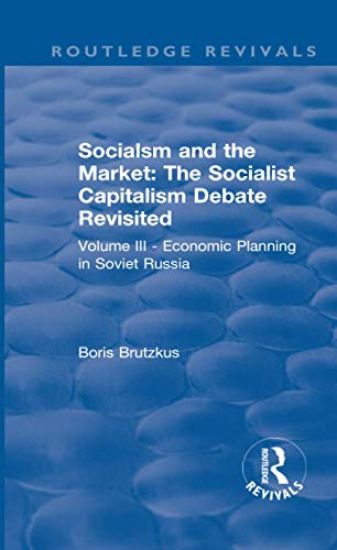
Revival: Economic Planning in Soviet Russia (1935)

Revival: Economic Planning in Soviet Russia (1935)

F. A Hayek; Boris Brutzkus

Routledge
2019
nidottu
The ideas set forth in these pages matured in the authors mind during the early years of constructive communism in Petrograd. The communist government, intoxicated by its successes in the counter-revolution, had promised to deal promptly with all economic problems now that its hands where free to do so. It was at this moment of its greatest triumphs that the author put forward his contention that the system of Marxian communism, as then conceived, was-intrinsically unsound and must inevitably break down.
Ekonomiska villkor för mellanstatlig federalism
"Icke desto mindre, om det pris vi måste betala för en internationell, demokratisk regering är att begränsa regeringens makt och räckvidd, då är det verkligen inte ett för högt pris, och alla de som är genuint, demokratiskt övertygade borde vara villiga att betala det." Ekonomiska villkor för mellanstatlig federalism ingår i en serie essäer om federalism. Timbro förlags essäserie presenterar nya och gamla svar på eviga frågor om människan, samhället och politiken. Nya svenska originaltexter varvas med översättningar. F. A. Hayek (1899 1992) var en av 1900-talets mest inflytelserika förespråkare av klassisk liberalism. Hans analyser av sambanden mellan ekonomiska institutioner och det vidare samhället gav honom 1974 tillsammans med Gunnar Myrdal Ekonomipriset till Alfred Nobels minne.
Revival: Economic Planning in Soviet Russia (1935)

Revival: Economic Planning in Soviet Russia (1935)

F. A Hayek; Boris Brutzkus

Routledge
2018
sidottu
The ideas set forth in these pages matured in the authors mind during the early years of constructive communism in Petrograd. The communist government, intoxicated by its successes in the counter-revolution, had promised to deal promptly with all economic problems now that its hands where free to do so. It was at this moment of its greatest triumphs that the author put forward his contention that the system of Marxian communism, as then conceived, was-intrinsically unsound and must inevitably break down.
The Market and Other Orders

The Market and Other Orders

F. a. Hayek

University of Chicago Press
2017
nidottu
In addition to his groundbreaking contributions to pure economic theory, F. A. Hayek also closely examined the ways in which the knowledge of many individual market participants could culminate in an overall order of economic activity. His attempts to come to terms with the "knowledge problem" thread through his career and comprise the writings collected in the fifteenth volume of the University of Chicago Press's Collected Works of F. A. Hayek series. The Market and Other Orders brings together more than twenty works spanning almost forty years that consider this question. Consisting of speeches, essays, and lectures, including Hayek's 1974 Nobel lecture, "The Pretense of Knowledge," the works in this volume draw on a broad range of perspectives, including the philosophy of science, the physiology of the brain, legal theory, and political philosophy. Taking readers from Hayek's early development of the idea of spontaneous order in economics through his integration of this insight into political theory and other disciplines, the book culminates with Hayek's integration of his work on these topics into an overarching social theory that accounts for spontaneous order in the variety of complex systems that Hayek studied throughout his career. Edited by renowned Hayek scholar Bruce Caldwell, who also contributes a masterly introduction that provides biographical and historical context, The Market and Other Orders forms the definitive compilation of Hayek's work on spontaneous order.
The Sensory Order and Other Writings on the Foundations of Theoretical Psychology
The Sensory Order, first published in 1952, sets forth F. A. Hayek's classic theory of mind in which he describes the mental mechanism that classifies perceptions that cannot be accounted for by physical laws. Hayek's substantial contribution to theoretical psychology has been addressed in the work of Thomas Szasz, Gerald Edelman, and Joaquin Fuster.
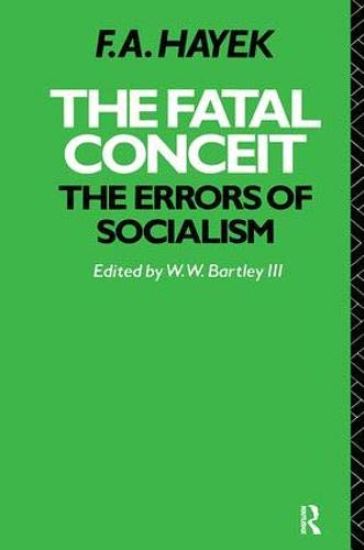
The Fatal Conceit

The Fatal Conceit

F.A. Hayek

Routledge
2017
sidottu
Hayek gives the main arguments for the free-market case and presents his manifesto on the “errors of socialism.” Hayek argues that socialism has, from its origins, been mistaken on factual, and even on logical, grounds and that its repeated failures in the many different practical applications of socialist ideas that this century has witnessed were the direct outcome of these errors. He labels as the “fatal conceit” the idea that “man is able to shape the world around him according to his wishes.”