
Kirjailija
F. Scott Fitzgerald
Kirjat ja teokset yhdessä paikassa: 1 096 kirjaa, julkaisuja vuosilta 1905–2030, suosituimpiin kuuluu Tender is the Night. Vertaile teosten hintoja ja tarkista saatavuus suomalaisista kirjakaupoista.
Nimi esiintyy myös muodoissa: F Scott Fitzgerald, F.Scott Fitzgerald, F. Scott Fitzgerald, (?????? F Scott Fitzgerald, F SCOTT FITZGERALD
1 096 kirjaa
Kirjojen julkaisuvuodet: 1905–2030.
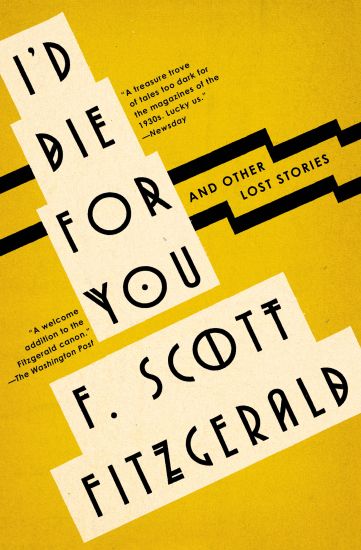
A collection of the last remaining unpublished and uncollected short stories by F. Scott Fitzgerald, the iconic American writer of The Great Gatsby who is more widely read today than ever. "A treasure trove of tales too dark for the magazines of the 1930s. Lucky us" (Newsday). "His best readers will find much to enjoy" (The New York Times Book Review). I'd Die For You, edited by Anne Margaret Daniel, is a collection of F. Scott Fitzgerald's stories never widely shared. Some were submitted individually to major magazines during the 1930s and accepted for publication during Fitzgerald's lifetime, but never printed. Some were written as movie scenarios and sent to studios or producers, but not filmed. Others are stories that could not be sold because their subject matter or style departed from what editors expected of Fitzgerald. Some of the eighteen stories were physically lost, coming to light only in the past few years. All were lost, in one sense or another: lost in the painful shuffle of the difficulties of Fitzgerald's life in the middle 1930s; lost to readers because contemporary editors did not understand or accept what he was trying to write; lost because archives are like that. Readers will experience here Fitzgerald writing about controversial topics, depicting young men and women who actually spoke and thought more as young men and women did, without censorship. Rather than permit changes and sanitizing by his contemporary editors, Fitzgerald preferred to let his work remain unpublished, even at a time when he was in great need of money and review attention. Written in his characteristically beautiful, sharp, and surprising language, exploring themes both familiar and fresh, these stories provide new insight into the bold and uncompromising arc of Fitzgerald's career. I'd Die For You is a revealing, intimate look at Fitzgerald's creative process that shows him to be a writer working at the fore of modern literature--in all its developing complexities.
The Beautiful and Damned
F. Scott Fitzgerald
Createspace Independent Publishing Platform
2018
nidottu
A meditation on love, money and decadence reflected in the life of Anthony Patch, a 1920s socialite exploring the New York cafe society scene during the Jazz Age. The story follows his relationship with his wife, Gloria, his service in the army, and his alcoholism. As in Fitzgerald's other novels, the characters are complex, especially with respect to marriage and intimacy. The book is believed to be largely based on Fitzgerald's relationship with Zelda Fitzgerald.
The Beautiful And Damned - The Original Classic (Bee Press Edition)
F. Scott Fitzgerald
Createspace Independent Publishing Platform
2018
nidottu
THIS EDITION IS THE ORIGINAL CLASSIC NOVEL WRITTEN BY THE BEST SELLING AUTHOR OF: THE GREAT GATSBY F. SCOTT FITZGERLAD FIRST PUBLISHED IN 1922 The Beautiful and Damned is a morality tale, a meditation on love, money and decadence.

This unlikely story begins on a sea that was a blue dream, as colorful as blue-silk stockings, and beneath a sky as blue as the irises of children's eyes. From the western half of the sky the sun was shying little golden disks at the sea-if you gazed intently enough you could see them skip from wave tip to wave tip until they joined a broad collar of golden coin that was collecting half a mile out and would eventually be a dazzling sunset. About half-way between the Florida shore and the golden collar a white steam-yacht, very young and graceful, was riding at anchor and under a blue-and-white awning aft a yellow-haired girl reclined in a wicker settee reading The Revolt of the Angels, by Anatole France. She was about nineteen, slender and supple, with a spoiled alluring mouth and quick gray eyes full of a radiant curiosity. Her feet, stockingless, and adorned rather than clad in blue-satin slippers which swung nonchalantly from her toes, were perched on the arm of a settee adjoining the one she occupied.
"The Beautiful and Damned" was F. Scott Fitzgerald's second major novel, in which he explored the angst of a handful of Americans after the "Great War." Fitzgerald's career would be brought to a sudden end with his untimely death in 1940, but his renown as an American writer would grow posthumously. This edition is based on Fitzgerald's original, 1922, version.
Compiled and published after Fitzgerald’s death by his friend, the prominent critic and editor Edmund Wilson, The Crack-Up is a collection of writings that chronicle the author’s state of mind and personal perspective on events, fellow writers and public figures of the 1920s and 1930s. In addition to articles and essays such as the celebrated title piece, this volume includes a selection of Fitzgerald’s notebooks, which – as well as being a repository of anecdotes and witty lines – provide a fascinating behind-the-scenes glimpse into the novelist’s creative process, with passages that would be reworked into his fiction. An entertaining and eclectic miscellany that sheds light on the author and his times, The Crack-Up is an invaluable companion to such well-known works as The Great Gatsby and Tender Is the Night.
There was a rough stone age and a smooth stone age and a bronze age, and many years afterward a cut-glass age. In the cut-glass age, when young ladies had persuaded young men with long, curly mustaches to marry them, they sat down several months afterward and wrote thank-you notes for all sorts of cut-glass presents-punch-bowls, finger-bowls, dinner-glasses, wine-glasses, ice-cream dishes, bonbon dishes, decanters, and vases-for, though cut glass was nothing new in the nineties, it was then especially busy reflecting the dazzling light of fashion from the Back Bay to the fastnesses of the Middle West. After the wedding the punch-bowls were arranged in the sideboard with the big bowl in the centre; the glasses were set up in the china-closet; the candlesticks were put at both ends of things-and then the struggle for existence began.
In the millennium an educational genius will write a book to be given to every young man on the date of his disillusion. This work will have the flavor of Montaigne's essays and Samuel Butler's note-books-and a little of Tolstoi and Marcus Aurelius. It will be neither cheerful nor pleasant but will contain numerous passages of striking humor. Since first-class minds never believe anything very strongly until they've experienced it, its value will be purely relative ... all people over thirty will refer to it as "depressing." This prelude belongs to the story of a young man who lived, as you and I do, before the book.

After dark on Saturday night one could stand on the first tee of the golf-course and see the country-club windows as a yellow expanse over a very black and wavy ocean. The waves of this ocean, so to speak, were the heads of many curious caddies, a few of the more ingenious chauffeurs, the golf professional's deaf sister-and there were usually several stray, diffident waves who might have rolled inside had they so desired. This was the gallery. The balcony was inside. It consisted of the circle of wicker chairs that lined the wall of the combination clubroom and ballroom. At these Saturday-night dances it was largely feminine; a great babel of middle-aged ladies with sharp eyes and icy hearts behind lorgnettes and large bosoms.
At the present time no one I know has the slightest desire to hit Samuel Meredith; possibly this is because a man over fifty is liable to be rather severely cracked at the impact of a hostile fist, but, for my part, I am inclined to think that all his hitable qualities have quite vanished. But it is certain that at various times in his life hitable qualities were in his face, as surely as kissable qualities have ever lurked in a girl's lips. I'm sure every one has met a man like that, been casually introduced, even made a friend of him, yet felt he was the sort who aroused passionate dislike-expressed by some in the involuntary clinching of fists, and in others by mutterings about "takin' a poke" and "landin' a swift smash in ee eye." In the juxtaposition of Samuel Meredith's features this quality was so strong that it influenced his entire life. What was it? Not the shape, certainly, for he was a pleasant- looking man from earliest youth: broad-bowed with gray eyes that were frank and friendly.

The Curious Case of Benjamin Button
F. Scott Fitzgerald
Createspace Independent Publishing Platform
2018
nidottu
Today, F. Scott Fitzgerald is known for his novels, but in his lifetime, his fame stemmed from his prolific achievement as one of America's most gifted story writers. "The Curious Case of Benjamin Button," a witty and fantastical satire about aging, is one of his most memorable stories. In 1860 Benjamin Button is born an old man and mysteriously begins aging backward. At the beginning of his life he is withered and worn, but as he continues to grow younger he embraces life -- he goes to war, runs a business, falls in love, has children, goes to college and prep school, and, as his mind begins to devolve, he attends kindergarten and eventually returns to the care of his nurse. This strange and haunting story embodies the sharp social insight that has made Fitzgerald one of the great voices in the history of American literature.

In 1915 Horace Tarbox was thirteen years old. In that year he took the examinations for entrance to Princeton University and received the Grade A-excellent-in C sar, Cicero, Vergil, Xenophon, Homer, Algebra, Plane Geometry, Solid Geometry, and Chemistry. Two years later while George M. Cohan was composing "Over There," Horace was leading the sophomore class by several lengths and digging out theses on "The Syllogism as an Obsolete Scholastic Form," and during the battle of Ch teau-Thierry he was sitting at his desk deciding whether or not to wait until his seventeenth birthday before beginning his series of essays on "The Pragmatic Bias of the New Realists." After a while some newsboy told him that the war was over, and he was glad, because it meant that Peat Brothers, publishers, would get out their new edition of "Spinoza's Improvement of the Understanding.

The Curious Case of Benjamin Button
F. Scott Fitzgerald
Createspace Independent Publishing Platform
2018
nidottu
As long ago as 1860 it was the proper thing to be born at home. At present, so I am told, the high gods of medicine have decreed that the first cries of the young shall be uttered upon the anesthetic air of a hospital, preferably a fashionable one. So young Mr. and Mrs. Roger Button were fifty years ahead of style when they decided, one day in the summer of 1860, that their first baby should be born in a hospital. Whether this anachronism had any bearing upon the astonishing history I am about to set down will never be known. I shall tell you what occurred, and let you judge for yourself. The Roger Buttons held an enviable position, both social and financial, in ante-bellum Baltimore. They were related to the This Family and the That Family, which, as every Southerner knew, entitled them to membership in that enormous peerage which largely populated the Confederacy. This was their first experience with the charming old custom of having babies-Mr. Button was naturally nervous. He hoped it would be a boy so that he could be sent to Yale College in Connecticut, at which institution Mr. Button himself had been known for four years by the somewhat obvious nickname of "Cuff." On the September morning consecrated to the enormous event he arose nervously at six o'clock, dressed himself, adjusted an impeccable stock, and hurried forth through the streets of Baltimore to the hospital, to determine whether the darkness of the night had borne in new life upon its bosom. When he was approximately a hundred yards from the Maryland Private Hospital for Ladies and Gentlemen he saw Doctor Keene, the family physician, descending the front steps, rubbing his hands together with a washing movement-as all doctors are required to do by the unwritten ethics of their profession.

The Baltimore Station was hot and crowded, so Lois was forced to stand by the telegraph desk for interminable, sticky seconds while a clerk with big front teeth counted and recounted a large lady's day message, to determine whether it contained the innocuous forty-nine words or the fatal fifty-one. Lois, waiting, decided she wasn't quite sure of the address, so she took the letter out of her bag and ran over it again. "Darling," IT BEGAN-"I understand and I'm happier than life ever meant me to be. If I could give you the things you've always been in tune with-but I can't Lois; we can't marry and we can't lose each other and let all this glorious love end in nothing. "Until your letter came, dear, I'd been sitting here in the half dark and thinking where I could go and ever forget you; abroad, perhaps, to drift through Italy or Spain and dream away the pain of having lost you where the crumbling ruins of older, mellower civilizations would mirror only the desolation of my heart-and then your letter came.

This Side of Paradise: Original and Unabridged
F. Scott Fitzgerald
Createspace Independent Publishing Platform
2017
nidottu
This Side of Paradise, the debut novel of F. Scott Fitzgerald, author of The Great Gatsby. Taking its title from a line of Rupert Brooke's poem Tiare Tahiti, the book examines the lives and morality of post-World War I youth. Its protagonist, Amory Blaine, is an attractive Princeton University student who dabbles in literature. The novel explores the theme of love warped by greed and status seeking. The novel famously helped F. Scott Fitzgerald gain Zelda Sayre's hand in marriage due to its success.

The Beautiful and the Damned
F. Scott Fitzgerald
Createspace Independent Publishing Platform
2017
nidottu
First published in 1922, The Beautiful and the Damned followed Fitzgerald's impeccable debut, This Side of Paradise, thus securing his place in the tradition of great American novelists. Embellished with the author's lyrical prose, here is the story of Harvard-educated, aspiring aesthete Anthony Patch and his beautiful wife, Gloria. As they await the inheritance of his grandfather's fortune, their reckless marriage sways under the influence of alcohol and avarice. A devastating look at the nouveau riche and New York nightlife, as well as the ruinous effects of wild ambition, The Beautiful and the Damned achieved stature as one of Fitzgerald's most accomplished novels. Its distinction as a classic endures to this day. Pocket Book's Enriched Classics present the great works of world literature enhanced for the contemporary reader. Special features include critical perspectives, suggestions for further read, and a unique visual essay composed of period photographs that help bring every word to life.
The Curious Case of Benjamin Button
F. Scott Fitzgerald
Createspace Independent Publishing Platform
2017
nidottu
This story was inspired by a remark of Mark Twain's to the effect that it was a pity that the best part of life came at the beginning and the worst part at the end. By trying the experiment upon only one man in a perfectly normal world I have scarcely given his idea a fair trial. Several weeks after completing it, I discovered an almost identical plot in Samuel Butler's "Note-books." The story was published in "Collier's" last summer and provoked this startling letter from an anonymous admirer in Cincinnati: "Sir-- I have read the story Benjamin Button in Colliers and I wish to say that as a short story writer you would make a good lunatic I have seen many peices of cheese in my life but of all the peices of cheese I have ever seen you are the biggest peice. I hate to waste a peice of stationary on you but I will."