
Kirjailija
Friedrich Nietzsche
Kirjat ja teokset yhdessä paikassa: 921 kirjaa, julkaisuja vuosilta 1885–2026, suosituimpiin kuuluu Näin puhui Zarathustra. Vertaile teosten hintoja ja tarkista saatavuus suomalaisista kirjakaupoista.
921 kirjaa
Kirjojen julkaisuvuodet: 1885–2026.
Friedrich Nietzsche (1844-1900) es uno de los grandes mitos de la cultura occidental. Su pensamiento ha traspasado tanto las fronteras nacionales como las disciplinarias, y sus repercusiones han llegado hasta los mbitos de la religi n, el psicoan lisis, la historia, el arte. Quiz s por esto mismo ha sido y sigue siendo uno de los fil sofos peor comprendidos. Existe, as , una suerte de leyenda de Nietzsche, que ha producido, entre otras cosas, una flagrante ficci n que opaca en muchos casos las ideas del propio autor. Nacido en R cken (Sajonia), hijo y nieto de pastores protestantes, Nietzsche dedic gran parte de su obra al cuestionamiento de la religi n y su secularizaci n en la filosof a y la moral, partiendo de una perspectiva afirmadora de la vida. En su sostenido trato con la religi n, manifest una marcada hostilidad frente al cristianismo, al que caracterizaba como una moral de esclavos, producto del resentimiento de los d biles contra los fuertes. As , la moral cristiana y la metaf sica plat nica y cristiana se presentan como dos de los objetivos m s recurrentes de sus ataques. El Anticristo fue escrito en el final del verano de 1888 y en el comienzo del oto o. Este pol mico texto pudo ser redactado r pidamente gracias al material acumulado para La voluntad de poder. En funci n de las vicisitudes ocurridas a partir del derrumbe intelectual de Nietzsche, el manuscrito no vio la luz hasta fines de 1894, a o en que fue publicado por el Archivo Nietzsche.
Beyond Good and Evil is a comprehensive overview of Nietzsche's mature philosophy. The book consists of 296 aphorisms, ranging in length from a few sentences to a few pages. These aphorisms are grouped thematically into nine different chapters and are bookended by a preface and a poem. While each aphorism can stand on its own, there is also something of a linear progression between aphorisms within chapters and from one chapter to another. Nonetheless, each aphorism presents a distinctive point of view, and even the individual chapter summaries omit a great deal. The preface accuses philosophers of dogmatism, and the first chapter explores this claim. Every great philosophy, Nietzsche asserts, is little more than the personal confession. Philosophers build up complex systems of thought to justify their own assumptions and prejudices. If we can dig these out, we can see what these philosophers value most deeply, and so gain insight into their character. Nietzsche contrasts their dogmatism with the "free spirit" that is not caught up in a particular point of view. He hopes the philosophers of the future will be characterized by such an experimental method, willing to try out any hypothesis, and follow any argument all the way to its conclusion. After a discussion of the religious spirit, which he claims is a kind of dogmatism, Nietzsche embarks on a series of epigrams, most of which highlight our bizarre psychological make-up. Next, he looks at the long history of moral systems as a set of different attempts at self- overcoming. He speaks out strongly against the morality of the "herd" that encourages a dull mediocrity in all. He finds such a mediocrity in modern scholarship, which is overly concerned with digging up dry, dull facts. Nietzsche's ideal philosopher creates meaning and values, and does not simply deal with empty facts. Nietzsche asserts that there is an "order of rank" according to which the spiritual strength of all people can be measured. Because of this difference between people, it would be absurd to apply one moral code to all people. Nietzsche suggests that the strongest people are marked by a cruelty to themselves, according to which they mercilessly expose their every prejudice and assumption in order to dig more deeply into themselves. At bottom, however, everyone has prejudices. To prove this point, Nietzsche launches an eight-page tirade against women. Next, he addresses the question of nationalities and nationalism, drawing on a kind of Lamarckism that sees different nationalities or "races" as inherently having certain characteristics. Among other things, Nietzsche attacks anti- Semitism, criticizes the English, and advances the concept of the "good European," who rises above nationalist sentiment to find true individuality. The final chapter presents Nietzsche's conception of "what is noble": a solitary, suffering soul, who has risen so far above the common rabble as to be unrecognizable and totally misunderstood by them. He closes the book with a weak poem about such a noble soul sitting on a mountaintop wishing he had more friends.
L'Antéchrist: Essai d'une Critique du Christianisme
Friedrich Nietzsche
Createspace Independent Publishing Platform
2015
nidottu
Le th me de ce livre est l'avenir de l'homme et cet avenir est analys la lumi re de l'histoire des valeurs occidentales qui se sont largement diffus es dans le monde. Selon Nietzsche, ces valeurs compromettent les progr s de l'humanit car elles sont fond es sur la haine et le fanatisme faisant partie de la morale chr tienne; la valeur essentielle de ce syst me du ressentiment est la piti qui juge la vie d'un point de vue pessimiste ( quoi bon ? Pourquoi souffrir ? Il y a une vie meilleure qui justifie celle-ci . ). Nietzsche pose alors la question de savoir s'il existe une r ponse cette interpr tation d pr ciatrice de la souffrance de l'existence. Les concepts par lesquels Nietzsche r pond ces questions (Volont de puissance, ternel Retour, Surhomme) ne sont pas voqu s explicitement dans ce texte, et Nietzsche se concentre principalement sur la critique de la falsification chr tienne des valeurs.
L'Origine de la Tragédie
Friedrich Nietzsche
Createspace Independent Publishing Platform
2015
nidottu
C'est en 1871 que parut la Naissance de la Trag die . L'auteur prenait comme point de d part le probl me de la douleur. Pourquoi chez ce peuple heureux des Grecs, la naissance de l'art, cette vision compl te o se r fugie l'homme fatigu de la r alit d cousue, cette cr ation par l'id e d'un monde meilleur qui console du monde mauvais ? L'apparente tranquillit radieuse des anciens cachait-elle un pessimisme profond ? Les dieux sereins de l'Olympe ne seraient-ils eux-m mes qu'une illusion heureuse que les Grecs se forg rent pour supporter la vie ? Le pessimisme cesserait d' tre un signe de d cadence comme nous sommes trop enclins le croire ? Autant de questions insolubles, et qui m me n'avaient pas t pos es.
Le Voyageur et son Ombre
Friedrich Nietzsche
Createspace Independent Publishing Platform
2015
nidottu
L'homme ne se sent d pendant de rien depuis toujours, s'il tait un jour confront s la d pendance il s'en rendrait tout de suite compte. Le texte de Nietzsche est donc paradoxal et nous invite d passer ce pr jug que les hommes peuvent avoir en nous mettant dans une position de si on se rendait compte de nos d pendances . Que peut-on qualifier de libre arbitre ? Cela peut tre une notion comme le justifie Descartes dans Lettre Mesland ou alors m me une illusion comme Spinoza a d montr dans Ethique. C'est le probl me que Nietzsche traite dans Le voyageur et son ombre.
Aurore: Réflexions sur les préjugés moraux
Friedrich Nietzsche
Createspace Independent Publishing Platform
2015
nidottu
- Alors j'entrepris quelque chose qui ne pouvait tre l'affaire de tout le monde: je descendis dans les profondeurs: je me mis percer le fond, je commen ai examiner et saper une vieille confiance, sur quoi, depuis quelques milliers d'ann es, nous autres philosophes, nous avons l'habitude de construire, comme sur le terrain le plus solide, - et de reconstruire toujours, quoique jusqu' pr sent chaque construction se soit effondr e: je commen ai saper notre confiance en la morale. ...] En nous s'accomplit, pour le cas o vous d sireriez une formule, - l'autod passement de la morale.
Première Considération Inactuelle
Friedrich Nietzsche
Createspace Independent Publishing Platform
2015
nidottu
A travers la figure embl matique de David Strauss, Nietzsche attaque vigoureusement, et avec ironie, les philistins de la culture allemande. Pour y arriver, il distingue clairement la Kultur de l'homme instruit de la Bildung, propre de l'homme cultiv . L'homme instruit, le philistin, est celui qui vit dans l'illusion de poss der un savoir, qui par essence lui chappe puisqu'il ne l'interroge pas. Or, selon Nietzsche, la culture implique l'id e de sens critique, d'autonomie du jugement, de perception du sens de ce qui existe. Elle passe par une bonne ma trise de la langue, une connaissance des grandes oeuvres de l'art et de la pens e, une ouverture la d marche scientifique, une id e des lois et des institutions qui r gissent la soci t dans laquelle nous vivons.
Seconde Considération Inactuelle: De l'utilité et de l'inconvénient de l'histoire pour la vie
Friedrich Nietzsche
Createspace Independent Publishing Platform
2015
nidottu
Ce livre pose la question de la valeur de la culture historique des soci t s modernes. Nietzsche se demande en effet si l'oubli n'est pas n cessaire au bonheur, l'action, et si, l'homme ne peut tre victime d'un exc s de m moire: " trop d'histoire tue l'homme" nous dit-il dans ce livre.
Par delà le bien et le mal: Prélude d'une philosophie de l'avenir
Friedrich Nietzsche
Createspace Independent Publishing Platform
2015
nidottu
A bien des gards, Par-del le bien et le mal est une synth se compl te de la philosophie de Nietzsche sa maturit , et plus particuli rement de sa pens e morale. Le livre se compose de 296 aphorismes, d'une longueur tr s variable. Ces aphorismes sont regroup s th matiquement en neuf chapitres diff rents. Bien que chaque aphorisme puisse tre lu et analys de mani re ind pendante, on peut voir une progression lin aire entre les aphorismes et au sein des chapitres.
Ainsi Parlait Zarathoustra: Un livre pour tous et pour personne
Friedrich Nietzsche
Createspace Independent Publishing Platform
2015
nidottu
On ne m'a pas demand - mais on aurait d me demander -, ce que signifie dans ma bouche, dans la bouche du premier immoraliste, le nom de Zarathoustra, car c'est juste le contraire qui fait le caract re norm ment unique de ce Perse dans l'histoire. Zarathoustra, le premier, a vu dans la lutte du bien et du mal la vraie roue motrice du cours des choses. La transposition en m taphysique de la morale con ue comme force, cause, fin en soi, telle est son oeuvre. Mais cette question pourrait au fond tre consid r e d j comme une r ponse. Zarathoustra cr a cette fatale erreur qu'est la morale; par cons quent il doit aussi tre le premier reconna tre son erreur.
Human, All Too Human & Beyond Good and Evil
Friedrich Nietzsche
Wordsworth Editions Ltd
2015
nidottu
Halvin toimitettuna 11,90 €
Human, All Too Human (1878) marks the point where Nietzsche abandons German romanticism for the French Enlightenment. At a moment of crisis in his life (no longer a friend of Richard Wagner, forced to leave academic life through ill health), he sets out his views in a scintillating and bewildering series of aphorisms which contain the seeds of his later philosophy (e.g. the will to power, the need to transcend conventional Christian morality). The result is one of the cornerstones of his life's work. It well deserves its subtitle ‘A Book for Free Spirits’, and its original dedication to Voltaire, whose project of radical enlightenment here finds a new champion. Beyond Good and Evil (1886) is a scathing and powerful critique of philosophy, religion and science. Here Nietzsche presents us with problems and challenges that are as troubling as they are inspiring, while at the same time outlining the virtues, ideas, and practices which will characterise the philosophy of the future. Relentless, energetic, tirelessly probing, he both determines that philosophy's agenda and is himself the embodiment of the type of thought he wants to foster.
Aphorisms on Love and Hate
Friedrich Nietzsche
Penguin Classics
2015
nidottu
Halvin toimitettuna 9,90 €
'We must learn to love, learn to be kind, and this from our earliest youth ... Likewise, hatred must be learned and nurtured, if one wishes to become a proficient hater'This volume contains a selection of Nietzsche's brilliant and challenging aphorisms, examining the pleasures of revenge, the falsity of pity, and the incompatibility of marriage with the philosophical life. Introducing Little Black Classics: 80 books for Penguin's 80th birthday. Little Black Classics celebrate the huge range and diversity of Penguin Classics, with books from around the world and across many centuries. They take us from a balloon ride over Victorian London to a garden of blossom in Japan, from Tierra del Fuego to 16th-century California and the Russian steppe. Here are stories lyrical and savage; poems epic and intimate; essays satirical and inspirational; and ideas that have shaped the lives of millions. Friedrich Nietzsche (1844-1900). Nietzsche's works available in Penguin Classics are A Nietzsche Reader, Beyond Good and Evil, Ecce Homo, Human, All Too Human, On the Genealogy of Morals, The Birth of Tragedy, The Portable Nietzsche, Thus Spoke Zarathustra, Twilight of Idols and Anti-Christ.

One of the most iconoclastic philosophers of all time, Nietzsche dramatically rejected notions of good and evil, truth and God. Beyond Good and Evil demonstrates that the world is steeped in false piety and infected with a 'slave morality'. With wit and subversive energy, Nietzsche demands that the individual impose their own 'will to power' upon the world.
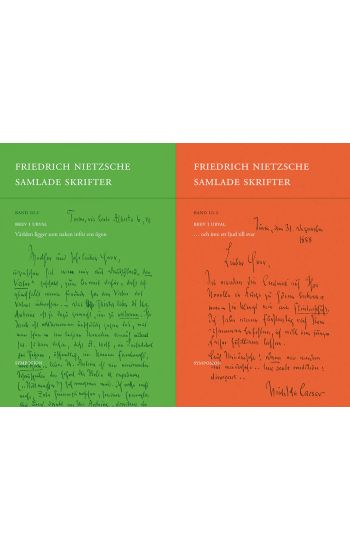
Samlade skrifter. Bd 10.1 och Bd 10.2, Brev i urval
Friedrich Nietzsche
Brutus Östlings bokf Symposion
2014
nidottu
Nietzsches omfångsrika brevväxling presenteras här för första gången på svenska i ett digert urval som band 10.1 och band 10.2 i Samlade skrifter. Ämnena som behandlas i breven är många: personliga framgångar och tillkortakommanden, yrkesval och livsfrågor, självanalys, hopp och uppgivenhet; här framträder flera av tidens viktigaste politiska och kulturella skeenden och frågor precis som tankefigurer som formar Nietzsches filosofi. Allt från tankeskiss till friarbrev och krigsförklaring. Avsändarorterna är barnkammaren, slagfältet, sjuksalen och hotell- och pensionatsrum runt om i Europa. Mottagarna av breven är många av tidens kända kulturpersonligheter: Richard och Cosima Wagner, Franz Liszt, August Strindberg, Georg Brandes mfl. Breven är översatta av Peter Handberg som också har skrivit efterord (band 10. 2) och en omfattande notapparat. I redaktionen för Nietzsches samlade skrifter ingår Thomas H. Brobjer, Ulf I. Eriksson, Peter Handberg och Hans Ruin." Jag har plågats svårt, allt har drivits till sin spets, professuren är nedlagd. Jag lämnar Basel för gott inom några dagar. Mitt bohag skall säljas." Nietzsche till Marie Baumgartner, maj 1879" Igår tänkte jag ut en bild av moralité larmoyante, för att tala med Diderot. Vinterlandskap. En gammal kusk som med ett uttryck av den mest brutala cynism, ännu hårdare än vintern, kastar vatten på sin egen häst. Hästen, den stackars plågade kraken, vänder sig om, tacksam, mycket tacksam." Nietzsche till Reinhart von Seydlitz, juni 1888.

Beyond Good and Evil / on the Genealogy of Morality
Friedrich Nietzsche
Stanford University Press
2014
pokkari
Halvin toimitettuna 29,80 €
Beyond Good and Evil is Nietzsche's first sustained philosophical treatment of issues important to him. Unlike the expository prose of the essayistic period (1872-76), the stylized forays and jabs of the aphoristic period (1878-82), and the lyrical-philosophical rhetoric of the Zarathustra-period (1882-85), Beyond Good and Evil inscribes itself boldly into the history of philosophy, challenging ancient and modern notions of philosophy's achievements and insisting on a new task for "new philosophers." This is a watershed book for Nietzsche and for philosophy in the modern era. On the Genealogy of Morality applies Nietzsche's celebrated genealogical method, honed in the earlier aphoristic writings, to the problem of morality's influence on the human species. In three treatises that strikingly anticipate insights appearing much later in Freud's Civilization and Its Discontents (1930), Nietzsche provides an anthropological psychograph of our species, revealing the origins of the concepts of good and evil, the roles played by guilt and bad conscience, and the persistence of ascetic ideals. Manifesting a hopeful yet unsentimental assessment of the human condition, these books resonated throughout the 20th century and continue to exert broad appeal.