Kirjailija
Friedrich Wilhelm Nietzsche
Kirjat ja teokset yhdessä paikassa: 783 kirjaa, julkaisuja vuosilta 1886–2026, suosituimpiin kuuluu The Antichrist. Vertaile teosten hintoja ja tarkista saatavuus suomalaisista kirjakaupoista.
783 kirjaa
Kirjojen julkaisuvuodet: 1886–2026.
The Case of Wagner - Nietzsche contra Wagner. The twilight of the idols. The antichrist. is an unchanged, high-quality reprint of the original edition of 1899. Hansebooks is editor of the literature on different topic areas such as research and science, travel and expeditions, cooking and nutrition, medicine, and other genres. As a publisher we focus on the preservation of historical literature. Many works of historical writers and scientists are available today as antiques only. Hansebooks newly publishes these books and contributes to the preservation of literature which has become rare and historical knowledge for the future.

Die Geburt der Trag die - Versuch einer Selbstkritik ist ein unver nderter, hochwertiger Nachdruck der Originalausgabe. Hansebooks ist Herausgeber von Literatur zu unterschiedlichen Themengebieten wie Forschung und Wissenschaft, Reisen und Expeditionen, Kochen und Ern hrung, Medizin und weiteren Genres. Der Schwerpunkt des Verlages liegt auf dem Erhalt historischer Literatur. Viele Werke historischer Schriftsteller und Wissenschaftler sind heute nur noch als Antiquit ten erh ltlich. Hansebooks verlegt diese B cher neu und tr gt damit zum Erhalt selten gewordener Literatur und historischem Wissen auch f r die Zukunft bei.
Also sprach Zarathustra - Ein Buch f r Alle und Keinen ist ein unver nderter, hochwertiger Nachdruck der Originalausgabe. Hansebooks ist Herausgeber von Literatur zu unterschiedlichen Themengebieten wie Forschung und Wissenschaft, Reisen und Expeditionen, Kochen und Ern hrung, Medizin und weiteren Genres. Der Schwerpunkt des Verlages liegt auf dem Erhalt historischer Literatur. Viele Werke historischer Schriftsteller und Wissenschaftler sind heute nur noch als Antiquit ten erh ltlich. Hansebooks verlegt diese B cher neu und tr gt damit zum Erhalt selten gewordener Literatur und historischem Wissen auch f r die Zukunft bei.
Menschliches, Allzumenschliches - Ein Buch f r freie Geister ist ein unver nderter, hochwertiger Nachdruck der Originalausgabe. Hansebooks ist Herausgeber von Literatur zu unterschiedlichen Themengebieten wie Forschung und Wissenschaft, Reisen und Expeditionen, Kochen und Ern hrung, Medizin und weiteren Genres. Der Schwerpunkt des Verlages liegt auf dem Erhalt historischer Literatur. Viele Werke historischer Schriftsteller und Wissenschaftler sind heute nur noch als Antiquit ten erh ltlich. Hansebooks verlegt diese B cher neu und tr gt damit zum Erhalt selten gewordener Literatur und historischem Wissen auch f r die Zukunft bei.
Zur Genealogie der Moral ist ein philosophisches Werk von Friedrich Nietzsche aus dem Jahr 1887. Das Werk, das aus einer Vorrede und drei "Abhandlungen" besteht, geh rt zu den einflussreichsten Schriften Nietzsches. Er legte hier keine Aphorismen vor wie in den meisten anderen seiner Werke, sondern l ngere, systematische Texte mit durchaus wissenschaftlichem Anspruch: Er stellt darin soziologische, historische und psychologische Thesen auf. Nietzsche wollte anders als klassische Moralphilosophen keine Moral herleiten oder begr nden, sondern die geschichtliche Entwicklung und die psychischen Voraussetzungen bestimmter moralischer Wertvorstellungen nachvollziehen. Er fragt also nicht, wie die Menschen handeln sollten, sondern warum Menschen glauben, sie sollten auf bestimmte Weise handeln, oder andere dazu bringen wollen, so oder so zu handeln. Friedrich Wilhelm Nietzsche (1844-1900) war ein deutscher klassischer Philologe, dessen Hauptwerk jedoch aus Schriften besteht, die ihn - allerdings erst postum - als Philosophen weltber hmt machten. Als Nebenwerke schuf er Dichtungen und musikalische Kompositionen. Nietzsches Denken hat weit ber die Philosophie hinaus gewirkt und ist bis heute unterschiedlichsten Deutungen und Bewertungen unterworfen. Nietzsche schuf keine systematische Philosophie. Oft w hlte er den Aphorismus als Ausdrucksform seiner Gedanken. Seine Prosa, seine Gedichte und der pathetisch-lyrische Stil von Also sprach Zarathustra verschafften ihm auch Anerkennung als Schriftsteller.
Asi hablo Zaratustra
Friedrich Wilhelm Nietzsche
Createspace Independent Publishing Platform
2017
nidottu
"Esta f bula vitalista, trufada de exquisitos elementos narrativos y l ricos, es la obra fundamental de Nietzsche que, como nuevo mes as, predica la transformaci n de la voluntad de poder del hombre hasta alcanzar la categor a nueva de superhombre. Zaratustra, trasunto del legendario fil sofo persa Zoroastro, es para Nietzsche algo similar a lo que Juan el Bautista represent para Jes s de Nazaret. Como tal, la buena nueva nicheana es cr tica y ant tesis de todas las creencias burguesas hijas del cristianismo".
The Birth of Tragedy: Hellenism and Pessimism
Friedrich Wilhelm Nietzsche
Createspace Independent Publishing Platform
2017
nidottu
The Birth of Tragedy Hellenism and PessimismByFriedrich NietzscheTranslated by Wm. A. HaussmannThe influences that exercised power over him in those days may be described in the three following terms: Hellenism, Schopenhauer, Wagner. His love of Hellenism certainly led him to philology; but, as a matter of fact, what concerned him most was to obtain a wide view of things in general, and this he hoped to derive from that science; philology in itself, with his splendid method and thorough way of going to work, served him only as a means to an end. If Hellenism was the first strong influence which already in Pforta obtained a sway over my brother, in the winter of 1865-66, a completely new, and therefore somewhat subversive, influence was introduced into his life with Schopenhauer's philosophy. When he reached Leipzig in the autumn of 1865, he was very downcast; for the experiences that had befallen him during his one year of student life in Bonn had deeply depressed him.
The Will to Power: An Attempted Transvaluation of All Values
Friedrich Wilhelm Nietzsche
Createspace Independent Publishing Platform
2017
nidottu
The Will to PowerAn Attempted Transvaluation Of All ValuesByFriedrich NietzscheTranslated By Anthony M. LudoviciIn the volume before us we have the first two books of what was to be Nietzsche's greatest theoretical and philosophical prose work. The reception given to Thus Spake Zarathustra had been so unsatisfactory, and misunderstandings relative to its teaching had become so general, that, within a year of the publication of the first part of that famous philosophical poem, Nietzsche was already beginning to see the necessity of bringing his doctrines before the public in a more definite and unmistakable form. During the years that followed--that is to say, between 1883 and 1886--this plan was matured, and although we have no warrant, save his sister's own word and the internal evidence at our disposal, for classing Beyond Good and Evil (published 1886) among the contributions to Nietzsche's grand and final philosophical scheme, "The Will to Power," it is now impossible to separate it entirely from his chief work as we would naturally separate The Birth of Tragedy, the Thoughts out of Season, the volumes entitled Human, all-too-Human, The Dawn of Day, and Joyful Wisdom.
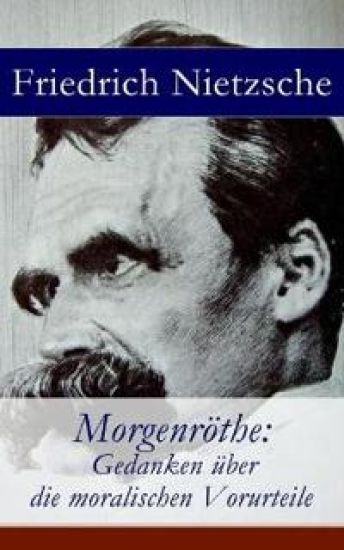
Morgenr te: Gedanken ber die moralischen Vorurteile ist ein Anfang Juli 1881 erschienenes philosophisches Werk Friedrich Nietzsches. In dem aus Aphorismen unterschiedlicher L nge bestehenden Buch hinterfragte Nietzsche die Entstehung und den Wahrheitsgehalt moralischer und religi ser Systeme. Dabei setzte er dem tragischen Pathos einer christlichen Existenz das kontemplative Gl ck eines Erkennenden gegen ber und interpretierte die Glaubensekstase als psychopathologisches Ph nomen. Die Moral als Grundlage der Kultur erscheint als Kirke, als "Meisterin der Verf hrung." So schickte sich Nietzsche an, "in die Tiefe zu steigen" und "unser Vertrauen zur Moral zu untergraben." In der Morgenr te skizzierte Nietzsche erstmals Umrisse der Formel vom Willen zur Macht, die sp ter von Zarathustra in aller Deutlichkeit vorgetragen wurde. Friedrich Wilhelm Nietzsche (1844-1900) war ein deutscher klassischer Philologe, der posthum als Philosoph zu Weltruhm kam. Er stellte den Wert der Wahrheit berhaupt in Frage und wurde damit Wegbereiter postmoderner philosophischer Ans tze. Auch Nietzsches Konzepte des " bermenschen," des "Willens zur Macht" oder der "ewigen Wiederkunft" geben bis heute Anlass zu Deutungen und Diskussionen.
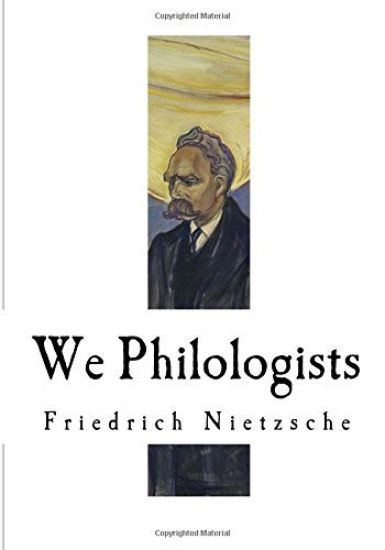
We Philologists: Friedrich Nietzsche
Friedrich Wilhelm Nietzsche
Createspace Independent Publishing Platform
2017
nidottu
We PhilologistsFriedrich NietzscheTranslated by J. M. KennedyThe subject of education was one to which Nietzsche, especially during his residence in Basel, paid considerable attention, and his insight into it was very much deeper than that of, say, Herbert Spencer or even Johann Friedrich Herbart, the latter of whom has in late years exercised considerable influence in scholastic circles. Nietzsche clearly saw that the "philologists" (using the word chiefly in reference to the teachers of the classics in German colleges and universities) were absolutely unfitted for their high task, since they were one and all incapable of entering into the spirit of antiquity. Although at the first reading, therefore, this book may seem to be rather fragmentary, there are two main lines of thought running through it: an incisive criticism of German professors, and a number of constructive ideas as to what classical culture really should be.
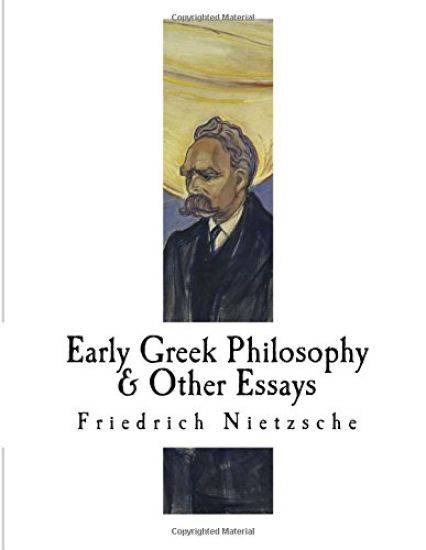
Early Greek Philosophy & Other Essays: Friedrich Nietzsche
Friedrich Wilhelm Nietzsche
Createspace Independent Publishing Platform
2017
nidottu
Early Greek Philosophy & Other EssaysBy Friedrich NietzscheTranslated By Maximilian A. MuggeThe essays contained in this volume treat of various subjects. With the exception of perhaps one we must consider all these papers as fragments. Written during the early Seventies, and intended mostly as prefaces, they are extremely interesting, since traces of Nietzsche's later tenets--like Slave and Master morality, the Superman--can be found everywhere. But they are also very valuable on account of the young philosopher's daring and able handling of difficult and abstruse subjects. "Truth and Falsity," and "The Greek Woman" are probably the two essays which will prove most attractive to the average reader.
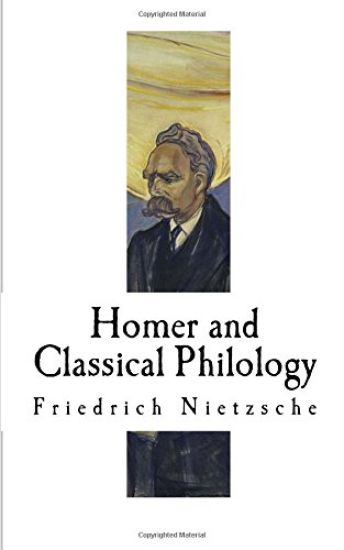
Homer and Classical Philology: Friedrich Nietzsche
Friedrich Wilhelm Nietzsche
Createspace Independent Publishing Platform
2017
nidottu
Homer and Classical PhilologyFriedrich NietzscheInaugural Address delivered at Bale University, 28th of May 1869. At the present day no clear and consistent opinion seems to be held regarding Classical Philology. We are conscious of this in the circles of the learned just as much as among the followers of that science itself. The cause of this lies in its many-sided character, in the lack of an abstract unity, and in the inorganic aggregation of heterogeneous scientific activities which are connected with one another only by the name "Philology." It must be freely admitted that philology is to some extent borrowed from several other sciences, and is mixed together like a magic potion from the most outlandish liquors, ores, and bones.
Ecce Homo: Nietzsches Autobiography
Friedrich Wilhelm Nietzsche
Createspace Independent Publishing Platform
2017
nidottu
Ecce HomoNietzsches AutobiographyBy Friedrich NietzscheTranslated by Anthony M. LudoviciEcce Homo is the last prose work that Nietzsche wrote. It is true that the pamphlet Nietzsche contra Wagner was prepared a month later than the Autobiography; but we cannot consider this pamphlet as anything more than a compilation, seeing that it consists entirely of aphorisms drawn from such previous works as Joyful Wisdom, Beyond Good and Evil, The Genealogy of Morals, etc. Coming at the end of a year in which he had produced the Case of Wagner, The Twilight of the Idols, and The Antichrist, Ecce Homo is not only a coping-stone worthy of the wonderful creations of that year, but also a fitting conclusion to his whole life, in the form of a grand summing up of his character as a man, his purpose as a reformer, and his achievement as a thinker.
The Dawn of Day
Friedrich Wilhelm Nietzsche
Createspace Independent Publishing Platform
2017
nidottu
Friedrich NietzscheThe Dawn of DayTranslated by John McFarland KennedyWhen Nietzsche called his book The Dawn of Day, he was far from giving it a merely fanciful title to attract the attention of that large section of the public which judges books by their titles rather than by their contents. The Dawn of Day represents, figuratively, the dawn of Nietzsche's own philosophy. Hitherto he had been considerably influenced in his outlook, if not in his actual thoughts, by Schopenhauer, Wagner, and perhaps also Comte. Human, all-too-Human, belongs to a period of transition. After his rupture with Bayreuth, Nietzsche is, in both parts of that work, trying to stand on his own legs, and to regain his spiritual freedom; he is feeling his way to his own philosophy. The Dawn of Day, written in 1881 under the invigorating influence of a Genoese spring, is the dawn of this new Nietzsche. "With this book I open my campaign against morality," he himself said later in his autobiography, the Ecce Homo.
The AntichristFriedrich NietzscheTranslated from the German with an introduction by H. L. MenckenFriedrich Wilhelm Nietzsche; 15 October 1844 - 25 August 1900, was a German philosopher, cultural critic, poet, philologist, and Latin and Greek scholar whose work has exerted a profound influence on Western philosophy and modern intellectual history. He began his career as a classical philologist before turning to philosophy. But in all this justifiable fear, of course, there remains a false assumption, and that is the assumption that Nietzsche proposed to destroy Christianity altogether, and so rob the plain people of the world of their virtue, their spiritual consolations, and their hope of heaven. Nothing could be more untrue. The fact is that Nietzsche had no interest whatever in the delusions of the plain people -- that is, intrinsically. It seemed to him of small moment what they believed, so long as it was safely imbecile. What he stood against was not their beliefs, but the elevation of those beliefs, by any sort of democratic process, to the dignity of a state philosophy -- what he feared most was the pollution and crippling of the superior minority by intellectual disease from below.
Beyond Good and Evil
Friedrich Wilhelm Nietzsche
Createspace Independent Publishing Platform
2017
nidottu
Beyond Good and Evil is a book by philosopher Friedrich Nietzsche that expands the ideas of his previous work, Thus Spoke Zarathustra, with a more critical and polemical approach. It was first published in 1886. In Beyond Good and Evil, Nietzsche accuses past philosophers of lacking critical sense and blindly accepting dogmatic premises in their consideration of morality. Specifically, he accuses them of founding grand metaphysical systems upon the faith that the good man is the opposite of the evil man, rather than just a different expression of the same basic impulses that find more direct expression in the evil man. The work moves into the realm "beyond good and evil" in the sense of leaving behind the traditional morality which Nietzsche subjects to a destructive critique in favour of what he regards as an affirmative approach that fearlessly confronts the perspectival nature of knowledge and the perilous condition of the modern individual.
Thus Spake Zarathustra: Comfortable Classics
Friedrich Wilhelm Nietzsche
Createspace Independent Publishing Platform
2017
nidottu
Designed specifically for students of literature and bibliophiles. We are pleased to bring you the complete and unabridged text of this classic book. Because this is the original work by the author, you may find slight differences in spellings and punctuation than those you
Thus Spake Zarathustra - A Book for All and None (Wisehouse Classics)
Friedrich Wilhelm Nietzsche
Wisehouse Classics
2017
pokkari
Thus Spake Zarathustra
Friedrich Wilhelm Nietzsche
Createspace Independent Publishing Platform
2017
nidottu
Thus Spoke Zarathustra (German: Also sprach Zarathustra, sometimes translated Thus Spake Zarathustra), subtitled A Book for All and None (Ein Buch f r Alle und Keinen), is a written work by German philosopher Friedrich Nietzsche, composed in four parts between 1883 and 1885. Much of the work deals with ideas such as the "eternal recurrence of the same", the parable on the "death of God", and the "prophecy" of the Overman, which were first introduced in The Gay Science. Described by Nietzsche himself as "the deepest ever written", the book is a dense and esoteric treatise on philosophy and morality, featuring as protagonist a fictionalized Zarathustra. A central irony of the text is that the style of the Bible is used by Nietzsche to present ideas of his which fundamentally oppose Judaeo-Christian morality and tradition.