Kirjailija
Friedrich Wilhelm Nietzsche
Kirjat ja teokset yhdessä paikassa: 783 kirjaa, julkaisuja vuosilta 1886–2026, suosituimpiin kuuluu The Antichrist. Vertaile teosten hintoja ja tarkista saatavuus suomalaisista kirjakaupoista.
783 kirjaa
Kirjojen julkaisuvuodet: 1886–2026.
The Antichrist by Friedrich Nietzsche and translated from the German with an introduction by H. L. Mencken. The Antichrist (German: Der Antichrist) is a book by the philosopher Friedrich Nietzsche, originally published in 1895. Although it was written in 1888, its controversial content made Franz Overbeck and Heinrich Koselitz delay its publication, along with Ecce Homo. The German title can be translated into English as either The Anti-Christ or The Anti-Christian, depending on how the German word Christ is translated. This book belongs to the most rare of men. Perhaps not one of them is yet alive. It is possible that they may be among those who understand my "Zarathustra": how could I confound myself with those who are now sprouting ears? - First the day after tomorrow must come for me. Some men are born posthumously. The conditions under which any one understands me, and necessarily understands me - I know them only too well. Even to endure my seriousness, my passion, he must carry intellectual integrity to the verge of hardness. He must be accustomed to living on mountain tops - and to looking upon the wretched gabble of politics and nationalism as beneath him. He must have become indifferent; he must never ask of the truth whether it brings profit to him or a fatality to him. . . . He must have an inclination, born of strength, for questions that no one has the courage for; the courage for the forbidden; predestination for the labyrinth. The experience of seven solitudes. New ears for new music. New eyes for what is most distant. A new conscience for truths that have hitherto remained unheard. And the will to economize in the grand manner - to hold together his strength, his enthusiasm. . . . Reverence for self; love of self; absolute freedom of self. . . .
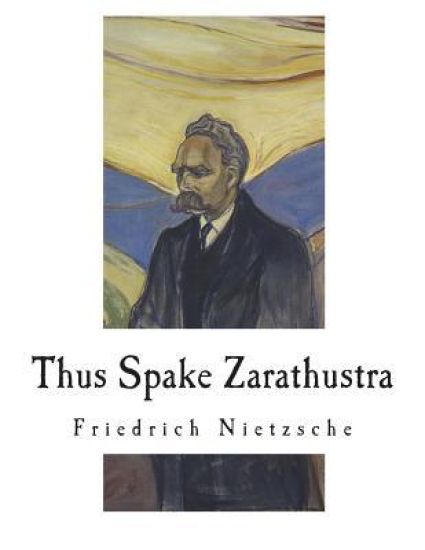
Thus Spake Zarathustra: A Book for All and None
Friedrich Wilhelm Nietzsche
Createspace Independent Publishing Platform
2018
nidottu
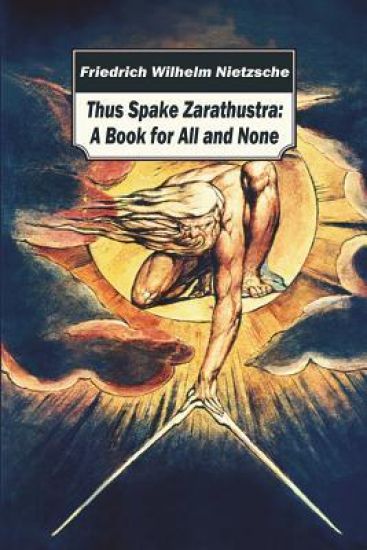
Thus Spake Zarathustra: A Book for All and None, A Philosophical Novel by Friedrich Nietzsche and translated by Thomas Common. Thus Spoke Zarathustra: A Book for All and None (German: Also sprach Zarathustra: Ein Buch u r Alle und Keinen, also translated as Thus Spake Zarathustra) is a philosophical novel by German philosopher Friedrich Nietzsche, composed in four parts between 1883 and 1885 and published between 1883 and 1891. Much of the work deals with ideas such as the "eternal recurrence of the same", the parable on the "death of God", and the "prophecy" of the Ubermensch, which were first introduced in The Gay Science. "Zarathustra" is my brother's most personal work; it is the history of his most individual experiences, of his friendships, ideals, raptures, bitterest disappointments and sorrows. Above it all, however, there soars, transfiguring it, the image of his greatest hopes and remotest aims. My brother had the figure of Zarathustra in his mind from his very earliest youth: he once told me that even as a child he had dreamt of him. At different periods in his life, he would call this haunter of his dreams by different names; "but in the end," he declares in a note on the subject, "I had to do a Persian the honour of identifying him with this creature of my fancy. Persians were the first to take a broad and comprehensive view of history. Every series of evolutions, according to them, was presided over by a prophet; and every prophet had his 'Hazar, '- his dynasty of a thousand years."
Classic Books Library presents this brand new edition of Nietzche's philosophical text "Beyond Good and Evil," published in 1886. Building on his previous works, this text challenges traditional perceptions of how truth and knowledge are established, and each chapter is dedicated to a different concept. "Beyond Good and Evil" explores the dogmatism and prejudice in the philosophy of the past, reveals the psychological sense of control underpinning morality and discusses the complexities of the human soul. Friedrich Wilhelm Nietzsche (1844-1900) was a German philologist, philosopher, poet and scholar. His work covered many topics, but he is most famous for his critiques of culture, morality and truth. Nietzche's philosophical writing went on to influence many great philosophers, artists, writers and composers of the 20th Century.
Thus Spake Zarathustra
Friedrich Wilhelm Nietzsche
Createspace Independent Publishing Platform
2018
nidottu
Ecce Homo-"Behold the man" -were the words Pilate used to refer to Jesus when presenting the masses with a choice between saving him or saving Barabbas. They are also the words Friedrich Nietzsche chose as the title for his literary self-portrait, his statement of how he sees himself and wants others to see him. Ecce Homo constitutes a reflection upon Nietzsche's life and career, but also forcefully repudiates those interpretations of his previous works purporting to find support there for imperialism, anti-Semitism, militarism, and Social Darwinism. It will be of great interest to anyone concerned with ethics, nihilism, psychology, and the meaning and cultural significance of religion.
Thus Spake Zarathustra
Friedrich Wilhelm Nietzsche
Createspace Independent Publishing Platform
2018
nidottu
Thus Spoke Zarathustra: A Book for All and None (German: Also sprach Zarathustra: Ein Buch f r Alle und Keinen, also translated as Thus Spake Zarathustra) is a comedic philosophical novel by German philosopher Friedrich Nietzsche, composed in four parts between 1883 and 1885 and published between 1883 and 1891. Much of the work deals with ideas such as the "eternal recurrence of the same", the parable on the "death of God", and the "prophecy" of the bermensch, which were first introduced in The Gay Science.
Beyond Good and Evil
Friedrich Wilhelm Nietzsche
Createspace Independent Publishing Platform
2018
nidottu
Rare edition with unique illustrations and elegant classic cream paper. A scathing and powerful critique of philosophy, religion and science. Here Nietzsche presents us with problems and challenges that are as troubling as they are inspiring, while at the same time outlining the virtues, ideas, and practices which will characterise the philosophy of the future. Relentless, energetic, tirelessly probing, he both determines that philosophy's agenda and is himself the embodiment of the type of thought he wants to foster. Includes unique illustations.
Thus Spake Zarathustra
Friedrich Wilhelm Nietzsche
Createspace Independent Publishing Platform
2018
nidottu
Thus Spake Zarathustra A Book for All and None
Friedrich Wilhelm Nietzsche
Createspace Independent Publishing Platform
2018
nidottu
Thus Spake Zarathustra is an important philosophical text by German philosopher Friedrich Nietzsche. In it he begins his exploration of morality, questioning the assumption of Christianity or Judaism as a basis for morality. He wrote about the "death of God" and the " bermensch" (superhuman) who would have supreme morality. Ironically, Nietzsche mimics the style of the Bible, fictionalizing Zarathustra as his protagonist.
Beyond Good and Evil
Friedrich Wilhelm Nietzsche
Createspace Independent Publishing Platform
2018
nidottu
Prelude to a Philosophy of the Future is a book by philosopher Friedrich Nietzsche, first published in 1886. It draws on and expands the ideas of his previous work, Thus Spoke Zarathustra, but with a more critical and polemical approach. In Beyond Good and Evil, Nietzsche accuses past philosophers of lacking critical sense and blindly accepting dogmatic premises in their consideration of morality. Specifically, he accuses them of founding grand metaphysical systems upon the faith that the good man is the opposite of the evil man, rather than just a different expression of the same basic impulses that find more direct expression in the evil man. The work moves into the realm "beyond good and evil" in the sense of leaving behind the traditional morality which Nietzsche subjects to a destructive critique in favour of what he regards as an affirmative approach that fearlessly confronts the perspectival nature of knowledge and the perilous condition of the modern individual.
Ecce Homo: Nietzsches Autobiography
Friedrich Wilhelm Nietzsche
Createspace Independent Publishing Platform
2018
nidottu
Ecce Homo: Nietzsches Autobiography by Friedrich Nietzsche. Ecce Homo is the last prose work that Nietzsche wrote. It is true that the pamphlet Nietzsche contra Wagner was prepared a month later than the Autobiography; but we cannot consider this pamphlet as anything more than a compilation, seeing that it consists entirely of aphorisms drawn from such previous works as Joyful Wisdom, Beyond Good and Evil, The Genealogy of Morals, etc. Coming at the end of a year in which he had produced the Case of Wagner, The Twilight of the Idols, and The Antichrist, Ecce Homo is not only a coping-stone worthy of the wonderful creations of that year, but also a fitting conclusion to his whole life, in the form of a grand summing up of his character as a man, his purpose as a reformer, and his achievement as a thinker. As if half conscious of his approaching spiritual end, Nietzsche here bids his friends farewell, just in the manner in which, in the Twilight of the Idols (Aph. 36, Part ix.), he declares that every one should be able to take leave of his circle of relatives and intimates when his time seems to have come-that is to say, while he is still himself while he still knows what he is about, and is able to measure his own life and life in general, and speak of both in a manner which is not vouchsafed to the groaning invalid, to the man lying on his back, decrepit and exhausted, or to the moribund victim of some wasting disease.
The Genealogy of Morals: A Polemic
Friedrich Wilhelm Nietzsche
Createspace Independent Publishing Platform
2018
nidottu
The Genealogy of Morals: A Polemic by Friedrich Nietzsche. Translated by Horace B. Samuel, Peoples and Countries (Fragment) translated by J. M. Kennedy. On the Genealogy of Morality: A Polemic is an 1887 book by German philosopher Friedrich Nietzsche. It consists of a preface and three interrelated essays that expand and follow through on concepts Nietzsche sketched out in Beyond Good and Evil (1886). The three Abhandlungen trace episodes in the evolution of moral concepts with a view to confronting "moral prejudices", specifically those of Christianity and Judaism. Some Nietzsche scholars consider Genealogy to be a work of sustained brilliance and power as well as his masterpiece. Since its publication, it has influenced many authors and philosophers. We are unknown, we knowers, ourselves to ourselves: this has its own good reason. We have never searched for ourselves-how should it then come to pass, that we should ever find ourselves? Rightly has it been said: "Where your treasure is, there will your heart be also." Our treasure is there, where stand the hives of our knowledge. It is to those hives that we are always striving; as born creatures of flight, and as the honey-gatherers of the spirit, we care really in our hearts only for one thing-to bring something "home to the hive " As far as the rest of life with its so-called "experiences" is concerned, which of us has even sufficient serious interest? or sufficient time? In our dealings with such points of life, we are, I fear, never properly to the point; to be precise, our heart is not there, and certainly not our ear. Rather like one who, delighting in a divine distraction, or sunken in the seas of his own soul, in whose ear the clock has just thundered with all its force its twelve strokes of noon, suddenly wakes up, and asks himself, "What has in point of fact just struck?" so do we at times rub afterwards, as it were, our Pg 2] puzzled ears, and ask in complete astonishment and complete embarrassment, "Through what have we in point of fact just lived?" further, "Who are we in point of fact?" and count, after they have struck, as I have explained, all the twelve throbbing beats of the clock of our experience, of our life, of our being-ah -and count wrong in the endeavour. Of necessity we remain strangers to ourselves, we understand ourselves not, in ourselves we are bound to be mistaken, for of us holds good to all eternity the motto, "Each one is the farthest away from himself"-as far as ourselves are concerned we are not "knowers."
Human, All Too Human, A Book for Free Spirits
Friedrich Wilhelm Nietzsche; Alexander Harvey; Paul Victor Cohn
Lulu.com
2018
sidottu
Human, All Too Human is the first book by Friedrich Nietzsche to use the aphoristic style that would become emblematic of his most famous philosophy. This compact and inexpensive print edition ensures that you can absorb and appreciate these philosophical insights at little expense. His style, combining Nietzsche's vehement brand of argument with keynote nihilistic energy, is evident. Quickfire, furious nature of the points made in some respects foreshadow later works in which these qualities are enhanced still further. For the clinical yet perceptive style present in this early work, Nietzsche's adherents compare Human, All Too Human to the earliest works of psychology. Throughout the text, Nietzsche examines human traits and behaviours in a series of short passages, presenting a number of posits and philosophic arguments in each. The shortest of these are only a single paragraph, while the longest run for several.
Inhalt: - Italien (Adolf Friedrich von Schack) - Erinnerung an Italien (Alfred de Musset) - Venedig (Alfred de Musset) - Berliner in Italien (Alfred Henschke) - Deutscher in Italien (Alfred Henschke) - Venedig (Alfred Henschke) - China in Italien (Anastasius Gr n) - Venedig (Anastasius Gr n) - In Verona (Alfred Mei ner) - N rdliches und s dliches Italien (August von Platen) - Venedig (August von Platen) - Italien im Fr hling (August von Platen) - Venedigs erster Tag (Conrad Ferdinand Meyer) - In Italien (Demetrius Schrutz) - Abendfeier in Venedig (Emanuel Geibel) - Aus Venedig (Emil Peschkau) - Das mittelalterliche Italien (Franz Binhack) - Italien (Franz Grillparzer) - Venedig (Franz von Werner) - Zwar, mein Italien, bleiben, was wir sagen (Francesco Petrarca) - Venedig (Friedrich Hebbel) - Venedig (Friedrich Nietzsche) - Abschied von Italien (Georg Friedrich Treitschke) - In Venedig (Georg Trakl) - An Italien (Giacomo Leopardi) - Italien (Gustav Pfizer) - In Italien (Heinrich Lersch) - Fragment aus Italien (Heinrich Leuthold) - Im Feldspitale zu Verona (Hermann von Gilm zu Rosenegg) - Mein Venedig (Isabelle Kaiser) - Italien (Isolde Kurz) - Das ist Italien, das ich verlie ... (J. W. Goethe) - Abschied von Italien (Johann Gottfried Kinkel) - Italien (Josef Huggenberger) - Durst in Venedig (Joseph Victor von Scheffel) - An Italien (Karl Henckell) - Auf die Wiederkunft des Kaisers aus Italien (Karl Mastalier) - Das Amphitheater in Verona (Karl Zettel) - Venedig - VIII. (Moritz Graf von Strachwitz) - Rom und Italien (Paul de Lagarde) - Verona (Paul Heyse) - Venedig (Paul Heyse) - Ancona (Paul Heyse) - Parma (Paul Heyse) - Pisa (Paul Heyse) - Venedig (Rainer Maria Rilke) - Goethes letzte Nacht in Italien (Stefan George) - Sonnenaufgang in Venedig (Stefan Zweig) - Der Traum von Venedig (Theodor D ubler) - Oh Farbenstadt Venedig, dir zu F en (Theodor D ubler) - ...
Götzen-Dämmerung oder Wie man mit dem Hammer philosophiert
Friedrich Wilhelm Nietzsche
E-Artnow
2018
pokkari
G tzen-D mmerung ist ein Sp twerk Friedrich Nietzsches, in dem er wesentliche Aspekte seines bisherigen Denkens zusammenfasste. Mit ihm setzte er den Weg der Umwertung aller Werte weiter fort und bezog sich auf die "G tzen" seiner Zeit, deren D mmerung er voraussah. Das heterogene Werk enth lt viele metaphysikkritische, kunst- und sprachphilosophische Einsichten, die f r das Verst ndnis der sp ten Philosophie Nietzsches von gro er Bedeutung sind. Friedrich Nietzsche (1844-1900) war ein deutscher klassischer Philologe. Erst postum machten ihn seine Schriften als Philosophen weltber hmt. Im Nebenwerk schuf er Dichtungen und musikalische Kompositionen. Urspr nglich preu ischer Staatsb rger, war er seit seiner bersiedlung nach Basel 1869 staatenlos.