Kirjojen hintavertailu – 12 859 824 kirjaa ja 27 kauppaa
Kirjailija
G. K. Chesterton
Kirjat ja teokset yhdessä paikassa: 2 054 kirjaa, julkaisuja vuosilta 1900–2026, suosituimpiin kuuluu A Miscellany of Poems by G. K. Chesterton. Vertaile teosten hintoja ja tarkista saatavuus suomalaisista kirjakaupoista.
Nimi esiintyy myös muodoissa: G K Chesterton, G.K. Chesterton, G.K Chesterton, G. K Chesterton
Gilbert Keith Chesterton, KC*SG (29 May 1874 - 14 June 1936), better known as G. K. Chesterton, was an English writer, poet, philosopher, dramatist, journalist, orator, lay theologian, biographer, and literary and art critic. Chesterton is often referred to as the "prince of paradox". Time magazine has observed of his writing style: "Whenever possible G. K. Chesterton's collected essays on subjects ranging from detective stories and penny dreadfuls to heraldry and patriotism. The essays originally appeared in "The Speaker" but were edited and revised for republication.
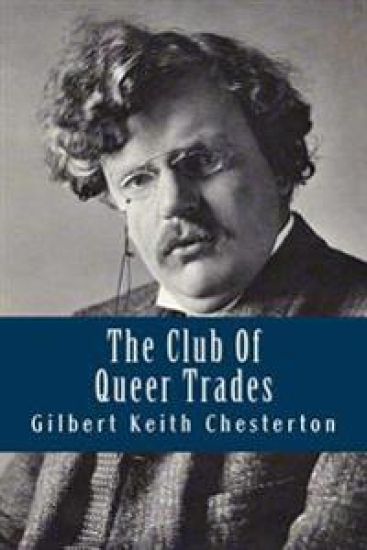
The Club of Queer Trades is a collection of stories by G. K. Chesterton first published in 1905. Each story in the collection is centered on a person who is making his living by some novel and extraordinary means (a "queer trade", using the word "queer" in the sense of "peculiar"). To gain admittance one must have invented a unique means of earning a living and the subsequent trade being the main source of income.
What's Wrong with the World represents an extrapolation of Chesterton's original response to a query posed in so many words by the Times to a selection of eminent writers and thinkers of the day. "Dear Sirs," ran GK's succinct rejoinder, "I am". The publication of the book suggested that, on reflection, there might have been more to say on the subject, and indeed Chesterton takes on several topics such as education, government, big business, and feminism with an unparalleled critical analysis.
This is a book in two parts. The first, "The Enigma of Innocent Smith", concerns the arrival of a new tenant at Beacon House, a London boarding establishment. Like Mary Poppins, this man (who is tentatively identified by lodger Arthur Inglewood as an ex-schoolmate named Innocent Smith) is accompanied by a great wind, and he breathes new life into the household with his games and antics. During his first day in residence the eccentric Smith creates the High Court of Beacon; arranges to elope with Mary Gray, paid companion to heiress Rosamund Hunt; inspires Inglewood to declare his love for Diana Duke, the landlady's niece; and prompts a reconciliation between jaded journalist Michael Moon and Rosamund. However, when the household is at its happiest two doctors appear with awful news: Smith is wanted on charges of burglary, desertion of a spouse, polygamy, and attempted murder. The fact that Smith almost immediately fires several shots from a revolver at Inglewood's friend Dr. Herbert Warner seems to confirm the worst. Before Smith can be taken to a jail or an asylum, Michael Moon declares that the case falls under the purview of the High Court of Beacon and suggests that the household investigate the matter before involving the authorities or the press. The second part, "The Explanations of Innocent Smith", follows the trial. The prosecution consists of Moses Gould, a merrily cynical Jew who lives at Beacon House and considers Smith at best a fool and at worst a scoundrel, and Dr. Cyrus Pym, an American criminal specialist called in by Dr. Warner; Michael Moon and Arthur Inglewood act for the defence. The evidence consists of correspondence from people who witnessed or participated in the exploits that led to the charges against Smith. In every case, the defendant is revealed to be, as his first name states, innocent. He fires bullets near people to make them value life; the house he breaks into is his own; he travels around the world only to return with renewed appreciation for his house and family; and the women he absconded with are actually his wife Mary, posing as a spinster under different aliases so they may repeatedly re-enact their courtship. Smith is, needless to say, acquitted on all charges.
Written in 1908 by G. K. Chesterton, Orthodoxy has become a classic of Christian apologetics. Chesterton considered this book a companion to his other work, Heretics, writing it expressly in response to G. S. Street's criticism of the earlier work, "that he was not going to bother about his theology until I had really stated mine". In the book's preface Chesterton states the purpose is to "attempt an explanation, not of whether the Christian faith can be believed, but of how he personally has come to believe it." In it, Chesterton presents an original view of Christian religion. He sees it as the answer to natural human needs, the "answer to a riddle" in his own words, and not simply as an arbitrary truth received from somewhere outside the boundaries of human experience.
Set in the early part of the twentieth century, the novel's main protagonist, Gabriel Syme is a Scotland Yard detective who's assigned to break the trend of anarchic groups mushrooming all over London. He hides his true identity and takes on the role of a poet. He meets Lucian Gregory, also a poet, and they become friends. One evening, they get into a passionate debate on the true function of poetry and whether it is a symbol of revolution. As the debate rages on, Gregory is incensed and indiscreet enough to confess that he is part of a secret group that espouses anarchy. The group meets in a remote public house in Chiswick on the banks of the Thames and Gregory invites Syme to join them that evening, to prove that he (Gregory) is indeed a true blue anarchist.
Manalive (1912) is a book by G. K. Chesterton detailing a popular theme both in his own philosophy, and in Christianity, of the "holy fool", such as in Dostoevsky's The Idiot and Cervantes' Don Quixote. Perhaps the most light-hearted of all Chesterton's "serious" works, Manalive pits a group of disillusioned young people against Mr. Innocent Smith, a bubbly, high-spirited gentleman who literally falls into their midst. Later accused of murder and denounced for philandering everywhere he goes, Smith prompts his newfound acquaintances to recognize an important idea in most unexpected ways.
Each story in the collection is centered on a person who is making his living by some novel and extraordinary means (a "queer trade", using the word "queer" in the sense of "peculiar"). To gain admittance one must have invented a unique means of earning a living and the subsequent trade being the main source of income. Contents: The Tremendous Adventures of Major Brown The Painful Fall of a Great Reputation The Awful Reason of the Vicar's Visit The Singular Speculation of the House-agent The Noticeable Conduct of Professor Chadd The Eccentric Seclusion of the Old Lady
Constantly in today's world, the Church has had to deal with a growing threat to its stability, that of rebellion against the very word of God in such a strong force that saying anything about the Bible in public forums brings a mass of abuse from the public. Chesterton recognized that this was happening back in his day and tried to address going concerns. The issues he raised nearly a century ago still ring true today and are as applicable now as they were back when this work was originally published.