Kirjailija
George Bernard Shaw
Kirjat ja teokset yhdessä paikassa: 606 kirjaa, julkaisuja vuosilta 1972–2026, suosituimpiin kuuluu Love Among the Artists (An Autobiographical Novel of G. B. Shaw). Vertaile teosten hintoja ja tarkista saatavuus suomalaisista kirjakaupoista.
Nimi esiintyy myös muodoissa: George Bernard Shaw
606 kirjaa
Kirjojen julkaisuvuodet: 1972–2026.
"If you can't appreciate what you've got, you'd better get what you can appreciate." ― George Bernard Shaw, Pygmalion." Pygmalion will be a revelation to anyone familiar with My Fair Lady. The issues of class and gender that fascinated Shaw still strike a chord with modern audiences" -- J. D. Atkinson, British Theatre Guide."a love story with brusque diffidence and a wealth of humor." - New York Times (1914) This timeless play is certain to delight contemporary readers. Pygmalion was written by the renown British playwright George Bernard Shaw. The title comes from the Greek mythological figure Pygmalion. In ancient Greek mythology, Pygmalion was a man who fell in love with one of his sculptures which then came to life. The influence of this myth is clear throughout the play. The play follows the young flower girl Eliza; opening as the social climber Freddy Eynsford-Hill bumps into Eliza in his haste to get a taxi--leading to her dropping her entire day's flowers. Eliza, and her strong accent, are observed by Henry Higgins a professor of phonetics and his fellow philologist Colonel Pickering. Higgins confidently states to Pickering that he could pass Eliza off as a duchess through giving her elocution lessons. In five hilarious and witty acts the relationships between these four characters unfolds. First presented on stage to the public in 1913, the play has now been staged across the world. One of Shaw's most famous plays, it has led to a highly commended film adaptation and was the influence behind the musical 'My Fair Lady.'George Bernard Shaw was born in Dublin, Ireland in 1856. This Irish playwright, critic, and political activist is probably best known for his influence on Western theatre through works such as Pygmalion. Shaw became known as one of the leading dramatists of his generation and was awarded the Nobel Prize in Literature in 1925 "for his work which is marked by both idealism and humanity, its stimulating satire often being infused with a singular poetic beauty." The word "Shavian" has entered into the English language as a way of expressing Shaw's ideas and his methods of communication. He is particularly known for his use of realism and the way he interweaves his political, social and religious ideas throughout his works.
Back To Methuselah: A Metabiological Pentateuch With Preface (The Infidel Half Century) This book is a result of an effort made by us towards making a contribution to the preservation and repair of original classic literature. In an attempt to preserve, improve and recreate the original content, we have worked towards: 1. Type-setting & Reformatting: The complete work has been re-designed via professional layout, formatting and type-setting tools to re-create the same edition with rich typography, graphics, high quality images, and table elements, giving our readers the feel of holding a 'fresh and newly' reprinted and/or revised edition, as opposed to other scanned & printed (Optical Character Recognition - OCR) reproductions. 2. Correction of imperfections: As the work was re-created from the scratch, therefore, it was vetted to rectify certain conventional norms with regard to typographical mistakes, hyphenations, punctuations, blurred images, missing content/pages, and/or other related subject matters, upon our consideration. Every attempt was made to rectify the imperfections related to omitted constructs in the original edition via other references. However, a few of such imperfections which could not be rectified due to intentional\unintentional omission of content in the original edition, were inherited and preserved from the original work to maintain the authenticity and construct, relevant to the work. We believe that this work holds historical, cultural and/or intellectual importance in the literary works community, therefore despite the oddities, we accounted the work for print as a part of our continuing effort towards preservation of literary work and our contribution towards the development of the society as a whole, driven by our beliefs. We are grateful to our readers for putting their faith in us and accepting our imperfections with regard to preservation of the historical content. HAPPY READING
Robert Loraine (1876-1935) was a decorated war hero, an actor, and a surrogate son to Bernard Shaw. After triumphantly launching Shaw's masterpiece Man and Superman in America in the lead role of John Tanner, and creating roles in other plays by Shaw, Loraine suspended his acting career to serve as a pilot in World War I. After twice being seriously wounded, Loraine returned to acting in London and New York, achieving memorable successes punctuated by depressing failures, and often dependent on morphine to control the ongoing pain from his wounds. Throughout all of this, Shaw, like a stern but benevolent father, was a constant presence: advising, cajoling, encouraging, and scolding on matters financial, theatrical, and personal. This selection of twenty-five letters from Shaw to Loraine, fourteen of them published for the first time, eleven published for the first time in complete and accurate transcriptions, were written between 1909 and 1933 against a background of war and changing theatrical values. Introduced, edited, and annotated by Shaw scholar Leonard Conolly, the letters document what was for both men--outside of their marriages (childless in Shaw's case)--among the most significant relationships of their lives.
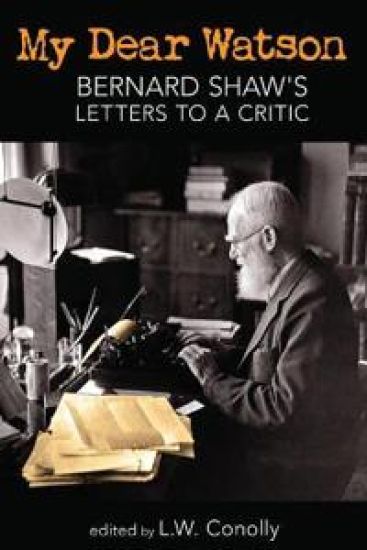
Over the course of three decades, George Bernard Shaw and theatre critic Malcolm Watson of the Daily Telegraph carried out an extensive correspondence. My Dear Watson brings together in book form the previously unpublished letters from Shaw to Watson (those from Watson to Shaw are no longer extant): letters that are significant for the light they shed on the working relationship between Shaw and one of London's major newspapers. Many of the letters include self-drafted "interviews" with Shaw that Watson was able to use (sometimes with considerable embellishment) in his columns in the Telegraph. The letters reveal not only Shaw's views on his own plays, but also important theatrical initiatives of the time. Shaw's attempts to educate Watson on theatre censorship add new dimensions to Shaw's deep engagement with the controversial issue, while Watson's "interview" with Shaw about anticipated raucous audience behaviour at the opening night of Pygmalion, and Shaw's subsequent thank-you to Watson for his cooperation in trying to establish a "new code of manners in the theatre," speak to Shaw's serious concern about giving actors a fair hearing. All but one of the letters deal with theatrical matters; the exception deals with a personal income tax question that Watson had raised with Shaw and, apart from revealing Shaw's knowledge of British tax legislation, suggests that the professional relationship between the two men had reached a level of comfort and respect that enabled such discussion of personal matters. Shaw's letters to Watson, and the self-drafted interviews that accompanied some of the letters, provide the backbone of the narrative of their relationship. Editor L. W. Conolly has provided relevant context to link the letters, including transcripts of Watson's columns on Shaw. The book also includes full transcripts of, or lengthy extracts from, Daily Telegraph reviews of Shaw's major plays during the years that Watson worked for the paper. The result is a work that sheds significant light not only on one of the English language's greatest playwrights but also on the practice and profession of theatre criticism." Conolly's editing, notes and references are thorough and illuminating, and his subtle editorial approach and impeccable scholarship make this slim volume highly entertaining as well as informative." --Dr. Anne Wright, The Shavian
Paradoxen Poe : Edgar Allan Poe som inspiratör och föregångare
Lars Nyberg; D. H. Lawrence; George Bernard Shaw; Jules Verne; Fjodor Dostojevskij; Charles Baudelaire
H:ström Text Kultur AB
2019
nidottu
Med sin nydanande stil och sitt intresse för det mänskliga psykets skuggsidor har Edgar Allan Poe varit en inflytelserik föregångar till såväl symbolister, naturalister och modernister i litteraturhistorien. Han kan dessutom sägas vara skaparen av science fiction- och detektivgenrerna. I denna volym samlas texter om Poe av fem författare ur världshistorien, som alla, om än på radikalt olika sätt, tagit intryck av hans egenartade och varierande författarskap: Charles Baudelaire, Fjodor Dostojevskij, Jules Verne, George Bernard Shaw och D. H. Lawrence. Lars Nyberg, översättare av Baudelaire, Rilke och Xenofon med flera, ger i en initierad inledning en bakgrund till den ofta motsägelsefulla receptionen av Poes författarskap och belyser de skiftande aspekterna i de impulser Poe givit sina efterföljare.
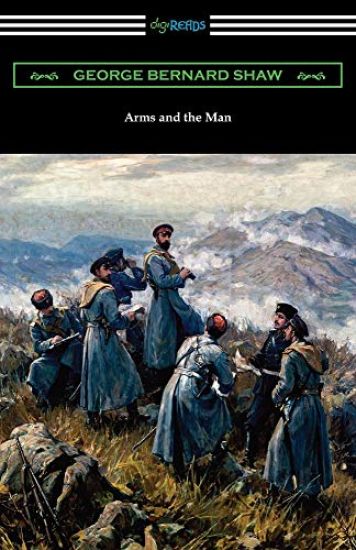
One of George Bernard Shaw's most performed and studied plays, "Arms and the Man" is a classic example of Shaw's comedic wit. First produced in 1894, the play is set during the Serbo-Bulgarian war and tells the story of Raina Petkoff, a young Bulgarian woman, who is engaged to Sergius, a soldier away at war whom she idolizes. While both her father and fianc are away fighting, Raina, at home with her mother, has a very innocent and romantic idea of war and soldiers. Her views are challenged when she helps Captain Bluntschli, a Swiss mercenary fighting for the Serbian army, to hide from the Russian and Bulgarian troops. After the war ends and both her father and fianc return home, Raina comes to see that Sergius is not the hero that she had fantasized him to be and she loses some of her naivete. Captain Bluntschli returns to visit Raina, she and Sergius decide not to marry, and Raina and Bluntschli fall in love instead. While humorous and witty, "Arms and the Man" remains a timely and biting social commentary on the foolishness of romanticizing war as wonderful fun. This edition is printed on premium acid-free paper.
Man and Superman by George Bernard Shaw was written in 1903 as a four act drama, responding to those who had questioned Shaw as to why he had never written a play based on the Don Juan theme. Man and Superman opened at The Royal Court Theatre in London on 23 May 1905 without the performance of the 3rd Act. A part of the act, Don Juan in Hell (Act 3, Scene 2), was performed when the drama was staged on June 4, 1907 at the Royal Court. The play was not produced in its entirety until 1915 by the Travelling Repertory Company at the Lyceum Theatre, Edinburgh. The long third act of the play is often cut. Don Juan in Hell consists of a philosophical debate between Don Juan (played by the same actor who plays Jack Tanner), and the Devil, with Do a Ana (Ann) and the Statue of Don Gonzalo, Ana's father (Roebuck Ramsden, an aged acquaintance of Tanner's and Ann's Guardian) looking on. Don Juan in Hell is often performed separately as a play in its own right, most famously in the 50's in a concert version with Charles Boyer as Don Juan, Charles Laughton as the Devil, Cedric Hardwicke as the Commander, and Agnes Moorehead as Do a Ana. This version was also released as a spoken word album on LP, but has yet to appear on CD. However, the complete performance recording is now available at various sites on the Internet. Although Man and Superman can be performed as a light comedy of manners Shaw intended the drama to be something much deeper, as suggested by the title. This title comes from Friedrich Nietzsche's philosophical ideas about the " bermensch" ("Superman"). The plot centers on John Tanner, author of "The Revolutionist's Handbook and Pocket Companion," which is published with the play as a 58-page appendix. Tanner is a confirmed bachelor despite the pursuits of Ann Whitefield and her persistent efforts to make him marry her. Ann is referred to as "the Life Force" and represents Shaw's view that in every culture, it is the women who force the men to marry them rather than the men who take the initiative.
Caesar and Cleopatra is a play written in 1898 by George Bernard Shaw that depicts a fictionalized account of the relationship between Julius Caesar and Cleopatra. It was first published with Captain Brassbound's Conversion and The Devil's Disciple in Shaw's 1901 collection Three Plays for Puritans. It was first performed in a single staged reading at Newcastle upon Tyne on 15 March 1899, to secure the copyright. The play was produced in New York in 1906 and in London at the Savoy Theatre in 1907.
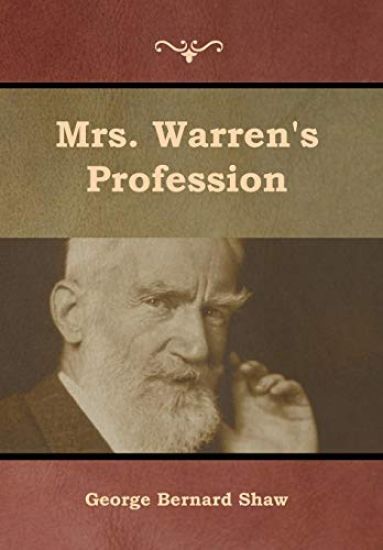
Mrs. Warren's Profession is a play written by George Bernard Shaw in 1893, and first performed in London in 1902. The play is about a former prostitute, now a madam (brothel proprietor), who attempts to come to terms with her disapproving daughter. It is a problem play, offering social commentary to illustrate Shaw's belief that the act of prostitution was not caused by moral failure but by economic necessity. Elements of the play were borrowed from Shaw's 1882 novel Cashel Byron's Profession, about a man who becomes a boxer due to limited employment opportunities. (wikipedia.org)