Kirjojen hintavertailu – 12 859 824 kirjaa ja 27 kauppaa
Kirjailija
George MacDonald
Kirjat ja teokset yhdessä paikassa: 1 736 kirjaa, julkaisuja vuosilta 1848–2026, suosituimpiin kuuluu Malcolm. Vertaile teosten hintoja ja tarkista saatavuus suomalaisista kirjakaupoista.
George MacDonald (10 December 1824 - 18 September 1905) was a Scottish author, poet, and Christian minister. He was a pioneering figure in the field of fantasy literature and the mentor of fellow writer Lewis Carroll. His writings have been cited as a major literary influence by many notable authors including W. H. Auden, C. S. Lewis, J. R. R. Tolkien, Walter de la Mare, E. Nesbit and Madeleine L'Engle. C. S. Lewis wrote that he regarded MacDonald as his "master" "Picking up a copy of Phantastes one day at a train-station bookstall, I began to read. A few hours later," said Lewis, "I knew that I had crossed a great frontier." G. K. Chesterton cited The Princess and the Goblin as a book that had "made a difference to my whole existence". Elizabeth Yates wrote of Sir Gibbie, "It moved me the way books did when, as a child, the great gates of literature began to open and first encounters with noble thoughts and utterances were unspeakably thrilling."
George MacDonald (10 December 1824 - 18 September 1905) was a Scottish author, poet, and Christian minister. He was a pioneering figure in the field of fantasy literature and the mentor of fellow writer Lewis Carroll. His writings have been cited as a major literary influence by many notable authors including W. H. Auden, C. S. Lewis, J. R. R. Tolkien, Walter de la Mare, E. Nesbit and Madeleine L'Engle. C. S. Lewis wrote that he regarded MacDonald as his "master" "Picking up a copy of Phantastes one day at a train-station bookstall, I began to read. A few hours later," said Lewis, "I knew that I had crossed a great frontier." G. K. Chesterton cited The Princess and the Goblin as a book that had "made a difference to my whole existence". Elizabeth Yates wrote of Sir Gibbie, "It moved me the way books did when, as a child, the great gates of literature began to open and first encounters with noble thoughts and utterances were unspeakably thrilling."
George MacDonald (10 December 1824 - 18 September 1905) was a Scottish author, poet, and Christian minister. He was a pioneering figure in the field of fantasy literature and the mentor of fellow writer Lewis Carroll. His writings have been cited as a major literary influence by many notable authors including W. H. Auden, C. S. Lewis, J. R. R. Tolkien, Walter de la Mare, E. Nesbit and Madeleine L'Engle. C. S. Lewis wrote that he regarded MacDonald as his "master" "Picking up a copy of Phantastes one day at a train-station bookstall, I began to read. A few hours later," said Lewis, "I knew that I had crossed a great frontier." G. K. Chesterton cited The Princess and the Goblin as a book that had "made a difference to my whole existence". Elizabeth Yates wrote of Sir Gibbie, "It moved me the way books did when, as a child, the great gates of literature began to open and first encounters with noble thoughts and utterances were unspeakably thrilling." Even Mark Twain, who initially disliked MacDonald, became friends with him, and there is some evidence that Twain was influenced by MacDonald.
George MacDonald (10 December 1824 - 18 September 1905) was a Scottish author, poet, and Christian minister. He was a pioneering figure in the field of fantasy literature and the mentor of fellow writer Lewis Carroll. His writings have been cited as a major literary influence by many notable authors including W. H. Auden, C. S. Lewis, J. R. R. Tolkien, Walter de la Mare, E. Nesbit and Madeleine L'Engle. 1] C. S. Lewis wrote that he regarded MacDonald as his "master" "Picking up a copy of Phantastes one day at a train-station bookstall, I began to read. A few hours later," said Lewis, "I knew that I had crossed a great frontier." G. K. Chesterton cited The Princess and the Goblin as a book that had "made a difference to my whole existence". Elizabeth Yates wrote of Sir Gibbie, "It moved me the way books did when, as a child, the great gates of literature began to open and first encounters with noble thoughts and utterances were unspeakably thrilling." Even Mark Twain, who initially disliked MacDonald, became friends with him, and there is some evidence that Twain was influenced by MacDonald. citation needed] Christian author Oswald Chambers wrote in his Christian Disciplines that "it is a striking indication of the trend and shallowness of the modern reading public that George MacDonald's books have been so neglected". In addition to his fairy tales, MacDonald wrote several works on Christian apologetics including several that defended a view that has been described as Christian Universalism. George MacDonald was born on 10 December 1824 at Huntly, Aberdeenshire, Scotland. His father, a farmer, was one of the MacDonalds of Glen Coe, and a direct descendant of one of the families that suffered in the massacre of 1692. citation needed] The Doric dialect of the Aberdeenshire area appears in the dialogue of some of his non-fantasy novels.
George MacDonald (10 December 1824 - 18 September 1905) was a Scottish author, poet, and Christian minister. He was a pioneering figure in the field of fantasy literature and the mentor of fellow writer Lewis Carroll. His writings have been cited as a major literary influence by many notable authors including W. H. Auden, C. S. Lewis, J. R. R. Tolkien, Walter de la Mare, E. Nesbit and Madeleine L'Engle. C. S. Lewis wrote that he regarded MacDonald as his "master" "Picking up a copy of Phantastes one day at a train-station bookstall, I began to read. A few hours later," said Lewis, "I knew that I had crossed a great frontier." G. K. Chesterton cited The Princess and the Goblin as a book that had "made a difference to my whole existence". Elizabeth Yates wrote of Sir Gibbie, "It moved me the way books did when, as a child, the great gates of literature began to open and first encounters with noble thoughts and utterances were unspeakably thrilling." Even Mark Twain, who initially disliked MacDonald, became friends with him, and there is some evidence that Twain was influenced by MacDonald. citation needed] Christian author Oswald Chambers wrote in his Christian Disciplines that "it is a striking indication of the trend and shallowness of the modern reading public that George MacDonald's books have been so neglected". In addition to his fairy tales, MacDonald wrote several works on Christian apologetics including several that defended a view that has been described as Christian Universalism. George MacDonald was born on 10 December 1824 at Huntly, Aberdeenshire, Scotland. His father, a farmer, was one of the MacDonalds of Glen Coe, and a direct descendant of one of the families that suffered in the massacre of 1692. citation needed] The Doric dialect of the Aberdeenshire area appears in the dialogue of some of his non-fantasy novels. MacDonald grew up in an unusually literate environment: one of his maternal uncles was a notable Celtic scholar, editor of the Gaelic Highland Dictionary and collector of fairy tales and Celtic poetry. His paternal grandfather had supported the publication of an Ossian edition, the controversial Celtic text believed by some to have contributed to the starting of European Romanticism. MacDonald's step-uncle was a Shakespeare scholar, and his paternal cousin another Celtic academic. Both his parents were readers, his father harbouring predilections for Newton, Burns, Cowper, Chalmers, Coleridge and Darwin, to quote a few, while his mother had received a classical education which included multiple languages. MacDonald grew up in the Congregational Church, with an atmosphere of Calvinism. However, MacDonald's family was atypical, with his paternal grandfather a Catholic-born, fiddle-playing, Presbyterian elder; his paternal grandmother an Independent church rebel; his mother was a sister to the Gallic-speaking radical who became Moderator of the disrupting Free Church, while his step-mother, to whom he was also very close, was the daughter of a Celtic Episcopalian minister. MacDonald graduated from the University of Aberdeen, citation needed] and then went to London, studying at Highbury College for the Congregational ministry.
George MacDonald (10 December 1824 - 18 September 1905) was a Scottish author, poet, and Christian minister. He was a pioneering figure in the field of fantasy literature and the mentor of fellow writer Lewis Carroll. His writings have been cited as a major literary influence by many notable authors including W. H. Auden, C. S. Lewis, J. R. R. Tolkien, Walter de la Mare, E. Nesbit and Madeleine L'Engle. C. S. Lewis wrote that he regarded MacDonald as his "master" "Picking up a copy of Phantastes one day at a train-station bookstall, I began to read. A few hours later," said Lewis, "I knew that I had crossed a great frontier." G. K. Chesterton cited The Princess and the Goblin as a book that had "made a difference to my whole existence". Elizabeth Yates wrote of Sir Gibbie, "It moved me the way books did when, as a child, the great gates of literature began to open and first encounters with noble thoughts and utterances were unspeakably thrilling."
The Disciple - And Other Poems is an unchanged, high-quality reprint of the original edition of 1897. Hansebooks is editor of the literature on different topic areas such as research and science, travel and expeditions, cooking and nutrition, medicine, and other genres. As a publisher we focus on the preservation of historical literature. Many works of historical writers and scientists are available today as antiques only. Hansebooks newly publishes these books and contributes to the preservation of literature which has become rare and historical knowledge for the future.
Once upon a time, so long ago that I have quite forgotten the date, there lived a king and queen who had no children. And the king said to himself, "All the queens of my acquaintance have children, some three, some seven, and some as many as twelve; and my queen has not one. I feel ill-used." So he made up his mind to be cross with his wife about it. But she bore it all like a good patient queen as she was. Then the king grew very cross indeed. But the queen pretended to take it all as a joke, and a very good one too. "Why don't you have any daughters, at least?" said he. "I don't say sons; that might be too much to expect." "I am sure, dear king, I am very sorry," said the queen. "So you ought to be," retorted the king; "you are not going to make a virtue of that, surely." But he was not an ill-tempered king, and in any matter of less moment would have let the queen have her own way with all his heart. This, however, was an affair of state. The queen smiled. "You must have patience with a lady, you know, dear king," said she. She was, indeed, a very nice queen, and heartily sorry that she could not oblige the king immediately.
I have been requested to write some papers on our Lord's miracles. I venture the attempt in the belief that, seeing they are one of the modes in which his unseen life found expression, we are bound through them to arrive at some knowledge of that life. For he has come, The Word of God, that we may know God: every word of his then, as needful to the knowing of himself, is needful to the knowing of God, and we must understand, as far as we may, every one of his words and every one of his actions, which, with him, were only another form of word. I believe this the immediate end of our creation. And I believe that this will at length result in the unravelling for us of what must now, more or less, appear to every man the knotted and twisted coil of the universe. It seems to me that it needs no great power of faith to believe in the miracles-for true faith is a power, not a mere yielding. There are far harder things to believe than the miracles. For a man is not required to believe in them save as believing in Jesus. If a man can believe that there is a God, he may well believe that, having made creatures capable of hungering and thirsting for him, he must be capable of speaking a word to guide them in their feeling after him. And if he is a grand God, a God worthy of being God, yea (his metaphysics even may show the seeker), if he is a God capable of being God, he will speak the clearest grandest word of guidance which he can utter intelligible to his creatures. For us, that word must simply be the gathering of all the expressions of his visible works into an infinite human face, lighted up by an infinite human soul behind it, namely, that potential essence of man, if I may use a word of my own, which was in the beginning with God. If God should thus hear the cry of the noblest of his creatures, for such are all they who do cry after him, and in very deed show them his face, it is but natural to expect that the deeds of the great messenger should be just the works of the Father done in little. If he came to reveal his Father in miniature, as it were (for in these unspeakable things we can but use figures, and the homeliest may be the holiest), to tone down his great voice, which, too loud for men to hear it aright, could but sound to them as an inarticulate thundering, into such a still small voice as might enter their human ears in welcome human speech, then the works that his Father does so widely, so grandly that they transcend the vision of men, the Son must do briefly and sharply before their very eyes. This, I think, is the true nature of the miracles, an epitome of God's processes in nature beheld in immediate connection with their source-a source as yet lost to the eyes and too often to the hearts of men in the far-receding gradations of continuous law. That men might see the will of God at work, Jesus did the works of his Father thus. Here I will suppose some honest, and therefore honourable, reader objecting: But do you not thus place the miracles in dignity below the ordinary processes of nature? I answer: The miracles are mightier far than any goings on of nature as beheld by common eyes, dissociating them from a living Will; but the miracles are surely less than those mighty goings on of nature with God beheld at their heart. In the name of him who delighted to say "My Father is greater than I," I will say that his miracles in bread and in wine were far less grand and less beautiful than the works of the Father they represented, in making the corn to grow in the valleys, and the grapes to drink the sunlight on the hill-sides of the world, with all their infinitudes of tender gradation and delicate mystery of birth. But the Son of the Father be praised, who, as it were, condensed these mysteries before us, and let us see the precious gifts coming at once from gracious hands-hands that love could kiss and nails could wound.
"She has had, and sail have baith, time aboot (in turn); and I houp they'll du something for her in time, sir." "Her time shall be short here, anyhow. She's not worth the sugar you give her." "Eh, sir luik at her," said Malcolm, in a tone of expostulation, as he stepped back a few paces and regarded her with admiring eyes. "Saw ye ever sic legs? an' sic a neck? an' sic a heid? an' sic fore an' hin' quarters? She's a' bonny but the temper o' her, an' that she canna help like the likes o' you an me." "She'll be the death o' somebody some day. The sooner we get rid of her the better. Just look at that," he added, as the mare laid back her ears and made a vicious snap at nothing in particular. "She was a favourite o' my -- maister, the marquis," returned the youth, "an' I wad ill like to pairt wi' her." "I'll take any offer in reason for her," said the factor. "You'll just ride her to Forres market next week, and see what you can get for her.
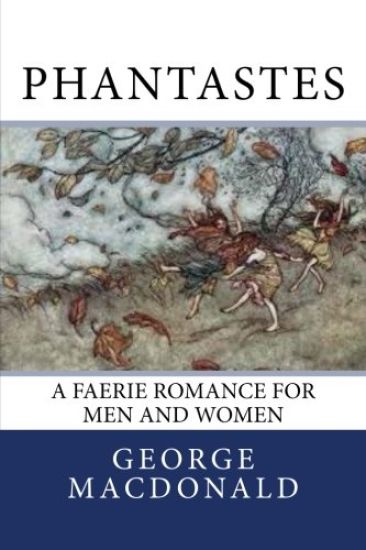
Phantastes: A Faerie Romance for Men and Women is a fantasy novel written by George MacDonald, first published in London in 1858. Its importance was recognized in its later revival in paperback by Ballantine Books as the fourteenth volume of the celebrated Ballantine Adult Fantasy series in April 1970. This was the first prose work published by MacDonald. Because of its limited financial success, MacDonald saw himself forced to turn to writing realistic novels. Phantastes, however, exerted a strong influence on fantasy authors of later generations: for example, C. S. Lewis in his book Suprised by Joy claimed that his imagination had been "baptized" by reading it. The story centers on the character Anodos ("pathless" or "ascent" in Greek) and takes its inspiration from German Romanticism, particularly Novalis. The story concerns a young man who is pulled into a dreamlike world and there hunts for his ideal of female beauty, embodied by the "Marble Lady". Anodos lives through many adventures and temptations while in the other world, until he is finally ready to give up his ideals. In its themes and overall storyline, Phantastes is a kind of dry run for MacDonald's later novel Lilith.
Alec Forbes of Howglen is a novel by George MacDonald, first published in 1865 and is primarily concerned with Scottish country life. The 'Howglen' described in the novel is probably a reference to George MacDonald's childhood home in Huntly, Scotland, 'The Farm.' The 'Glamour' river, on which the town of the novel is situated, has been immortalized in the names of modern-day streets in Huntly, as well as a children's park near the site of the old MacDonald family Mill. George MacDonald (10 December 1824 - 18 September 1905) was a Scottish author, poet, and Christian minister. He was a pioneering figure in the field of fantasy literature and the mentor of fellow writer Lewis Carroll. His writings have been cited as a major literary influence by many notable authors including W. H. Auden, C. S. Lewis, J. R. R. Tolkien, Walter de la Mare, E. Nesbit and Madeleine L'Engle. C. S. Lewis wrote that he regarded MacDonald as his "master" "Picking up a copy of Phantastes one day at a train-station bookstall, I began to read. A few hours later," said Lewis, "I knew that I had crossed a great frontier." G. K. Chesterton cited The Princess and the Goblin as a book that had "made a difference to my whole existence". Elizabeth Yates wrote of Sir Gibbie, "It moved me the way books did when, as a child, the great gates of literature began to open and first encounters with noble thoughts and utterances were unspeakably thrilling." Even Mark Twain, who initially disliked MacDonald, became friends with him, and there is some evidence that Twain was influenced by MacDonald. Christian author Oswald Chambers (1874-1917) wrote in Christian Disciplines, vol. 1, (pub. 1934) that "it is a striking indication of the trend and shallowness of the modern reading public that George MacDonald's books have been so neglected". In addition to his fairy tales, MacDonald wrote several works on Christian apologetics including several that defended his view of Christian Universalism.
Within and Without: A Dramatic Poem is an 1855 poetic play, the first published work of Scottish author George MacDonald. It is written mostly in unrhymed iambic pentameter, although portions are written in rhymed iambic pentameter, mixed iambic and anapestic tetrameter, and other forms. In its original printing, the piece is 183 pages long. It is prefaced with a dedicatory poem entitled "To Louisa Powell MacDonald" (MacDonald's wife). George MacDonald (10 December 1824 - 18 September 1905) was a Scottish author, poet, and Christian minister. He was a pioneering figure in the field of fantasy literature and the mentor of fellow writer Lewis Carroll. His writings have been cited as a major literary influence by many notable authors including W. H. Auden, C. S. Lewis, J. R. R. Tolkien, Walter de la Mare, E. Nesbit and Madeleine L'Engle. C. S. Lewis wrote that he regarded MacDonald as his "master" "Picking up a copy of Phantastes one day at a train-station bookstall, I began to read. A few hours later," said Lewis, "I knew that I had crossed a great frontier." G. K. Chesterton cited The Princess and the Goblin as a book that had "made a difference to my whole existence". Elizabeth Yates wrote of Sir Gibbie, "It moved me the way books did when, as a child, the great gates of literature began to open and first encounters with noble thoughts and utterances were unspeakably thrilling." Even Mark Twain, who initially disliked MacDonald, became friends with him, and there is some evidence that Twain was influenced by MacDonald. Christian author Oswald Chambers (1874-1917) wrote in Christian Disciplines, vol. 1, (pub. 1934) that "it is a striking indication of the trend and shallowness of the modern reading public that George MacDonald's books have been so neglected". In addition to his fairy tales, MacDonald wrote several works on Christian apologetics including several that defended his view of Christian Universalism.
Phantastes: A Faerie Romance for Men and Women is a fantasy novel written by George MacDonald, first published in London in 1858. It was later reprinted in paperback by Ballantine Books as the fourteenth volume of the Ballantine Adult Fantasy series in April 1970. The story centres on the character Anodos ("pathless", or "ascent" in Greek) and takes its inspiration from German Romanticism, particularly Novalis. The story concerns a young man who is pulled into a dreamlike world and there hunts for his ideal of female beauty, embodied by the "Marble Lady". Anodos lives through many adventures and temptations while in the other world, until he is finally ready to give up his ideals. The edition published in 1905 was illustrated by Pre-Raphaelite painter Arthur Hughes. C. S. Lewis wrote, concerning his first reading of Phantastes at age sixteen, "That night my imagination was, in a certain sense, baptized; the rest of me , ] not unnaturally, took longer. I had not the faintest notion what I had let myself in for by buying Phantastes." plot: The tale starts the day after Anodos' twenty-first birthday. He discovers an ancient fairy lady (whom he learns could be his grandmother) in the desk which he opens with a key that he inherited as a birthright from his late father. After the fairy shows him Fairy Land in a vision, Anodos awakes the next day to find that his room, crafted after natural elements, is taking literal form and transforming into a wood. He discovers that he has been transported to Fairy Land. Anodos then encounters a woman and her daughter in a cottage who warn him about the Ash Tree and the Alder Tree, who seek to destroy him. He is told that the spirits of these trees can leave their tree-hosts and wander throughout Fairy Land. He then explores the world of the fairies, which live in flowers, causing them to glow. The flowers, he is told, die if the fairies leave. He then has a nightmarish encounter with the spirit of the Ash Tree, escapes, and finds rest in the warmth and love of the Beech Tree's spirit. After this, he finds the statue (fondly called "my Marble Lady" by Anodos) by Pygmalion. After he sings to it, the statue flees from him. He pursues the lady and finds a woman he believes to be her. However, this lady is actually the Maid of the Alder Tree in disguise. The spirit of the Ash Tree joins the Maid and is close to killing Anodos when he is saved by Sir Percivale (who chopped the actual ash tree with an axe). Anodos then meets a woman and her daughter who believe in fairy tales and the magic of Fairy Land, despite the disbelief of the woman's husband. Anodos also finds his shadow, an evil presence that follows and torments Anodos throughout the rest of the story. Anodos finds a palace that mysteriously belongs to him, and it contains a room with an inscription that reads "Sir Anodos." In the palace, he reads the story of Cosmo of Prague. Cosmo is a believer in fantasy who sacrifices his life to free the soul of his lover from an enchanted mirror (whether the event was a fictional story made by an author from Fairy Land or if it was a recording from an event in Anodos' world is left ambiguous). Anodos spends much time in the palace, relating his various wanderings and readings. In one such wandering, he comes upon corridors filled with still statues. Hearing the last vestiges of song from the corridors, and considering the statues as recently frozen into immobility upon his approach, Anodos ventures deeper and deeper into the halls. He dreams of the marble lady, that she alone has an empty pedestal among the statues. He later finds this pedestal, and, figuring a way in which to trick the statues into continuing to dance as he enters the room, he eventually sings to the pedestal. The marble lady materializes, but Anodos attempts to grab her. She flees and disappears. Anodos follows, going down into a strange subterranean world with gnome-like creatures (like the German Kobolds) that mock him....