Kirjailija
Giorgio Agamben
Kirjat ja teokset yhdessä paikassa: 139 kirjaa, julkaisuja vuosilta 1993–2027, suosituimpiin kuuluu The Body of Europe. Vertaile teosten hintoja ja tarkista saatavuus suomalaisista kirjakaupoista.
139 kirjaa
Kirjojen julkaisuvuodet: 1993–2027.
Obgleich die abendländische Philosophie seit jeher den Menschen als sowohl sprechendes wie sterbliches Wesen bestimmt, ist nach Heidegger "das Wesensverhältnis zwischen Tod und Sprache noch ungedacht". In diesem frühen philosophischen Werk dokumentiert Giorgio Agamben den Lektüreverlauf eines Seminars, das ebendieses "Wesensverhältnis" zu denken versuchte: acht Tage (und sieben Exkurse) intensiver Auseinandersetzung mit Hegel und Heidegger, Benveniste und Jakobson, Aimeric de Peguilhan und Leopardi, Leonardo und Aristoteles, die immer wieder auf jene andere Stimme stößt, in der die bedeutungslosen, tierischen Stimmen "aufgehoben" sind. Sie erweist sich als die ursprüngliche ethische Dimension, in der der Mensch der Sprache sein Jawort, ihrem Stattfinden seine Zustimmung gibt. Sollte also, der Behauptung ihres notorischen Phonozentrismus zum Trotz, die Metaphysik schon immer Grammatologie betrieben haben? Und wird man den metaphysischen Horizont, in dem Logik und Ethik, Sprache und Tod ununterscheidbar werden, nur überschreiten können, wenn man einen infantilen Gebrauch von der Sprache zu machen versteht?
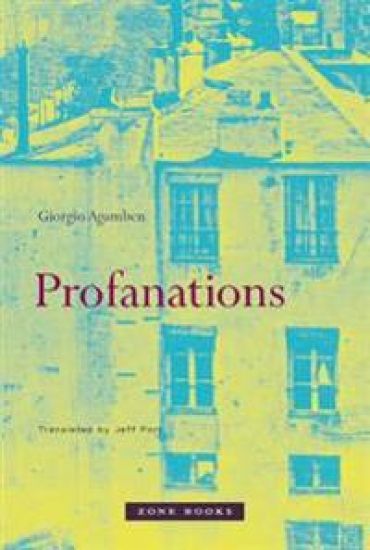
Essays by a provocative Italian philosopher on memory and oblivion, on what is lost and what remains. The Italian philosopher Giorgio Agamben has always been an original reader of texts, understanding their many rich historical, aesthetic, and political meanings and effects. In Profanations, Agamben has assembled for the first time some of his most pivotal essays on photography, the novel, and film. A meditation on memory and oblivion, on what is lost and what remains, Profanations proves yet again that Agamben is one of the most provocative writers of our time. In ten essays, Agamben ponders a series of literary and philosophical problems: the relation among genius, ego, and theories of subjectivity; the problem of messianic time as explicated in both images and lived experience; parody as a literary paradigm; and the potential of magic to provide an ethical canon. The range of topics and themes addressed here attest to the creativity of Agamben's singular mode of thought and his persistent concern with the act of witnessing, sometimes futile, sometimes earth-shattering. "In Praise of Profanity," the central essay of this short but dense book, confronts the question of profanity as the crucial political task of the moment. An act of resistance to every form of separation, the concept of profanation reorients perceptions of how power, consumption, and use interweave to produce an urgent political modality and desire: to profane the unprofanable. Agamben not only provides a new and potent theoretical model but describes it with a writerly style that itself forges inescapable links among literature, politics, and philosophy.
How and why did experience and knowledge become separated? Is it possible to talk of an infancy of experience, a "dumb" experience? For Walter Benjamin, the "poverty of experience" was a characteristic of modernity, originating in the catastrophe of the First World War. For Giorgio Agamben, the Italian editor of Benjamin's complete works, the destruction of experience no longer needs catastrophes: daily life in any modern city will suffice. Agamben's profound and radical exploration of language, infancy, and everyday life traces concepts of experience through Kant, Hegel, Husserl and Benveniste. In doing so he elaborates a theory of infancy that throws new light on a number of major themes in contemporary thought: the anthropological opposition between nature and culture; the linguistic opposition between speech and language; the birth of the subject and the appearance of the unconscious. Agamben goes on to consider time and history; the Marxist notion of base and superstructure (via a careful reading of the famous Adorno-Benjamin correspondence on Baudelaire's Paris); and the difference between rituals and games. Beautifully written, erudite and provocative, these essays will be of great interest to students of philosophy, linguistics, anthropology and politics.
Language and Death
Giorgio Agamben
University of Minnesota Press
2006
nidottu
Halvin toimitettuna 30,10 €
A formidable and influential work, Language and Death sheds a highly original light on issues central to Continental philosophy, literary theory, deconstruction, hermeneutics, and speech-act theory. Focusing especially on the incompatible philosophical systems of Hegel and Heidegger within the space of negativity, Giorgio Agamben offers a rigorous reading of numerous philosophical and poetic works to examine how these issues have been traditionally explored. Agamben argues that the human being is not just "speaking" and "mortal" but irreducibly "social" and "ethical." Giorgio Agamben teaches philosophy at the Collège International de Philosophie in Paris and at the University of Macerata in Italy. He is the author of Means without End (2000), Stanzas (1993), and The Coming Community (1993), all published by the University of Minnesota Press. Karen E. Pinkus is professor of French and Italian at the University of Southern California. Michael Hardt is professor of literature and romance studies at Duke University.
The Time That Remains
Giorgio Agamben
Stanford University Press
2005
pokkari
Halvin toimitettuna 32,50 €
In The Time That Remains, Agamben seeks to separate the Pauline texts from the history of the Church that canonized them, thus revealing them to be "the fundamental messianic texts of the West." He argues that Paul's letters are concerned not with the foundation of a new religion but rather with the "messianic" abolition of Jewish law. Situating Paul's texts in the context of early Jewish messianism, this book is part of a growing set of recent critiques devoted to the period when Judaism and Christianity were not yet fully distinct, placing Paul in the context of what has been called "Judaeo-Christianity." Agamben's philosophical exploration of the problem of messianism leads to the other major figure discussed in this book, Walter Benjamin. Advancing a claim without precedent in the vast literature on Benjamin, Agamben argues that Benjamin's philosophy of history constitutes a repetition and appropriation of Paul's concept of "remaining time." Through a close reading and comparison of Benjamin's "Theses on the Philosophy of History" and the Pauline Epistles, Agamben discerns a number of striking and unrecognized parallels between the two works.
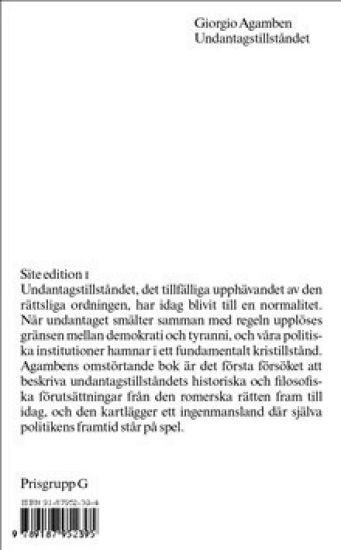
Undantagstillståndet, det tillfälliga upphävandet av den rättsliga ordningen, har idag blivit till en normalitet. När undantaget smälter samman med regeln upplöses gränsen mellan demokrati och tyranni, och våra politiska institutioner hamnar i ett fundamentalt kristtillstånd. Agambens omstörtande bok är det första försöket att beskriva undantagstillståndets historiska och filosofiska förutsättningar från den romerska rätten fram till idag, och den kartlägger ett ingenmansland där själva politikens framtid står på spel.
Two months after the attacks of 9/11, the Bush administration, in the midst of what it perceived to be a state of emergency, authorized the indefinite detention of noncitizens suspected of terrorist activities and their subsequent trials by a military commission. Here, distinguished Italian philosopher Giorgio Agamben uses such circumstances to argue that this unusual extension of power, or "state of exception," has historically been an underexamined and powerful strategy that has the potential to transform democracies into totalitarian states. The sequel to Agamben's Homo Sacer: Sovereign Power and Bare Life, State of Exception is the first book to theorize the state of exception in historical and philosophical context. In Agamben's view, the majority of legal scholars and policymakers in Europe as well as the United States have wrongly rejected the necessity of such a theory, claiming instead that the state of exception is a pragmatic question. Agamben argues here that the state of exception, which was meant to be a provisional measure, became in the course of the twentieth century a normal paradigm of government. Writing nothing less than the history of the state of exception in its various national contexts throughout Western Europe and the United States, Agamben uses the work of Carl Schmitt as a foil for his reflections as well as that of Derrida, Benjamin, and Arendt. In this highly topical book, Agamben ultimately arrives at original ideas about the future of democracy and casts a new light on the hidden relationship that ties law to violence.
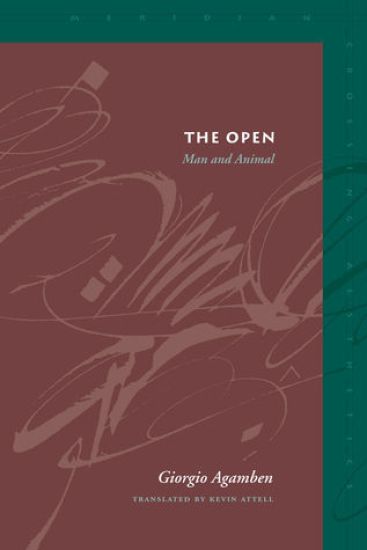
The end of human history is an event that has been foreseen or announced by both messianics and dialecticians. But who is the protagonist of that history that is coming—or has come—to a close? What is man? How did he come on the scene? And how has he maintained his privileged place as the master of, or first among, the animals? In The Open, contemporary Italian philosopher Giorgio Agamben considers the ways in which the "human" has been thought of as either a distinct and superior type of animal, or a kind of being that is essentially different from animal altogether. In an argument that ranges from ancient Greek, Christian, and Jewish texts to twentieth-century thinkers such as Heidegger, Benjamin, and Kojève, Agamben examines the ways in which the distinction between man and animal has been manufactured by the logical presuppositions of Western thought, and he investigates the profound implications that the man/animal distinction has had for disciplines as seemingly disparate as philosophy, law, anthropology, medicine, and politics.
"Dit buchelin heizit ein paradis der fornuftigen sele, paradisus animae intelligentis" Das kommende Sein ist weder individuell noch allgemein, sondern beliebig. Singulär, doch ohne Identität. Bestimmt, doch nur im leeren Raum des Beispiels. Und dennoch weder allgemein. noch gleichgültig: es ist im Gegenteil solcherart, dass es immer angeht- es ist der eigentliche Gegenstand der Liebe. Seine Logik: die Paradoxa der Mengenlehre, die Ununterscheidbarkeit einer Klasse von ihren Elementen, einer Sache von ihrer Bezeichnung. Seine Ethik: einzig die eigene Seinsweise sein, nichts vermögen als die eigene Möglichkeit oder Potenz, die Sprache als solche erfahren. Seine Politik: eine Gemeinschaft ohne jede Voraussetzung oder Bedingung der Zugehörigkeit (italienisch, rot, moslemisch, kommunistisch sein) zu bilden, der unwiderrufliche Auszug aus dem Staat, die Konstruktion eines mitteilbaren Körpers. "Giorgio Agamben gehört zu den anspruchsvollsten und genauesten Schriftstellern, die mir in dem letzten Jahren begegnet sind. Seine Schriften sind elegant, heiter und- um ein etwas verbrauchtes Wort mit neuem Leben zu erfüllen- absolut revolutionär." Avital Ronell
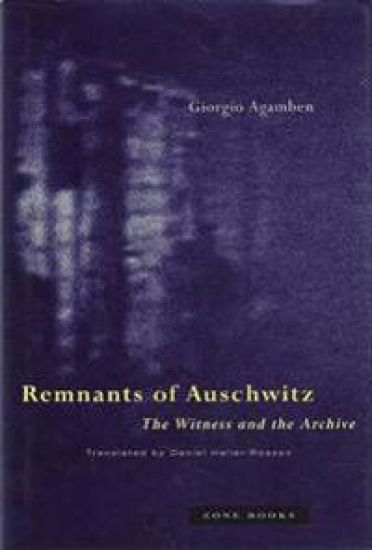
A philosophical study of the testimony of the survivors of Auschwitz. In this book the Italian philosopher Giorgio Agamben looks closely at the literature of the survivors of Auschwitz, probing the philosophical and ethical questions raised by their testimony. "In its form, this book is a kind of perpetual commentary on testimony. It did not seem possible to proceed otherwise. At a certain point, it became clear that testimony contained at its core an essential lacuna; in other words, the survivors bore witness to something it is impossible to bear witness to. As a consequence, commenting on survivors' testimony necessarily meant interrogating this lacuna or, more precisely, attempting to listen to it. Listening to something absent did not prove fruitless work for this author. Above all, it made it necessary to clear away almost all the doctrines that, since Auschwitz, have been advanced in the name of ethics."-Giorgio Agamben
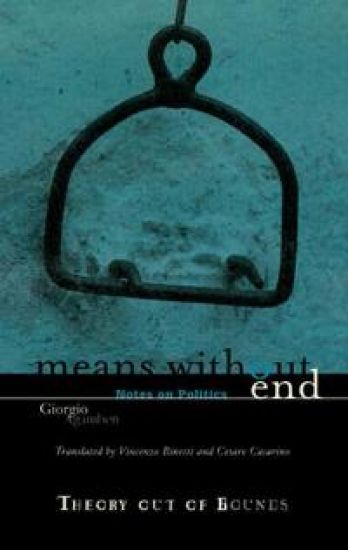
An essential reevaluation of the proper role of politics in contemporary life. A critical rethinking of the categories of politics within a new sociopolitical and historical context, this book builds on the previous work of the distinguished political philosopher Giorgio Agamben to address the status and nature of politics itself. Bringing politics face-to-face with its own failures of consciousness and consequence, Agamben frames his analysis in terms of clear contemporary relevance. He proposes, in his characteristically allusive and intriguing way, a politics of gesture-a politics of means without end. Among the topics Agamben takes up are the "properly" political paradigms of experience, as well as those generally not viewed as political. He begins by elaborating work on biopower begun by Foucault, returning the natural life of humans to the center of the polis and considering it as the very basis for politics. He then considers subjects such as the state of exception (the temporary suspension of the juridical order); the concentration camp (a zone of indifference between public and private and, at the same time, the secret matrix of the political space in which we live); the refugee, who, breaking the bond between the human and the citizen, moves from marginal status to the center of the crisis of the modern nation-state; and the sphere of pure means or gestures (those gestures that, remaining nothing more than means, liberate themselves from any relation to ends) as the proper sphere of politics. Attentive to the urgent demands of the political moment, as well as to the bankruptcy of political discourse, Agamben's work brings politics back to life, and life back to politics.
In this book, one of Italy's most important and original contemporary philosophers considers the status of art in the modern era. He takes seriously Hegel's claim that art has exhausted its spiritual vocation, that it is no longer through art that Spirit principally comes to knowledge of itself. He argues, however, that Hegel by no means proclaimed the "death of art" (as many still imagine) but proclaimed rather the indefinite continuation of art in what Hegel called a "self-annulling" mode. With astonishing breadth and originality, the author probes the meaning, aesthetics, and historical consequences of that self-annulment. In essence, he argues that the birth of modern aesthetics is the result of a series of schisms—between artist and spectator, genius and taste, and form and matter, for example—that are manifestations of the deeper, self-negating yet self-perpetuating movement of irony. Through this concept of self-annulment, the author offers an imaginative reinterpretation of the history of aesthetic theory from Kant to Heidegger, and he opens up original perspectives on such phenomena as the rise of the modern museum, the link between art and terror, the natural affinity between "good taste" and its perversion, and kitsch as the inevitable destiny of art in the modern era. The final chapter offers a dazzling interpretation of Dürer's Melancholia in the terms that the book has articulated as its own. The Man Without Content will naturally interest those who already prize Agamben's work, but it will also make his name relevant to a whole new audience—those involved with art, art history, the history of aesthetics, and popular culture.
This book, by one of Italy's most important and original contemporary philosophers, represents a broad, general, and ambitious undertaking—nothing less than an attempt to rethink the nature of poetic language and to rearticulate relationships among theology, poetry, and philosophy in a tradition of literature initiated by Dante. The author presents "literature" as a set of formal or linguistic genres that discuss or develop theological issues at a certain distance from the discourse of theology. This distance begins to appear in Virgil and Ovid, but it becomes decisive in Dante and in his decision to write in the vernacular. His vernacular Italian reaches back through classical allusion to the Latin that was in his day the language of theology, but it does so with a difference. It is no accident that in the Commedia Virgil is Dante's guide. The book opens with a discussion of just how Dante's poem is a "comedy," and it concludes with a discussion of the "ends of poetry" in a variety of senses: enjambment at the ends of lines, the concluding lines of poems, and the end of poetry as a mode of writing this sort of literature. Of course, to have poetry "end" does not mean that people stop writing it, but that literature passes into a period in which it is concerned with its own ending, with its own bounds and limits, historical and otherwise. Though most of the essays make specific reference to various authors of the Italian literary tradition (including Dante, Polifilo, Pascoli, Delfini, and Caproni), they transcend the confines of Italian literature and engage several other literary and philosophical authors (Plato, Aristotle, the Stoics, Boethius, the Provençal poets, Mallarmé, and Hölderlin, among others).
The work of Giorgio Agamben, one of Italy's most important and original philosophers, has been based on an uncommon erudition in classical traditions of philosophy and rhetoric, the grammarians of late antiquity, Christian theology, and modern philosophy. Recently, Agamben has begun to direct his thinking to the constitution of the social and to some concrete, ethico-political conclusions concerning the state of society today, and the place of the individual within it. In Homo Sacer, Agamben aims to connect the problem of pure possibility, potentiality, and power with the problem of political and social ethics in a context where the latter has lost its previous religious, metaphysical, and cultural grounding. Taking his cue from Foucault's fragmentary analysis of biopolitics, Agamben probes with great breadth, intensity, and acuteness the covert or implicit presence of an idea of biopolitics in the history of traditional political theory. He argues that from the earliest treatises of political theory, notably in Aristotle's notion of man as a political animal, and throughout the history of Western thinking about sovereignty (whether of the king or the state), a notion of sovereignty as power over "life" is implicit. The reason it remains merely implicit has to do, according to Agamben, with the way the sacred, or the idea of sacrality, becomes indissociable from the idea of sovereignty. Drawing upon Carl Schmitt's idea of the sovereign's status as the exception to the rules he safeguards, and on anthropological research that reveals the close interlinking of the sacred and the taboo, Agamben defines the sacred person as one who can be killed and yet not sacrificed-a paradox he sees as operative in the status of the modern individual living in a system that exerts control over the collective "naked life" of all individuals.
The work of Giorgio Agamben, one of Italy's most important and original philosophers, has been based on an uncommon erudition in classical traditions of philosophy and rhetoric, the grammarians of late antiquity, Christian theology, and modern philosophy. Recently, Agamben has begun to direct his thinking to the constitution of the social and to some concrete, ethico-political conclusions concerning the state of society today, and the place of the individual within it. In Homo Sacer, Agamben aims to connect the problem of pure possibility, potentiality, and power with the problem of political and social ethics in a context where the latter has lost its previous religious, metaphysical, and cultural grounding. Taking his cue from Foucault's fragmentary analysis of biopolitics, Agamben probes with great breadth, intensity, and acuteness the covert or implicit presence of an idea of biopolitics in the history of traditional political theory. He argues that from the earliest treatises of political theory, notably in Aristotle's notion of man as a political animal, and throughout the history of Western thinking about sovereignty (whether of the king or the state), a notion of sovereignty as power over "life" is implicit. The reason it remains merely implicit has to do, according to Agamben, with the way the sacred, or the idea of sacrality, becomes indissociable from the idea of sovereignty. Drawing upon Carl Schmitt's idea of the sovereign's status as the exception to the rules he safeguards, and on anthropological research that reveals the close interlinking of the sacred and the taboo, Agamben defines the sacred person as one who can be killed and yet not sacrificed—a paradox he sees as operative in the status of the modern individual living in a system that exerts control over the collective "naked life" of all individuals.
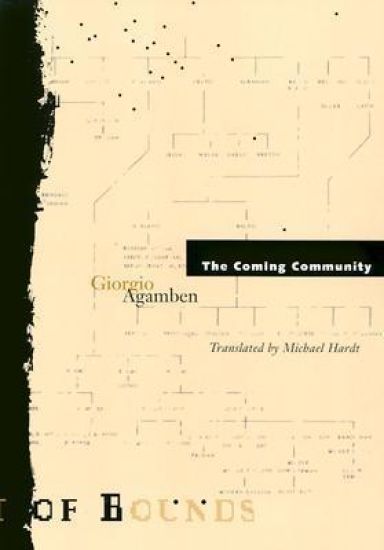
Coming Community
Giorgio Agamben
University of Minnesota Press
1993
nidottu
Halvin toimitettuna 30,10 €
In this extraordinary and original philosophical achievement, Agamben develops the concept of community and the social implications of his philosophical thought. Agamben's exploration is, in part, a contemporary response to the work of Heidegger, Wittgenstein, Blanchot, Jean-Luc Nancy, and, more historically, Plato, Spinoza, and medieval scholars and theorists of Judeo-Christian scriptures.