Kirjailija
Giorgio Agamben
Kirjat ja teokset yhdessä paikassa: 139 kirjaa, julkaisuja vuosilta 1993–2027, suosituimpiin kuuluu The Body of Europe. Vertaile teosten hintoja ja tarkista saatavuus suomalaisista kirjakaupoista.
139 kirjaa
Kirjojen julkaisuvuodet: 1993–2027.
Why has power in the West assumed the form of an "economy," that is, of a government of men and things? If power is essentially government, why does it need glory, that is, the ceremonial and liturgical apparatus that has always accompanied it? In the early centuries of the Church, in order to reconcile monotheism with God's threefold nature, the doctrine of Trinity was introduced in the guise of an economy of divine life. It was as if the Trinity amounted to nothing more than a problem of managing and governing the heavenly house and the world. Agamben shows that, when combined with the idea of providence, this theological-economic paradigm unexpectedly lies at the origin of many of the most important categories of modern politics, from the democratic theory of the division of powers to the strategic doctrine of collateral damage, from the invisible hand of Smith's liberalism to ideas of order and security. But the greatest novelty to emerge from The Kingdom and the Glory is that modern power is not only government but also glory, and that the ceremonial, liturgical, and acclamatory aspects that we have regarded as vestiges of the past actually constitute the basis of Western power. Through a fascinating analysis of liturgical acclamations and ceremonial symbols of power—the throne, the crown, purple cloth, the Fasces, and more—Agamben develops an original genealogy that illuminates the startling function of consent and of the media in modern democracies. With this book, the work begun with Homo Sacer reaches a decisive point, profoundly challenging and renewing our vision of politics.
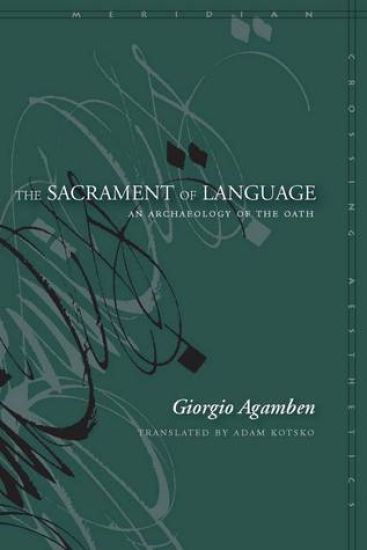
Oaths play an essential part in the political and religious history of the West as a 'sacrament of power'. Yet despite numerous studies by linguists, anthropologists and historians of law and of religion, there exists no complete analysis of the oath which seeks to explain the strategic function that this phenomenon has performed at the intersection of law, religion and politics. The oath seems to define man himself as a political animal, but what is an oath and from where does it originate? Taking this question as its point of departure, Giorgio Agamben's book develops a pathbreaking 'archaeology' of the oath. Via a firsthand survey of Greek and Roman sources which shed light on the nexus of the oath with archaic legislation, acts of condemnation and the names of gods and blasphemy, Agamben recasts the birth of the oath as a decisive event of anthropogenesis, the process by which mankind became humanity. If the oath has historically constituted itself as a 'sacrament of power', it has functioned at one and the same time as a 'sacrament of language' - a sacrament in which man, discovering that he can speak, chooses to bind himself to his language and to use it to put life and destiny at stake.
Democracy in What State?
Giorgio Agamben; Alain Badiou; Daniel Bensaid; Wendy Brown; Jean-Luc Nancy; Jacques Rancière; Kristin Ross; Slavoj Žižek
Columbia University Press
2011
sidottu
"Is it meaningful to call oneself a democrat? And if so, how do you interpret the word?" In responding to this question, eight iconoclastic thinkers prove the rich potential of democracy, along with its critical weaknesses, and reconceive the practice to accommodate new political and cultural realities. Giorgio Agamben traces the tense history of constitutions and their coexistence with various governments. Alain Badiou contrasts current democratic practice with democratic communism. Daniel Bensaid ponders the institutionalization of democracy, while Wendy Brown discusses the democratization of society under neoliberalism. Jean-Luc Nancy measures the difference between democracy as a form of rule and as a human end, and Jacques Ranciere highlights its egalitarian nature. Kristin Ross identifies hierarchical relationships within democratic practice, and Slavoj Zizek complicates the distinction between those who desire to own the state and those who wish to do without it. Concentrating on the classical roots of democracy and its changing meaning over time and within different contexts, these essays uniquely defend what is left of the left-wing tradition after the fall of Soviet communism. They confront disincentives to active democratic participation that have caused voter turnout to decline in western countries, and they address electoral indifference by invoking and reviving the tradition of citizen involvement. Passionately written and theoretically rich, this collection speaks to all facets of modern political and democratic debate.
This book is a continuation of Giorgio Agamben's investigation of political theory, which began with the highly influential volume Homo Sacer: Sovereign Power and Bare Life. Having already traced the roots of the idea of sovereignty, sacredness, and economy, he now turns to a perhaps unlikely topic: the concept of the oath. Following the Italian scholar Paolo Prodi, Agamben sees the oath as foundational for Western politics and undertakes an exploration of the roots of the phenomenon of the oath in human experience. He rejects the common idea that the oath finds its origin in religion, arguing instead that the oath points toward a particular response to the experience of language, a response that gave birth to both religion and law as we now know them. This book is important not only for readers of Agamben or of continental philosophy more broadly, but for anyone interested in questions relating to the relationships among religion, law, and language.
Vad innebär det att vara demokrat?
Slavoj Zizek; Giorgio Agamben; Jacques Ranciere; Wendy Brown
Tankekraft Förlag
2010
kartonkisidos
Finns det någon mening med att kalla sig "demokrat" i en samtid där praktiskt taget alla kallar sig demokrater? Kan ett begrepp som tycks kunna betyda både allt och inget fortfarande ha ett meningsfullt politiskt innehåll? I föreliggande bok åtar sig några av vår tids mest namnkunniga politiska teoretiker att besvara denna provokativa fråga. Svaren de presenterar formuleras utifrån skilda utgångspunkter och leder i flera fall till helt olika slutsatser. Samtidigt förenas de alla av ett gemensamt grundantagande: "demokrati" kan inte vara namnet på en redan förverkligad samhällsmodell eller en metod för att med jämna mellanrum utse politiska ledare. Tvärtom fortsätter demokratibegreppet att vara föremål för kamp och fungera som kärna åt politikens mest centrala frågor.
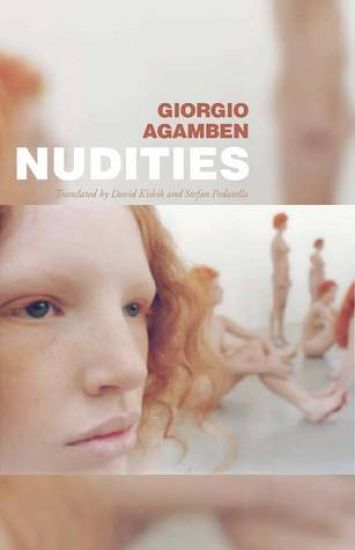
Encompassing a wide range of subjects, the ten masterful essays gathered here may at first appear unrelated to one another. In truth, Giorgio Agamben's latest book is a mosaic of his most pressing concerns. Take a step backward after reading it from cover to cover, and a world of secret affinities between the chapters slowly comes into focus. Take another step back, and it becomes another indispensable piece of the finely nuanced philosophy that Agamben has been patiently constructing over four decades of sustained research. If nudity is unconcealment, or the absence of all veils, then Nudities is a series of apertures onto truth. A guiding thread of this collection—weaving together the prophet's work of redemption, the glorious bodies of the resurrected, the celebration of the Sabbath, and the specters that stroll the streets of Venice—is inoperativity, or the cessation of work. The term should not be understood as laziness or inertia, but rather as the paradigm of human action in the politics to come. Itself the result of inoperativity, Nudities shuttles between philosophy and poetry, philological erudition and unexpected digression, metaphysical treatise and critique of modern life. And whether the subject at hand is personal identity or the biometric apparatus, the slanderer or the land surveyor, Kafka or Kleist, every page bears the singular imprint of one of the most astute philosophers of our time.
Dem Eid kommt als ? Sakrament der Macht? in der Geschichte der abendländischen Politik und Religion eine grundlegende Rolle zu. Dennoch fehlt - ungeachtet zahlreicher linguistischer, anthropologischer und historischer Studien - ein all diese Aspekte umfassender Versuch, den systematisch-strategischen Ort zu bestimmen, den die Institution des Eides am Schnittpunkt von Recht, Religion und Politik einnimmt. Hier setzt Giorgio Agamben mit seiner ? Archäologie des Eides? an - und trifft mitten ins Zentrum der Existenz des Menschen als sprechendes sowie als politisches Tier. Im Rückgriff auf griechische und römische Quellen stellt Agamben den Konnex her zwischen dem Eid einerseits und archaischer Gesetzgebung, Fluch und Götternamen andererseits. Dabei gewinnt er eine völlig neuartige Perspektive auf den Ursprung des Eides: Der Eid wird zum entscheidenden Moment in der Anthropogenese; als Sakrament der Macht hat er sich etablieren können, weil er zuallererst das Sakrament der Sprache ist. Indem sich der Mensch als sprechendes Wesen entdeckt, bindet er sich auch an die Sprache und setzt in ihr sein Schicksal aufs Spiel.
"I myndighedernes øjne - og måske har de ret - er der intet der ligner en terrorist så meget, som et helt almindeligt menneske." - Giorgio Agamben I Hvad er et dispositiv? - og to andre essays bygger den italienske filosof Giorgio Agamben videre på centrale temaer som biopolitik og det politiske, som han tidligere har udfoldet i Undtagelsestilstand og Homo Sacer. Teksterne kan læses som aktualiserede opdateringer af Michel Foucaults genealogiske sonderinger i forholdet mellem regering, magt og liv, men går også nye veje og henvender sig derfor til enhver, der vil forstå forudsætningerne for samfundslivet i det 21. årh. "Taget i betragtning hvor megen debat Agambens knivskarpe udmeldinger de sidste år har afstedkommet, må man formode, hans seneste bog vil vække opmærksomhed." - Toke Lykkeberg Nielsen i Information om Qu'est-ce-qu'un dispositif? / Hvad er et dispositiv?
Homo sacer : den suveräna makten och det nakna livet
Giorgio Agamben
Bokförlaget Daidalos
2010
nidottu
Med Homo sacer (1995) inledde den italienske filosofen Giogio agamben en serie böcker som undersöker den västerländska politikens fundament och som skulle göra honom till en uppmärksammad och kontrovesiell tänkare. Här leder han oss från en analys av begreppet suveränitet, som förstås som den politiska ordningens yttersta grundval, till det nakna livet, som är det liv som står i motsats till suveräniteten, och till den moderna biopolitiska makten där bilogiskt och politiskt liv oupplösligt vävs samman. »Agamben har blivit en av vår tids mest omdiskuterade filosofer, och starkt påverkat diskussioner om suveränitet, om relationen mellan lag och liv, och om gränserna för det politiska.» /Patricia Lorenzoni i Hd »Agamben bör nog räknas till dagens mest uppburna filosofer.» /Ola Sigurdson i Svd
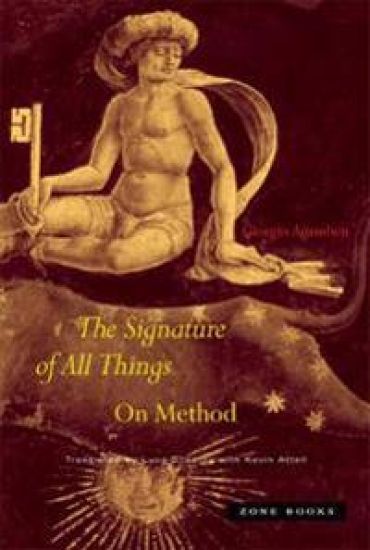
The search to create a science of signatures that exceeds the attempts of semiology and hermeneutics to determine pure and unmarked signs. The Signature of All Things is Giorgio Agamben's sustained reflection on method. To reflect on method implies for Agamben an archaeological vigilance: a persistent form of thinking in order to expose, examine, and elaborate what is obscure, unanalyzed, even unsaid, in an author's thought. To be archaeologically vigilant, then, is to return to, even invent, a method attuned to a "world supported by a thick weave of resemblances and sympathies, analogies and correspondences." Collecting a wide range of authors and topics in a slim but richly argued volume, Agamben enacts the search to create a science of signatures that exceeds the attempts of semiology and hermeneutics to determine the pure and unmarked signs that signify univocally, neutrally, and eternally. Three conceptual figures organize Agamben's argument and the advent of his new method: the paradigm, the signature, and archaeology. Each chapter is devoted to an investigation of one of these concepts and Agamben carefully constructs its genealogy transhistorically and from an interdisciplinary perspective. And at each moment of the text, Agamben pays tribute to Michel Foucault, whose methods he rethinks and effectively uses to reformulate the logic of the concepts he isolates. The Signature of All Things reveals once again why Agamben is one of the most innovative thinkers writing today.
The three essays collected in this book offer a succinct introduction to Agamben's recent work through an investigation of Foucault's notion of the apparatus, a meditation on the intimate link of philosophy to friendship, and a reflection on contemporariness, or the singular relation one may have to one's own time. "Apparatus" (dispositif in French) is at once a most ubiquitous and nebulous concept in Foucault's later thought. In a text bearing the same name ("What is a dispositif?") Deleuze managed to contribute its mystification, but Agamben's leading essay illuminates the notion: "I will call an apparatus," he writes, "literally anything that has in some way the capacity to capture, orient, determine, intercept, model, control, or secure the gestures, behaviors, opinions, or discourses of living beings." Seen from this perspective, Agamben's work, like Foucault's, may be described as the identification and investigation of apparatuses, together with incessant attempts to find new ways to dismantle them. Though philosophy contains the notion of philos, or friend, in its very name, philosophers tend to be very skeptical about friendship. In his second essay, Agamben tries to dispel this skepticism by showing that at the heart of friendship and philosophy, but also at the core of politics, lies the same experience: the shared sensation of being. Guided by the question, "What does it mean to be contemporary?" Agamben begins the third essay with a reading of Nietzsche's philosophy and Mandelstam's poetry, proceeding from these to an exploration of such diverse fields as fashion, neurophysiology, messianism and astrophysics.
Hva er et menneskeliv, og hva er politikkens oppgave? Slike fundamentale spørsmål er den italienske filosofen Giorgio Agamben opptatt av. Han utfordrer selve grunnelementene i vestlig politisk tenkning: våre forestillinger om stat, nasjon, identitet og språk. I en rekke engasjerte og dyptpløyende essay viser han hvilke konsekvenser politikken har for enkeltmennesket, for eksempel i forhold til flyktningspørsmål, internering og politisk unntakstilstand. Agamben har dessuten en visjon om en alternativ politikk som ikke bygger på treenigheten nasjon, statsborgerskap og territorium, men som tar utgangspunkt i menneskenes språklige fellesskap. Midler uten mål er en tvers igjennom original og tankevekkende bok, uansett hvor man selv befinner seg i det politiske landskapet. Nr. 57 i Cappelens upopulære skrifter.
La question de la methode est ici abordee a partir d'une reflexion sur trois concepts: le paradigme, la signature, l'archeologie. L'analyse du paradigme permet de dessiner les lignes essentielles d'un chapitre qui fait defaut dans l'histoire de la logique occidentale - la theorie de l'exemple et de l'analogie. Sur les traces des traites de l'age baroque et de la Renaissance de signatura rerum, le deuxieme volet definit la signature comme signe dans le signe, qui joue un role decisif dans l'interpretation des signes, de la theorie medievale des sacrements a Benveniste, de la doctrine des transcendantaux a Warburg et a Freud. Le troisieme, enfin, poursuit les analyses de Foucault sur la relation entre archeologie et histoire et pose un concept d'origine qui ne reste pas isole dans le passe, mais qui, comme les mots indo-europeens en grammaire comparee ou l'enfant en psychanalyse, ne cesse d'agir dans le present pour le rendre intelligible. L'entrelacs de ces trois noeuds problematiques ouvre l'espace d'un court traite sur la methode, question premiere et ultime pour tout travail en philosophie et en sciences humaines.