Kirjojen hintavertailu – 12 859 819 kirjaa ja 27 kauppaa
Kirjailija
H. G. Wells
Kirjat ja teokset yhdessä paikassa: 1 483 kirjaa, julkaisuja vuosilta 1895–2027, suosituimpiin kuuluu Maailmojen sota. Vertaile teosten hintoja ja tarkista saatavuus suomalaisista kirjakaupoista.
Nimi esiintyy myös muodoissa: H G Wells, H.G. Wells, H.G Wells, H. G Wells
A cautionary horror story about the dangers of greed, isolation and a science without ethics, from the father of science fiction. The stranger arrives early in February, one wintry day, through a biting wind and a driving snow. He is wrapped up from head to foot, and the brim of his hat hides every inch of his face. Rude and rough, the stranger works with strange apparatus locked in his room all day and walks along lonely lanes at night, his bandaged face inspiring fear in children and dogs. Is he the mutilated victim of an accident? A criminal on the run? An eccentric genius? But no-one in the village comes close to guessing who has come amongst them, or what those bandages hide. ‘Wells was the founding father of science fiction, and in his utopian fantasy novels he was proved eerily correct’ Daily Telegraph
Read this stunning Vintage Classics edition of the original story of alien invasion from the father of science fiction, H. G. Wells. No one would have believed in the last years of the nineteenth century that this world was being watched keenly and closely by intelligences greater than man's; that as men busied themselves about their various concerns they were scrutinised and studied. Yet across the gulf of space, intellects vast and cool and unsympathetic regarded this earth with envious eyes, and slowly and surely drew their plans against us. Then, late one night, in the middle of the English countryside, they landed...
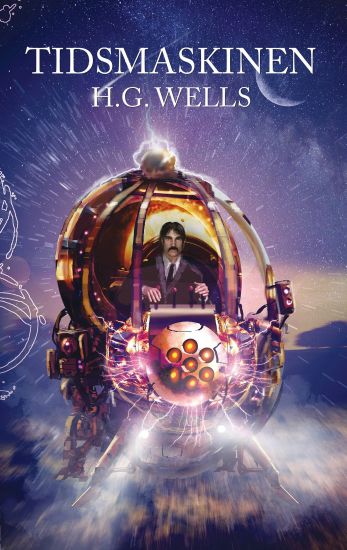
Det här var inte vad han hade väntat sig. Uppfinnaren från London har anlänt till en avlägsen framtid. Omedelbart blir hans tidsmaskin stulen. Strandad i en värld fylld av mirakel och förfall söker han efter en väg hem och finner en dold ondska. Tidsmaskinen gavs ut första gången 1895 och är en av de största science fiction-klassikerna. Här ryms både ett vilt äventyr och en skarpsinnig reflektion över människans hjärta och drivkraft.
summary She tells us the story of Mr Plattner, a professor at an English private school, whose banal life only comes alive when he discovers an interest in chemistry. It is fun to analyze in a very empirical way the samples that bring him his students. Until the day when one of them brings him a strange green powder ... The combustion of the latter leads to an explosion during which Plattner literally volatilizes; There is no trace of him. He reappears 9 days later, alive, with a very strange story. He tells us that he spent all this time in a parallel world, a very obscure overseas world lit only by a phosphorescent light of green color and peopled with specters of the same color. These ectoplasms are none other than the "spectators of the overseas", the souls of the deceased obliged to look down on the consequences of the actions realized during their lifetime. Finally, after nine days of wandering, and seeing the shadow of death, Plattner accidentally regains our world.
The Invisible Man is a 1897 science fiction novel, originally serialized in Pearson's Magazine. The Invisible Man of the title is "Griffin", a scientist who theorizes that if a person's refractive index is changed to exactly that of air and his body does not absorb or reflect light, then he will not be visible. He successfully carries out this procedure on himself, but cannot become visible again, becoming mentally unstable as a result. Herbert George Wells (21 September 1866 - 13 August 1946)-known as H. G. Wells-was a prolific English writer in many genres, including the novel, history, politics, social commentary, and textbooks and rules for war games. Wells is now best remembered for his science fiction novels and is called a "father of science fiction", along with Jules Verne and Hugo Gernsback. His most notable science fiction works include The Time Machine (1895), The Island of Doctor Moreau (1896), The Invisible Man (1897), and The War of the Worlds (1898). He was nominated for the Nobel Prize in Literature four times.
This book is also available in extra large print. For more on our large print and dyslexia-friendly books, and our bulk discounts for schools visit: firestonebooks.com
Tono-Bungay is narrated by George Ponderevo, who is persuaded to help develop the business of selling Tono-Bungay, a patent medicine created by his ambitious uncle Edward. George devotes seven years to organising the production and manufacture of a product which he believes to be "a damned swindle". He then quits day-to-day involvement with the enterprise in favour of aeronautics. But he remains associated with his uncle Edward, who becomes a financier of the first order and is on the verge of achieving social as well as economic dominance when his business empire collapses. George tries to rescue his uncle's failing finances by stealing quantities of a radioactive compound called "quap " from an island off the coast of West Africa, but the expedition is unsuccessful. His nephew engineers his uncle's escape from England in an experimental aircraft he has built, but the ruined entrepreneur turned financier catches pneumonia on the flight and dies in a French village near Bordeaux, despite George's efforts to save him. The novel ends with George finding a new occupation: designing destroyers for the highest bidder. Tono-Bungay is narrated by George Ponderevo, who is persuaded to help develop the business of selling Tono-Bungay, a patent medicine created by his ambitious uncle Edward. George devotes seven years to organising the production and manufacture of a product which he believes to be "a damned swindle". He then quits day-to-day involvement with the enterprise in favour of aeronautics. But he remains associated with his uncle Edward, who becomes a financier of the first order and is on the verge of achieving social as well as economic dominance when his business empire collapses. George tries to rescue his uncle's failing finances by stealing quantities of a radioactive compound called "quap " from an island off the coast of West Africa, but the expedition is unsuccessful. His nephew engineers his uncle's escape from England in an experimental aircraft he has built, but the ruined entrepreneur turned financier catches pneumonia on the flight and dies in a French village near Bordeaux, despite George's efforts to save him. The novel ends with George finding a new occupation: designing destroyers for the highest bidder. Edward Ponderevo's business career offers the occasion for a satirical portrait of late-Victorian and Edwardian England, arguably the main theme of the novel. As a Bildungsroman, however, Tono-Bungay explores the development of the narrator's emotional life. Three sexual relationships (his unsuccessful marriage to Marion, his affair with the liberated Effie, and his doomed relationship with Beatrice Normandy, a belle dame sans merci whom he has known since childhood and who loves but refuses to marry him) are analysed, and also his frustrated love for his stern, austere mother (a domestic servant) and his powerful attachment to his aunt Susan, a character whose depiction is in part a portrait of Wells's second wife, Amy Catherine Robbins (better known as Jane).
The Island of Doctor Moreau is an 1896 science fiction novel, by English author, H. G. Wells. The text of the novel is the narration of Edward Prendick, a shipwrecked man rescued by a passing boat who is left on the island home of Doctor Moreau, who creates human-like hybrid beings from animals via vivisection. The novel deals with a number of philosophical themes, including pain and cruelty, moral responsibility, human identity, and human interference with nature. 2] Wells described the novel as "an exercise in youthful blasphemy". The Island of Doctor Moreau is a classic of early science fiction 3] and remains one of Wells's best-known books, and has been adapted to film and other media on many occasions. Herbert George Wells (21 September 1866 - 13 August 1946)-known as H. G. Wells-was a prolific English writer in many genres, including the novel, history, politics, social commentary, and textbooks and rules for war games. Wells is now best remembered for his science fiction novels and is called a "father of science fiction", along with Jules Verne and Hugo Gernsback. His most notable science fiction works include The Time Machine (1895), The Island of Doctor Moreau (1896), The Invisible Man (1897), and The War of the Worlds (1898). He was nominated for the Nobel Prize in Literature four times.
The protagonist is the novel's first-person narrator, Stephen Stratton. The Passionate Friends is written as if addressed to Stephen's eldest son, who is on the verge of adolescence. Stephen is the only child of a rector who loses his faith due to Darwinism. The most important relationship of Stephen's life is with the Lady Mary Christian (later Lady Mary Justin), a beautiful blue-eyed contemporary who has been his childhood "playmate" and with whom he falls deeply in love at the age of nineteen during the summer before he begins his studies at Oxford. Mary returns his love, but will not promise to marry Stephen. Having resolved to "belong to myself," Mary weds Justin, a wealthy financier, but intends also to remain Stephen's intimate friend. Stephen cannot accept this, breaks off relations, and experiences despair. In an attempt to put his troubles behind him, Stephen volunteers to fight in South Africa, where the Second Boer War has just begun (1899). He becomes an officer and distinguishes himself in the fighting, and also is exposed for the first time to "the social fundamental of Labor." Back in England he decides to pursue a political career, since his father has unexpectedly inherited a substantial fortune. But by chance his father is now living on a property adjacent to Lady Mary Justin's; they meet and become lovers. Stephen had begun to court another near neighbor, Rachel, but the resumption of his passionate relationship with Mary suspends this project. Disaster strikes when Justin sees Stephen kiss his wife. In the following crisis the powerful Justin hides Mary away in an Irish castle and prevails upon Stephen to leave England for a period of three years. Traveling the world, Stephen studies Asian societies and develops convictions about the historical development of humanity. He believes that "Civilization has never yet existed, it has only continually and obstinately attempted to be. Our Civilization is but the indistinct twilight before the dawn." He resolves to devote himself to "the making of a new world-city, a new greater State above your legal States, in which all human life becomes a splendid enterprise, free and beautiful." In a villa on the Rhine he chances to meet Rachel again, and after a trip to America he asks her to become his wife; they are married on Nov. 8, 1906. Stephen undertakes with a progressive American named Giddings a career as a publisher of world literature and reference books.
In truth the mastery of flying was the work of thousands of men-this man a suggestion and that an experiment, until at last only one vigorous intellectual effort was needed to finish the work. But the inexorable injustice of the popular mind has decided that of all these thousands, one man, and that a man who never flew, should be chosen as the discoverer, just as it has chosen to honour Watt as the discoverer of steam and Stephenson of the steam-engine. Thirteen short stories by HG Wells, the master of speculative fiction Included in this collection is "Mr Skelmersdale in Fairyland" where a man finds his way into fairyland where a fairy queen tries to seduce him away from his human fianc e. In other stories a ghost gets stuck and can't get back to the "other side", a man decides to try being a god for a few months, a magic shop sells "the real thing", a scientist sells time in a bottle, a body is stolen (while its owner is still alive) and a man dreams or does he? Dig into a hearty dose of classic science fiction from the pen of one of the foremost figures in the genre, H. G. Wells. This wide-ranging collection brings together a treasure trove of Wells' trademark tales, all of which are packed with fascinating ideas and plenty of action.
The Wheels of Chance was written at the height of the cycling craze (1890-1905), when practical, comfortable bicycles first became widely and cheaply available and before the rise of the automobile (see History of the bicycle). The advent of the bicycle stirred sudden and profound changes in the social life of England. Even the working class could travel substantial distances, quickly and cheaply, and the very idea of travelling for pleasure became a possibility for thousands of people for the first time. This new freedom affected many. It began to weaken the rigid English class structure and it gave an especially powerful boost to the existing movement toward female emancipation. Wells explored these social changes in his story. The hero of The Wheels of Chance, Mr. Hoopdriver, is a frustrated "draper's assistant" in Putney, a badly paid, grinding position (and one which Wells briefly held), and yet he owns a bicycle and is setting out on a bicycling tour of "the Southern Coast" on his annual ten days holiday. Hoopdriver survives his frustration by escaping in his imagination into a world of fantasy. He is not a skilled rider of his forty-three-pound bicycle, and his awkwardness reflects both Wells's own uncertainties in negotiating the English class system and his critical view of that society. Nonetheless, Hoopdriver is treated sympathetically: "But if you see how a mere counter-jumper, a cad on castors, and a fool to boot, may come to feel the little insufficiencies of life, and if he has to any extent won your sympathies, my end is attained."
The First Men in the Moon is a scientific romance published in 1901 by the English author H. G. Wells, who called it one of his "fantastic stories". The novel tells the story of a journey to the moon undertaken by the two protagonists, a businessman narrator, Mr. Bedford, and an eccentric scientist, Mr. Cavor. Bedford and Cavor discover that the moon is inhabited by a sophisticated extraterrestrial civilization of insect-like creatures they call "Selenites. The narrator is a London businessman who withdraws to the countryside to write a play, by which he hopes to alleviate his financial problems. Bedford rents a small countryside house in Lympne, in Kent, where he wants to work in peace. He is bothered every afternoon, however, at precisely the same time, by a passer-by making odd noises. After two weeks Bedford accosts the man, who proves to be a reclusive physicist named Mr. Cavor. Bedford befriends Cavor when he learns he is developing a new material, cavorite, which can negate the force of gravity
However, the story soon focuses on Bert who is an unimpressive, not particularly gifted, unsuccessful young man with few ideas about larger things - but far from unintelligent. He has a strong attachment to a young woman named Edna, and works as a helper and later a partner in a bicycle shop. When bankruptcy threatens one summer, he and his partner abandon the shop, devise a singing act ("the Desert Dervishes"), and resolve to try their fortunes in English sea resorts. As chance would have, their initial performance is interrupted by a balloon which lands on the beach before them, and which turns out to contain one Mr. Butteridge. Butteridge is famous for his successful invention of an easily manoeuvrable fixed-wing aircraft whose secret he has not revealed and that he is seeking to sell to the British government or, failing that, to Germany. Prior to Butteridge, nobody had succeeded in producing a practical heavier-than-air machine, only a few awkward devices of limited utility such as the German "Drachenflieger", which had to be towed aloft and released from an airship. Butteridge's invention is a major breakthrough, as it is highly manoeuvrable, capable of both very fast and very slow flight, and requires only a small area to take off and land, reminiscent of the later autogyro. By accident Bert is carried off in Butteridge's balloon, and discovers Butteridge's secret plans on board it. Bert is clever enough to appraise his situation, and when the balloon is shot down in a secret German "aeronautic park east of Hamburg," Bert intends to pass himself off as Butteridge to sell the secret. However, he has stumbled upon the German air fleet just as it is about to launch a surprise attack on the United States - and Prince Karl Albert, the author and leader of this plan, decides to take him along for the campaign. The Prince, world-famous as "The German Alexander" or Napoleon, is a living manifestation of German Nationalism and boundless imperial ambitions, his personality as depicted by Wells in some ways resembling that of Kaiser Wilhelm II. Bert's disguise is soon seen through by the Germans, and - narrowly avoiding being summarily thrown overboard by the furious Prince - he is relegated to the role of a witness to the true horror of war.ty."
Plot summary An unnamed narrator is the author of a prologue ("The Man Who Wrote in the Tower") and an epilogue ("The Window of the Tower"). In these short texts is depicted an encounter with a "happy, active-looking" old man: the protagonist and author of the first-person narrative, writing the story of his life immediately before and after "the Change". This narrative is divided into three "books": Book I: The Comet; Book II: The Green Vapours; and Book III: The New World. Book I, recounts that William ("Willie") Leadford, "third in the office staff of Rawdon's pot-bank a place where pottery is made] in Clayton," quits his job just as an economic recession caused by American dumping hits industrial Britain, and is unable to find another position. His emotional life is dominated by his attachment to Nettie Stuart, "the daughter of the head gardener of the rich Mr. Verrall's widow", of a village called Checkshill Towers. Converted to socialism by his friend 'Parload', Leadford blames class-based injustice for the squalid living conditions in which he and his mother live. The date of the action is unspecified. When Nettie jilts Leadford for the son and heir of the Verrall family, Leadford buys a revolver, intending to kill them both and himself. As this plot matures, a comet with an "unprecedented band in the green" in its spectroscopy looms gradually larger in the sky, eventually becoming brighter than the Moon. Just as Leadford is about to kill his rivals, the green comet enters the Earth's atmosphere and disintegrates, causing a soporific green fog. Book II opens with Leadford's awakening, in which he is acutely aware of the beauty in the world and his attitude toward others is one of generous fellow-feeling. The same effects occur in every human being, who accordingly re-organize human society. By chance, Leadford falls in with a Cabinet minister and briefly becomes his secretary. Book III begins with an intense discussion by Verrall, Leadford, and Nettie, about their future. Although Nettie wants to establish a m nage trois, Leadford and Verrall reject the idea, and Leadford devotes himself to his mother until her death. Leadford marries Anna, who has been helping care for his mother, and they have a son; but soon thereafter Nettie contacts Leadford. In the epilogue, the 72-year-old Leadford reveals that he, Nettie, Verrall, and Anna were from then on "very close, you understand, we were friends, helpers, personal lovers in a world of lovers". The author is troubled "by my uneasy sense of profound moral differences."