Kirjojen hintavertailu – 12 859 819 kirjaa ja 27 kauppaa

Kirjailija

H. G. Wells

Kirjat ja teokset yhdessä paikassa: 1 483 kirjaa, julkaisuja vuosilta 1895–2027, suosituimpiin kuuluu Maailmojen sota. Vertaile teosten hintoja ja tarkista saatavuus suomalaisista kirjakaupoista.

Nimi esiintyy myös muodoissa: H G Wells, H.G. Wells, H.G Wells, H. G Wells

1 483 kirjaa

Kirjojen julkaisuvuodet: 1895–2027.

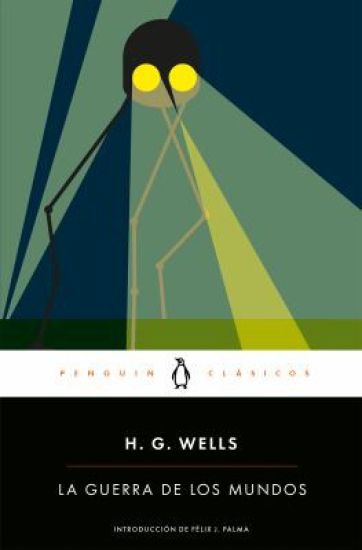
La Guerra de Los Mundos / The War of the Worlds
La obra de Wells ha influido largamente a la tradici n literaria de la ciencia ficci n. La guerra de los mundos narra por primera vez en la historia de la literatura un tema que ser recurrente desde entonces y originar todo un subg nero dentro de la ciencia ficci n: la invasi n de la Tierra por extraterrestres procedentes de Marte. A trav s de esta f bula en la que ocupan un lugar central las descripciones cient ficas, las premoniciones sobre el futuro de la tecnolog a y los entresijos de la pol tica, H. G. Wells nos habla sobre la vanidad y la seguridad ficticia de una humanidad autosatisfecha, y los peligros que acechan su supervivencia. Su presencia ineludible se descubre as en el imaginario de autores consagrados del g nero como F lix J. Palma, que firma la introducci n que abre la presente edici n. Asimismo, recuperamos la cl sica traducci n que en su d a hizo Julio Vacarezza y de la que han disfrutado generaciones enteras. ENGLISH DESCRIPTION The War of the Worlds is a science fiction novel by English author H. G. Wells. It first appeared in serialized form in 1897, published simultaneously in Pearson's Magazine in the UK and Cosmopolitan magazine in the US. The first appearance in book form was published by William Heinemann of London in 1898. It is the first-person narrative of an unnamed protagonist in Surrey and that of his younger brother in London as Earth is invaded by Martians. Written between 1895 and 1897, it is one of the earliest stories that detail a conflict between mankind and an extraterrestrial race. The novel is one of the most commented-on works in the science fiction canon. The War of the Worlds has two parts, Book One: The Coming of the Martians and Book Two: The Earth under the Martians. The narrator, a philosophically inclined author, struggles to return to his wife while seeing the Martians lay waste to the southern country outside London. Book One also imparts the experience of his brother, also unnamed, who describes events as they deteriorate in the capital, forcing him to escape the Martian onslaught by boarding a paddle steamer near Tillingham, on the Essex coast. The plot has been related to invasion literature of the time. The novel has been variously interpreted as a commentary on evolutionary theory, British Imperialism, and generally Victorian superstitions, fears and prejudices. At the time of publication it was classified as a scientific romance, like his earlier novel The Time Machine. The War of the Worlds has been both popular (having never gone out of print) and influential, spawning half a dozen feature films, radio dramas, a record album, various comic book adaptations, a television series, and sequels or parallel stories by other authors. It has even influenced the work of scientists, notably Robert Hutchings Goddard.
The Country Of The Blind And Other Stories

The Country Of The Blind And Other Stories

H. G. Wells

Createspace Independent Publishing Platform
2016
nidottu
"The Country of the Blind" is a short story written by H. G. Wells. It was rst published in the April 1904 issue of The Strand Magazine and included in a 1911 collection of Wells's short stories, The Country of the Blind and Other Stories. It is one of Wells's best known short stories, and features prominently in literature dealing with blindness. While attempting to summit the unconquered crest of Parascotopetl (a ctitious mountain in Ecuador), a mountaineer named Nu ez (prn: noon-yes) slips and falls down the far side of the mountain. At the end of his descent, down a snow-slope in the mountain's shadow, he nds a valley, cut off from the rest of the world on all sides by steep precipices. Unbeknownst to Nu ez, he has discovered the fabled "Country of the Blind". The isolated community prospered over the years, despite a disease that struck them early on, rendering all newborns blind. As the blindness slowly spreads over many generations, the people's remaining senses sharpened, and by the time the last sighted villager had died, the community had fully adapted to life without sight. This classic title has been re-discovered and published by RADLEY BOOKS. Each RADLEY CLASSIC is a meticulously restored, luxurious and faithful reproduction of a classic book; produced with elegant text layout, clarity of presentation, and stylistic features that make reading a true pleasure. Special attention is given to legible fonts and adequate letter sizing, correct line length for readability, generous margins and triple lead (lavish line separation); plus we do not allow any mistakes/changes/ additions to creep into the author's words. Visit RADLEY BOOKS at www.radleybooks.com (or search RADLEY CLASSIC on Amazon) to see more classic book titles in this series.
This Misery Of Boots

This Misery Of Boots

H. G. Wells

Createspace Independent Publishing Platform
2016
nidottu
This Misery of Boots is a 1907 political tract by H. G. Wells advocating socialism. Published by the Fabian Society, This Misery of Boots is the expansion of a 1905 essay with the same name. Its five chapters condemn private property in land and means of production and calls for their expropriation by the state "not for profit, but for service." Wells had considered himself a socialist since the mid-1880s, but his socialism was one marked by "a unique personal bias" and "is always projected toward a world order." In 1886-1889 Wells had undertaken a study of the classic utopian writings of the Western tradition, and in the 1890s he integrated his socialistic beliefs with his views on evolution. He read psychology to seek practical insights. In the first decade of the twentieth century Wells refined his views, writing many essays and four book-length works promoting socialism: Mankind in the Making (1903), A Modern Utopia (1905), Socialism and the Family (1906), and New Worlds for Old (1908). Wells joined the Fabian Society on March 13, 1903. He remained a member until 1908. George Bernard Shaw wrote to Sidney Webb: "Do not underrate Wells. What you said the other day about his article in the Independent Review being a mere piece of journalism suggested to me that you did not appreciate the effect his writing produces on the imagination of the movement." This Misery of Boots is often described as "brilliant" and has often been reprinted. This classic title has been published by RADLEY BOOKS. Each RADLEY CLASSIC is a meticulously restored, luxurious and faithful reproduction of a classic book; produced with elegant text layout, clarity of presentation, and stylistic features that make reading a true pleasure. Special attention is given to legible fonts and adequate letter sizing, correct line length for readability, generous margins and triple lead (lavish line separation); plus we do not allow any mistakes/changes/ additions to creep into the author's words. Visit RADLEY BOOKS at www.radleybooks.com (or search RADLEY CLASSIC on Amazon) to see more classic book titles in this series.
The Wheels Of Chance

The Wheels Of Chance

H. G. Wells

Createspace Independent Publishing Platform
2016
nidottu
The Wheels of Chance was written at the height of the cycling craze (1890-1905), when practical, comfortable bicycles rst became widely and cheaply available and before the rise of the automobile (see History of the bicycle). The advent of the bicycle stirred sudden and profound changes in the social life of England. Even the working class could travel substantial distances, quickly and cheaply, and the very idea of travelling for pleasure became a possibility for thousands of people for the rst time. This new freedom affected many. It began to weaken the rigid English class structure and it gave an especially powerful boost to the existing movement toward female emancipation. Wells explored these social changes in his story. Each RADLEY CLASSIC is a meticulously restored, luxurious and faithful reproduction of a classic book; produced with elegant text layout, clarity of presentation, and stylistic features that make reading a true pleasure. Special attention is given to legible fonts and adequate letter sizing, correct line length for readability, generous margins and triple lead (lavish line separation); plus we do not allow any mistakes/changes/ additions to creep into the original author's words. Visit RADLEY BOOKS at www.radleybooks.com to see more classic book titles in this series.
The Plattner Story And Others

The Plattner Story And Others

H. G. Wells

Createspace Independent Publishing Platform
2016
nidottu
The Plattner Story and Others is a collection of seventeen short stories written by H. G. Wells. This volume was rst published in March 1897 by Methuen & Co. The Plattner Story is itself a classic Victorian science ction short story, rst published in 1896. A young chemistry teacher is blown into a parallel universe or 4th dimension by a greenish powder. Another tale tells of "The Argonauts of the Air" which is a short story written several years before the rst ight of the Wright brothers, and it describes the painstaking development of a ying machine, in the face of public amusement, and its unsuccessful trial ight over London. Each RADLEY CLASSIC is a meticulously restored, luxurious and faithful reproduction of a classic book; produced with elegant text layout, clarity of presentation, and stylistic features that make reading a true pleasure. Special attention is given to legible fonts and adequate letter sizing, correct line length for readability, generous margins and triple lead (lavish line separation); plus we do not allow any mistakes/changes/ additions to creep into the author's words. (Visit: www.radleybooks.com)
The Invisible Man

The Invisible Man

H. G. Wells

Createspace Independent Publishing Platform
2016
nidottu
The Invisible Man is a science fiction novella by H. G. Wells. Originally serialized in Pearson's Weekly in 1897, it was published as a novel the same year. The Invisible Man of the title is Griffin, a scientist who has devoted himself to research into optics and invents a way to change a body's refractive index to that of air so that it neither absorbs nor reflects light and thus becomes invisible. He successfully carries out this procedure on himself, but fails in his attempt to reverse it. While its predecessors, The Time Machine and The Island of Doctor Moreau, were written using first-person narrators, Wells adopts a third-person objective point of view in The Invisible Man. A mysterious man, Griffin, arrives at the local inn of the English village of Iping, West Sussex, during a snowstorm. The stranger wears a long-sleeved, thick coat and gloves; his face is hidden entirely by bandages except for a fake pink nose; and he wears a wide-brimmed hat. He is excessively reclusive, irascible, and unfriendly. He demands to be left alone and spends most of his time in his rooms working with a set of chemicals and laboratory apparatus, only venturing out at night. While Griffin is staying at the inn, hundreds of strange glass bottles (that he calls his luggage) arrive. Many local townspeople believe this to be very strange. He becomes the talk of the village. Meanwhile, a mysterious burglary occurs in the village. Griffin has run out of money and is trying to find a way to pay for his board and lodging. When his landlady demands that he pay his bill and quit the premises, he reveals part of his invisibility to her in a fit of pique. An attempt to apprehend the stranger is frustrated when he undresses to take advantage of his invisibility, fights off his would-be captors, and flees to the downs. There Griffin coerces a tramp, Thomas Marvel, into becoming his assistant. With Marvel, he returns to the village to recover three notebooks that contain records of his experiments. When Marvel attempts to betray the Invisible Man to the police, Griffin chases him to the seaside town of Port Burdock, threatening to kill him. Marvel escapes to a local inn and is saved by the people at the inn, but Griffin escapes. Marvel later goes to the police and tells them of this "invisible man," then requests to be locked up in a high-security jail. Griffin's furious attempt to avenge his betrayal leads to his being shot. He takes shelter in a nearby house that turns out to belong to Dr. Kemp, a former acquaintance from medical school. To Kemp, he reveals his true identity: the Invisible Man is Griffin, a former medical student who left medicine to devote himself to optics. Griffin recounts how he invented chemicals capable of rendering bodies invisible, and, on impulse, performed the procedure on himself.
The Door In The Wall And Other Stories

The Door In The Wall And Other Stories

H. G. Wells

Createspace Independent Publishing Platform
2016
nidottu
The Door in the Wall, considered by both readers and critics, to be Wells's finest tale, examines an issue to which Wells returned repeatedly in his writing: the contrast between aesthetics and science and the difficulty of choosing between them. This collection also includes The Star, A Dream of Armageddon, The Cone, A Moonlight Fable, The DiamondMaker, The Lord of the Dynamos, and The Country of the Blind. Each RADLEY CLASSIC is a meticulously restored, luxurious and faithful reproduction of a classic book; produced with elegant text layout, clarity of presentation, and stylistic features that make reading a true pleasure. Special attention is given to legible fonts and adequate letter sizing, correct line length for readability, generous margins and triple lead (lavish line separation); plus we do not allow any mistakes/changes/ additions to creep into the author's words. Visit: www.radleybooks.com
Mankind in The Making

Mankind in The Making

H. G. Wells

Createspace Independent Publishing Platform
2016
nidottu
Mankind in the Making (1903) is H. G. Wells's sequel to Anticipations (1901). Mankind in the Making analyzes the "process" of "man's making," i.e. "the great complex of circumstances which mould the vague possibilities of the average child into the reality of the citizen of the modern state." Taking an aggressive tone in criticizing many aspects of contemporary institutions, Wells proposed a doctrine he called "New Republicanism," which "tests all things by their effect upon the evolution of man." Wells proposes to "provide the first tentatives of a political doctrine that shall be equally available for application in the British Empire and the United States." He notes an "especial indebtedness to my friend, Mr. Graham Wallas
The Secret Places Of The Heart

The Secret Places Of The Heart

H. G. Wells

Createspace Independent Publishing Platform
2016
nidottu
H. G. Wells was so charmed by Margaret Sanger that he based The Secret Places of the Heart on his time with her. The novel -- a thinly-veiled autobiography -- depicts an English gentleman, Sir Richard Hardy, who is attempting to sort out his marital problems while he travels the English countryside in the company of a psychiatrist. The Secret Places of the Heart was, in many ways, a love letter from Wells to Sanger... This classic title has been published by RADLEY BOOKS. Each RADLEY CLASSIC is a meticulously restored, luxurious and faithful reproduction of a classic book; produced with elegant text layout, clarity of presentation, and stylistic features that make reading a true pleasure. Special attention is given to legible fonts and adequate letter sizing, correct line length for readability, generous margins and triple lead (lavish line separation); plus we do not allow any mistakes/changes/ additions to creep into the author's words. Visit RADLEY BOOKS at www.radleybooks.com (or search RADLEY CLASSIC on Amazon) to see more classic book titles in this series.
In The Days of The Comet

In The Days of The Comet

H. G. Wells

Createspace Independent Publishing Platform
2016
nidottu
In the Days of the Comet (1906) is a science fiction novel by H. G. Wells in which humanity is "exalted" when a comet causes "the nitrogen of the air, the old azote," to "change out of itself" and become "a respirable gas, differing indeed from oxygen, but helping and sustaining its action, a bath of strength and healing for nerve and brain." The result: "The great Change has come for evermore, happiness and beauty are our atmosphere, there is peace on earth and good will to all men. An unnamed narrator is the author of a prologue ("The Man Who Wrote in the Tower") and an epilogue ("The Window of the Tower"). In these short texts is depicted an encounter with a "happy, active-looking" old man: the protagonist and author of the first-person narrative, writing the story of his life immediately before and after "the Change". This narrative is divided into three "books": Book I: The Comet; Book II: The Green Vapours; and Book III: The New World. Book I, recounts that William ("Willie") Leadford, "third in the office staff of Rawdon's pot-bank a place where pottery is made] in Clayton," quits his job just as an economic recession caused by American dumping hits industrial Britain, and is unable to find another position. His emotional life is dominated by his attachment to Nettie Stuart, "the daughter of the head gardener of the rich Mr. Verrall's widow", of a village called Checkshill Towers. Converted to socialism by his friend 'Parload', Leadford blames class-based injustice for the squalid living conditions in which he and his mother live. The date of the action is unspecified. When Nettie jilts Leadford for the son and heir of the Verrall family, Leadford buys a revolver, intending to kill them both and himself. As this plot matures, a comet with an "unprecedented band in the green" in its spectroscopy looms gradually larger in the sky, eventually becoming brighter than the Moon. Just as Leadford is about to kill his rivals, the green comet enters the Earth's atmosphere and disintegrates, causing a soporific green fog. Book II opens with Leadford's awakening, in which he is acutely aware of the beauty in the world and his attitude toward others is one of generous fellow-feeling. The same effects occur in every human being, who accordingly re-organize human society. By chance, Leadford falls in with a Cabinet minister and briefly becomes his secretary. Book III begins with an intense discussion by Verrall, Leadford, and Nettie, about their future. Although Nettie wants to establish a m nage trois, Leadford and Verrall reject the idea, and Leadford devotes himself to his mother until her death. Leadford marries Anna, who has been helping care for his mother, and they have a son; but soon thereafter Nettie contacts Leadford. In the epilogue, the 72-year-old Leadford reveals that he, Nettie, Verrall, and Anna were from then on "very close, you understand, we were friends, helpers, personal lovers in a world of lovers". The author is troubled "by my uneasy sense of profound moral differences."
The World Set Free

The World Set Free

H. G. Wells

Createspace Independent Publishing Platform
2016
nidottu
The World Set Free is a novel published in 1914 by H. G. Wells. The book is based on a prediction of nuclear weapons of a more destructive and uncontrollable sort than the world has yet seen. A frequent theme of Wells's work, as in his 1901 non ction book Anticipations, was the history of humans' mastery of power and energy through technological advance, seen as a determinant of human progress. The novel begins: "The history of mankind is the history of the attainment of external power. Man is the tool-using, re-making animal. . . . Always down a lengthening record, save for a set-back ever and again, he is doing more." (Many of the ideas Wells develops here found a fuller development when he wrote The Outline of History in 1918-1919.) The novel is dedicated "To Frederick Soddy's Interpretation of Radium," a volume published in 1909. Scientists of the time were well aware that the slow natural radioactive decay of elements like radium continues for thousands of years, and that while the rate of energy release is negligible, the total amount released is huge. Wells used this as the basis for his story. Each RADLEY CLASSIC is a meticulously restored, luxurious and faithful reproduction of a classic book; produced with elegant text layout, clarity of presentation, and stylistic features that make reading a true pleasure. Special attention is given to legible fonts and adequate letter sizing, correct line length for readability, generous margins and triple lead (lavish line separation); plus we do not allow any mistakes/changes/additions to creep into the author's words. Visit RADLEY BOOKS at www.radleybooks.com to see more classic book titles in this series.
Tales of Space and Time

Tales of Space and Time

H. G. Wells

Createspace Independent Publishing Platform
2016
nidottu
Tales of Space and Time is a fantasy and science ction collection of three short stories and two novellas written by the English author H. G. Wells between 1897 and 1898. It was rst published by Doubleday & McClure Co. in 1899. All the stories had rst been published in various monthly periodicals and this was the rst volume to collect these stories. Included stories are as follows: The Crystal Egg, The Star, A Story Of The Stone Age, A Story Of Days To Come, and The Man Who Could Work Miracles. Each RADLEY CLASSIC is a meticulously restored, luxurious and faithful reproduction of a classic book; produced with elegant text layout, clarity of presentation, and stylistic features that make reading a true pleasure. Special attention is given to legible fonts and adequate letter sizing, correct line length for readability, generous margins and triple lead (lavish line separation); plus we do not allow any mistakes/changes/additions to creep into the author's words. (Visit: www.radleybooks.com)
The Island of Doctor Moreau

The Island of Doctor Moreau

H. G. Wells

Createspace Independent Publishing Platform
2016
nidottu
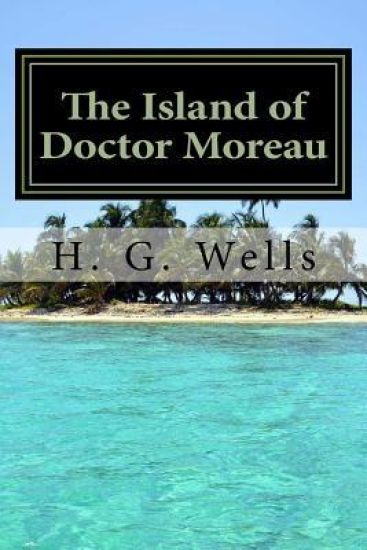
The Island of Doctor Moreau is the account of Edward Prendick, an Englishman with a scientific education who survives a shipwreck in the southern Pacific Ocean. A passing ship takes him aboard, and a man named Montgomery revives him. Prendick also meets a grotesque bestial native named M'ling, who appears to be Montgomery's manservant. The ship is transporting a number of animals which belong to Montgomery. As they approach the island, Montgomery's destination, the captain demands Prendick leave the ship with Montgomery. Montgomery explains that he will not be able to host Prendick on the island. Despite this, the captain leaves Prendick in a dinghy and sails away. Seeing that the captain has abandoned Prendick, Montgomery takes pity and rescues him. As ships rarely pass the island, Prendick will be housed in an outer room of an enclosed compound. The island belongs to Dr. Moreau. Prendick remembers that he has heard of Moreau, formerly an eminent physiologist in London whose gruesome experiments in vivisection had been publicly exposed and has fled England as a result of his exposure. The next day, Moreau begins working on a puma. Prendick gathers that Moreau is performing a painful experiment on the animal, and its anguished cries drive Prendick out into the jungle. While he wanders, he comes upon a group of people who seem human but have an unmistakable resemblance to swine. As he walks back to the enclosure, he suddenly realises he is being followed by a figure in the jungle. He panics and flees, and the figure gives chase. As his pursuer bears down on him, Prendick manages to stun him with a stone and observes the pursuer is a monstrous hybrid of animal and man. When Prendrick returns to the enclosure and questions Montgomery, Montgomery refuses to be open with him. After failing to get an explanation, Prendick finally gives in and takes a sleeping draught.
In The Fourth Year

In The Fourth Year

H. G. Wells

Createspace Independent Publishing Platform
2016
nidottu
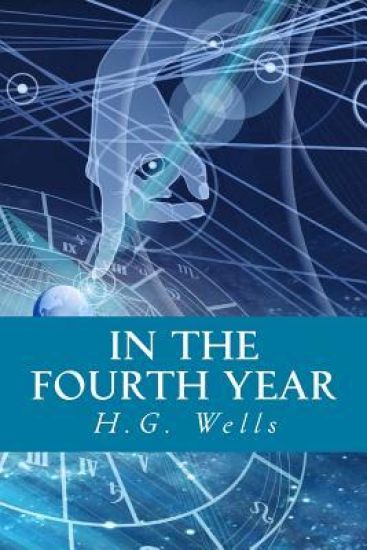
In the Fourth Year is a collection H. G. Wells assembled in the spring of 1918 from essays he had recently published discussing the problem of establishing lasting peace when World War I ended. It is mostly devoted to plans for the League of Nations and the discussion of post-war politics. Wells states in his May 1918 preface that the notion of a War to End War had seemed Utopian when he advanced it in 1914, but that in 1918 it had achieved "an air not only of being so practical, but of being so urgent and necessary and so manifestly the sane thing before mankind that not to be busied upon it, not to be making it more widely known and better understood, not to be working out its problems and bringing it about, is to be living outside of the contemporary life of the world." In the Fourth Year contains eleven chapters on the League of Nations, Allied war aims, and political institutions.
The Wonderful Visit

The Wonderful Visit

H. G. Wells

Createspace Independent Publishing Platform
2016
nidottu
The Wonderful Visit is an 1895 novel by H. G. Wells. With an angel-a creature of fantasy unlike a religious angel-as protagonist and taking place in contemporary England, the book could be classi ed as contemporary fantasy, although the genre was not recognised in Wells's time. The Wonderful Visit also has strong satirical themes, gently mocking customs and institutions of Victorian England as well as idealistic rebellion itself. The Wonderful Visit tells how an angel spends a little more than a week in southern England. He is at rst mistaken for a bird because of his dazzling polychromatic plumage, for he is "neither the Angel of religious feeling nor the Angel of popular belief," but rather "the Angel of Italian art." As a result, he is hunted and shot in the wing by an amateur ornithologist, the Rev. K. Hilyer, the vicar of Siddermoton, and then taken in and cared for at the vicarage. The creature comes from "the Land of Dreams" (also the angel's term for our world), and while "charmingly affable," is "quite ignorant of the most elementary facts of civilisation." During his brief visit he grows increasingly dismayed by what he learns about the world in general and about life in Victorian England in particular. As he grows increasingly critical of local mores, he is eventually denounced as "a Socialist." Each RADLEY CLASSIC is a meticulously restored, luxurious and faithful reproduction of a classic book; produced with elegant text layout, clarity of presentation, and stylistic features that make reading a true pleasure. Special attention is given to legible fonts and adequate letter sizing, correct line length for readability, generous margins and triple lead (lavish line separation); plus we do not allow any mistakes/changes/ additions to creep into the author's words. Visit RADLEY BOOKS at www.radleybooks.com to see more classic book titles in this series.
The Research Magnificent

The Research Magnificent

H. G. Wells

Createspace Independent Publishing Platform
2016
nidottu
The text of this novel of ideas presents itself as a book that has been written as the result of a promise to a dying man. William Porphyry Benham is a man who has lived a life devoted to a complicated, protean idea: "that he had to live life nobly and thoroughly." He has left behind him "half a score of patent les quite distended with papers] and a writing-table drawer-full," and the novel is by implication what his friend White, who has promised to "see after your book," has produced to acquit himself of the promise, since the papers themselves are "an indigestible aggregation." Benham is a man of means due to curious circumstances: his mother left his father, a schoolmaster, for a wealthy man named Nolan who died soon thereafter, but not before leaving "about a third of his very large fortune entirely to Mrs. Benham and the rest to her in trust for her son, whom he deemed himself to have injured." His mother subsequently marries a great London surgeon and becomes Lady Marayne; her indiscretion is forgiven and she enjoys a position of privilege. The bulk of the novel recounts Benham's effort to live nobly, which brings him into con ict with his mother, with his friend Prothero, a schoolboy chum who becomes a Cambridge don, and with his wife, Amanda, a young woman he loves passionately but then leaves behind in England to travel the world (India, Russia, China) in search of wisdom. It is in Johannesburg, South Africa, that Benham is fatally shot while attempting to stop soldiers ring at strikers. Each RADLEY CLASSIC is a meticulously restored, luxurious and faithful reproduction of a classic book; produced with elegant text layout, clarity of presentation, and stylistic features that make reading a true pleasure. Special attention is given to legible fonts and adequate letter sizing, correct line length for readability, generous margins and triple lead (lavish line separation); plus we do not allow any mistakes/changes/ additions to creep into the author's words. Visit RADLEY BOOKS at www.radleybooks.com to see more classic book titles in this series.