Kirjojen hintavertailu – 12 859 819 kirjaa ja 27 kauppaa

Kirjailija

H. G. Wells

Kirjat ja teokset yhdessä paikassa: 1 483 kirjaa, julkaisuja vuosilta 1895–2027, suosituimpiin kuuluu Maailmojen sota. Vertaile teosten hintoja ja tarkista saatavuus suomalaisista kirjakaupoista.

Nimi esiintyy myös muodoissa: H G Wells, H.G. Wells, H.G Wells, H. G Wells

1 483 kirjaa

Kirjojen julkaisuvuodet: 1895–2027.

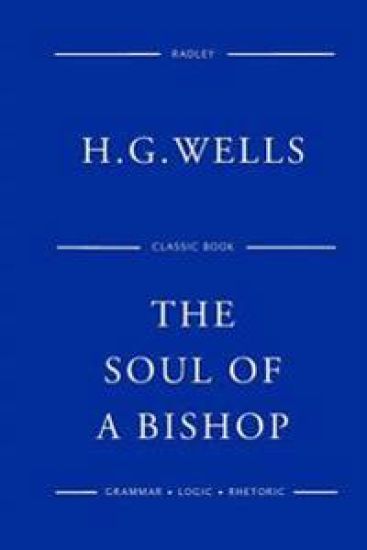
The Soul Of A Bishop

The Soul Of A Bishop

H. G. Wells

Createspace Independent Publishing Platform
2017
nidottu
The Soul of a Bishop tells the story of a spiritual crisis that leads Edward Scrope, Lord Bishop of Princhester, to give up his diocese in England's industrial heartland and leave the Anglican Church. Troubled during World War I by doctrinal doubts and a sense of the irrelevance of his Anglicism as well as nervousness and insomnia, a crisis is precipitated by a visit to a wealthy parishioner's home where he meets an extremely wealthy American widow, Lady Sunderbund. To her he speaks for the first time of his religious discontent. Shortly thereafter he takes a drug that, instead of mitigating his symptoms, gives him "a new and more vivid apprehension of things." The bishop experiences a mystical vision of "the Angel of God" and then God in the North Library of the Athenaeum Club, London. He emerges from the experience convinced that he must leave the Church, but is persuaded by an old mentor, Bishop Likeman, to wait three months before doing anything, during which time he continues in his episcopal duties. The Soul of a Bishop is a novelistic treatment of themes Wells developed in another book published the same year, God the Invisible King. In that volume, which was widely discussed at the time, as in The Soul of a Bishop, Wells rejects the theological doctrine of the Trinity that he attributed to the Council of Nicaea (the novel opens with Scrope dreaming about the Council of Nicaea). This classic title has been published by RADLEY BOOKS. Each RADLEY CLASSIC is a meticulously restored, luxurious and faithful reproduction of a classic book; produced with elegant text layout, clarity of presentation, and stylistic features that make reading a true pleasure. Special attention is given to legible fonts and adequate letter sizing, correct line length for readability, generous margins and triple lead (lavish line separation); plus we do not allow any mistakes/changes/ additions to creep into the author's words. Visit RADLEY BOOKS at www.radleybooks.com (or search RADLEY CLASSIC on Amazon) to see more classic book titles in this series.
The Wheels of Chance: A Bicycling Idyll (1895) NOVEL by: H. G. Wells (Illustrated)

The Wheels of Chance: A Bicycling Idyll (1895) NOVEL by: H. G. Wells (Illustrated)

H. G. Wells

Createspace Independent Publishing Platform
2017
nidottu
a novel first published in 1895; was written at the peak of what has been called the Golden Age of the bicycle-the years of 1890-1905 when practical, comfortable bicycles first became widely and cheaply available, and before the rise of the automobile. Herbert George Wells (21 September 1866 - 13 August 1946)-known as H. G. Wells-was a prolific English writer in many genres, including the novel, history, politics, social commentary, and textbooks and rules for war games. Wells is now best remembered for his science fiction novels and is called a "father of science fiction", along with Jules Verne and Hugo Gernsback. His most notable science fiction works include The Time Machine (1895), The Island of Doctor Moreau (1896), The Invisible Man (1897), and The War of the Worlds (1898). He was nominated for the Nobel Prize in Literature four times.
The Salvaning of civilization

The Salvaning of civilization

H. G. Wells

Createspace Independent Publishing Platform
2017
nidottu
Extract: I THE PROBABLE FUTURE OF MANKIND 1 The present outlook of human affairs is one that admits of broad generalizations and that seems to require broad generalizations. We are in one of those phases of experience which become cardinal in history. A series of immense and tragic events have shattered the self-complacency and challenged the will and intelligence of mankind. That easy general forward movement of human affairs which for several generations had seemed to justify the persuasion of a necessary and invincible progress, progress towards greater powers, greater happiness, and a continual enlargement of life, has been checked violently and perhaps arrested altogether. The spectacular catastrophe of the Great War has revealed an accumulation of destructive forces in our outwardly prosperous society, of which few of us had dreamt; and it has also revealed a profound incapacity to deal with and restrain these forces. The two years of want, confusion, and indecision that have followed the Great War in Europe and Asia, and the uncertainties that have disturbed life even in the comparatively untouched American world, seem to many watchful minds even more ominous to our social order than the war itself. What is happening to our race? they ask. Did the prosperities and confident hopes with which the twentieth century opened, mark nothing more than a culmination of fortuitous good luck? Has the cycle of prosperity and progress closed? To what will this staggering and blundering, the hatreds and mischievous adventures of the present time, bring us? Is the world in the opening of long centuries of confusion and disaster such as ended the Western Roman Empire in Europe or the Han prosperity in China? And if so, will the debacle extend to America? Or is the American (and Pacific?) system still sufficiently removed and still sufficiently autonomous to maintain a progressive movement of its own if the Old World collapse?.......
God the invisible King

God the invisible King

H. G. Wells

Createspace Independent Publishing Platform
2017
nidottu
Argument Wells describes his aim as to state "as forcibly and exactly as possible the religious belief of the writer." He distinguishes his religious beliefs from Christianity, and warns readers that he is "particularly uncompromising" on the doctrine of the Trinity, which he blames on "the violent ultimate crystallization of Nicaea." He pleads for a "modern religion" or "renascent religion" that has "no revelation and no founder." Wells rejects any belief related to God as Nature or the Creator, confining himself to the "finite" God "of the human heart." He devotes a chapter to misconceptions about God that are due to mistaken "mental elaboration" as opposed to "heresies of speculation," and says that the God in which he believes has nothing to do with magic, providence, quietism, punishment, the threatening of children, or sexual ethics. Positively, in a chapter entitled "The Likeness of God," he states his belief that God is courage, a person, youth (i.e. forward- rather than backward-looking), and love. Wells finds in scientific atheists like Metchnikoff beliefs that are equivalent to what he regards as "the fundamental proposition of religious translated into terms of materialistic science, the proposition that damnation is really over-individuation and that salvation is escape from self into the larger being of life." In God the Invisible King, Wells regards belief in God as welling up from within the individual: "if you do not feel God then there is no persuading you of him; we cannot win over the incredulous." The book argues that God seeks "the conquest of death," through a struggle to "transform the world into a theocracy" that he regards as "more and more manifestly the real future of mankind," not through suffering or non-resistance. Sin is seen not as bad conduct but as the product of disharmonies of "the inner being" that "snatch us away from our devotion to God's service" and such weaknesses "cannot damn a man once he has found God."....
The World Set Free

The World Set Free

H. G. Wells

Createspace Independent Publishing Platform
2017
nidottu
The World Set Free is a novel written in 1913 and published in 1914 by H. G. Wells. The book is based on a prediction of nuclear weapons of a more destructive and uncontrollable sort than the world has yet seen. It had appeared first in serialised form with a different ending as A Prophetic Trilogy, consisting of three books: A Trap to Catch the Sun, The Last War in the World and The World Set Free. A frequent theme of Wells's work, as in his 1901 nonfiction book Anticipations, was the history of humans' mastery of power and energy through technological advance, seen as a determinant of human progress. The novel begins: "The history of mankind is the history of the attainment of external power. Man is the tool-using, fire-making animal. . . . Always down a lengthening record, save for a set-back ever and again, he is doing more." (Many of the ideas Wells develops here found a fuller development when he wrote The Outline of History in 1918-1919.) The novel is dedicated "To Frederick Soddy's Interpretation of Radium," a volume published in 1909. Wells's knowledge of atomic physics came from reading William Ramsay, Ernest Rutherford, and Frederick Soddy; the last discovered the disintegration of uranium. Soddy's book Wealth, Virtual Wealth and Debt praises The World Set Free. Wells's novel may even have influenced the development of nuclear weapons, as the physicist Le Szil rd read the book in 1932, the same year the neutron was discovered. In 1933 Szil rd conceived the idea of neutron chain reaction, and filed for patents on it in 1934. Wells's "atomic bombs" have no more force than ordinary high explosive and are rather primitive devices detonated by a "bomb-thrower" biting off "a little celluloid stud." They consist of "lumps of pure Carolinum" that induce "a blazing continual explosion" whose half-life is seventeen days, so that it is "never entirely exhausted," so that "to this day the battle-fields and bomb fields of that frantic time in human history are sprinkled with radiant matter, and so centres of inconvenient rays."
Certain personal matters

Certain personal matters

H. G. Wells

Createspace Independent Publishing Platform
2017
nidottu
Extract: THOUGHTS ON CHEAPNESS AND MY AUNT CHARLOTTE The world mends. In my younger days people believed in mahogany; some of my readers will remember it-a heavy, shining substance, having a singularly close resemblance to raw liver, exceedingly heavy to move, and esteemed on one or other count the noblest of all woods. Such of us as were very poor and had no mahogany pretended to have mahogany; and the proper hepatite tint was got by veneering. That makes one incline to think it was the colour that pleased people. In those days there was a word "trashy," now almost lost to the world. My dear Aunt Charlotte used that epithet when, in her feminine way, she swore at people she did not like. "Trashy" and "paltry" and "Brummagem" was the very worst she could say of them. And she had, I remember, an intense aversion to plated goods and bronze halfpence. The halfpence of her youth had been vast and corpulent red-brown discs, which it was folly to speak of as small change. They were fine handsome coins, and almost as inconvenient as crown-pieces. I remember she corrected me once when I was very young. "Don't call a penny a copper, dear," she said; "copper is a metal. The pennies they have nowadays are bronze." It is odd how our childish impressions cling to us. I still regard bronze as a kind of upstart intruder, a mere trashy pretender among metals. All my Aunt Charlotte's furniture was thoroughly good, and most of it extremely uncomfortable; there was not a thing for a little boy to break and escape damnation in the household. Her china was the only thing with a touch of beauty in it-at least I remember nothing else-and each of her blessed plates was worth the happiness of a mortal for days together. And they dressed me in a Nessus suit of valuable garments. I learned the value of thoroughly good things only too early. I knew the equivalent of a teacup to the very last scowl, and I have hated good, handsome property ever since. For my part I love cheap things, trashy things, things made of the commonest rubbish that money can possibly buy; things as vulgar as primroses, and as transitory as a morning's frost. Think of all the advantages of a cheap possession-cheap and nasty, if you will-compared with some valuable substitute.........
The outline of History, Volume II

The outline of History, Volume II

H. G. Wells

Createspace Independent Publishing Platform
2017
nidottu
The Outline of History, subtitled either "The Whole Story of Man" or "Being a Plain History of Life and Mankind", is a work by H. G. Wells that first appeared in an illustrated version of 24 fortnightly installments beginning on 22 November 1919 and was published as a single volume in 1920. It sold more than two million copies, was translated into many languages, and had a considerable impact on the teaching of history in institutions of higher education. Wells modelled the Outline on the Encyclop die of Denis Diderot. Many revised versions were produced during Wells's lifetime, and the author kept notes on factual corrections he received from around the world. The last revision in his lifetime was published in 1937. Herbert George Wells (21 September 1866 - 13 August 1946)-known as H. G. Wells was a prolific English writer in many genres, including the novel, history, politics, social commentary, and textbooks and rules for war games. Wells is now best remembered for his science fiction novels and is called a "father of science fiction", along with Jules Verne and Hugo Gernsback. His most notable science fiction works include The Time Machine (1895), The Island of Doctor Moreau (1896), The Invisible Man (1897), and The War of the Worlds (1898). He was nominated for the Nobel Prize in Literature four times. Wells's earliest specialised training was in biology, and his thinking on ethical matters took place in a specifically and fundamentally Darwinian context. He was also from an early date an outspoken socialist, often (but not always, as at the beginning of the First World War) sympathising with pacifist views. His later works became increasingly political and didactic, and he wrote little science fiction, while he sometimes indicated on official documents that his profession was that of journalist. Novels like Kipps and The History of Mr Polly, which describe lower-middle-class life, led to the suggestion, when they were published, that he was a worthy successor to Charles Dickens, but Wells described a range of social strata and even attempted, in Tono-Bungay (1909), a diagnosis of English society as a whole. A diabetic, in 1934 Wells co-founded the charity The Diabetic Association (known today as Diabetes UK).
The outline of History, Volume I

The outline of History, Volume I

H. G. Wells

Createspace Independent Publishing Platform
2017
nidottu
The Outline of History, subtitled either "The Whole Story of Man" or "Being a Plain History of Life and Mankind", is a work by H. G. Wells that first appeared in an illustrated version of 24 fortnightly installments beginning on 22 November 1919 and was published as a single volume in 1920. It sold more than two million copies, was translated into many languages, and had a considerable impact on the teaching of history in institutions of higher education. Wells modelled the Outline on the Encyclop die of Denis Diderot. Many revised versions were produced during Wells's lifetime, and the author kept notes on factual corrections he received from around the world. The last revision in his lifetime was published in 1937. Herbert George Wells (21 September 1866 - 13 August 1946)-known as H. G. Wells was a prolific English writer in many genres, including the novel, history, politics, social commentary, and textbooks and rules for war games. Wells is now best remembered for his science fiction novels and is called a "father of science fiction", along with Jules Verne and Hugo Gernsback. His most notable science fiction works include The Time Machine (1895), The Island of Doctor Moreau (1896), The Invisible Man (1897), and The War of the Worlds (1898). He was nominated for the Nobel Prize in Literature four times. Wells's earliest specialised training was in biology, and his thinking on ethical matters took place in a specifically and fundamentally Darwinian context. He was also from an early date an outspoken socialist, often (but not always, as at the beginning of the First World War) sympathising with pacifist views. His later works became increasingly political and didactic, and he wrote little science fiction, while he sometimes indicated on official documents that his profession was that of journalist. Novels like Kipps and The History of Mr Polly, which describe lower-middle-class life, led to the suggestion, when they were published, that he was a worthy successor to Charles Dickens, but Wells described a range of social strata and even attempted, in Tono-Bungay (1909), a diagnosis of English society as a whole. A diabetic, in 1934 Wells co-founded the charity The Diabetic Association (known today as Diabetes UK).
The Soul of a Bishop (1917). By: H. G. Wells, frontispiece By: C. Allan Gilbert (September 3, 1873 - April 20, 1929).: The Soul of a Bishop is a 1917
The Soul of a Bishop is a 1917 novel by H. G. Wells. The Soul of a Bishop tells the story of a spiritual crisis that leads Edward Scrope, Lord Bishop of Princhester, to give up his diocese in England's industrial heartland and leave the Anglican Church. Troubled during World War I by doctrinal doubts and a sense of the irrelevance of his Anglicism as well as nervousness and insomnia, a crisis is precipitated by a visit to a wealthy parishioner's home where he meets an extremely wealthy American widow, Lady Sunderbund. To her he speaks for the first time of his religious discontent. Shortly thereafter he takes a drug that, instead of mitigating his symptoms, gives him "a new and more vivid apprehension of things." The bishop experiences a mystical vision of "the Angel of God" and then God in the North Library of the Athenaeum Club, London. 2] He emerges from the experience convinced that he must leave the Church, but is persuaded by an old mentor, Bishop Likeman, to wait three months before doing anything, during which time he continues in his episcopal duties. Bishop Scrope keeps these developments from his wife, Lady Ella, and his four daughters until Lady Sunderbund arrives unannounced in Princhester, vowing to become his spiritual pupil. The strain of this new situation leads him to take Dr. Dale's drug a second time, and under its influence he has a second vision, this time of the terrestrial globe in a state of spiritual ferment to which the world's clergy is not ministering. Under the influence of this revelation he delivers a heretical confirmation address in the cathedral and resolves thereafter to leave the Church. Lady Sunderbund wishes to devote her riches to helping him found a new church, but in the process of developing plans for it Scrope realizes, in a third vision that this time is not mediated by any drug, that in the new religion he must serve "there must be no idea of any pulpit, of any sustained mission." In a final epiphany, he realizes that his refusal to "trust his family to God" has been holding him back, and that "this distrust has been the flaw in the faith of all religious systems hitherto." Five years after it began, Scrope's spiritual crisis is resolved.... Charles Allan Gilbert (September 3, 1873 - April 20, 1929), better known as C. Allan Gilbert, was a prominent American illustrator. He is especially remembered for a widely published drawing (a memento mori or vanitas) titled All Is Vanity.... Herbert George Wells (21 September 1866 - 13 August 1946)-known as H. G. Wells-was a prolific English writer in many genres, including the novel, history, politics, social commentary, and textbooks and rules for war games. Wells is now best remembered for his science fiction novels and is called a "father of science fiction", along with Jules Verne and Hugo Gernsback. His most notable science fiction works include The Time Machine (1895), The Island of Doctor Moreau (1896), The Invisible Man (1897), and The War of the Worlds (1898). He was nominated for the Nobel Prize in Literature four times.....
The new Machiavelli. By: H. G. Wells: Novel (World's classic's)

The new Machiavelli. By: H. G. Wells: Novel (World's classic's)

H. G. Wells

Createspace Independent Publishing Platform
2017
nidottu
A successful author and Liberal MP with a loving and benevolent wife, Richard Remington appears to be a man to envy. But underneath his superficial contentment, he is far from happy with either his marriage or the politics of his party. The New Machiavelli describes the disarray into which his life is thrown when he meets the young and beautiful Isabel Rivers and becomes tormented by desire.... Herbert George Wells (21 September 1866 - 13 August 1946)-known as H. G. Wells-was a prolific English writer in many genres, including the novel, history, politics, social commentary, and textbooks and rules for war games. Wells is now best remembered for his science fiction novels and is called a "father of science fiction", along with Jules Verne and Hugo Gernsback. His most notable science fiction works include The Time Machine (1895), The Island of Doctor Moreau (1896), The Invisible Man (1897), and The War of the Worlds (1898). He was nominated for the Nobel Prize in Literature four times. Wells's earliest specialised training was in biology, and his thinking on ethical matters took place in a specifically and fundamentally Darwinian context. He was also from an early date an outspoken socialist, often (but not always, as at the beginning of the First World War) sympathising with pacifist views. His later works became increasingly political and didactic, and he wrote little science fiction, while he sometimes indicated on official documents that his profession was that of journalist. Novels like Kipps and The History of Mr Polly, which describe lower-middle-class life, led to the suggestion, when they were published, that he was a worthy successor to Charles Dickens, but Wells described a range of social strata and even attempted, in Tono-Bungay (1909), a diagnosis of English society as a whole. A diabetic, in 1934 Wells co-founded the charity The Diabetic Association (known today as Diabetes UK). Early life Herbert George Wells was born at Atlas House, 46 High Street, Bromley, in Kent, on 21 September 1866. Called "Bertie" in the family, he was the fourth and last child of Joseph Wells (a former domestic gardener, and at the time a shopkeeper and professional cricketer) and his wife, Sarah Neal (a former domestic servant). An inheritance had allowed the family to acquire a shop in which they sold china and sporting goods, although it failed to prosper: the stock was old and worn out, and the location was poor. Joseph Wells managed to earn a meagre income, but little of it came from the shop and he received an unsteady amount of money from playing professional cricket for the Kent county team. Payment for skilled bowlers and batsmen came from voluntary donations afterwards, or from small payments from the clubs where matches were played. A defining incident of young Wells's life was an accident in 1874 that left him bedridden with a broken leg. To pass the time he started reading books from the local library, brought to him by his father. He soon became devoted to the other worlds and lives to which books gave him access; they also stimulated his desire to write. Later that year he entered Thomas Morley's Commercial Academy, a private school founded in 1849 following the bankruptcy of Morley's earlier school. The teaching was erratic, the curriculum mostly focused, Wells later said, on producing copperplate handwriting and doing the sort of sums useful to tradesmen. Wells continued at Morley's Academy until 1880. In 1877, his father, Joseph Wells, fractured his thigh. The accident effectively put an end to Joseph's career as a cricketer, and his subsequent earnings as a shopkeeper were not enough to compensate for the loss of the primary source of family income....
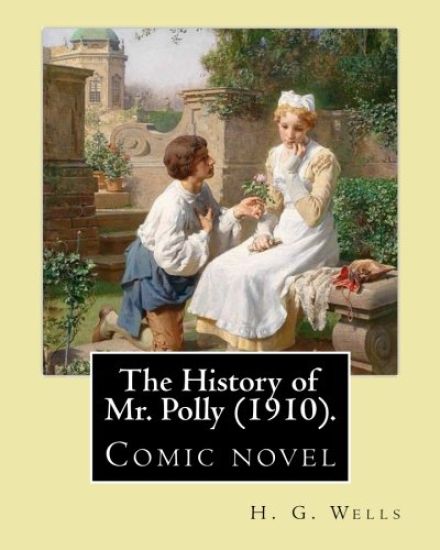
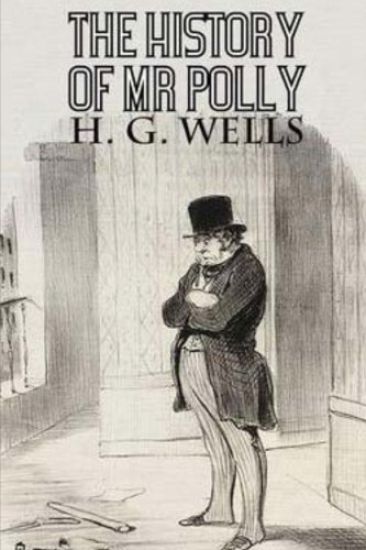
The History of Mr. Polly (1910). By: H. G. Wells: Comic novel

The History of Mr. Polly (1910). By: H. G. Wells: Comic novel

H. G. Wells

Createspace Independent Publishing Platform
2017
nidottu
The History of Mr. Polly is a 1910 comic novel by H. G. Wells. Plot: The protagonist of The History of Mr. Polly is an antihero inspired by H. G. Wells' early experiences in the drapery trade: Alfred Polly, born circa 1870, a timid and directionless young man living in Edwardian England, who despite his own bumbling achieves contented serenity with little help from those around him. Mr. Polly's most striking characteristic is his "innate sense of epithet", which leads him to coin hilarious expressions like "the Shoveacious Cult" for "sunny young men of an abounding and elbowing energy" and "dejected angelosity" for the ornaments of Canterbury Cathedral. Alfred Polly lives in the imaginary town of Fishbourne in Kent(not to be confused with Fishbourne, West Sussex or Fishbourne, Isle of Wight - the town in the story is thought to be based on Sandgate, Kent where Wells lived for several years). The novel begins in medias res by presenting a miserable Mr. Polly: "He hated Foxbourne, he hated Foxbourne High Street, he hated his shop and his wife and his neighbours - every blessed neighbour - and with indescribable bitterness he hated himself". Thereafter the The History of Mr. Polly is divided in three parts. Chapters 1-6 depict his life up to age 20, when he marries his cousin Miriam Larkins and sets up an outfitter's shop in Fishbourne. Second Chapters 7-8 show Mr. Polly's spectacular suicide attempt, which ironically makes him a local hero, wins him insurance money that saves him from bankruptcy, and yields the insight that "Fishbourne wasn't the world", which leads him to abandon his shop and his wife. Chapters 9-10, at the Potwell Inn (apparently located in West Sussex), culminates in Mr. Polly's courageous victory over "Uncle Jim", a malicious relative of the innkeeper's granddaughter. An epilogue then depicts Mr. Polly at ease as assistant-innkeeper, after a brief visit to ascertain Miriam's prosperity.... Herbert George Wells (21 September 1866 - 13 August 1946)-known as H. G. Wells-was a prolific English writer in many genres, including the novel, history, politics, social commentary, and textbooks and rules for war games. Wells is now best remembered for his science fiction novels and is called a "father of science fiction", along with Jules Verne and Hugo Gernsback. His most notable science fiction works include The Time Machine (1895), The Island of Doctor Moreau (1896), The Invisible Man (1897), and The War of the Worlds (1898). He was nominated for the Nobel Prize in Literature four times.....
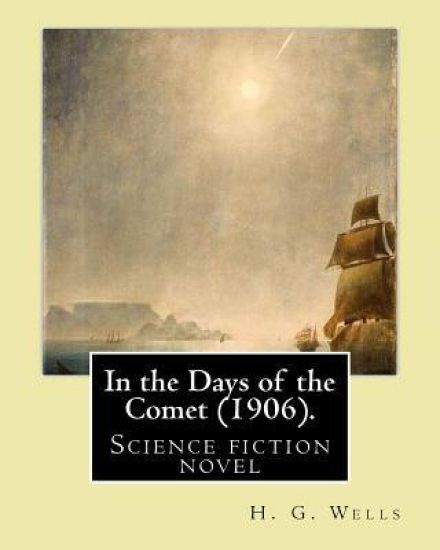
In the Days of the Comet (1906). By: H. G. Wells: In the Days of the Comet (1906) is a science fiction novel by H. G. Wells
In the Days of the Comet (1906) is a science fiction novel by H. G. Wells in which humanity is "exalted" when a comet causes "the nitrogen of the air, the old azote," to "change out of itself" and become "a respirable gas, differing indeed from oxygen, but helping and sustaining its action, a bath of strength and healing for nerve and brain." The result: "The great Change has come for evermore, happiness and beauty are our atmosphere, there is peace on earth and good will to all men." Plot: An unnamed narrator is the author of a prologue ("The Man Who Wrote in the Tower") and an epilogue ("The Window of the Tower"). In these short texts is depicted an encounter with a "happy, active-looking" old man: the protagonist and author of the first-person narrative, writing the story of his life immediately before and after "the Change". This narrative is divided into three "books" Book I: The Comet; Book II: The Green Vapours; and Book III: The New World. Book I, recounts that William ("Willie") Leadford, "third in the office staff of Rawdon's pot-bank a place where pottery is made] in Clayton,"quits his job just as an economic recession caused by American dumping hits industrial Britain, and is unable to find another position. His emotional life is dominated by his attachment to Nettie Stuart, "the daughter of the head gardener of the rich Mr. Verrall's widow", 3] of a village called Checkshill Towers. Converted to socialism by his friend 'Parload', Leadford blames class-based injustice for the squalid living conditions in which he and his mother live. The date of the action is unspecified. When Nettie jilts Leadford for the son and heir of the Verrall family, Leadford buys a revolver, intending to kill them both and himself. As this plot matures, a comet with an "unprecedented band in the green" in its spectroscopy looms gradually larger in the sky, eventually becoming brighter than the Moon. Just as Leadford is about to kill his rivals, the green comet enters the Earth's atmosphere and disintegrates, causing a soporific green fog. Book II opens with Leadford's awakening, in which he is acutely aware of the beauty in the world and his attitude toward others is one of generous fellow-feeling. The same effects occur in every human being, who accordingly re-organize human society. By chance, Leadford falls in with a Cabinet minister and briefly becomes his secretary. Book III begins with an intense discussion by Verrall, Leadford, and Nettie, about their future. Although Nettie wants to establish a m nage trois, Leadford and Verrall reject the idea, and Leadford devotes himself to his mother until her death. Leadford marries Anna, who has been helping care for his mother, and they have a son; but soon thereafter Nettie contacts Leadford. In the epilogue, the 72-year-old Leadford reveals that he, Nettie, Verrall, and Anna were from then on "very close, you understand, we were friends, helpers, personal lovers in a world of lovers". The author is troubled "by my uneasy sense of profound moral differences."... Herbert George Wells (21 September 1866 - 13 August 1946)-known as H. G. Wells-was a prolific English writer in many genres, including the novel, history, politics, social commentary, and textbooks and rules for war games. Wells is now best remembered for his science fiction novels and is called a "father of science fiction", along with Jules Verne and Hugo Gernsback. His most notable science fiction works include The Time Machine (1895), The Island of Doctor Moreau (1896), The Invisible Man (1897), and The War of the Worlds (1898). He was nominated for the Nobel Prize in Literature four times....
The first men in the moon. By: H. G. Wells (illustrated): Scientific romance

The first men in the moon. By: H. G. Wells (illustrated): Scientific romance

H. G. Wells

Createspace Independent Publishing Platform
2017
nidottu
The First Men in the Moon is a scientific romance published in 1901 by the English author H. G. Wells, who called it one of his "fantastic stories". The novel tells the story of a journey to the moon undertaken by the two protagonists, a businessman narrator, Mr. Bedford, and an eccentric scientist, Mr. Cavor. Bedford and Cavor discover that the moon is inhabited by a sophisticated extraterrestrial civilization of insect-like creatures they call "Selenites". The narrator is a London businessman who withdraws to the countryside to write a play, by which he hopes to alleviate his financial problems. Bedford rents a small countryside house in Lympne, in Kent, where he wants to work in peace. He is bothered every afternoon, however, at precisely the same time, by a passer-by making odd noises. After two weeks Bedford accosts the man, who proves to be a reclusive physicist named Mr. Cavor. Bedford befriends Cavor when he learns he is developing a new material, cavorite, which can negate the force of gravity. When a sheet of cavorite is prematurely processed, it makes the air above it weightless and shoots off into space. Bedford sees in the commercial production of cavorite a possible source of "wealth enough to work any sort of social revolution we fancied; we might own and order the whole world". Cavour hits upon the idea of a spherical spaceship made of "steel, lined with glass", and with sliding "windows or blinds" made of cavorite by which it can be steered, and persuades a reluctant Bedford to undertake a voyage to the moon; Cavor is certain there is no life there. On the way to the moon, they experience weightlessness, which Bedford finds "exceedingly restful". On the surface of the moon the two men discover a desolate landscape, but as the sun rises, the thin, frozen atmosphere vaporizes and strange plants begin to grow with extraordinary rapidity. Bedford and Cavor leave the capsule, but in romping about get lost in the rapidly growing jungle. They hear for the first time a mysterious booming coming from beneath their feet. They encounter "great beasts", "monsters of mere fatness", that they dub "mooncalves", and five-foot-high "Selenites" tending them. At first they hide and crawl about, but growing hungry partake of some "monstrous coralline growths" of fungus that inebriate them. They wander drunkenly until they encounter a party of six extraterrestrials, who capture them. The insectoid lunar natives (referred to as "Selenites", after Selene, the moon goddess) are part of a complex and technologically sophisticated society that lives underground, but this is revealed only in radio communications received from Cavor after Bedford's return to earth. Bedford and Cavor break out of captivity beneath the surface of the moon and flee, killing several Selenites. In their flight they discover that gold is common on the moon. In their attempt to find their way back to the surface and to their sphere, they come upon some Selenites carving up mooncalves but fight their way past. Back on the surface, they split up to search for their spaceship. Bedford finds it but returns to Earth without Cavor, who injured himself in a fall and was recaptured by the Selenites, as Bedford learns from a hastily scribbled note he left behind... Herbert George Wells (21 September 1866 - 13 August 1946)-known as H. G. Wells-was a prolific English writer in many genres, including the novel, history, politics, social commentary, and textbooks and rules for war games. Wells is now best remembered for his science fiction novels and is called a "father of science fiction", along with Jules Verne and Hugo Gernsback.
The Island of Doctor Moreau is an 1896 science fiction novel, By: English author, H. G. Wells.: Science fiction
The Island of Doctor Moreau is an 1896 science fiction novel, by English author, H. G. Wells. The text of the novel is the narration of Edward Prendick, a shipwrecked man rescued by a passing boat who is left on the island home of Doctor Moreau, who creates human-like hybrid beings from animals via vivisection.he Island of Doctor Moreau is the account of Edward Prendick, an Englishman with a scientific education who survives a shipwreck in the southern Pacific Ocean. A passing ship takes him aboard, and a man named Montgomery revives him. Prendick also meets a grotesque bestial native named M'ling, who appears to be Montgomery's manservant. The ship is transporting a number of animals which belong to Montgomery. As they approach the island, Montgomery's destination, the captain demands Prendick leave the ship with Montgomery. Montgomery explains that he will not be able to host Prendick on the island. Despite this, the captain leaves Prendick in a dinghy and sails away. Seeing that the captain has abandoned Prendick, Montgomery takes pity and rescues him. As ships rarely pass the island, Prendick will be housed in an outer room of an enclosed compound. The island belongs to Dr. Moreau. Prendick remembers that he has heard of Moreau, formerly an eminent physiologist in London whose gruesome experiments in vivisection had been publicly exposed and has fled England as a result of his exposure. The next day, Moreau begins working on a puma. Prendick gathers that Moreau is performing a painful experiment on the animal, and its anguished cries drive Prendick out into the jungle. While he wanders, he comes upon a group of people who seem human but have an unmistakable resemblance to swine. As he walks back to the enclosure, he suddenly realises he is being followed by a figure in the jungle. He panics and flees, and the figure gives chase. As his pursuer bears down on him, Prendick manages to stun him with a stone and observes the pursuer is a monstrous hybrid of animal and man. When Prendrick returns to the enclosure and questions Montgomery, Montgomery refuses to be open with him. After failing to get an explanation, Prendick finally gives in and takes a sleeping draught. Prendick awakes the next morning with the previous night's activities fresh in his mind. Seeing that the door to Moreau's operating room has been left unlocked, he walks in to find a humanoid form lying in bandages on the table before he is ejected by a shocked and angry Moreau. He believes that Moreau has been vivisecting humans and that he is the next test subject. He flees into the jungle where he meets an Ape-Man who takes him to a colony of similarly half-human/half-animal creatures. Their leader is a large grey thing named the Sayer of the Law who has him recite a strange litany called the Law that involves prohibitions against bestial behavior and praise for Moreau..... Herbert George Wells (21 September 1866 - 13 August 1946)-known as H. G. Wells-was a prolific English writer in many genres, including the novel, history, politics, social commentary, and textbooks and rules for war games. Wells is now best remembered for his science fiction novels and is called a "father of science fiction", along with Jules Verne and Hugo Gernsback. His most notable science fiction works include The Time Machine (1895), The Island of Doctor Moreau (1896), The Invisible Man (1897), and The War of the Worlds (1898). He was nominated for the Nobel Prize in Literature four times. .
The History of Mr. Polly (1910) (comic) NOVEL by: H. G. Wells

The History of Mr. Polly (1910) (comic) NOVEL by: H. G. Wells

H. G. Wells

Createspace Independent Publishing Platform
2017
nidottu
The History of Mr. Polly is a 1910 comic novel by H. G. Wells. The protagonist of The History of Mr. Polly is an antihero inspired by H. G. Wells' early experiences in the drapery trade: Alfred Polly, born circa 1870, a timid and directionless young man living in Edwardian England, who despite his own bumbling achieves contented serenity with little help from those around him. Mr. Polly's most striking characteristic is his "innate sense of epithet", which leads him to coin hilarious expressions like "the Shoveacious Cult" for "sunny young men of an abounding and elbowing energy" and "dejected angelosity" for the ornaments of Canterbury CathedraAlfred Polly lives in the imaginary town of Fishbourne in Kent (not to be confused with Fishbourne, West Sussex or Fishbourne, Isle of Wight - the town in the story is thought to be based on Sandgate, Kent where Wells lived for several years) The novel begins in medias res by presenting a miserable Mr. Polly: "He hated Foxbourne, a] he hated Foxbourne High
War And The Future

War And The Future

H. G. Wells

Createspace Independent Publishing Platform
2017
nidottu
War and the Future (1917) is a work of war propaganda by H. G. Wells that was published in the North America under the title Italy, France, and Britain at War (the subtitle of the British original). Wells would have preferred the title The War of Ideas, but his publisher over-ruled him. Except for the opening piece, its chapters were published as articles in the press. Though proclaiming early in the volume that "I avow myself an extreme Paci st," Wells staunchly supported Britain's war against Germany "in the hope that so we and the world may be freed from the German will-to-power and all its humiliating and disgusting consequences henceforth for ever." Wells was a reluctant propagandist, as he states in the volume's early pages. Government censors attempted to excise his criticism of British military officers, but Wells ignored their excisions. He told his publisher his text had been approved, and told censors that he lost their revised proofs, though in fact he had burned them. Wells sailed for France on 8 Aug 1916. He visited the French front at Soissons, then went to Udine via Venice. He returned to France via Verona and Milan, visiting Arras, Dompierre, Fricourt, and Albert. This classic title has been published by RADLEY BOOKS. Each RADLEY CLASSIC is a meticulously restored, luxurious and faithful reproduction of a classic book; produced with elegant text layout, clarity of presentation, and stylistic features that make reading a true pleasure. Special attention is given to legible fonts and adequate letter sizing, correct line length for readability, generous margins and triple lead (lavish line separation); plus we do not allow any mistakes/changes/ additions to creep into the author's words. Visit RADLEY BOOKS at www.radleybooks.com (or search RADLEY CLASSIC on Amazon) to see more classic book titles in this series.