Kirjojen hintavertailu – 12 859 818 kirjaa ja 27 kauppaa

Kirjailija

Jacques Derrida

Kirjat ja teokset yhdessä paikassa: 172 kirjaa, julkaisuja vuosilta 1982–2027, suosituimpiin kuuluu Given Time II. Vertaile teosten hintoja ja tarkista saatavuus suomalaisista kirjakaupoista.

172 kirjaa

Kirjojen julkaisuvuodet: 1982–2027.

Att läsa Hegel

Att läsa Hegel

Judith Butler; Slavoj Zizek; Fredric Jameson; Susan Buck-Morss; Jacques Derrida; Jurgen Habermas

Tankekraft Förlag
2012
kartonkisidos
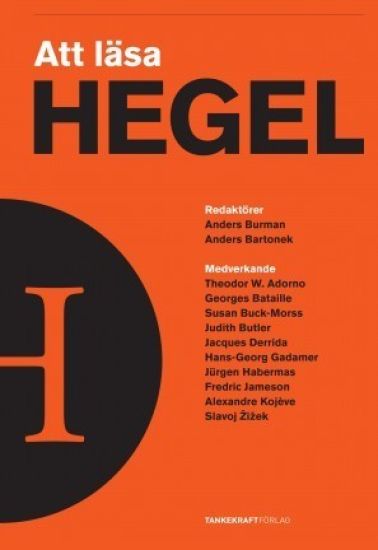
Georg Wilhelm Friedrich Hegel utgör på många sätt portalfiguren för de senaste två århundradenas filosofi och politiska teori. Såväl marxismen som existentialismen, fenomenologin och den kritiska teorin, ja även den moderna analytiska filosofin, uppstod till stor del som reaktioner på hans tänkande och den hegelianism som utvecklades efter hans död. Föreliggande antologi samlar tio tongivande läsningar av Hegel, skrivna av några av den så kallade kontinentalfilosofiska traditionens mest betydelsefulla företrädare. På olika sätt fokuserar samtliga texter på Hegels politiska tänkande. Särskilt uppmärksammas den berömda utläggningen i Andens fenomenologi om begäret, kampen om erkännandet och den dialektiska relationen mellan herren och slaven, men även Hegels idé om det borgerliga samhället och hans syn på staten diskuteras i flera av bidragen. Sammantaget visar texterna att det finns goda skäl att betrakta Hegel som den förste moderne filosofen. Bokens redaktörer, idéhistorikern Anders Burman och filosofen Anders Bartonek, är verksamma vid Södertörns högskola.
The Beast and the Sovereign, Volume I

The Beast and the Sovereign, Volume I

Jacques Derrida

University of Chicago Press
2011
nidottu

Halvin toimitettuna 36,90 €

When he died in 2004, Jacques Derrida left behind a vast legacy of unpublished material, much of it in the form of written lectures. With "The Beast and the Sovereign, Volume I", the University of Chicago Press inaugurated an ambitious series, edited by Geoffrey Bennington and Peggy Kamuf, translating these important works into English. This volume, now in paperback, launched the series with Derrida's exploration of the persistent association of animality with sovereignty. "The Beast and The Sovereign" are connected, he contends, because neither animals nor kings are subject to the law - the sovereign stands above it, while the beast falls outside the law from below. An astonishing array of texts - from La Fontaine's fable "The Wolf and the Lamb" to Machiavelli's "Prince" - come into critical play as Derrida focuses in on questions of force, right, justice, and philosophical interpretations of the limits between man and animal.
Parages

Parages

Jacques Derrida

Stanford University Press
2010
pokkari

Halvin toimitettuna 31,00 €

Parages brings together four essays by Derrida on the fictions of Maurice Blanchot. Three of the essays—"Living On," "Title To Be Specified," and "The Law of Genre," are by now canonical. The fourth, "Pace Not(s)" as well as Derrida's 1986 introduction to the French edition of the book, appear here in English for the first time. This was a breakthrough publication in the analysis of Blanchot, a notoriously difficult writer. It is safe to say Derrida contributed much to that writer's reputation in both French and English, always insisting on the philosophical pertinence of Blanchot's work to any discussion of the relationship between literature and critical thought. Through patient citation, and an ample collocation and readings of Blanchot's various motifs, Derrida explores a variety of questions, including the limits of genre, the procedure of crossing out, and the evocation of a non-dialectical and non-privative negativity. The book marks a crucial stage in Derrida's itinerary and provides a context for his later writings on apophatics in such works as On the Name (SUP, 1995) and his response to Heidegger on death in Aporias (SUP, 1993).
Parages

Parages

Jacques Derrida

Stanford University Press
2010
sidottu
Parages brings together four essays by Derrida on the fictions of Maurice Blanchot. Three of the essays—"Living On," "Title To Be Specified," and "The Law of Genre," are by now canonical. The fourth, "Pace Not(s)" as well as Derrida's 1986 introduction to the French edition of the book, appear here in English for the first time. This was a breakthrough publication in the analysis of Blanchot, a notoriously difficult writer. It is safe to say Derrida contributed much to that writer's reputation in both French and English, always insisting on the philosophical pertinence of Blanchot's work to any discussion of the relationship between literature and critical thought. Through patient citation, and an ample collocation and readings of Blanchot's various motifs, Derrida explores a variety of questions, including the limits of genre, the procedure of crossing out, and the evocation of a non-dialectical and non-privative negativity. The book marks a crucial stage in Derrida's itinerary and provides a context for his later writings on apophatics in such works as On the Name (SUP, 1995) and his response to Heidegger on death in Aporias (SUP, 1993).
Athens, Still Remains

Athens, Still Remains

Jacques Derrida

Fordham University Press
2010
sidottu
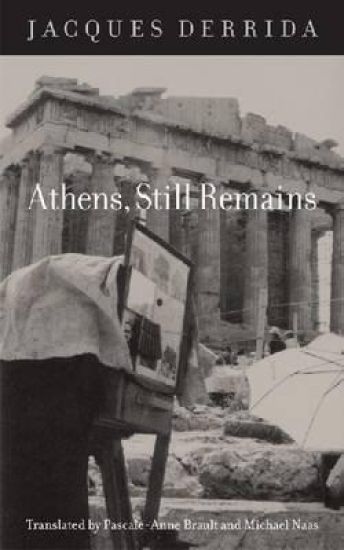
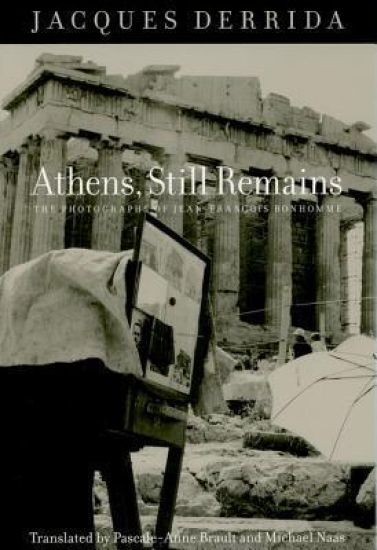
Athens, Still Remains is an extended commentary on a series of photographs of contemporary Athens by the French photographer Jean-François Bonhomme. But in Derrida's hands commentary always has a way of unfolding or, better, developing in several unexpected and mutually illuminating directions. First published in French and Greek in 1996, Athens, Still Remains is Derrida's most sustained analysis of the photographic medium in relationship to the history of philosophy and his most personal reflection on that medium. At once photographic analysis, philosophical essay, and autobiographical narrative, Athens, Still Remains presents an original theory of photography and throws a fascinating light on Derrida's life and work. The book begins with a sort of verbal snapshot or aphorism that haunts the entire book: "we owe ourselves to death." Reading this phrase through Bonhomme's photographs of both the ruins of ancient Athens and contemporary scenes of a still-living Athens that is also on its way to ruin and death, Derrida interrogates a philosophical tradition that runs from Socrates to Heidegger in which the human—and especially the philosopher—is thought to owe himself to death, to a certain thought of death or comportment with regard to death. Combining philosophical speculations on mourning and death, event and repetition, and time and difference with incisive commentary on Bonhomme's photographs and a narrative of Derrida's 1995 trip to Greece, Athens, Still Remains is one of Derrida's most accessible, personal, and moving works without being, for all that, any less philosophical. As Derrida reminds us, the word photography—an eminently Greek word—means "the writing of light," and it brings together today into a single frame contemporary questions about the work of art in the age of mechanical reproduction and much older questions about the relationship between light, revelation, and truth—in other words, an entire philosophical tradition that first came to light in the shadow of the Acropolis.
Athens, Still Remains

Athens, Still Remains

Jacques Derrida

Fordham University Press
2010
pokkari
Athens, Still Remains is an extended commentary on a series of photographs of contemporary Athens by the French photographer Jean-François Bonhomme. But in Derrida's hands commentary always has a way of unfolding or, better, developing in several unexpected and mutually illuminating directions. First published in French and Greek in 1996, Athens, Still Remains is Derrida's most sustained analysis of the photographic medium in relationship to the history of philosophy and his most personal reflection on that medium. At once photographic analysis, philosophical essay, and autobiographical narrative, Athens, Still Remains presents an original theory of photography and throws a fascinating light on Derrida's life and work. The book begins with a sort of verbal snapshot or aphorism that haunts the entire book: "we owe ourselves to death." Reading this phrase through Bonhomme's photographs of both the ruins of ancient Athens and contemporary scenes of a still-living Athens that is also on its way to ruin and death, Derrida interrogates a philosophical tradition that runs from Socrates to Heidegger in which the human—and especially the philosopher—is thought to owe himself to death, to a certain thought of death or comportment with regard to death. Combining philosophical speculations on mourning and death, event and repetition, and time and difference with incisive commentary on Bonhomme's photographs and a narrative of Derrida's 1995 trip to Greece, Athens, Still Remains is one of Derrida's most accessible, personal, and moving works without being, for all that, any less philosophical. As Derrida reminds us, the word photography—an eminently Greek word—means "the writing of light," and it brings together today into a single frame contemporary questions about the work of art in the age of mechanical reproduction and much older questions about the relationship between light, revelation, and truth—in other words, an entire philosophical tradition that first came to light in the shadow of the Acropolis.
Voice and Phenomenon

Voice and Phenomenon

Jacques Derrida

Northwestern University Press
2010
nidottu
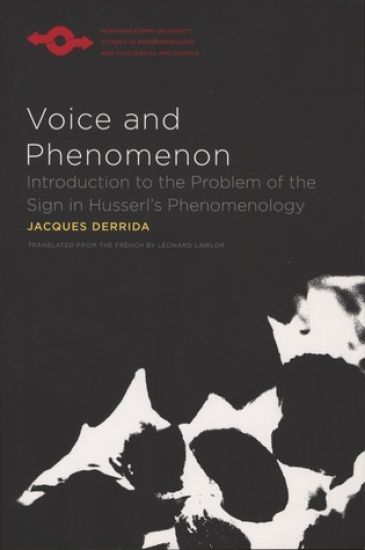
Published in 1967, when Derrida is 37 years old, Voice and Phenomenon appears at the same moment as Of Grammatology and Writing and Difference. All three books announce the new philosophical project called “deconstruction.” Although Derrida will later regret the fate of the term “deconstruction,” he will use it throughout his career to define his own thinking. While Writing and Difference collects essays written over a 10 year period on diverse figures and topics, and Of Grammatology aims its deconstruction at “the age of Rousseau,” Voice and Phenomenon shows deconstruction engaged with the most important philosophical movement of the last hundred years: phenomenology. Only in relation to phenomenology is it possible to measure the importance of deconstruction. Only in relation to Husserl’s philosophy is it possible to understand the novelty of Derrida’s thinking. Voice and Phenomenon therefore may be the best introduction to Derrida’s thought in general. To adapt Derrida’s comment on Husserl’s Logical Investigations, it contains “the germinal structure” of Derrida’s entire thought. Lawlor’s fresh translation of Voice and Phenomenon brings new life to Derrida’s most seminal work.
Copy, Archive, Signature

Copy, Archive, Signature

Jacques Derrida

Stanford University Press
2010
pokkari
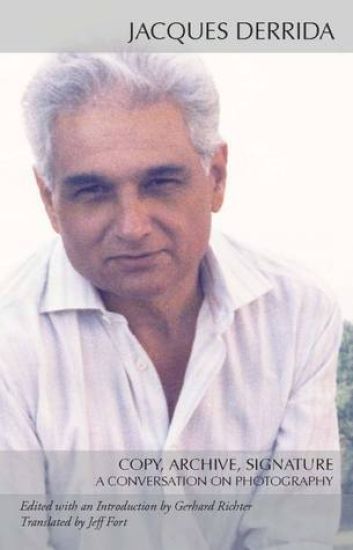
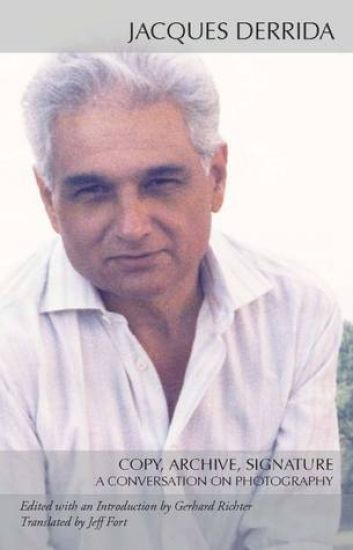
This book makes available for the first time in English—and for the first time in its entirety in any language—an important yet little-known interview on the topic of photography that Jacques Derrida granted in 1992 to the German theorist of photography Hubertus von Amelunxen and the German literary and media theorist Michael Wetzel. Their conversation addresses, among other things, questions of presence and its manufacture, the technicity of presentation, the volatility of the authorial subject, and the concept of memory. Derrida offers a penetrating intervention with regard to the distinctive nature of photography vis-à-vis related technologies such as cinema, television, and video. Questioning the all-too-facile divides between so-called old and new media, original and reproduction, analog and digital modes of recording and presenting, he provides stimulating insights into the ways in which we think and speak about the photographic image today. Along the way, the discussion fruitfully interrogates the question of photography in relation to such key concepts as copy, archive, and signature. Gerhard Richter introduces the volume with a critical meditation on the relationship between deconstruction and photography by way of the concepts of translation and invention. Copy, Archive, Signature will be of compelling interest to readers in the fields of contemporary European critical thought, photography, aesthetic theory, media studies, and French Studies, as well as those following the singular intellectual trajectory of one the most influential thinkers of our time.
Copy, Archive, Signature

Copy, Archive, Signature

Jacques Derrida

Stanford University Press
2010
sidottu
This book makes available for the first time in English—and for the first time in its entirety in any language—an important yet little-known interview on the topic of photography that Jacques Derrida granted in 1992 to the German theorist of photography Hubertus von Amelunxen and the German literary and media theorist Michael Wetzel. Their conversation addresses, among other things, questions of presence and its manufacture, the technicity of presentation, the volatility of the authorial subject, and the concept of memory. Derrida offers a penetrating intervention with regard to the distinctive nature of photography vis-à-vis related technologies such as cinema, television, and video. Questioning the all-too-facile divides between so-called old and new media, original and reproduction, analog and digital modes of recording and presenting, he provides stimulating insights into the ways in which we think and speak about the photographic image today. Along the way, the discussion fruitfully interrogates the question of photography in relation to such key concepts as copy, archive, and signature. Gerhard Richter introduces the volume with a critical meditation on the relationship between deconstruction and photography by way of the concepts of translation and invention. Copy, Archive, Signature will be of compelling interest to readers in the fields of contemporary European critical thought, photography, aesthetic theory, media studies, and French Studies, as well as those following the singular intellectual trajectory of one the most influential thinkers of our time.
The Beast and the Sovereign, Volume I

The Beast and the Sovereign, Volume I

Jacques Derrida

University of Chicago Press
2009
sidottu
When he died in 2004, Jacques Derrida left behind a vast legacy of unpublished material, much of it in the form of written lectures. With "The Beast and the Sovereign, Volume I", the University of Chicago Press inaugurated an ambitious series, edited by Geoffrey Bennington and Peggy Kamuf, translating these important works into English. This volume, now in paperback, launched the series with Derrida's exploration of the persistent association of animality with sovereignty. "The Beast and The Sovereign" are connected, he contends, because neither animals nor kings are subject to the law - the sovereign stands above it, while the beast falls outside the law from below. An astonishing array of texts - from La Fontaine's fable "The Wolf and the Lamb" to Machiavelli's "Prince" - come into critical play as Derrida focuses in on questions of force, right, justice, and philosophical interpretations of the limits between man and animal.
Geneses, Genealogies, Genres, and Genius

Geneses, Genealogies, Genres, and Genius

Jacques Derrida

Columbia University Press
2008
pokkari
Jacques Derrida argues that the feminist and intellectual Helene Cixous is the most important writer working within the French idiom today. To prove this, he elucidates the epistemological and historical interconnectedness of four terms: genesis, genealogy, genre, and genius, and how they pertain to or are implicated in Cixous's work. Derrida explores Cixous's genius (a masculine term in French, he is quick to point out) and the inspiration that guides and informs her writing. He marvels at her skillful working within multiple genres. He focuses on a number of her works, including her extraordinary novel Manhattan and her lyrical and evocative Dream I Tell You, a book addressed to Derrida himself and one in which Cixous presents a series of her dreams. Derrida also delves into the nature of the literary archive, the production of literature, and the importance of the poetic and sexual difference to the entirety of his own work. For forty years, Derrida had a close personal and intellectual relationship with Helene Cixous. Clever, playful, and eloquent, Geneses, Genealogies, Genres, and Genius charts the influence these two critical giants had on each other and is the most vital work to address Cixous's contribution to French thought.
The Animal That Therefore I Am

The Animal That Therefore I Am

Jacques Derrida

Fordham University Press
2008
pokkari

Halvin toimitettuna 35,80 €

The Animal That Therefore I Am is the long-awaited translation of the complete text of Jacques Derrida's ten-hour address to the 1997 Cérisy conference entitled "The Autobiographical Animal," the third of four such colloquia on his work. The book was assembled posthumously on the basis of two published sections, one written and recorded session, and one informal recorded session. The book is at once an affectionate look back over the multiple roles played by animals in Derrida's work and a profound philosophical investigation and critique of the relegation of animal life that takes place as a result of the distinction—dating from Descartes—between man as thinking animal and every other living species. That starts with the very fact of the line of separation drawn between the human and the millions of other species that are reduced to a single "the animal." Derrida finds that distinction, or versions of it, surfacing in thinkers as far apart as Descartes, Kant, Heidegger, Lacan, and Levinas, and he dedicates extended analyses to the question in the work of each of them. The book's autobiographical theme intersects with its philosophical analysis through the figures of looking and nakedness, staged in terms of Derrida's experience when his cat follows him into the bathroom in the morning. In a classic deconstructive reversal, Derrida asks what this animal sees and thinks when it sees this naked man. Yet the experiences of nakedness and shame also lead all the way back into the mythologies of "man's dominion over the beasts" and trace a history of how man has systematically displaced onto the animal his own failings or bêtises. The Animal That Therefore I Am is at times a militant plea and indictment regarding, especially, the modern industrialized treatment of animals. However, Derrida cannot subscribe to a simplistic version of animal rights that fails to follow through, in all its implications, the questions and definitions of "life" to which he returned in much of his later work.
The Animal That Therefore I Am

The Animal That Therefore I Am

Jacques Derrida

Fordham University Press
2008
sidottu
The Animal That Therefore I Am is the long-awaited translation of the complete text of Jacques Derrida's ten-hour address to the 1997 Cérisy conference entitled "The Autobiographical Animal," the third of four such colloquia on his work. The book was assembled posthumously on the basis of two published sections, one written and recorded session, and one informal recorded session. The book is at once an affectionate look back over the multiple roles played by animals in Derrida's work and a profound philosophical investigation and critique of the relegation of animal life that takes place as a result of the distinction—dating from Descartes—between man as thinking animal and every other living species. That starts with the very fact of the line of separation drawn between the human and the millions of other species that are reduced to a single "the animal." Derrida finds that distinction, or versions of it, surfacing in thinkers as far apart as Descartes, Kant, Heidegger, Lacan, and Levinas, and he dedicates extended analyses to the question in the work of each of them. The book's autobiographical theme intersects with its philosophical analysis through the figures of looking and nakedness, staged in terms of Derrida's experience when his cat follows him into the bathroom in the morning. In a classic deconstructive reversal, Derrida asks what this animal sees and thinks when it sees this naked man. Yet the experiences of nakedness and shame also lead all the way back into the mythologies of "man's dominion over the beasts" and trace a history of how man has systematically displaced onto the animal his own failings or bêtises. The Animal That Therefore I Am is at times a militant plea and indictment regarding, especially, the modern industrialized treatment of animals. However, Derrida cannot subscribe to a simplistic version of animal rights that fails to follow through, in all its implications, the questions and definitions of "life" to which he returned in much of his later work.
Psyche

Psyche

Jacques Derrida

Stanford University Press
2008
pokkari
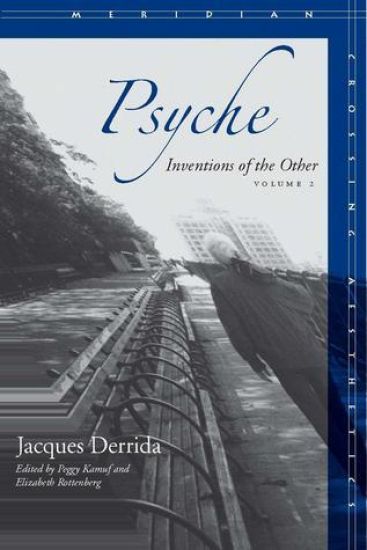
Psyche: Inventions of the Other is the first publication in English of the twenty-eight essay collection Jacques Derrida published in two volumes in 1998 and 2003. Advancing his reflection on many issues, such as sexual difference, architecture, negative theology, politics, war, nationalism, and religion, Volume II also carries on Derrida's engagement with a number of key thinkers and writers: De Certeau, Heidegger, Kant, Lacoue-Labarthe, Mandela, Rosenszweig, and Shakespeare, among others. Included in this volume are new or revised translations of seminal essays (for example, "Geschlecht I: Sexual Difference, Ontological Difference," "Geschlecht II: Heidegger's Hand," "How to Avoid Speaking: Denials," and "Interpretations at War: Kant, the Jew, the German").
Psyche

Psyche

Jacques Derrida

Stanford University Press
2008
sidottu
Psyche: Inventions of the Other is the first publication in English of the twenty-eight essay collection Jacques Derrida published in two volumes in 1998 and 2003. Advancing his reflection on many issues, such as sexual difference, architecture, negative theology, politics, war, nationalism, and religion, Volume II also carries on Derrida's engagement with a number of key thinkers and writers: De Certeau, Heidegger, Kant, Lacoue-Labarthe, Mandela, Rosenszweig, and Shakespeare, among others. Included in this volume are new or revised translations of seminal essays (for example, "Geschlecht I: Sexual Difference, Ontological Difference," "Geschlecht II: Heidegger's Hand," "How to Avoid Speaking: Denials," and "Interpretations at War: Kant, the Jew, the German").
Marx' spøkelser

Marx' spøkelser

Jacques Derrida

Pax
2007
nidottu
I denne boka blir rettferdighetsproblematikken satt sammen med spørsmålet om hvorvidt marxismen fremdeles er en levende samfunnsteori etter kommunismens sammenbrudd. Med utgangspunkt i to berømte spøkelser - det ene hentet fra Shakespeares Hamlet, det andre fra Det kommunistiske manifest - gir den franske filosofen en tolkning av kommunismens gjengangere.
Psyche

Psyche

Jacques Derrida

Stanford University Press
2007
sidottu
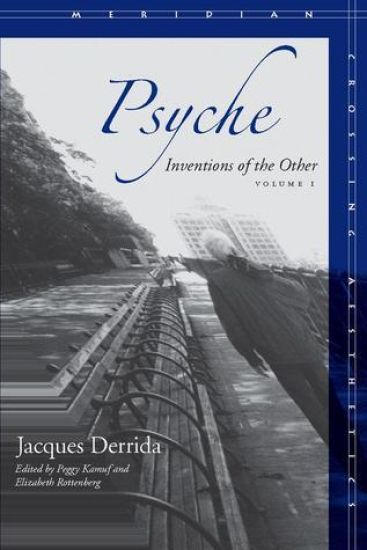
Psyche: Inventions of the Other is the first publication in English of the twenty-eight essay collection Jacques Derrida published in two volumes in 1998 and 2003. In Volume I, Derrida advances his reflection on many topics: psychoanalysis, theater, translation, literature, representation, racism, and nuclear war, among others. The essays in this volume also carry on Derrida's engagement with a number of key thinkers and writers: Barthes, Benjamin, de Man, Flaubert, Freud, Heidegger, Lacoue-Labarthe, Levinas, and Ponge. Included in this volume are new or revised translations of seminal essays (for example, "Psyche: Invention of the Other," "The Retrait of Metaphor," "At This Very Moment in This Work Here I Am," "Tours de Babel" and "Racism's Last Word"), as well as three essays that appear here in English for the first time.
1...34567...9