Kirjojen hintavertailu – 12 859 818 kirjaa ja 27 kauppaa

Kirjailija

Jacques Derrida

Kirjat ja teokset yhdessä paikassa: 172 kirjaa, julkaisuja vuosilta 1982–2027, suosituimpiin kuuluu Given Time II. Vertaile teosten hintoja ja tarkista saatavuus suomalaisista kirjakaupoista.

172 kirjaa

Kirjojen julkaisuvuodet: 1982–2027.

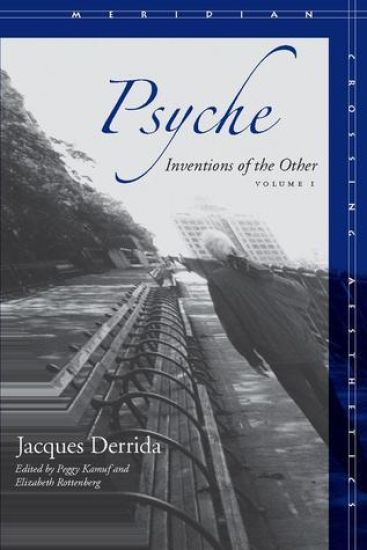
Psyche

Psyche

Jacques Derrida

Stanford University Press
2007
pokkari
Psyche: Inventions of the Other is the first publication in English of the twenty-eight essay collection Jacques Derrida published in two volumes in 1998 and 2003. In Volume I, Derrida advances his reflection on many topics: psychoanalysis, theater, translation, literature, representation, racism, and nuclear war, among others. The essays in this volume also carry on Derrida's engagement with a number of key thinkers and writers: Barthes, Benjamin, de Man, Flaubert, Freud, Heidegger, Lacoue-Labarthe, Levinas, and Ponge. Included in this volume are new or revised translations of seminal essays (for example, "Psyche: Invention of the Other," "The Retrait of Metaphor," "At This Very Moment in This Work Here I Am," "Tours de Babel" and "Racism's Last Word"), as well as three essays that appear here in English for the first time.
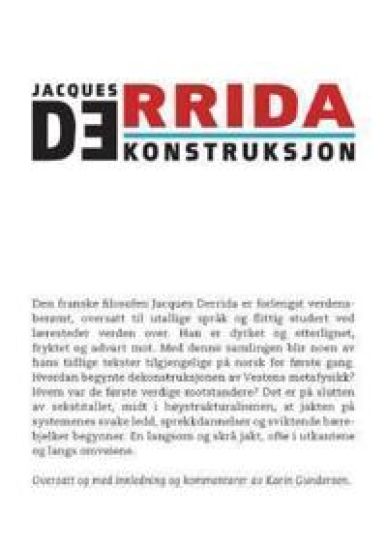
Sannheten i maleriet

Sannheten i maleriet

Jacques Derrida

Pax
2007
nidottu
Filosofen Derrida har flere steder skrevet om kunst og kunsterfaring. I denne boken tar han for seg Heideggers Kunstens opprinnelse, den første utgivelsen i ARTES-serien, og ulike tolkninger av denne teksten. Ikke minst får den radikale, amerikanske kunsthistorikeren Meyer Shapiro sitt pass påskrevet i friske og frekke vendinger. Men også bondelivsdyrkeren Hamsun (som Heidegger var opptatt av, og siterte) opptrer i den lekne analysen. Derrida lager en dekonstruktiv nærlesning av Heidegger, og kritiserer Schapiro for å ha feillest hovedmotivet, dvs. van Goghs såkalte bondesko. For hvis sko er det egentlig? Er de .bare. noen tilfeldige sko, eller noen helt bestemte sko! Er de van Goghs egne, eller selve den undertrykte bondeklassens sko? Og hvilket av van Goghs mange malerier av slitte sko med løse lisser dreier Heideggers tekst seg egentlig om? Derridas dialog om Heideggers tekst blir slik både et eksempel på en kunsthistorisk diskurs og på dekonstruksjonen som filosofisk og litterær metode. Her handler det altså om hva vi ser når vi ser et bilde, og om hvilken tenkning som styrer tolkningen. Det valgte essayet er det avsluttende kapitlet i La vérité en peinture (1978). Tittelen er et sitat fra Cézanne. Utgis med et etterord av filosof Espen Hammer
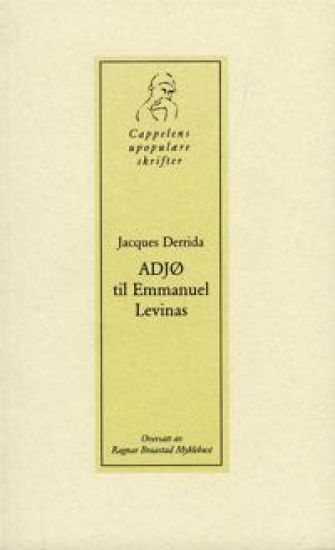
Adjø til Emmanuel Levinas

Adjø til Emmanuel Levinas

Jacques Derrida

Cappelen Damm akademisk
2007
nidottu
Jacques Derrida reflekterer her over hva uttrykket àdieu betyr for menneskene - både som en fundamental gestus mellom mennesker og som et uttrykk for menneskets stilling overfor Gud, a-dieu. Gjennom en nylesning av Levinas' Totalitet og uendelighet stiller han på en ny og innsiktsfull måte spørsmålet om hva en etikk og en politikk basert på gjestfrihet og imøtekommenhet overfor den andre vil innebære. Boken inneholder talen Derrida holdt ved Levinas begravelse 27. desember 1995 og et essay laget til ettårsmarkeringen av hans død. Nr. 39 i Cappelens upopulære skrifter.
Geneses, Genealogies, Genres, and Genius

Geneses, Genealogies, Genres, and Genius

Jacques Derrida

Columbia University Press
2006
sidottu
Jacques Derrida argues that the feminist and intellectual Helene Cixous is the most important writer working within the French idiom today. To prove this, he elucidates the epistemological and historical interconnectedness of four terms: genesis, genealogy, genre, and genius, and how they pertain to or are implicated in Cixous's work. Derrida explores Cixous's genius (a masculine term in French, he is quick to point out) and the inspiration that guides and informs her writing. He marvels at her skillful working within multiple genres. He focuses on a number of her works, including her extraordinary novel Manhattan and her lyrical and evocative Dream I Tell You, a book addressed to Derrida himself and one in which Cixous presents a series of her dreams. Derrida also delves into the nature of the literary archive, the production of literature, and the importance of the poetic and sexual difference to the entirety of his own work. For forty years, Derrida had a close personal and intellectual relationship with Helene Cixous. Clever, playful, and eloquent, Geneses, Genealogies, Genres, and Genius charts the influence these two critical giants had on each other and is the most vital work to address Cixous's contribution to French thought.
Geneses, Genealogies, Genres and Genius

Geneses, Genealogies, Genres and Genius

Jacques Derrida

Edinburgh University Press
2006
sidottu
He insists on my dreams, on my letters, on my Hs on my Cs, on my Js, on my Gs. G, G, G, G, jet ! A" You are my insister A" he says. A" You are my insister A" I say. No one has performed more learned yet more innocent pirouettes around words, letters, no one has ever managed to get French more joyously drunk, giving philosophy the full measure of its greatness once and for all, its tragic, its comic spell. [I never read him without being appalled at my urge to laugh with enchantment.]' Helene Cixous ORIGINAL TEXT BY DERRIDA TRANSLATED INTO ENGLISH FOR THE FIRST TIME In this book Derrida responds to the work Dream I Tell You by Helene Cixous, using it to explore the nature of the literary archive, the production of literature and Cixous' genius. These texts allow the reader to puzzle the genealogy of deconstruction and to consider the importance of the poetic and sexual difference to the entirety of Derrida's work. They also demonstrate that, as Derrida admits, he has always been a devotee of Cixous. Key Features: *The single most important work to address Helene Cixous' contribution to French thought. *Charts the influence of Cixous and Derrida on each other.
H. C. for Life, That Is to Say...

H. C. for Life, That Is to Say...

Jacques Derrida

Stanford University Press
2006
pokkari
H. C. for Life, That Is to Say . . . is Derrida's literary critical recollection of his lifelong friendship with Hélène Cixous. The main figure that informs Derrida's reading here is that of "taking sides." While Hélène Cixous in her life and work takes the side of life, "for life," Derrida admits always feeling drawn to the side of death. Rather than being an obvious choice, taking the side of life is an act of faith, by wagering one's life on life. H. C. for Life sets up and explores this interminable "argument" between Derrida and Cixous as to what death has in store deep within life itself, before the end. In addition to being a memoir, it is also a theoretical confrontation—for example about the meaning of "might" and "omnipotence," and a philosophical and philological analysis of the crypts within the vast oeuvre of Hélène Cixous. Finally, the book is Derrida's tribute to the thought of the woman whom he regards as one of the great French poets, writers, and thinkers of our time.
Specters of Marx

Specters of Marx

Jacques Derrida

Routledge
2006
nidottu
Prodigiously influential, Jacques Derrida gave rise to a comprehensive rethinking of the basic concepts and categories of Western philosophy in the latter part of the twentieth century, with writings central to our understanding of language, meaning, identity, ethics and values. In 1993, a conference was organized around the question, 'Whither Marxism?’, and Derrida was invited to open the proceedings. His plenary address, 'Specters of Marx', delivered in two parts, forms the basis of this book. Hotly debated when it was first published, a rapidly changing world and world politics have scarcely dented the relevance of this book.
Sovereignties in Question

Sovereignties in Question

Jacques Derrida

Fordham University Press
2005
pokkari
Contents • Shibboleth: For Paul Celan • "A Self-Unsealing Poetic Text": Poetics and Politics of Witnessing • Language Does Not Belong: An Interview • The Majesty of the Present: Reading Celan's "The Meridian" • Rams: Uninterrupted Dialogue—between Two Infinities, the Poem This book brings together five powerful encounters. Themes central to all of Derrida's writings thread the intense confrontation between the most famous philosopher of our time and the Jewish poet writing in German who, perhaps more powerfully than any other, has testified to the European experience of the twentieth century. They include the date or signature and its singularity; the notion of the trace; temporal structures of futurity and the "to come"; the multiplicity of language and questions of translation; such speech acts as testimony and promising, but also lying and perjury; the possibility of the impossible; and, above all, the question of the poem as addressed and destined beyond knowledge, seeking to speak to and for the irreducibly other. The memory of encounters with thinkers who have also engaged Celan's work animates these writings, which include a brilliant dialogue between two interpretative modes—hermeneutics and deconstruction. Derrida's approach to a poem is a revelation on many levels, from the most concrete ways of reading —for example, his analysis of a sequence of personal pronouns—to the most sweeping imperatives of human existence (and Derrida's writings are always a study in the imbrication of such levels). Above all, he voices the call to responsibility in the ultimate line of Celan's poem: "The world is gone, I must carry you," which sounds throughout the book's final essay like a refrain. Only two of the texts in this volume do not appear here in English for the first time. Of these, Schibboleth has been entirely retranslated and has been set following Derrida's own instructions for publication in French; "A Self-Unsealing Poetic Text" was substantially rewritten by Derrida himself and basically appears here as the translation of a new text. Jacques Derrida's most recent books in English translation include Counterpath: Traveling with Jacques Derrida (with Catherine Malabou). He died in Paris on October 8, 2004. Thomas Dutoit teaches at the Université de Paris 7. He translated Aporias and edited On the Name, both by Jacques Derrida.
Sovereignties in Question

Sovereignties in Question

Jacques Derrida

Fordham University Press
2005
sidottu
Contents • Shibboleth: For Paul Celan • “A Self-Unsealing Poetic Text”: Poetics and Politics of Witnessing • Language Does Not Belong: An Interview • The Majesty of the Present: Reading Celan’s “The Meridian” • Rams: Uninterrupted Dialogue—between Two Infinities, the Poem This book brings together five powerful encounters. Themes central to all of Derrida’s writings thread the intense confrontation between the most famous philosopher of our time and the Jewish poet writing in German who, perhaps more powerfully than any other, has testified to the European experience of the twentieth century. They include the date or signature and its singularity; the notion of the trace; temporal structures of futurity and the “to come”; the multiplicity of language and questions of translation; such speech acts as testimony and promising, but also lying and perjury; the possibility of the impossible; and, above all, the question of the poem as addressed and destined beyond knowledge, seeking to speak to and for the irreducibly other. The memory of encounters with thinkers who have also engaged Celan’s work animates these writings, which include a brilliant dialogue between two interpretative modes—hermeneutics and deconstruction. Derrida’s approach to a poem is a revelation on many levels, from the most concrete ways of reading —for example, his analysis of a sequence of personal pronouns—to the most sweeping imperatives of human existence (and Derrida’s writings are always a study in the imbrication of such levels). Above all, he voices the call to responsibility in the ultimate line of Celan’s poem: “The world is gone, I must carry you,” which sounds throughout the book’s final essay like a refrain. Only two of the texts in this volume do not appear here in English for the first time. Of these, Schibboleth has been entirely retranslated and has been set following Derrida's own instructions for publication in French; "A Self-Unsealing Poetic Text" was substantially rewritten by Derrida himself and basically appears here as the translation of a new text. Jacques Derrida’s most recent books in English translation include Counterpath: Traveling with Jacques Derrida (with Catherine Malabou). He died in Paris on October 8, 2004. Thomas Dutoit teaches at the Université de Paris 7. He translated Aporias and edited On the Name, both by Jacques Derrida.
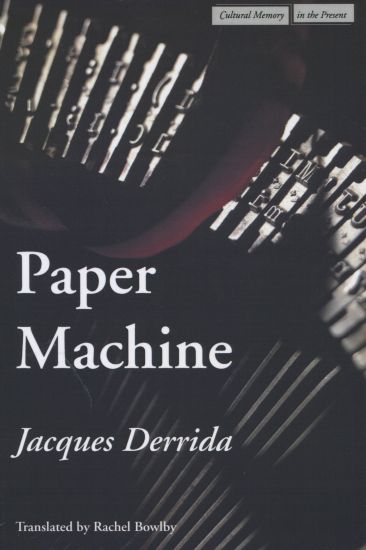
Paper Machine

Paper Machine

Jacques Derrida

Stanford University Press
2005
pokkari
This book questions the book itself, archivization, machines for writing, and the mechanicity inherent in language, the media, and intellectuals. Derrida questions what takes place between the paper and the machine inscribing it. He examines what becomes of the archive when the world of paper is subsumed in new machines for virtualization, and whether there can be a virtual event or a virtual archive. Derrida continues his long-standing investigation of these issues, and ties them into the new themes that governed his teaching and thinking in the past few years: the secret, pardon, perjury, state sovereignty, hospitality, the university, animal rights, capital punishment, the question of what sort of mediatized world is replacing the print epoch, and the question of the "wholly other." Derrida is remarkable at making seemingly occasional pieces into part of a complexly interconnected trajectory of thought.
Paper Machine

Paper Machine

Jacques Derrida

Stanford University Press
2005
sidottu
This book questions the book itself, archivization, machines for writing, and the mechanicity inherent in language, the media, and intellectuals. Derrida questions what takes place between the paper and the machine inscribing it. He examines what becomes of the archive when the world of paper is subsumed in new machines for virtualization, and whether there can be a virtual event or a virtual archive. Derrida continues his long-standing investigation of these issues, and ties them into the new themes that governed his teaching and thinking in the past few years: the secret, pardon, perjury, state sovereignty, hospitality, the university, animal rights, capital punishment, the question of what sort of mediatized world is replacing the print epoch, and the question of the "wholly other." Derrida is remarkable at making seemingly occasional pieces into part of a complexly interconnected trajectory of thought.
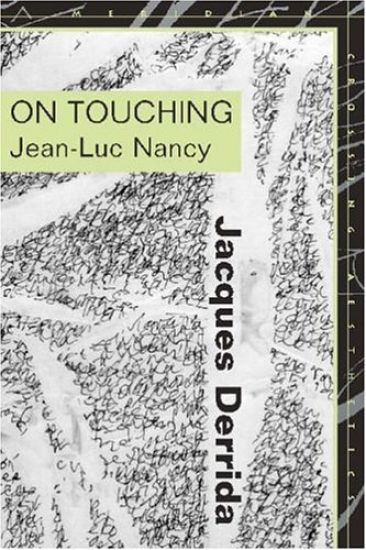
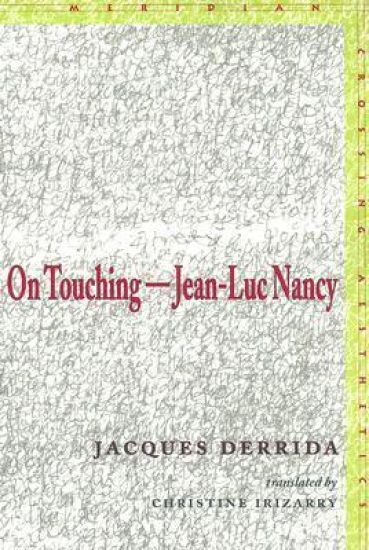
On Touching—Jean-Luc Nancy

On Touching—Jean-Luc Nancy

Jacques Derrida

Stanford University Press
2005
sidottu
Using the philosophy of Jean-Luc Nancy as an anchoring point, Jacques Derrida in this book conducts a profound review of the philosophy of the sense of touch, from Plato and Aristotle to Jean-Luc Nancy, whose ground-breaking book Corpus he discusses in detail. Emmanuel Levinas, Maurice Merleau-Ponty, Edmund Husserl, Didier Franck, Martin Heidegger, Francoise Dastur, and Jean-Louis Chrétien are discussed, as are René Descartes, Diderot, Maine de Biran, Félix Ravaisson, Immanuel Kant, Sigmund Freud, and others. The scope of Derrida's deliberations makes this book a virtual encyclopedia of the philosophy of touch (and the body). Derrida gives special consideration to the thinking of touch in Christianity and, in discussing Jean-Luc Nancy's essay "Deconstruction of Christianity," devotes a section of the book to the sense of touch in the Gospels. Another section concentrates on "the flesh," as treated by Merleau-Ponty and others in his wake. Derrida's critique of intuitionism, notably in the phenomenological tradition, is one of the guiding threads of the book. On Touching includes a wealth of notes that provide an extremely useful bibliographical resource. Personal and detached all at once, this book, one of the first published in English translation after Jacques Derrida's death, serves as a useful and poignant retrospective on the work of the philosopher. A tribute by Jean-Luc Nancy, written a day after Jacques Derrida's death, is an added feature.
On Touching—Jean-Luc Nancy

On Touching—Jean-Luc Nancy

Jacques Derrida

Stanford University Press
2005
pokkari

Halvin toimitettuna 33,40 €

Using the philosophy of Jean-Luc Nancy as an anchoring point, Jacques Derrida in this book conducts a profound review of the philosophy of the sense of touch, from Plato and Aristotle to Jean-Luc Nancy, whose ground-breaking book Corpus he discusses in detail. Emmanuel Levinas, Maurice Merleau-Ponty, Edmund Husserl, Didier Franck, Martin Heidegger, Francoise Dastur, and Jean-Louis Chrétien are discussed, as are René Descartes, Diderot, Maine de Biran, Félix Ravaisson, Immanuel Kant, Sigmund Freud, and others. The scope of Derrida's deliberations makes this book a virtual encyclopedia of the philosophy of touch (and the body). Derrida gives special consideration to the thinking of touch in Christianity and, in discussing Jean-Luc Nancy's essay "Deconstruction of Christianity," devotes a section of the book to the sense of touch in the Gospels. Another section concentrates on "the flesh," as treated by Merleau-Ponty and others in his wake. Derrida's critique of intuitionism, notably in the phenomenological tradition, is one of the guiding threads of the book. On Touching includes a wealth of notes that provide an extremely useful bibliographical resource. Personal and detached all at once, this book, one of the first published in English translation after Jacques Derrida's death, serves as a useful and poignant retrospective on the work of the philosopher. A tribute by Jean-Luc Nancy, written a day after Jacques Derrida's death, is an added feature.
Rogues

Rogues

Jacques Derrida

Stanford University Press
2005
sidottu
Rogues, published in France under the title Voyous, comprises two major lectures that Derrida delivered in 2002 investigating the foundations of the sovereignty of the nation-state. The term "État voyou" is the French equivalent of "rogue state," and it is this outlaw designation of certain countries by the leading global powers that Derrida rigorously and exhaustively examines. Derrida examines the history of the concept of sovereignty, engaging with the work of Bodin, Hobbes, Rousseau, Schmitt, and others. Against this background, he delineates his understanding of "democracy to come," which he distinguishes clearly from any kind of regulating ideal or teleological horizon. The idea that democracy will always remain in the future is not a temporal notion. Rather, the phrase would name the coming of the unforeseeable other, the structure of an event beyond calculation and program. Derrida thus aligns this understanding of democracy with the logic he has worked out elsewhere. But it is not just political philosophy that is brought under deconstructive scrutiny here: Derrida provides unflinching and hard-hitting assessments of current political realities, and these essays are highly engaged with events of the post-9/11 world.
Rogues

Rogues

Jacques Derrida

Stanford University Press
2005
pokkari
Rogues, published in France under the title Voyous, comprises two major lectures that Derrida delivered in 2002 investigating the foundations of the sovereignty of the nation-state. The term "État voyou" is the French equivalent of "rogue state," and it is this outlaw designation of certain countries by the leading global powers that Derrida rigorously and exhaustively examines. Derrida examines the history of the concept of sovereignty, engaging with the work of Bodin, Hobbes, Rousseau, Schmitt, and others. Against this background, he delineates his understanding of "democracy to come," which he distinguishes clearly from any kind of regulating ideal or teleological horizon. The idea that democracy will always remain in the future is not a temporal notion. Rather, the phrase would name the coming of the unforeseeable other, the structure of an event beyond calculation and program. Derrida thus aligns this understanding of democracy with the logic he has worked out elsewhere. But it is not just political philosophy that is brought under deconstructive scrutiny here: Derrida provides unflinching and hard-hitting assessments of current political realities, and these essays are highly engaged with events of the post-9/11 world.
Positions

Positions

Jacques Derrida

T. T.Clark Ltd
2004
nidottu
This new edition of a key, accessible text to the work of the most influential psychoanalytic and literary critic alive today includes a new introduction by Christopher Norris setting these key early interviews in the context of the full trajectory of Derrida's thought.
Deconstruction and Criticism

Deconstruction and Criticism

Harold Bloom; Jacques Derrida

Continuum International Publishing Group Ltd.
2004
nidottu
Five essential and challenging essays by leading post-modern theorists on the art and nature of interpretation: Jacques Derrida, Harold Bloom, Geoffrey Hartman, Paul de Man, and J. Hillis Miller.