Kirjojen hintavertailu – 12 859 818 kirjaa ja 27 kauppaa

Kirjailija

Jacques Derrida

Kirjat ja teokset yhdessä paikassa: 172 kirjaa, julkaisuja vuosilta 1982–2027, suosituimpiin kuuluu Given Time II. Vertaile teosten hintoja ja tarkista saatavuus suomalaisista kirjakaupoista.

172 kirjaa

Kirjojen julkaisuvuodet: 1982–2027.

Dissemination

Dissemination

Jacques Derrida

Continuum International Publishing Group Ltd.
2004
nidottu
The notorious French philosopher, literary critic and film star(!) First translated in 1983, Dissemination contains three of Derrida's most central and seminal works: 'Plato's Pharmacy', 'The Double Session' and 'Dissemination'. The essays provide original readings of philosophy and literature, and present a re-evaluation of the logic of meaning and the function of writing in Western discourse. This is a groundbreaking work on the relationship and interplay between language, literature and philosophy.
Eyes of the University

Eyes of the University

Jacques Derrida

Stanford University Press
2004
pokkari
Completing the translation of Derrida's monumental work Right to Philosophy (the first part of which has already appeared under the title of Who's Afraid of Philosophy?), Eyes of the University brings together many of the philosopher's most important texts on the university and, more broadly, on the languages and institutions of philosophy. In addition to considerations of the implications for literature and philosophy of French becoming a state language, of Descartes' writing of the Discourse on Method in French, and of Kant's and Schelling's philosophies of the university, the volume reflects on the current state of research and teaching in philosophy and on the question of what Derrida calls a "university responsibility." Examining the political and institutional conditions of philosophy, the essays collected here question the growing tendency to orient research and teaching towards a programmable and profitable end. The volume is therefore invaluable for the light it throws upon an underappreciated aspect of Derrida's own engagement, both philosophical and political, in struggles against the stifling of philosophical research and teaching. As a founding member of the Research Group on the Teaching of Philosophy and as one of the conveners of the Estates General of Philosophy, Derrida was at the forefront of the struggle to preserve and extend the teaching of philosophy as a distinct discipline, in secondary education and beyond, in the face of conservative government education reforms in France. As one of the founders of the Collège International de Philosophie, he worked to provide a space for research in and around philosophy that was not accepted or legitimated in other institutions. Documenting and reflecting upon these engagements, Eyes of the University brings together some of the most important and incisive of Derrida's works.
Eyes of the University

Eyes of the University

Jacques Derrida

Stanford University Press
2004
sidottu
Completing the translation of Derrida's monumental work Right to Philosophy (the first part of which has already appeared under the title of Who's Afraid of Philosophy?), Eyes of the University brings together many of the philosopher's most important texts on the university and, more broadly, on the languages and institutions of philosophy. In addition to considerations of the implications for literature and philosophy of French becoming a state language, of Descartes' writing of the Discourse on Method in French, and of Kant's and Schelling's philosophies of the university, the volume reflects on the current state of research and teaching in philosophy and on the question of what Derrida calls a "university responsibility." Examining the political and institutional conditions of philosophy, the essays collected here question the growing tendency to orient research and teaching towards a programmable and profitable end. The volume is therefore invaluable for the light it throws upon an underappreciated aspect of Derrida's own engagement, both philosophical and political, in struggles against the stifling of philosophical research and teaching. As a founding member of the Research Group on the Teaching of Philosophy and as one of the conveners of the Estates General of Philosophy, Derrida was at the forefront of the struggle to preserve and extend the teaching of philosophy as a distinct discipline, in secondary education and beyond, in the face of conservative government education reforms in France. As one of the founders of the Collège International de Philosophie, he worked to provide a space for research in and around philosophy that was not accepted or legitimated in other institutions. Documenting and reflecting upon these engagements, Eyes of the University brings together some of the most important and incisive of Derrida's works.
For What Tomorrow . . .

For What Tomorrow . . .

Jacques Derrida; Elisabeth Roudinesco

Stanford University Press
2004
pokkari
"For what tomorrow will be, no one knows," writes Victor Hugo. This dialogue, proposed to Jacques Derrida by the historian Elisabeth Roudinesco, brings together two longtime friends who share a common history and an intellectual heritage. While their perspectives are often different, they have many common reference points: psychoanalysis, above all, but also the authors and works that have come to be known outside France as "post-structuralist." Beginning with a revealing glance back at the French intellectual scene over the past forty years, Derrida and Roudinesco go on to address a number of major social and political issues. Their extraordinarily wide-ranging discussion covers topics such as immigration, hospitality, gender equality, and "political correctness"; the disordering of the traditional family, same-sex unions, and reproductive technologies; the freedom of the "subject" over and against "scientism"; violence against animals; the haunting specter of communism and revolution; the present and future of anti-Semitism (as well as that which marked Derrida's own history) and the hazardous politics of criticizing the state of Israel; the principled abolition of the death penalty; and, to conclude, a chapter "in praise of psychoanalysis." These exchanges not only help to situate Derrida's thought within the milieu out of which it grew, they also show more clearly than ever how this thought, impelled by a deep concern for justice, can be brought to bear on the social and political issues of our day. What emerges here above all, far from an abstract, apolitical discourse, is a call to take responsibility—for the inheritance of a past, for the singularities of the present, and for the unforeseeable tasks of the future.
For What Tomorrow . . .

For What Tomorrow . . .

Jacques Derrida; Elisabeth Roudinesco

Stanford University Press
2004
sidottu
"For what tomorrow will be, no one knows," writes Victor Hugo. This dialogue, proposed to Jacques Derrida by the historian Elisabeth Roudinesco, brings together two longtime friends who share a common history and an intellectual heritage. While their perspectives are often different, they have many common reference points: psychoanalysis, above all, but also the authors and works that have come to be known outside France as "post-structuralist." Beginning with a revealing glance back at the French intellectual scene over the past forty years, Derrida and Roudinesco go on to address a number of major social and political issues. Their extraordinarily wide-ranging discussion covers topics such as immigration, hospitality, gender equality, and "political correctness"; the disordering of the traditional family, same-sex unions, and reproductive technologies; the freedom of the "subject" over and against "scientism"; violence against animals; the haunting specter of communism and revolution; the present and future of anti-Semitism (as well as that which marked Derrida's own history) and the hazardous politics of criticizing the state of Israel; the principled abolition of the death penalty; and, to conclude, a chapter "in praise of psychoanalysis." These exchanges not only help to situate Derrida's thought within the milieu out of which it grew, they also show more clearly than ever how this thought, impelled by a deep concern for justice, can be brought to bear on the social and political issues of our day. What emerges here above all, far from an abstract, apolitical discourse, is a call to take responsibility—for the inheritance of a past, for the singularities of the present, and for the unforeseeable tasks of the future.
The Problem of Genesis in Husserl's Philosophy

The Problem of Genesis in Husserl's Philosophy

Jacques Derrida

University of Chicago Press
2003
sidottu
Derrida's first book-length work, "The Problem of Genesis in Husserl's Philosophy", was originally written for his "diplome d'etudes superieurs" in 1953 and 1954. Surveying Husserl's major works on phenomenology, Derrida reveals what he sees as an internal tension in Husserl's central notion of "genesis" and gives us our first glimpse into the concerns and frustrations that would later lead him to abandon phenomenology and develop his now famous method of deconstruction. For Derrida, the problem of genesis in Husserl's philosophy is that both temporality and meaning must be generated by prior acts of the transcendental subject, but transcendental subjectivity must itself be constituted by an act of genesis. Hence, the notion of genesis in the phenomenological sense underlies both temporality and atemporality, history and philosophy, resulting in a tension that Derrida sees as ultimately unresolvable yet central to the practice of phenomenology. "The Problem of Geneses" complements Husserl's posthumously published "Origin of Geometry" and Derrida's own "Speech and Phenomena", showing the development of Derrida's approach to phenomenology as well as documenting the state of phenomenological thought in France during a particularly fertile period, when Levinas, Sartre, Merleau-Ponty, Ricoeur and Tran-Duc-Thao, as well as Derrida, were all working through it. But the book is most important in allowing us to follow Derrida's own development as a philosopher by tracing the roots of his later work in deconstruction to these early critical reflections on Husserl's phenomenology.
Marx spöken : skuldstaten, sorgearbetet och Den nya internationalen
Marx spöken intar en speciell plats i Jacques Derridas filosofiska författarskap. Derrida betraktades länge huvudsakligen som språkfilosof eller dekonstruktör av den västerländska filosofins kanon. Under det senaste decenniet har det blivit vanligt att tala om en etisk och politisk »vändning» i hans tänkande. Marx spöken betraktas då som själva platsen för denna vändning. Derrida skulle här ha lämnat sin tidigare upptagenhet med språk och text till förmån för frågor om rättvisa och ansvar. Detta har antingen välkomnats som tecken på ett etiskt imperativ i Derridas filosofi eller avfärdats som en till intet förpliktande utopism, där Derrida åkallar en »rättvisa» och ett »ansvar» utan förankring i den faktiska verkligheten. Det finns emellertid goda skäl att inte acceptera någon av dessa läsarter. Dekonstruktionen har aldrig begränsat sig till att analysera språk eller text. Etisk-politiska frågor har från första början varit viktiga och Marx spöken utvecklar tankespår som löper genom hela Derridas filosofi. Men man kan inte utvinna en given »etik» eller »politik» ur Derridas tänkande. Rättvisa kan hos honom inte förstås som ett etiskt ideal eller en utopisk idé. Han utgår tvärtom från ett ifrågasättande av själva idén om ett idealt tillstånd. Till den svenska översättningen har Martin Hägglund skrivit en introduktion.
Ethics, Institutions, and the Right to Philosophy

Ethics, Institutions, and the Right to Philosophy

Jacques Derrida; Peter Pericles Trifonas

Rowman Littlefield Publishers
2002
nidottu
This new book reflects Derrida's latest views on the role of education and international organizations in an era of globalization. In this book, Derrida develops a notion of the global citizen that is uniquely post-Kantian. He looks especially at the changing role of UNESCO and similar organizations at a time when individual and national identities, knowledge and commerce, and human rights all are brought to world attention in new ways than they have been in the past. Following Derrida's writings on these issues, prominent scholars engage in a dialogue with him on his approach to understanding the ethics of international institutions and education today.
Echographies of Television

Echographies of Television

Jacques Derrida; Bernard Stiegler

JOHN WILEY AND SONS LTD
2002
nidottu
This work provides an extended interview with Derrida about the impact of tele-technologies on our private and public lives. The book contains important new theoretical insights, and includes a related essay by Derrida and a concluding piece by Stiegler.
Echographies of Television

Echographies of Television

Jacques Derrida; Bernard Stiegler

Polity Press
2002
sidottu
In this important new book, Jacques Derrida talks with Bernard Stiegler about the effect of teletechnologies on our philosophical and political moment. Improvising before a camera, the two philosophers are confronted by the very technologies they discuss and so are forced to address all the more directly the urgent questions that they raise. What does it mean to speak of the present in a situation of "live" recording? How can we respond, responsibly, to a question when we know that the so-called "natural" conditions of expression, discussion, reflection, and deliberation have been breached? As Derrida and Stiegler discuss the role of teletechnologies in modern society, the political implications of Derrida's thought become apparent. Drawing on recent events in Europe, Derrida and Stiegler explore the impact of television and the internet on our understanding of the state, its borders and citizenship. Their discussion examines the relationship between the juridical and the technical, and it shows how new technologies for manipulating and transmitting images have influenced our notions of democracy, history and the body. The book opens with a shorter interview with Derrida on the news media, and closes with a provocative essay by Stiegler on the epistemology of digital photography. In Echographies of Television, Derrida and Stiegler open up questions that are of key social and political importance. Their book will be of great interest to all those already familiar with Derrida's work, as well as to students and scholars of philosophy, literature, sociology and media studies.
Who's Afraid of Philosophy?

Who's Afraid of Philosophy?

Jacques Derrida

Stanford University Press
2002
pokkari
This volume reflects Jacques Derrida's engagement in the late 1970s with French political debates on the teaching of philosophy and the reform of the French university system. He was a founding member of the Research Group on the Teaching of Philosophy (Greph), an activist group that mobilized opposition to the Giscard government's proposals to "rationalize" the French educational system in 1975, and a convener of the Estates General of Philosophy, a vast gathering in 1979 of educators from across France. While addressing specific contemporary political issues on occasion, thus providing insight into the pragmatic deployment of deconstructive analysis, the essays deal mainly with much broader concerns. With his typical rigor and spark, Derrida investigates the genealogy of several central concepts which any debate about teaching and the university must confront. Thus there are essays on the "teaching body," both the faculty corps and the strange interplay in the French (but not only the French) tradition between the mind and body of the professor; on the question of age in teaching, analyzed through a famous letter of Hegel; on the class, the classroom, and the socio-economic concept of class in education; on language, especially so-called "natural languages" like French; and on the legacy of the revolutionary tradition, the Estates General, in the university. The essays are linked by the extraordinary care and precision with which Derrida undertakes a political intervention into, and a philosophical analysis of, the institutionalization of philosophy in the university.
Who's Afraid of Philosophy?

Who's Afraid of Philosophy?

Jacques Derrida

Stanford University Press
2002
sidottu
This volume reflects Jacques Derrida's engagement in the late 1970s with French political debates on the teaching of philosophy and the reform of the French university system. He was a founding member of the Research Group on the Teaching of Philosophy (Greph), an activist group that mobilized opposition to the Giscard government's proposals to "rationalize" the French educational system in 1975, and a convener of the Estates General of Philosophy, a vast gathering in 1979 of educators from across France. While addressing specific contemporary political issues on occasion, thus providing insight into the pragmatic deployment of deconstructive analysis, the essays deal mainly with much broader concerns. With his typical rigor and spark, Derrida investigates the genealogy of several central concepts which any debate about teaching and the university must confront. Thus there are essays on the "teaching body," both the faculty corps and the strange interplay in the French (but not only the French) tradition between the mind and body of the professor; on the question of age in teaching, analyzed through a famous letter of Hegel; on the class, the classroom, and the socio-economic concept of class in education; on language, especially so-called "natural languages" like French; and on the legacy of the revolutionary tradition, the Estates General, in the university. The essays are linked by the extraordinary care and precision with which Derrida undertakes a political intervention into, and a philosophical analysis of, the institutionalization of philosophy in the university.
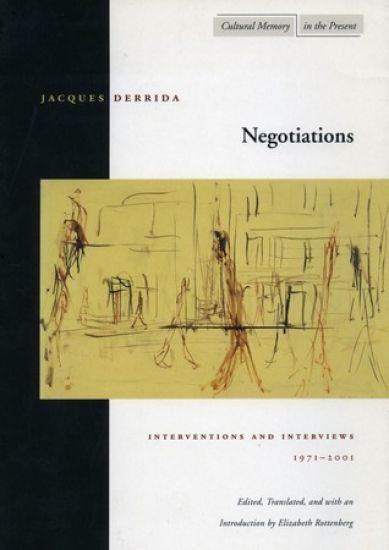
Negotiations

Negotiations

Jacques Derrida

Stanford University Press
2002
sidottu
This collection of essays and interviews, some previously unpublished and almost all of which appear in English for the first time, encompasses the political and ethical thinking of Jacques Derrida over thirty years. Passionate, rigorous, beautifully argued, wide-ranging, the texts shed an entirely new light on his work and will be welcomed by scholars in many disciplines—politics, philosophy, history, cultural studies, literature, and a range of interdisciplinary programs. Derrida's arguments vary in their responsiveness to given political questions—sometimes they are vivid polemics on behalf of a position or figure, sometimes they are reflective analyses of a philosophical problem. They are united by the recurrent question of political decision or responsibility and the insistence that the apparent simplicity or programmatic character of political decision is in fact a profound avoidance of the political. This volume testifies to the possibility and the necessity of a philosophical politics. Negotiations assembles some of the most telling examples of the intrinsic relationship, so often affirmed by Derrida in more abstract philosophical terms, between deconstructive reading practices and what is called the "political"—more precisely, politics in an almost down-to-earth, pragmatic, and commonsense use of the word. Among the many subjects covered in the book are: the death penalty in the United States, the civil war in Algeria, globalization and cosmopolitanism, the American Declaration of Independence, Jean-Paul Sartre, the value of objectivity, politics and friendship, and the relationship between deconstruction and actuality.

Acts of Religion

Acts of Religion

Jacques Derrida

Routledge
2001
sidottu
Acts of Religion, compiled in close association with Jacques Derrida, brings together for the first time a number of Derrida's writings on religion and questions of faith and their relation to philosophy and political culture. The essays discuss religious texts from Jewish, Christian, and Muslim traditions, as well as religious thinkers such as Kant, Levinas, and Gershom Scholem, and comprise pieces spanning Derrida's career. The collection includes two new essays by Derrida that appear here for the first time in any language, as well as a substantial introduction by Gil Anidjar that explores Derrida's return to his own "religious" origins and his attempts to bring to light hidden religious dimensions of the social, cultural, historical, and political.
Acts of Religion

Acts of Religion

Jacques Derrida

Routledge
2001
nidottu
Acts of Religion, compiled in close association with Jacques Derrida, brings together for the first time a number of Derrida's writings on religion and questions of faith and their relation to philosophy and political culture. The essays discuss religious texts from Jewish, Christian, and Muslim traditions, as well as religious thinkers such as Kant, Levinas, and Gershom Scholem, and comprise pieces spanning Derrida's career. The collection includes two new essays by Derrida that appear here for the first time in any language, as well as a substantial introduction by Gil Anidjar that explores Derrida's return to his own "religious" origins and his attempts to bring to light hidden religious dimensions of the social, cultural, historical, and political.
A Taste for the Secret

A Taste for the Secret

Jacques Derrida; Maurizio Ferraris

JOHN WILEY AND SONS LTD
2001
nidottu
In this series of dialogues, Derrida discusses and elaborates on some of the central themes of his work, such as the problems of genesis, justice, authorship and death. Combining autobiographical reflection with philosophical enquiry, Derrida illuminates the ideas that have characterized his thought from its beginning to the present day. If there is one feature that links these contributions, it is the theme of singularity - the uniqueness of the individual, the resistance of existence to philosophy, the temporality of the singular and exceptional moment, and the problem of exemplarity. The second half of this book contains an essay by Maurizio Ferraris, in which he explores the questions of indication, time and the inscription of the transcendental in the empirical. A work of outstanding philosophy and scholarship, the essay is developed in close proximity to Derrida and in dialogue with figures such as Plato, Aristotle, Plotinus, Kant, Hegel and Heidegger. It thereby provides a useful introduction to the philosophy of one of Italy's most prominent philosophers as well as an excellent complement to Derrida's own ideas. A Taste for the Secret consists of material that has never before appeared in English. It will be of interest to second-year undergraduates, graduate students and academics in philosophy, modern languages, literature, literary theory and the humanities generally.
A Taste for the Secret

A Taste for the Secret

Jacques Derrida; Maurizio Ferraris

Polity Press
2001
sidottu
In this series of dialogues, Derrida discusses and elaborates on some of the central themes of his work, such as the problems of genesis, justice, authorship and death. Combining autobiographical reflection with philosophical enquiry, Derrida illuminates the ideas that have characterized his thought from its beginning to the present day. If there is one feature that links these contributions, it is the theme of singularity - the uniqueness of the individual, the resistance of existence to philosophy, the temporality of the singular and exceptional moment, and the problem of exemplarity. The second half of this book contains an essay by Maurizio Ferraris, in which he explores the questions of indication, time and the inscription of the transcendental in the empirical. A work of outstanding philosophy and scholarship, the essay is developed in close proximity to Derrida and in dialogue with figures such as Plato, Aristotle, Plotinus, Kant, Hegel and Heidegger. It thereby provides a useful introduction to the philosophy of one of Italy's most prominent philosophers as well as an excellent complement to Derrida's own ideas. A Taste for the Secret consists of material that has never before appeared in English. It will be of interest to second-year undergraduates, graduate students and academics in philosophy, modern languages, literature, literary theory and the humanities generally.
On Cosmopolitanism and Forgiveness

On Cosmopolitanism and Forgiveness

Jacques Derrida

Routledge
2001
nidottu
One of the world's most famous philosophers, Jacques Derrida, explores difficult questions in this important and engaging book. Is it still possible to uphold international hospitality and justice in the face of increasing nationalism and civil strife in so many countries? Drawing on examples of treatment of minority groups in Europe, he skilfully and accessibly probes the thinking that underlies much of the practice, and rhetoric, that informs cosmopolitanism. What have duties and rights to do with hospitality? Should hospitality be grounded on a private or public ethic, or even a religious one? This fascinating book will be illuminating reading for all.