Kirjojen hintavertailu – 12 859 819 kirjaa ja 27 kauppaa

Kirjailija

Jean-Jacques Rousseau

Kirjat ja teokset yhdessä paikassa: 1 116 kirjaa, julkaisuja vuosilta 1755–2026, suosituimpiin kuuluu Emile. Vertaile teosten hintoja ja tarkista saatavuus suomalaisista kirjakaupoista.

Nimi esiintyy myös muodoissa: JEAN JACQUES ROUSSEAU, Jean -Jacques Rousseau

1 116 kirjaa

Kirjojen julkaisuvuodet: 1755–2026.

The Confessions and Correspondence, Including the Letters to Malesherbes
When Rousseau first read his Confessions to a 1770 gathering in Paris, reactions varied from admiration of his candor to doubts about his sanity to outrage. Indeed, Rousseau's intent and approach were revolutionary. As one of the first attempts at autobiography, the Confessions' novelty lay not in just its retelling the facts of Rousseau's life, but in its revelation of his innermost feelings and its frank description of the strengths and failings of his character. Based on his doctrine of natural goodness, Rousseau intended the Confessions as a testing ground to explore his belief that, as Christopher Kelly writes,"people are to be measured by the depth and nature of their feelings." Re-created here in a meticulously documented new translation based on the definitive Pléiade edition, the work represents Rousseau's attempt to forge connections among his beliefs, his feelings, and his life. More than a "behind-the-scenes look at the private life of a public man," Kelly writes, "the Confessions is at the center of Rousseau's philosophical enterprise."
Julie, or the New Heloise

Julie, or the New Heloise

Jean-Jacques Rousseau

Dartmouth College Press
1997
nidottu
An elegant translation of one of the most popular novels of its time. Rousseau's great epistolary novel, Julie, or the New Heloise, has been virtually unavailable in English since 1810. In it, Rousseau reconceptualized the relationship of the individual to the collective and articulated a new moral paradigm. The story follows the fates and smoldering passions of Julie d'Etange and St. Preux, a one-time lover who re-enters Julie's life at the invitation of her unsuspecting husband, M. de Wolmar. The complex tones of this work made it a commercial success and a continental sensation when it first appeared in 1761, and its embodiment of Rousseau's system of thought, in which feelings and intellect are intertwined, redefined the function and form of fiction for decades. As the characters negotiate a complex maze of passion and virtue, their purity of soul and honest morality reveal, as Rousseau writes in his preface,"the subtleties of heart of which this work is full." A comprehensive introduction and careful annotations make this novel accessible to contemporary readers, both as an embodiment of Rousseau's philosophy and as a portrayal of the tension and power inherent in domestic life.
DISCOURS SUR LES SCIENCES ET LES ARTS

DISCOURS SUR LES SCIENCES ET LES ARTS

JEAN-JACQUES ROUSSEAU

Francais / ranskankieliset
1997
Pehmeäkantinen
«Voilà comment le luxe, la dissolution et l’esclavage ont été de tout tems le châtiment des efforts orgueilleux que nous avons faits pour sortir de l’heureuse ignorance où la sagesse éternelle nous avoit placés. Le voile épais dont elle a couvert toutes ses opérations, sembloit nous avertir assez qu’elle ne nous a point destinés à de vaines recherches. Mais est-il quelqu’une de ses leçons dont nous ayons sû profiter, ou que nous ayons négligée impunément ? Peuples, sachez donc une fois que la nature a voulu vous préserver de la science, comme une mere arrache une arme dangereuse des mains de son enfant ; que tous les secrets qu’elle vous cache sont autant de maux dont elle vous garantit, et que le moindre de ses bienfaits. Les hommes sont pervers ; ils seroient pires encore, s’ils avoient eu le malheur de naître savans.» Jean-Jacques Rousseau.
Social Contract, Discourse on the Virtue Most Necessary for a Hero, Political Fragments, and Geneva Manuscript
Contains the Social Contract, as well as the first English translation of Rousseau's early Discourse on the Virtue Most Necessary for a Hero, numerous previously untranslated political fragments, and the first draft of the Social Contract (the so-called Geneva Manuscript). By placing Rousseau's famous exposition of "political right" and the "general will" in the context of his preparatory drafts, the editors provide significant insight into the formation of one of the most important and influential works in Western political thought.
Social Contract And The Discources

Social Contract And The Discources

Jean-Jacques Rousseau

Everymans Library
1993
sidottu

Halvin toimitettuna 20,30 €

THE SOCIAL CONTRACT is one of three most influential treatises ever written (the others being PLato's REPUBLIC and Marx's DAS KAPITAL) Of the three it is safe to say that only THE SOCIAL CONTRACT is much read in its entirety today, and it continues to exert a direct influence on contemporary political thought.
Discourse on the Origins of Inequality (Second Discourse), Polemics, and Political Economy
Includes the Second Discourse (complete with the author's extensive notes), contemporary critiques by Voltaire, Diderot, Bonnet, and LeRoy, Rousseau's replies (some never before translated), and Political Economy, which first outlined principles that were to become famous in the Social Contract. This is the first time that the works of 1755 and 1756 have been combined with careful commentary to show the coherence of Rousseau's "political system." The Second Discourse examines man in the true "state of nature," prior to the formation of the first human societies, tracing the "hypothetical history" of political society and social inequality as they developed out of natural equality and independence.
Discourse on the Sciences and Arts (First Discourse) and Polemics

Discourse on the Sciences and Arts (First Discourse) and Polemics

Jean-Jacques Rousseau

Dartmouth College Press
1992
sidottu
Contains the entire First Discourse, contemporary attacks on it, Rousseau's replies to his critics, and his summary of the debate in his preface to Narcissus. A number of these texts have never before been available in English. The First Discourse and Polemics demonstrate the continued relevance of Rousseau's thought. Whereas his critics argue for correction of the excesses and corruptions of knowledge and the sciences as sufficient, Rousseau attacks the social and political effects of the dominant forms of scientific knowledge.
Confessions

Confessions

Jean-Jacques Rousseau

Everymans Library
1992
sidottu

Halvin toimitettuna 20,30 €

This autobiography includes the record of a sexual and spiritual quest, exploring the deepest recesses of the author's mind while narrating the farcical comedy of errors which was his life. P. N. Furbank is the author of "E. M. Forster: A Life".
Emile; or On Education

Emile; or On Education

Jean-Jacques Rousseau

Penguin Classics
1991
pokkari

Halvin toimitettuna 23,90 €

In his pioneering treatise on education the great French philosopher Jean-Jacques Rousseau (1712-1778) presents concepts that had a significant influence on the development of pedagogy in the eighteenth century, and yet many of his ideas still sound radical today. Written in reaction to the stultifying system of rote learning and memorization prevalent throughout Europe at the time, Emile is a utopian vision of child-centered education, full of the sentiments of Romanticism, a movement that Rousseau inspired. Imagining a typical boy named Emile, Rousseau creates an ideal model of one-on-one tutelage from infancy to manhood with himself as the child's mentor. As in so many of his other famous works, here, too, Rousseau asserts his main thesis that human beings are by nature good; it is only the distorting influences of civilization that have corrupted them.
ESSAI SUR L’ORIGINE DES LANGUES OU IL EST PARLE DE LA MELODI

ESSAI SUR L’ORIGINE DES LANGUES OU IL EST PARLE DE LA MELODI

JEAN-JACQUES ROUSSEAU

Francais / ranskankieliset
1990
Pehmeäkantinen
«Sitôt qu’un homme fut reconnu par un autre pour un Être sentant, pensant et semblable à lui, le désir ou le besoin de lui communiquer ses sentiments et ses pensées lui en fit chercher les moyens. Ces moyens ne peuvent se tirer que des sens, les seuls instruments par lesquels un homme puisse agir sur un autre. Voilà donc l’institution des signes sensibles pour exprimer la pensée. Les inventeurs du langage ne firent pas ce raisonnement, mais l’instinct leur en suggéra la conséquence.» Jean-Jacques Rousseau.
Rousseau's Political Writings: Discourse on Inequality, Discourse on Political Economy,  On Social Contract
Each piece is fully annotated. Backgrounds includes a sketch of Rousseau’s life, selections from his Confessions, and comments on Rousseau’s work and character from such illustrious contemporaries and early critics as Voltaire, Hume, Boswell and Johnson, Paine, Kant, and Proudhon. Commentaries includes assessments of Rousseau’s political thought by a wide variety of scholars and critics including Judith Shklar, Robert Nisbet, Simone Weil, and Benjamin R. Barber.
The Social Contract

The Social Contract

Jean-Jacques Rousseau

Prometheus Books
1988
pokkari
With the publication of The Social Contract in 1761, Jean-Jacques Rousseau took his place among the leading political philosophers of the Enlightenment. Like his contractarian predecessors (Thomas Hobbes and John Locke), Rousseau sought to ground his political theory in an understanding of human nature, which he believed to be basically good but corrupted by the conflicting interests within society. Here self-interest degenerated into a state of war from which humanity could only be extricated by the imposition of a contract. As a party to the compact, each individual would find his true interest served within the political expression of the community of man, or the "general will." What is the content of human nature and how does it compel mankind to come together to create a civil society? What form does this society take? What benefits does it offer its citizens, and what must each individual sacrifice to reap its rewards? How does sovereign power manifest itself, and what consequences follow for those who choose not to abide by the "general will"? Does Rousseau's political theory set forth a blueprint for democracy -- one that results in equality, universal suffrage, and popular sovereignty -- or is it a recipe for central state totalitarianism? These are just a few of the complex questions that will confront readers of The Social Contract. Whatever their intent or ultimate result, Jean-Jacques Rousseau's views on the state and man's relationship to it have culminated in one of the most powerful and compelling pieces of political philosophy ever written.
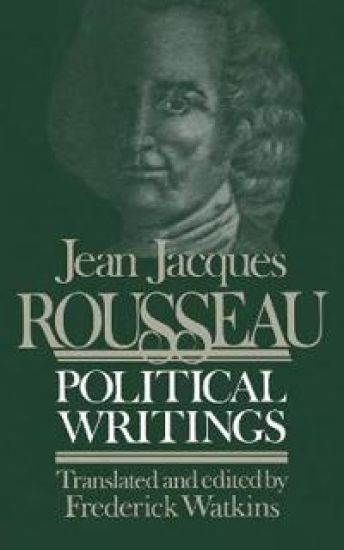
Political Writings

Political Writings

Jean-Jacques Rousseau; Frederick Mundell Watkins

University of Wisconsin Press
1986
nidottu
Frederick Watkins' 1953 edition of Rousseau's Political Writings has long been noted for being fully accurate while representing much of Rousseau's eloquence and elegance. It contains what is widely regarded as the finest English translation of The Social Contract, Rousseau's greatest political treatise. In addition, this edition offers the best available translation of the late and important Government of Poland and the only published English translation of the fragment Constitutional Project for Corsica, which, says Watkins, provides the clearest possible demonstration of the practical implications of Rousseau's political thought.
On the Origin of Language

On the Origin of Language

Jean-Jacques Rousseau; Johann Gottfried Herder

University of Chicago Press
1986
nidottu
This volume combines Rousseau's essay on the origin of diverse languages with Herder's essay on the genesis of the faculty of speech. Rousseau's essay is important to semiotics and critical theory, as it plays a central role in Jacques Derrida's book Of Grammatology, and both essays are valuable historical and philosophical documents.
Vom Gesellschaftsvertrag

Vom Gesellschaftsvertrag

Jean-Jacques Rousseau

Reclam Philipp Jun.
1986
pokkari
Im Gesellschaftsvertrag, unterteilt in vier Bücher, fasst Rousseau den Staat als einen von freien Bürgern geschlossenen Vertrag auf, in dem sich die freiwillige Vereinigung der Einzelwillen zu einem Gesamtwillen vollziehe. Rousseau fordert eine Verfassung, in der die >>natürliche und unveräußerliche Freiheit in Einklang mit dem Maß an Gewalt, das vom Wesen staatlicher Ordnung nun einmal nicht wegzudenken ist, zu bringen ist.
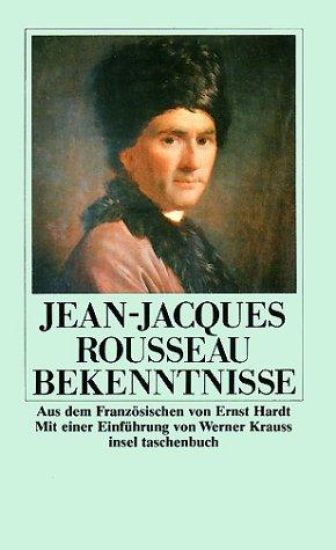
Bekenntnisse

Bekenntnisse

Jean-Jacques Rousseau

Insel Verlag GmbH
1985
pokkari
Im ersten Teil des romanhaft angelegten Werks, das sich in zwölf Bücher gliedert, schildert Rousseau seine Kindheit und Jugend bis 1741. Er berichtet von der Zeit seiner Wanderschaft, beleuchtet seine Wünsche und Sehnsüchte und lässt den Leser seine Suche nach Glück nachempfinden. Beeindruckend sind die Schilderungen des Landlebens. Neben der idyllischen Natur vermag Rousseau die erhabene Seite der Natur zu vermitteln: das Freie, Majestätische, die Welt der Berge, >>die die Seele weitet