Kirjailija
Jean-Jacques Rousseau
Kirjat ja teokset yhdessä paikassa: 1 116 kirjaa, julkaisuja vuosilta 1755–2026, suosituimpiin kuuluu Emile. Vertaile teosten hintoja ja tarkista saatavuus suomalaisista kirjakaupoista.
Nimi esiintyy myös muodoissa: JEAN JACQUES ROUSSEAU, Jean -Jacques Rousseau
1 116 kirjaa
Kirjojen julkaisuvuodet: 1755–2026.
"The Government of Poland is the only finished work in which Rousseau himself dons the mantle of legislator, applying the principles of the Social Contract to the real world around him. Poland teaches us much about the mysterious art of the Social Contract's 'legislator,' how he transforms each individual into part of a larger whole. Only in . . . Poland do we find what this crucial transformation entails and what it presupposes. But probably the greatest lesson to be learned from . . . Poland concerns Rousseau's understanding of the proper relationship between theory and practice. . . . Time and again we see Rousseau advising the Poles to do things which are in gross violation of the strict principles of political right he had elaborated in the Social Contract." --Richard Myers in Canadian Journal of Political Science
A Discourse on Inequality
Jean-Jacques Rousseau
Penguin Classics
1984
pokkari
Halvin toimitettuna 16,20 €
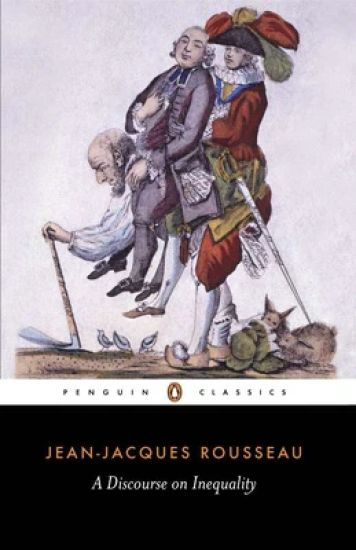
In A Discourse on Inequality Rousseau sets out to demonstrate how the growth of civilization corrupts man’s natural happiness and freedom by creating artificial inequalities of wealth, power and social privilege. Contending that primitive man was equal to his fellows, Rousseau believed that as societies become more sophisticated, the strongest and most intelligent members of the community gain an unnatural advantage over their weaker brethren, and that constitutions set up to rectify these imbalances through peace and justice in fact do nothing but perpetuate them. Rousseau’s political and social arguments in the Discourse were a hugely influential denunciation of the social conditions of his time and one of the most revolutionary documents of the eighteenth-century.
Reveries of the Solitary Walker
Jean-Jacques Rousseau
Penguin Classics
1979
pokkari
Halvin toimitettuna 16,20 €
After a period of forced exile and solitary wandering brought about by his radical views on religion and politics, Jean-Jacques Rousseau returned to Paris in 1770. Here, in the last two years of his life, he wrote his final work, the Reveries. In this eloquent masterpiece the great political thinker describes his sense of isolation from a society he felt had rejected his writings - and the manner in which he has come to terms with his alienation, as he walks around Paris, gazing at plants, day-dreaming and finding comfort in the virtues of solitude and the natural world. Meditative, amusing and lyrical, this is a fascinating exploration of Rousseau's thought as he looks back over his life, searching to justify his actions, to defend himself against his critics and to elaborate upon his philosophy.
Profession de Foi Du Vicaire Savoyard: Vicaire 76
Jean-Jacques Rousseau
Librarie Philosophique J. Vrin
1978
nidottu
With splendid new translations, these four major works offer a superlative introduction to a great social philosopher whose ideas helped spark a revolution that has still not ended. Can individual freedom and social stability be reconciled? What is the function of government? What are the benefits and liabilities of civilization? What is the original nature of man, and how can he most fully realize his potential? These were the questions that Jean-Jacques Rousseau investigated in works that helped set the stage for the French Revolution and have since stood as eloquent expressions of revolutionary views, not only in politics but also in such areas as personal lifestyles and educational practices. Rousseau's concepts of the natural goodness of man, the corrupting influence of social institutions, and the right and the power of the people to overthrow their oppressors and create new and more responsive forms of government and society are as richly relevant today as they were in eighteenth-century France. Includes: The Social Contract Discourse on Inequality Discourse on the Arts and Sciences "The Creed of a Savoyard Priest" (from Emile)
Widely regarded as the first modern autobiography, The Confessions is an astonishing work of acute psychological insight. Jean-Jacques Rousseau (1712-78) argued passionately against the inequality he believed to be intrinsic to civilized society. In his Confessions he relives the first fifty-three years of his radical life with vivid immediacy - from his earliest years, where we can see the source of his belief in the innocence of childhood, through the development of his philosophical and political ideas, his struggle against the French authorities and exile from France following the publication of Émile. Depicting a life of adventure, persecution, paranoia, and brilliant achievement, The Confessions is a landmark work by one of the greatest thinkers of the Enlightenment, which was a direct influence upon the work of Proust, Goethe and Tolstoy among others.
LE CHEMIN DE LA PERFECTION VOUS EST OUVERT
JEAN-JACQUES ROUSSEAU
Francais / ranskankieliset
1969
Pehmeäkantinen
Fort d’un amour passionné - mais platonique - pour la comtesse d’Houdetot, Jean-Jacques Rousseau rédige six lettres dans lesquelles, tel un professeur de vertu, il délivre une invitation à la sagesse.
This excellent translation makes available a classic work central to one of the most interesting controversies of the eighteenth century: the quarrel between Rousseau and Voltaire. Besides containing some of the most sensitive literary criticism ever written (especially of Molière), the book is an excellent introduction to the principles of classical political thought. It demonstrates the paradoxes of Rousseau's thought and clearly displays the temperament that led him to repudiate the hopes of the Enlightenment.
"In the 200 years since its publication in 1762, Rousseau's Émile has been the subject of endless controversy. The work was ordered burned in Paris and Geneva within weeks of its appearance; yet it was read passionately throughout Europe. Goethe called it 'the teacher's gospel,' while Kant maintained that no book had ever moved him so deeply. . . . Within this context it is well, perhaps to note a judgment Professor Boyd himself rendered a half-century ago at the beginning of a long and distinguished career in the field of education. 'I believe . . . that the Émile with all its faults is the most profound modern discussion of the fundamentals of education, the only modern work of the kind worthy to be put alongside the Republic of Plato.' . . . I know of no better definition of a classic."—From the Foreword by Lawrence A. Cremin
On the Social Contract
Jean-Jacques Rousseau
12th Media Services
1762
sidottu
Halvin toimitettuna 24,40 €
Unabridged English reproduction of On The Social Contract by Jean-Jacques Rousseau and translated by G. D. H. Cole. It's publication in 1762 lead to great discussion about 'what is government' on both sides of the Atlantic, and is still essential reading today.
A Discourse Upon The Origin And The Foundation Of The Inequality Among Mankind
Jean Jacques Rousseau
Binker North
1755
pokkari
Tittelen på boken henviser til den berømte kjærlighetshistorien og brevvekslingen mellom Abélard og Héloïse, en lidenskap som overlevde mannens kastraksjon og begges klosterliv og adskillelse. Og fra den fromme adelsfrøken Julie forføres av sin uadelige huslærer Saint-Preux svinger kjærligheten gjennom hundrevis av brev fra erotisk tilståelse og frihet til moralske skrupler og sosiale konvensjoner og hindringer. En rekke personer trekkes inn og rundt mønstergodset Clarens ved foten av Alpene og forfatteren får god anledning til å flette inn sine oppfatninger om tiden, religionen, samfunnet og alle tenkelige sosiale anliggender og forhold.